Software-Defined Data Centre Market Size & Share Analysis - Trends, Drivers, Competitive Landscape, and Forecasts (2026 - 2032)
This Report Provides In-Depth Analysis of the Software-Defined Data Centre Market Report Prepared by P&S Intelligence, Segmented by Component (Solutions, Services), Deployment (Private Cloud, Hybrid Cloud, Public Cloud), Organization Size (Large Enterprises, Small and Medium Enterprises), Data Center Type (Colocation Data Centers, Cloud Data Centers, Enterprise Data Centers, Edge Data Centers), End User (IT and Telecom, Government and Defense, BFSI, Healthcare, Manufacturing, Retail and E-commerce, Education), and Geographical Outlook for the Period of 2021 to 2032
Explore the market potential with our data-driven report
Software-Defined Data Centre Market Overview
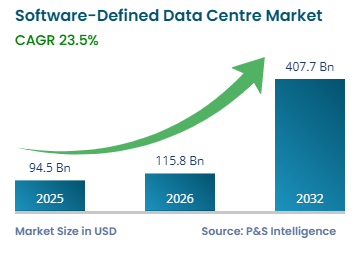
The software-defined data centre market size was USD 94.5 billion for 2025, and it will grow by 23.5% during 2026-2032, to reach USD 407.7 billion by 2032.
The software-defined data centre market is driven by the rapid digital transformation of enterprises, increasing adoption of cloud computing, artificial intelligence (AI), and hybrid and multi-cloud environments, along with the growing need for automated infrastructure management. These factors are accelerating the transition from hardware-centric architectures to software-driven environments that provide greater flexibility, scalability, and operational efficiency. The rapid growth in digital services, streaming platforms, remote work, AI workloads, and connected devices has significantly increased data processing requirements, creating the need for agile and intelligent data centre management solutions. Software-defined data centres enable organisations to centrally manage compute, storage, and networking resources through software, allowing faster resource provisioning, improved resource utilisation, simplified operations, and reduced dependence on manual hardware administration.
The growing emphasis on automation and intelligent workload management is further accelerating market growth as organisations modernise their IT environments to support cloud-native applications and distributed computing. Enterprises are increasingly adopting software-defined networking, software-defined storage, virtualisation, container orchestration, and AI-enabled management platforms to optimise resource allocation, strengthen cybersecurity, and improve energy efficiency across hybrid and multi-cloud environments. According to the International Energy Agency, global data centre electricity consumption reached around 415 terawatt-hours in 2024 as AI workloads, cloud services, and digital traffic continued to expand worldwide. Rising demand for scalable, resilient, and energy-efficient computing environments, coupled with increasing investments in next-generation digital infrastructure by governments and private enterprises, is expected to further accelerate the adoption of software-defined data centre solutions across industries.
Key Market Insights
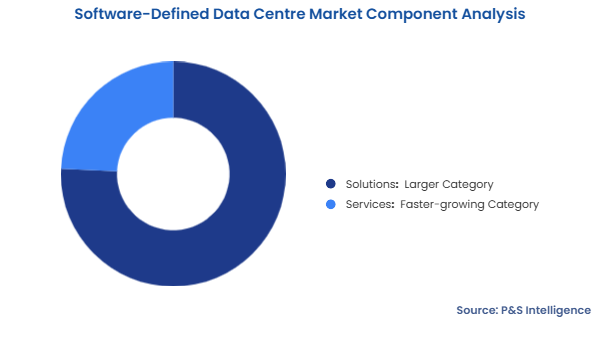
Solutions is the larger category, holding a market share of 75.5%, due to rising enterprise investments in Kubernetes-based automation and software-defined infrastructure platforms.
Hybrid Cloud is the fastest-growing category, registering a CAGR of 23.9%, driven by increasing enterprise demand for unified management across cloud and on-premise environments.
Large Enterprises is the larger category, holding a market share of 85.0%, because large-scale AI workloads require scalable and automated infrastructure management platforms.
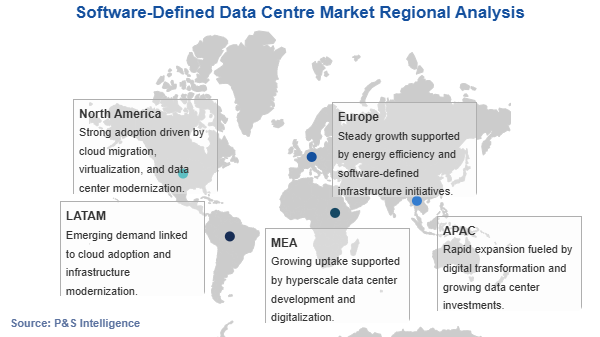
North America holds the largest share of 40.5%, due to strong hyperscale cloud infrastructure and rapid deployment of AI-ready data centre environments.
Asia-Pacific is the fastest-growing region, registering a CAGR of 25.0%, driven by expanding cloud infrastructure, 5G deployment, and enterprise digital transformation projects.
Software-Defined Data Centre Market Trends and Drivers
AI-Driven Autonomous Infrastructure Management Is a Major Trend
The market is witnessing a growing shift toward AI-driven autonomous infrastructure management as enterprises increasingly seek intelligent platforms capable of automating routine operations, optimising resource utilisation, and improving overall system performance. Organisations are adopting AI-powered management solutions to monitor data centre operations, predict equipment failures, balance workloads, and dynamically allocate compute, storage, and networking resources in real time. The integration of artificial intelligence with software-defined technologies is enabling faster decision-making, reducing operational complexity, and enhancing the reliability of modern data centre environments.
According to the Cloud Native Computing Foundation, 66% of organisations hosting generative AI models used Kubernetes to manage some or all inference workloads in 2025. Additionally, 58% of cloud-native innovators extensively adopted GitOps principles in 2025, highlighting the growing preference for automated, software-driven infrastructure management practices. These developments are accelerating the adoption of integrated platforms that combine virtualisation, Kubernetes orchestration, automation, security, and AI capabilities to support cloud-native applications, distributed computing, and next-generation enterprise data centre operations.
Rising Adoption of Hybrid and Multi-Cloud Infrastructure Drives Market
The software-defined data centre market is driven by the increasing adoption of hybrid and multi-cloud environments as enterprises seek greater flexibility, scalability, and operational resilience across their IT ecosystems. Organisations are moving beyond traditional on-premise infrastructure to distribute applications and workloads across public clouds, private clouds, and edge environments while maintaining centralised management and consistent performance. This transition is accelerating the demand for software-defined technologies that enable seamless orchestration of compute, storage, and networking resources across diverse deployment environments.
The rapid expansion of AI applications, cloud-native workloads, digital services, and remote operations has further increased the need for unified infrastructure management and efficient workload mobility. According to Nutanix, more than 90% of respondents in 2025 agreed that a single platform capable of running applications across data centres, cloud environments, and edge locations would support generative AI initiatives. This growing preference for integrated management platforms is encouraging enterprises to invest in software-defined networking, virtualisation, storage management, and automation solutions that simplify operations, strengthen business continuity, improve disaster recovery capabilities, and optimise resource utilisation across increasingly distributed computing environments.
Complex Migration from Legacy Infrastructure Restrains Market Growth
The market faces a major challenge due to the complexity of migrating from legacy IT systems to software-defined architectures. Many organisations continue to rely on ageing hardware, proprietary technologies, and fragmented network and storage environments that are not fully compatible with modern virtualisation, automation, and software-defined management platforms. Modernising these systems often requires significant capital investment, extensive system integration, application migration, and workforce training, increasing both implementation costs and deployment timelines.
According to Cloudflare, global internet traffic increased by 17.2% in 2024, placing additional pressure on existing IT environments to support rising digital workloads while maintaining uninterrupted operations. As organisations upgrade their data centre capabilities, they must balance infrastructure modernisation with business continuity, making migration a complex and resource-intensive process. Compatibility issues between legacy and modern platforms, cybersecurity concerns, implementation risks, and shortages of skilled IT professionals continue to slow the adoption of software-defined data centre solutions, particularly among small and medium-sized enterprises.
Expansion of Edge Computing Infrastructure Creates Market Opportunities
The expansion of edge computing infrastructure is creating significant growth opportunities for the software-defined data centre market as enterprises increasingly process data closer to the point of generation to support low-latency applications and real-time decision-making. The growing adoption of artificial intelligence (AI), Internet of Things (IoT) devices, industrial automation, autonomous systems, and smart city initiatives is driving the deployment of distributed computing environments that require centralised, software-driven management. Software-defined data centre technologies enable organisations to efficiently orchestrate compute, storage, and networking resources across geographically dispersed edge locations, improving operational agility, scalability, and resource utilisation.
According to the International Telecommunication Union, global 5G subscriptions reached around 3 billion in 2025, while 5G network coverage expanded to 55% of the world's population. The rapid expansion of 5G connectivity is accelerating edge infrastructure deployment by enabling high-speed, low-latency data transmission for bandwidth-intensive applications. As enterprises continue to expand distributed computing networks, demand for software-defined platforms capable of automating resource allocation, strengthening security, and simplifying multi-site infrastructure management is expected to create substantial growth opportunities for market players.
Drives Market
Software-Defined Data Centre Market Segmentation Analysis
Component Analysis
Solutions is the larger category, holding a market share of 75.5%, due to the growing demand for software-defined networking, virtualisation, storage management, automation, and orchestration platforms that enable centralised management of modern data centre operations. Organisations increasingly prefer integrated solutions because they improve resource utilisation, simplify infrastructure management, and support scalable AI-ready and cloud-native environments. According to the Cloud Native Computing Foundation, 82% of container users ran Kubernetes in production in 2025, reflecting the increasing adoption of software-controlled data centre technologies.
Services is the faster-growing category, registering a CAGR of 24.5%, because many organisations require specialised expertise to deploy, integrate, optimise, and manage software-defined data centre environments. The transition from legacy infrastructure to software-defined architectures often involves complex migration, system integration, application modernisation, and workforce training, driving demand for consulting, integration, managed, and support services.
The component analysed in this report are:
Solutions (Larger Category)
Software-Defined Compute
Software-Defined Networking
Software-Defined Storage
Automation and Orchestration
Security and Monitoring Solutions
Services (Faster-growing Category)
Consulting
Integration and Deployment
Support and Maintenance
Managed Services
Deployment Analysis
Private Cloud is the largest category, holding a market share of 65.0%, because organisations managing sensitive data and mission-critical workloads prioritise greater control, security, and regulatory compliance. Industries such as BFSI, healthcare, and government continue to favour private cloud deployments to protect confidential information while ensuring high system reliability and predictable performance. Private cloud environments also enable seamless integration of software-defined technologies with existing enterprise systems, allowing organisations to modernise operations without compromising governance, security, or operational continuity.
Hybrid Cloud is the fastest-growing category, registering a CAGR of 23.9%, as organisations increasingly combine private and public cloud resources to achieve greater scalability, workload flexibility, and cost efficiency. Hybrid deployments allow applications, storage, and networking resources to be managed through a unified software-defined platform while improving disaster recovery, business continuity, and workload mobility across distributed IT environments. According to Red Hat, 85% of organisations used a hybrid cloud model in 2025, highlighting the growing preference for flexible cloud strategies that support AI applications and cloud-native workloads.
The deployment analysed in this report are:
Private Cloud (Largest Category)
Hybrid Cloud (Fastest-growing Category)
Public Cloud
Organisation Size Analysis
Large Enterprises is the larger category, holding a market share of 85.0%, because these organisations operate complex IT ecosystems that require scalable, automated, and centrally managed data centre operations. The increasing adoption of artificial intelligence (AI), cloud-native applications, big data analytics, and hybrid cloud strategies has significantly expanded infrastructure requirements, driving demand for software-defined networking, compute, and storage solutions. According to International Business Machines Corporation, 42% of enterprise-scale companies surveyed had actively deployed AI in 2024.
Small and medium enterprises are the faster-growing category, registering a CAGR of 24.1%, because these businesses are increasingly embracing digital transformation while seeking cost-effective and scalable IT infrastructure. Software-defined data centre solutions enable SMEs to reduce capital expenditure, simplify infrastructure management, and improve business continuity without investing heavily in physical hardware. The growing availability of cloud-based deployment models, managed services, and subscription-based solutions is further enabling smaller organisations to modernise their IT operations with lower implementation costs and reduced technical complexity.
The organization size analysed in this report are:
Large Enterprises (Larger Category)
Small and Medium Enterprises (Faster-growing Category)
Data Centre Type Analysis
Colocation Data Centres is the largest category, holding a market share of 45.5%, because organisations increasingly rely on third-party facilities to expand computing capacity without investing in large-scale physical infrastructure. As enterprises continue to modernise their IT operations, colocation data centres offer the flexibility, reliability, and operational efficiency required to support AI applications, cloud-native workloads, disaster recovery, and business continuity strategies, thereby driving the adoption of software-defined data centre technologies.
Cloud Data Centres is the fastest-growing category, registering a CAGR of 23.5%, due to the rapid expansion of cloud computing, artificial intelligence (AI), and digital services that require highly scalable and automated computing environments. Organisations are increasingly deploying software-defined technologies to simplify resource orchestration, accelerate application deployment, and improve operational efficiency across public, private, and hybrid cloud environments. In 2025, Broadcom made VMware Cloud Foundation generally available for private cloud operations across data centres, edge sites, and managed cloud infrastructure, strengthening enterprise adoption of integrated software-defined cloud platforms.
The data centre types analysed in this report are:
IT and Telecom is the largest category, holding a market share of 30.0%, due to the continuous expansion of cloud computing, mobile networks, internet services, and AI-driven digital applications. The ongoing deployment of 5G networks, edge computing, and cloud-native technologies is further driving the adoption of software-defined data centre solutions that improve resource utilisation, network automation, and operational efficiency. According to the International Telecommunication Union, around 6 billion people used the internet globally in 2025, up from 5.8 billion in 2024.
Government and Defence is the fastest-growing category, registering a CAGR of 23.7%, as public sector organisations continue to modernise digital infrastructure to strengthen cybersecurity, improve operational resilience, and support secure management of mission-critical data. The increasing adoption of digital government initiatives, defence modernisation programmes, sovereign cloud strategies, and AI-enabled public services is accelerating investments in secure and scalable software-defined data centre environments.
The end user analysed in this report are:
IT and Telecom (Largest Category)
Government and Defence (Fastest-growing Category)
BFSI
Healthcare
Manufacturing
Retail and E-commerce
Education
Others
Drive strategic growth with comprehensive market analysis
Software-Defined Data Centre Market Regional Analysis
North America Software-Defined Data Centre Market Analysis
North America holds the largest share, of 40.5%, due to its mature digital ecosystem, early adoption of advanced technologies, and significant investments in cloud computing, artificial intelligence (AI), and data centre modernisation. The region is home to leading hyperscale cloud providers, colocation operators, and enterprise technology companies that continue to accelerate the deployment of software-defined networking, virtualisation, automation, and cloud-native platforms. According to the U.S. Energy Information Administration (EIA), data centres accounted for approximately 4.4% of total U.S. electricity consumption in 2023, reflecting the region's expanding digital infrastructure and increasing computing requirements. Strong demand from industries such as BFSI, healthcare, IT and telecom, and government is further driving the adoption of software-defined data centre solutions to improve operational efficiency, strengthen cybersecurity, and support rapidly growing AI and data-intensive workloads.
U.S. Software-Defined Data Centre Market Analysis
The U.S. market is driven by the strong presence of hyperscale cloud providers, leading technology companies, and one of the world's most advanced data centre ecosystems. Rapid investments in artificial intelligence (AI), cloud computing, high-performance computing, and enterprise digital transformation are accelerating the adoption of software-defined networking, virtualisation, and automated infrastructure management solutions. According to a Lawrence Berkeley National Laboratory report supported by the U.S. Department of Energy, data centres accounted for more than 4% of the country's total electricity consumption in 2024, highlighting the rapid expansion of computing capacity and digital infrastructure. Strong demand from financial services, healthcare, government, defence, and digital media sectors continues to drive investments in software-defined data centre platforms that enhance operational efficiency, strengthen cybersecurity, and support increasingly complex AI and cloud-native workloads.
Canada Software-Defined Data Centre Market Analysis
Canada is witnessing growing adoption of software-defined data centre technologies due to increasing investments in cloud computing, hyperscale data centres, artificial intelligence (AI), and enterprise digital transformation. Organisations across the country are modernising IT infrastructure to improve operational efficiency, strengthen cybersecurity, and support the growing demand for cloud-native applications and hybrid cloud environments. According to Natural Resources Canada, 78% of the country's electricity was generated from non-greenhouse-gas-emitting sources in 2024, including hydro, nuclear, wind, and solar power. The availability of a reliable low-carbon electricity supply supports the development of energy-efficient data centres while encouraging continued investments in software-defined infrastructure that enables scalable, automated, and sustainable digital operations across industries.
Asia-Pacific Software-Defined Data Centre Market Analysis
Asia-Pacific has the highest CAGR, of 25.0%, driven by rapid digital transformation, expanding cloud computing adoption, increasing artificial intelligence (AI) investments, and large-scale hyperscale data centre developments across the region. Growing demand for cloud-native applications, e-commerce, digital banking, smart manufacturing, and connected devices is accelerating the deployment of software-defined networking, virtualisation, and automation technologies to support scalable and efficient data centre operations. Governments across the region are also investing in digital infrastructure, smart city initiatives, and next-generation telecommunications networks, further strengthening market growth. According to the GSMA, 5G connections in Asia-Pacific are projected to reach approximately 1.4 billion by 2030, accounting for nearly half of all mobile connections in the region. The rapid expansion of high-speed connectivity, combined with increasing enterprise cloud adoption and hyperscale investments, is expected to accelerate demand for software-defined data centre solutions that provide centralised management, operational agility, and efficient resource utilisation across modern digital ecosystems.
China Software-Defined Data Centre Market Analysis
China’s market is growing rapidly because the continuous growth of domestic cloud computing, artificial intelligence (AI), and large-scale digital transformation initiatives. The country is witnessing significant investments in hyperscale data centres, smart manufacturing, industrial digitalisation, and enterprise cloud platforms, creating strong demand for software-defined networking, virtualisation, and automated infrastructure management solutions. According to the State Council Information Office of China, the country had deployed more than 4.19 million 5G base stations by the end of 2024. The rapid expansion of 5G networks is enabling high-speed connectivity, edge computing, and data-intensive digital services, increasing the demand for scalable software-defined data centre platforms capable of supporting automated resource management, low-latency operations, and growing enterprise computing requirements.
India Software-Defined Data Centre Market Analysis
India's software-defined data centre market is witnessing robust growth, driven by rapid digital transformation, expanding cloud adoption, increasing artificial intelligence (AI) deployment, and continuous investments in domestic data centre infrastructure. The country's thriving start-up ecosystem, digital payments landscape, e-commerce sector, and cloud-native enterprise applications are generating substantial data volumes, accelerating the adoption of software-defined networking, virtualisation, and automated infrastructure management solutions. According to the Press Information Bureau (PIB), India's total data centre capacity increased from around 375 MW in 2020 to nearly 1,500 MW by 2025. The rapid expansion of domestic data centre capacity, combined with growing enterprise cloud adoption and AI-driven workloads, is creating strong demand for software-defined data centre platforms that enhance scalability, operational efficiency, and centralised resource management across modern digital environments.
Europe Software-Defined Data Centre Market Analysis
Europe is witnessing steady growth in the software-defined data centre market, driven by increasing investments in cloud computing, enterprise digital transformation, and sustainable data centre development. Organisations across the region are modernising legacy IT environments by adopting software-defined networking, virtualisation, automation, and cloud-native technologies to improve operational efficiency, strengthen cybersecurity, and comply with evolving data governance requirements. According to the European Commission, approximately 78% of EU enterprises reached at least a basic level of digital intensity in 2024, reflecting the region's accelerating digital transformation and technology adoption. Increasing enterprise investments in cloud infrastructure, artificial intelligence (AI), edge computing, and green data centres are expected to drive sustained demand for software-defined data centre platforms that enable scalable, secure, and energy-efficient digital operations across Europe.
The regions and countries analysed in this report are:
North America (Largest Regional Market)
U.S. (Larger Country)
Canada (Faster-Growing Country)
Europe
Germany (Largest and Fastest-Growing Country)
U.K.
France
Italy
Spain
Rest of Europe
Asia-Pacific (Fastest-Growing Regional Market)
China (Largest Country)
India (Fastest-Growing Country)
Japan
South Korea
Australia
Rest of APAC
Latin America
Brazil (Largest and Fastest-Growing Country)
Mexico
Rest of LATAM
Middle East and Africa
Saudi Arabia (Fastest-Growing Country)
U.A.E. (Largest Country)
South Africa
Rest of MEA
Software-Defined Data Centre Market Competitive Landscape
The market is moderately consolidated because a limited group of large technology companies controls a significant portion of enterprise software-defined infrastructure deployments. Major players offer integrated platforms that combine virtualisation, software-defined networking, storage management, automation, and cloud orchestration within unified ecosystems. Large enterprises often prefer established vendors due to long-term infrastructure compatibility, cybersecurity capabilities, technical support networks, and existing enterprise relationships. This creates high entry barriers for smaller companies trying to compete in large-scale deployments. The market is also shaped by strategic partnerships, acquisitions, and platform integration activities as companies aim to strengthen hybrid cloud and AI infrastructure capabilities.
Top Companies in the Software-Defined Data Centre Market:
Broadcom Inc.
Microsoft Corporation
Cisco Systems, Inc.
Dell Technologies Inc.
Hewlett Packard Enterprise
IBM Corporation
Oracle Corporation
Nutanix, Inc.
NetApp, Inc.
Arista Networks, Inc.
Huawei Technologies Co., Ltd.
Fujitsu Limited
Software-Defined Data Centre Market Developments
In February 2026, Cisco introduced new data centre systems built around its Cisco Silicon One switching chip. The launch covered Nexus and Cisco 8000 platforms for large AI and cloud data centres, along with Nexus One for fabric management. The event was relevant to software-defined infrastructure because it added centralised control for high-capacity data centre fabrics.
In May 2026, Broadcom announced VMware Cloud Foundation (VCF) 9.1, an AI- and Kubernetes-native private cloud platform featuring integrated security, mixed-compute support across AMD, Intel, and NVIDIA hardware, and enhanced automation capabilities. The launch strengthened Broadcom's Software-Defined Data Centre (SDDC) portfolio by enabling enterprises to simplify infrastructure management, accelerate AI workload deployment, and improve operational efficiency across private cloud environments.
In May 2025, HPE launched an expanded private cloud portfolio built around HPE Morpheus software. The release included HPE Private Cloud Business Edition with VM Essentials, standalone Morpheus software, and virtualisation modernisation services. This was directly tied to software-defined data centres because it joined virtualised workloads, cloud management, and infrastructure control in one private cloud offering.
Frequently Asked Questions About This Report
What does the software defined data center market include for organizations?+
It includes data center infrastructure where compute, storage, networking, and security are virtualized and managed through software.
What factors are driving demand in the software defined data center market?+
Growth is driven by cloud operating models, automation needs, faster provisioning, resource efficiency, and demand for flexible infrastructure.
Why are organizations adopting software defined data center solutions across operations?+
Organizations adopt software defined data centers to simplify management, improve scalability, automate resources, and reduce hardware dependence.
How do software defined data center solutions improve decision making and efficiency?+
These solutions improve operations by centralizing control, enabling policy based provisioning, and adjusting resources according to workload demand.
What challenges affect adoption of software defined data center solutions today?+
Adoption is affected by migration complexity, legacy systems, skills, integration with existing tools, security design, and operational change.
Want a report tailored exactly to your business need?
Leading companies across industries trust us to deliver data-driven insights and innovative solutions for their most critical decisions. From data-driven strategies to actionable insights, we empower the decision-makers who shape industries and define the future. From Fortune 500 companies to innovative startups, we are proud to partner with organisations that drive progress in their industries.
Client Testimonials
Working with P&S Intelligence and their team was an absolute pleasure – their awareness of timelines and commitment to value greatly contributed to our project's success. Eagerly anticipating future collaborations.
McKinsey & Company
India
Unmatched Standards
Our insights into the minutest levels of the markets, including the latest trends and competitive landscape, give you all the answers you need to take your business to new heights
Complete Data Security
We take a cautious approach to protecting your personal and confidential information. Trust is the strongest bond that connects us and our clients, and trust we build by complying with all international and domestic data protection and privacy laws