Data Center Automation Market Size & Share Analysis - Trends, Drivers, Competitive Landscape, and Forecasts (2026 - 2032)
This Report Provides In-Depth Analysis of the Data Center Automation Market Report Prepared by P&S Intelligence, Segmented by Component (Solutions, Services), Deployment Mode (On-Premises, Cloud-Based, Hybrid), Data Center (Enterprise, Managed / Colocation, Cloud / Hyperscale), End-Use (IT & Telecom, Healthcare, BFSI, Government, Manufacturing, Retail & E-commerce, Energy & Utilities, Media & Entertainment), and Geographical Outlook for the Period of 2021 to 2032
Explore the market potential with our data-driven report
Data Center Automation Market Overview
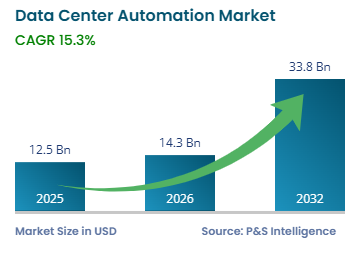
The market size will be an estimated USD 12.5 billion for 2025, and it will grow by 15.3% during 2026–2032, to reach USD 33.8 billion by 2032.
The market is driven by the rising cloud and AI workloads, need for energy efficiency, labor cost reduction, demand for high availability and uptime, scalability of hyperscale data centers, integration of IoT and AI/ML, regulatory compliance requirements, and pressure to reduce operational complexity. To manage the rapidly growing workloads, minimize downtime, enhance security, and reduce operational cost, enterprises, governments, cloud providers, and digital platforms increasingly require automated systems.
For handling large-scale computing environments, enabling intelligent resource allocation, policy-based orchestration, real-time monitoring, autonomous performance management across on-premises, cloud, and hybrid infrastructure, automation has become essential. Data centers now support banking, telecom, healthcare, e-commerce, public administration, and critical national digital infrastructure, driving the need for operational reliability and continuity.
As per the ITU, 6 billion people used the internet in 2025, representing nearly round two-third population of the world, which leads to massive data demand growth. Around 1.5–2% of the global electricity is consumed by data centers, which is accelerating the need for automation for energy efficiency and operational control, prevent failures, and reduces the losses exceeding USD 100,000 due to outages.
Key Market Insights
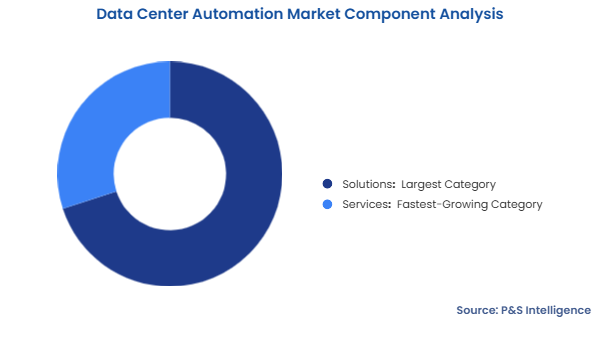
Solutions have the largest market with a share of 70% as they offer critical technologies for automating compute, network, and storage workloads.
Services are the fastest-growing category, driven by the need for external expertise to design and maintain complex ecosystems.
On-premises deployment is dominant with 45% share because of security requirements.
Cloud-based deployment has the fastest growth rate, of 15.7%, because of the need for scalable automation.
IT & telecom sector has a market share of 30% as it needs automation to ensure efficient performance in large systems spread over a wide geographical area.
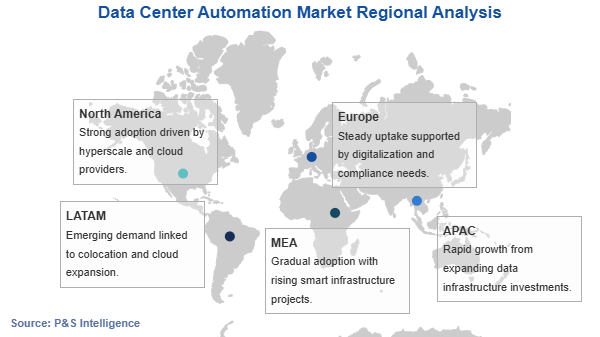
North America is the market leader, with 40% share and the Asia-Pacific region is the fastest-growing region, with 15.4% CAGR.
Data Center Automation Market Dynamics
Shift toward AI-Driven predictive and Autonomous Operations Is Major Trend
The shift toward AI-powered predictive and autonomous is a major trend, where automation platforms are shifting to intelligent decision-making systems from simple task scheduling. Machine learning is being integrated into the workflow to assist with predicting capacity, resolving issues, and making infrastructure self-healing. This trend enables dynamic optimization for resource utilization and energy conservation in cloud, hybrid, and edge configurations. The industry is witnessing advancements in automation tools with real-time analytics and activities that involve multiple domains, reducing manual processes and increasing the pace of operations.
The trend indicates that the industry is shifting from rule-based scripting to dynamic automation driven by AI, which can forecast issues and resolve them before they become problems. As per Cisco, 60% of IT companies and professionals except to have AI-enabled predictive automation across all network domains by 2026, to manage and simplify network operations. This will enable more-autonomous operations and predictive optimization of network workloads.
Increasing Scale and Complexity of Digital Workloads Drive Market
The ever-increasing scale and complexity of digital workloads force organizations to adopt automation to manage performance, reliability, and operational cost. The manual management of networks and infrastructure as becoming more difficult as companies begin to expand their cloud, hybrid models, edge computing, and real-time digital services. Automation of workloads enables companies to maintain consistency in configurations, accelerate deployment, reduce downtime, and ensure standardized operations of distributed systems. Moreover, the increasing need for constant availability and adherence to company and regulatory policies drives the demand for automated workloads, monitoring, and management. As per Ericsson, global mobile network data traffic is projected to grow nearly three-fold between 2024 and 2030, reaching approximately 473 exabytes (EB) per month.
Data Center Automation Market Segmentation Analysis
Component Analysis
Solutions are the largest category, holding a market share of 70%, since they provide the essential technologies that drive the automation of compute, network, storage, and workload levels in the contemporary data center. The automation capabilities are embedded in the infrastructure stacks and, therefore, the primary mechanism for enforcing policies and managing tasks across various domains. To gain visibility and control before layering additional automation practices, organizations adopt solutions first since they address core requirements, such as resource provisioning, policy enforcement, event detection, and workflow execution. Cisco’s Global Hybrid Cloud Trends estimates that 58% of organizations are deploying infrastructure automation to manage growing hybrid and multi-cloud complexity. This reflects the shift away from manual infrastructure management in complex environments.
Services are the fastest-growing category, registering a CAGR of 15.6%. As automation deployments scale, organizations increasingly rely on external expertise to design, integrate, customize, and maintain complex automation ecosystems. Professional consulting, integration, and managed automation services help clients reduce implementation risk, optimize workflows, and extend internal IT capabilities without adding any cost. Moreover, as infrastructure evolves, support and maintenance services ensure automation systems remain current, secure, and efficient. Studies reports an increasing enterprise demand for outsourced IT and managed services as organizations modernize infrastructure and adopt AI and cloud solutions.
The components analyzed in this report are:
Solutions (Larger Category)
Services (Faster-Growing Category)
Deployment Analysis
On-premises is the largest category, holding a market share of 45%, because many organizations, mainly in regulated industries and traditional enterprise sectors, need full control over their data center infrastructure. High security, compliance, and predictable performance are achieved by embedding automation directly into their physical or private infrastructure stacks. Legacy systems and bespoke configurations often require localized automation customization, which is easier to manage in on-premises environments. The Uptime Institute’s 2023 Global Data Center Survey shows that 48% of the enterprise IT workloads were hosted in corporate on-premises data centers.
Cloud-based is the fastest-growing category, registering a CAGR of 15.7%, because fast adoption of public and hybrid models creates demand for scalable, flexible, and centrally managed automation. Cloud deployment accelerates automation of operations, allowing organizations to divide workflows across distributed environments without heavy infrastructure investments. Organizations moving from traditional IT to cloud ecosystems and looking to unify automation across systems find this flexibility particularly attractive. Industry data indicates that more than 51% of enterprise workloads were hosted in public cloud environments by 2025.
The deployment modes analyzed in this report are:
On-Premises (Largest Category)
Cloud-Based (Fastest-Growing Category)
Hybrid
Data Center Analysis
Enterprise is the largest category, holding a market share of 50%. These data centers are used by organizations to host operational environments, such as business applications and internal services, that cannot be completely hosted by external providers. To reduce cost, improve uptime, and standardize operations, these facilities have developed infrastructure and longstanding processes. This drives sustained investment in automation to maintain performance consistency and ensure alignments with internal policies and governance frameworks. As per Uptime Institute, 48% of the enterprise IT workloads were hosted in corporate data centers in 2023, with forecasts suggesting about 43 % will remain there in 2025. This demonstrates the ongoing importance of on‑premises facilities for performance consistency, compliance, and internal governance.
Managed/colocation is the fastest-growing category, registering a CAGR of 15.5%, because they are critical for customers who want flexible capacity without having all the in-house systems. With the evolution of digital services, organizations migrate their workloads to third-party facilities. Here, common automation resources are used to facilitate the management of multi-tenant environments, enhance service level commitments, and coordinate activities across customers. Automation in these facilities enables quick provisioning, easy movement of workloads, and management, which attracts customers with hybrid requirements. This accelerates the adoption of automation in managed and colocation environments.
The data centers analyzed in this report are:
Enterprise (Largest Category)
Managed/Colocation (Fastest-Gowing Category)
Cloud/Hyperscale
End Use Analysis
IT & telecom is the largest category, because networking, connectivity solutions, and business IT implementations involve the most-complex requirements. Network providers and technology companies have large, geographically distributed systems, where automation is necessary to maintain performance, reduce operating risks, and enable rapid deployment. The tight relationships between this sector and cloud computing, edge connectivity, and digital platforms mean that automation is continually used to better utilize resources and keep things running. GSMA estimates that mobile network operators account for about 85% of the global investment in mobile internet connectivity infrastructure, or approximately USD 109 billion annually.
Healthcare is the fastest-growing category, because of the growing adoption of digital healthcare services, telemedicine, connected medical devices, and regulations. The need for automation to assist with workload and reduce manual labor is high in the healthcare industry because providers need to keep systems up and running in clinical, administrative, and remote healthcare. The adoption of automation in the healthcare industry is accelerated by the adoption of automation in digital patient records and real-time systems.
The end uses analyzed in this report are:
IT & Telecom (Largest Category)
Healthcare (Fastest-Growing Category)
BFSI
Government
Manufacturing
Retail & E-commerce
Energy & Utilities
Media & Entertainment
Others
Drive strategic growth with comprehensive market analysis
Data Center Automation Market Regional Outlook
North America Data Center Automation Market Analysis
North America is the leading market, with 40% share, because it was the first to adopt enterprise automation, has large data centers, and has a strong need for high availability. The region enjoys standardized IT practices, advanced vendor choices, and regulations that emphasize high availability, security, and business continuity.
U.S. Data Center Automation Market Growth
The U.S. market is driven by its diverse and complex data center ecosystem, ranging from large-scale campuses and edge locations to legacy enterprise environments. Automation increases as operators need to manage diverse infrastructure resulting from mergers, cloud migrations, and diverse vendors. Government regulations, industry regulations, and increasing AI workloads drive operators to adopt standardized orchestration and policy-driven automation.
In addition, cloud giants and technology innovators accelerate the adoption of advanced automation technology, and the U.S. becomes an example for new architectures rather than low costs. Lawrence Berkeley National Laboratory projects that U.S. data center electricity consumption could reach up to 580 TWh by 2030, driven largely by AI workloads.
Canada Data Center Automation Market Growth
Canada’s expansion is driven by more investments in data centers, increased demand for data residency within the country, and new cloud regions that are outside the core U.S. regions. The use of automation in facilities that is rising because of geographical distances and need to decrease reliance on experts. The need for energy efficiency and sustainability also drive the industry towards more automation and optimization of infrastructure. The industry is helped by mid-sized players who want scalable automation without the complexity of larger U.S. facilities. In December 2025, Microsoft announced a CAD 19-billion investment in Canadian cloud and AI infrastructure spanning 2023–2027, including expansion of data center regions in Quebec and Ontario.
Asia-Pacific Data Center Automation Market Analysis
Asia-Pacific has the highest CAGR, of 15.4%, driven by rapid infrastructure development, unbalanced delivery in various countries, and increasing requirements for scalable management in new data centers. Organizations are adopting automation to standardize processes, address talent gaps, and accelerate deployment in emerging digital markets.
China Data Center Automation Market Growth
The Chinese market revolves around government-supported data center expansion, large cloud computing platforms, and organized infrastructure development. Automation is based on standardized processes in massive data centers that enable industrial digitization, smart cities, and cloud initiatives. Chinese companies are automating to cope with the massive amount of data, reduce manual labor, and comply with government regulations in China. The Chinese ecosystem emphasizes integration with in-house platforms and software stacks, and automation is an integral part of the Chinese data infrastructure. At of the end of 2023, China's data center scale had reached 8.1 million standard racks in use, with a total computing power capacity of 230 Exaflops.
India Data Center Automation Market Growth
The reason for the rapid growth in India is the establishment of new data centers, the development of digital public services, and the adoption of cloud by more companies. Automation is beneficial for filling the skill gaps of employees, speeding up projects, and maintaining consistency in new facilities. In contrast to mature markets, the adoption of automation in India is directly related to greenfield investments, where automation is integrated from the outset rather than being retrofitted. Local colocation companies and regional cloud need automation for scalability and modularity. India’s operational data center capacity reached 1,520 MW in 2025, with capacity additions more than doubling year-on-year to 387 MW from 191 MW in 2024.
The regions and countries analyzed in this report are:
North America (Largest Regional Market)
U.S. (Largest Country)
Canada (Fastest‑Growing Country)
Europe
Germany (Largest Country)
U.K. (Fastest‑Growing Country)
France
Italy
Spain
Rest of Europe
Asia‑Pacific (Fastest‑Growing Regional Market)
China (Largest Country)
India (Fastest‑Growing Country)
Japan
South Korea
Australia
Rest of APAC
Latin America
Brazil (Largest Country)
Mexico (Fastest‑Growing Country)
Rest of LATAM
Middle East and Africa
Saudi Arabia (Largest Country)
U.A.E. (Fastest‑Growing Country)
South Africa
Rest of MEA
Data Center Automation Market Competitive Landscape
The market is fragmented, as there are many different kinds of firms offering solutions, ranging from global technology companies to cloud platform companies, infrastructure companies, and small automation software developers. There is no single major player in this market due to the complex and multi-layered nature of data centers. Organizations typically roll out automation solutions in a series of steps and integrate additional tools into existing infrastructure, sometimes opting for specialized solutions over a single-source provider. The industry is also fragmented based on the level of preparedness of various firms, regulatory requirements, and regional preferences for deployment.
The objectives of businesses, colocation companies, and hyperscalers are different, including optimizing business, addressing compliance, and scaling successfully, resulting in the selection of different suppliers. The automation of data centers is also related to other fields, including cloud management, DevOps solutions, and IT service management, allowing suppliers from other markets to compete in this space as well. Innovation, open-source alternatives, and modularity make it easier for new entrants to establish themselves.
Key Data Center Automation Companies:
VMware (by Broadcom)
Dell Technologies
IBM
Oracle
Fujitsu
Juniper Networks
BMC Software
ServiceNow
Schneider Electric
Siemens
ABB
Vertiv
NetApp
Red Hat
HashiCorp
Data Center Automation Market News
In January 2026, CS and Equinix began collaborating to automate the process of connecting enterprises at the edge through Equinix Fabric. This will enhance last-mile access and support for cloud and edge workloads in enterprise networks.
In December 2025, HPE expanded unified AIOps capabilities across its AI-native networking solutions, supporting automated operations in hybrid cloud environments.
In November 2025, Kyndryl expanded its data center and infrastructure modernization services portfolio to support large-scale enterprise transformation initiatives.
In October 2025, Flex announced a new integrated data center platform for AI-scale requirements. The platform integrates power, cooling, and compute in modular form to support next-generation infrastructure deployment.
In September 2025, Equinix opened its first AI-ready IBX data center in Chennai, India, adding to its global digital infrastructure footprint.
In August 2025, Leviton introduced new high-density connectivity solutions for hyperscale and AI data center networks. These include new fiber-optic infrastructure options.
Frequently Asked Questions About This Report
What key factors are driving the rapid growth of data center automation?+
The key factors driving the market include rising cloud workloads, AI integration, and the critical need for energy efficiency are forcing enterprises to adopt advanced automated systems for stability.
How does automation help reduce financial losses caused by system outages?+
Automation ensures real-time monitoring and autonomous recovery, preventing infrastructure failures that can result in operational losses exceeding one hundred thousand dollars.
Which market segment is currently witnessing the fastest growth rate globally?+
The services segment is growing fastest as enterprises require external expertise to design and maintain complex ecosystems across diverse global regions.
How does artificial intelligence transform traditional data center operational management?+
AI-driven tools enable predictive maintenance and autonomous resource allocation, allowing systems to manage performance intelligently without requiring constant human intervention.
Why does the IT and telecom sector dominate the automation market?+
This sector requires high-performance automation to manage massive systems spread across wide geographical areas while ensuring service reliability and uptime.
What is the primary advantage of deploying automation solutions on-premises?+
On-premises deployment remains dominant because organizations like banks and governments prioritize strict security protocols and regulatory compliance for their critical infrastructure.
Want a report tailored exactly to your business need?
Leading companies across industries trust us to deliver data-driven insights and innovative solutions for their most critical decisions. From data-driven strategies to actionable insights, we empower the decision-makers who shape industries and define the future. From Fortune 500 companies to innovative startups, we are proud to partner with organisations that drive progress in their industries.
Client Testimonials
Working with P&S Intelligence and their team was an absolute pleasure – their awareness of timelines and commitment to value greatly contributed to our project's success. Eagerly anticipating future collaborations.
McKinsey & Company
India
Unmatched Standards
Our insights into the minutest levels of the markets, including the latest trends and competitive landscape, give you all the answers you need to take your business to new heights
Complete Data Security
We take a cautious approach to protecting your personal and confidential information. Trust is the strongest bond that connects us and our clients, and trust we build by complying with all international and domestic data protection and privacy laws