This Report Provides In-Depth Analysis of the Hybrid Cloud Market Report Prepared by P&S Intelligence, Segmented by Component (Solution, Services), Service Model (Software as a Service (SaaS), Infrastructure as a Service (IaaS), Platform as a Service (PaaS)), Organization Size (Large Enterprises, Small & Medium Enterprises (SMEs)), Vertical (BFSI, Healthcare, IT & Telecom, Retail, Government, Manufacturing), Workload (Storage, Backup, & Disaster Recovery, Analytics & AI/ML, Application Development & Testing, Database Management, Enterprise Resource Planning, Customer Relationship Management, Collaboration & Content Management), and Geographical Outlook for the Period of 2021 to 2032
Explore the market potential with our data-driven report
Hybrid Cloud Market Overview
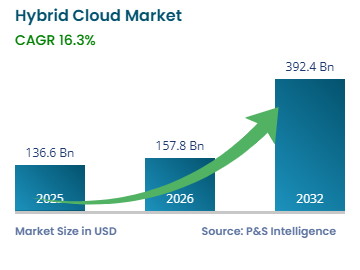
The hybrid cloud market size will be an estimated USD 136.6 billion for 2025, and it will grow by 16.3% during 2026-2032, to reach USD 392.4 billion by 2032.
The market is growing because of the fast integration of generative AI and organizations need for a scalable and secure infrastructure to support high-performance computing without compromising the data sovereignty. Now companies are shifting from single-cloud models and adopting hybrid architectures, which offer the unique ability to process massive AI workloads in public clouds while retaining sensitive intellectual property within private, controlled environments. This strategic shift is also proven by Flexeras latest industry data. According to their 2025 State of the Cloud Report 79% of the organizations are actively using AI and ML services or experimenting with them. Due to the fast adoption of AI, the demand of flexible hybrid framework has increased to efficiently manage complex and data-intensive applications, while optimizing costs.
Key Market Insights
Solutions lead the market with a 65% share, driven by enterprises prioritizing the rapid deployment of core infrastructure, including management, security, and orchestration platforms.
Services is the fastest-growing category, with a CAGR of 16.6%, driven by the growing skills gap in managing complex multi-cloud environments, leading organizations to rely on specialized third-party providers for implementation and maintenance.
Large enterprises dominate the market with a 70% share, driven by their substantial budgets and complex legacy systems that require hybrid architectures to manage global scale and strict data governance.
Storage, backup, & disaster recovery leads with a 30% share, driven by its critical role in ensuring data protection and business continuity across hybrid cloud environments.
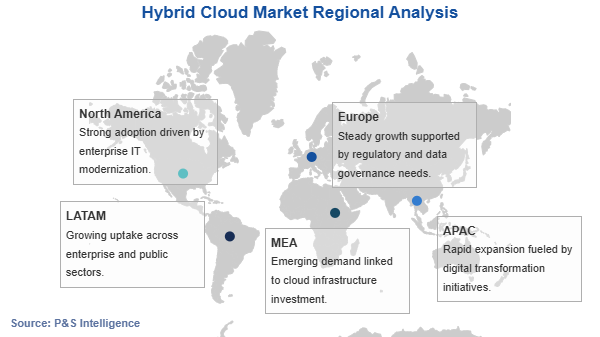
North America leads the market with a 40% share, while Asia-Pacific is the fastest-growing region.
Hybrid Cloud Market Dynamics
Rapid Adoption of Sovereign Cloud Architectures Is Major Trend
The adoption of sovereign hybrid cloud architectures is increasing quickly because data residency and privacy regulations have become very strict in the Asia-Pacific region. Government and regulated industries are demanding that sensitive and financial data of citizens should stay within the national borders, so that data sovereignty can be maintained. This regulatory landscape is forcing a shift toward sovereign-compliant hybrid deployments where the control plan is local, but compute power remains scalable. This strategic pivot is validated by industry data indicating that 90% of organizations are accelerating their investment in AI-centric hybrid strategies to support this exact balance of innovation and compliance.
Need for Operational Agility, Risk Reduction, and Cost Optimization Drives Market
Hybrid cloud is being adopted by businesses due to the demand for both scalability and the ability to be flexible within their IT Infrastructure. Many digital services (e.g., mobile applications), analytics tools (e.g., big data, AI), and seasonal fluctuations are causing variability in enterprise workloads. This has created an opportunity for businesses to scale their data center usage more efficiently than before. For example, most traditional data centers run at less than 40% utilization rates. Therefore, using on-premises and cloud-based resources to elastically scale is becoming more efficient. The same is true for meeting data security, privacy, and regulatory compliance requirements.
Organizations have to meet local data residency and auditing requirements, which may result in monetary fines of up to four% of gross revenue if those requirements are not met. Hybrid cloud allows organizations to keep their sensitive data in their own data center and use their public clouds for non-sensitive workloads. Cost savings and avoiding vendor lock-in are additional reasons why businesses are adopting hybrid cloud solutions. Businesses have reported 20–30% of their cloud costs as waste due to workloads that were not properly aligned and, therefore, will continue to seek balanced capital expense (CapEX) and operational expense (OpEX) models and greater flexibility from providers. Finally, business continuity and disaster recovery needs are increasing because a single outage can cost a large organization thousands of dollars per minute. Hybrid cloud architectures allow for geographic redundancy, faster recovery times, and higher availability than previous options, but without having to duplicate all of your infrastructure.
Escalating Integration of Generative AI Offers Opportunity
The primary engine propelling the hybrid Cloud market is the demand for scalable infrastructure that can support Generative AI while solving for cost and latency. Enterprises are adopting hybrid architectures to balance the immense compute power of public clouds for model training with the security of on-premise private clouds for sensitive data inference. This best of both worlds approach is critical as it minimizes latency, maintains cost-efficiency by reducing public cloud egress fees, and manages the explosive growth of corporate data. Recent reports confirm this shift, noting that 90% of organizations have containerized their applications specifically to support AI workloads in hybrid environments, establishing this approach as the new infrastructure standard for modern digital businesses.
Hybrid Cloud Market Segmentation Analysis
Component Analysis
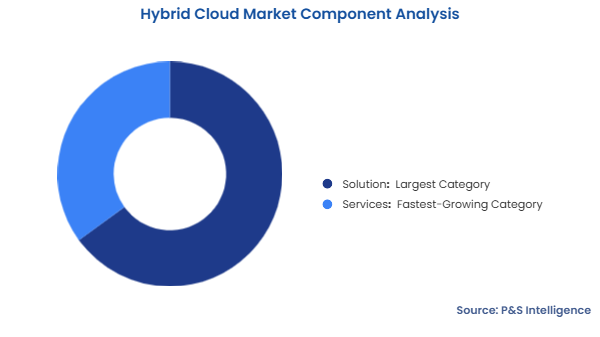
Solution is the largest category, accounting for a market share of 65%, because the overwhelming majority of global enterprises are prioritizing the immediate deployment of foundational infrastructure such as management platforms, security tools, and orchestration software. Many companies have integrated their existing on-premises legacy systems with modern public clouds, which is a capital-intensive process and warrants high IT budgets. Ciscos Global Hybrid Cloud Trends report confirms this structural reliance, noting that 82% of IT leaders have already adopted hybrid cloud infrastructure solutions as their baseline standard for operations.
Services is the fastest-growing category, witnessing a CAGR of 16.6%, as organizations increasingly face a skills gap in managing complex multi-cloud architectures, compelling them to outsource implementation, strategy, and maintenance to specialized third-party providers. As companies are moving ahead from the initial setup to the day-to-day operations phase, the demand for managed services, data sovereignty compliance consultancy, and AI stack tuning is rapidly increasing. 60% of all organizations now use MSPs to manage their public cloud workloads (Flexera 2025), a figure that is climbing year-over-year as complexity increases.
The components analyzed in this report are:
Solution (Largest Category)
Services (Fastest-Growing Category)
Service Model Analysis
SaaS is the largest category, holding a market share of 50%, simply because it is the primary consumption model for modern business software from CRM to collaboration, which requires zero infrastructure management from the user. It is the default entry point for cloud adoption. SaaS applications are an integral component in hybrid clouds where they functionally integrate on-premise systems with public cloud environments, providing end-to-end workflows that do not have interruption in functionality.
By integrating SaaS into hybrid architectures, organizations are able to scale quickly, maintain control over their sensitive data, and optimize use of IT resources. Thus, SaaS is also driving the use of hybrid cloud technologies by organizations across multiple industries.
IaaS is the fastest-growing category, registering a CAGR of 16.5%. This is because the explosion of data-heavy workloads, specifically generative AI training and big data analytics, requires massive, scalable raw compute and storage power that only infrastructure services can provide on demand. Companies are shifting from owning physical data centers to renting virtualized infrastructure, so that high-performance tasks can be handled easily, without depending on heavy upfront capital investment.
The service models analyzed in this report are:
Software as a Service (SaaS) (Largest Category)
Infrastructure as a Service (IaaS) (Fastest-Growing Category)
Platform as a Service (PaaS)
Organization Size Analysis
Large enterprises are the largest category, capturing a market share of 70%, because multinational corporations have massive budgets and their legacy infrastructure is also very complex, which is why they need hybrid architectures to balance global scale with strict data governance. These organizations primarily use private cloud to protect their intellectual property, while the public clouds are leveraged for customer-facing applications.
SMEs are the fastest-growing category, as the barrier to entry for advanced cloud technology lowers, allowing smaller firms to adopt cloud-lite hybrid models that offer enterprise-grade capabilities without heavy infrastructure costs. To stay in digital competition and to support remote workforce SMEs are deploying hybrid solutions rapidly, 53% of SMBs are already using the cloud, indicating a rapid acceleration in their adoption of sophisticated cloud services.
The organization sizes analyzed in this report are:
Large Enterprises (Largest Category)
Small & Medium Enterprises (SMEs) (Fastest-Growing Category)
Vertical Analysis
BFSI is the largest category, as this sector needs high-security environments to process trillion-dollar transactions together while maintaining strict financial regulations. Banks and insurance companies use private clouds to store sensitive customer data, while public clouds are used for high-speed trading analysis, mainly in customer service applications. Over 90% of the financial services organizations have already adopted advanced security tools for their hybrid environments, reflecting the massive scale of their investment in this secure infrastructure.
Healthcare is the fastest-growing category, exhibiting a CAGR of 16.7%, fueled by the urgent digitization of patient records, the explosion of telemedicine, and the integration of AI-driven diagnostic tools that require immense processing power. Hospitals and research institutions are adopting hybrid models to securely store patient data on-premises, whereas public clouds are used to analyze large genomic datasets. The healthcare industry is aggressively moving toward advanced hybrid maturity to support digital health initiatives.
The verticals analyzed in this report are:
BFSI (Largest Category)
Healthcare (Fastest-Growing Category)
IT & Telecom
Retail
Government
Manufacturing
Others
Workload Analysis
Storage, backup, & disaster recovery is the largest category, accounting for a market share of 30%, because data protection is the most fundamental and universally applied use case for hybrid cloud, serving as the safety net for business continuity. Virtually every enterprise utilizes a hybrid setup to keep mission-critical data backups off-site in the public cloud while maintaining primary storage on-premise for speed and access. Ransomware protection and data security are a top priority for IT leaders, driving the massive investment in hybrid storage solutions.
Analytics & AI/ML is the fastest-growing category, driven by the corporate gold rush to harness Generative AI and big data for strategic decision-making. This workload needs hybrid workflows, where sensitive proprietary data is secured in private environment, but the intense computational work of training models is offloaded to the public clouds’ vast resources. As per reports, 79% of the organizations are now using or experimenting with AI/ML PaaS services.
Drive strategic growth with comprehensive market analysis
Hybrid Cloud Market Geographical Analysis
North America Hybrid Cloud Market Analysis
North America is the largest market, capturing a share of 40%, as it is a global center for hyperscale innovation and cloud infrastructure investments. Dominance of this region gets stronger as U.S. enterprises are deploying hybrid architectures, so that they can support Generative AI initiatives along with managing strict data governance and FinOps mandates. The biggest proof of this maturity is that 59% of organizations have already made dedicated FinOps teams, specifically to govern these massive hybrid environments.
U.S. Hybrid Cloud Market Growth
Hybrid cloud development in the United States is fueled by earlier cloud adoption, established enterprise IT ecosystems, and expanding demand for digital transformation across various markets. Many companies seek to leverage public cloud innovations while maintaining their on-premises infrastructure capabilities to ensure performance, security, and regulatory compliance requirements are met. In heavily regulated sectors such as finance, healthcare, and government, hybrid cloud models enable organizations to maintain greater control over sensitive data while providing access to advanced analytics, artificial intelligence, and automation capabilities available through cloud platforms. The presence of hyperscale providers, system integrators, and software vendors has also contributed to increased hybrid cloud deployments in the U.S.
Asia-Pacific Hybrid Cloud Market Forecast
Asia-Pacific is the fastest-growing regional market, registering a CAGR of 16.%, primarily due to aggressive government mandates for digital transformation and data sovereignty across major economies. This acceleration is fueled by the cloud-first policies of developing nations that are actively leapfrogging legacy IT systems to adopt advanced hybrid architectures capable of supporting AI-driven applications.
China Hybrid Cloud Market Future
Hybrid cloud adoption in China is driven by data sovereignty requirements, cybersecurity regulations, and the dominance of domestic cloud providers. Companies often develop hybrid cloud architectures to enable greater control over critical data, while at the same time allowing them to scale their digital platforms, e-commerce, and manufacturing systems. State-owned enterprises and large private companies have deployed hybrid clouds to modernize their legacy IT environments without having to rely fully on public clouds. Rapidly developing smart manufacturing, AI applications, and digital government initiatives continue to support hybrid cloud as an effective and compliant infrastructure model.
India Hybrid Cloud Market Data
The hybrid cloud market in India is developing due to rapidly increasing digitization, cost sensitivity, and the coexistence of modern and legacy IT systems. Banking, telecommunications, IT services, and public sector organizations in India are adopting hybrid models to manage their data locally while scaling customer-facing applications in the cloud. Increasing adoption of SaaS, analytics, and AI workloads, along with evolving data protection frameworks, is driving hybrid deployments. Strong growth in data centers and managed service providers is also supporting hybrid cloud adoption among both large enterprises and mid-sized organizations in India.
The regions and countries analyzed in this report are:
North America (Largest Regional Market)
U.S. (Largest Country)
Canada (Fastest‑Growing Country)
Europe
Germany (Largest Country)
U.K. (Fastest‑Growing Country)
France
Italy
Spain
Rest of Europe
Asia‑Pacific (Fastest‑Growing Regional Market)
China (Largest Country)
India (Fastest‑Growing Country)
Japan
South Korea
Australia
Rest of APAC
Latin America
Brazil (Largest Country)
Mexico (Fastest‑Growing Country)
Rest of LATAM
Middle East and Africa
Saudi Arabia (Largest Country)
U.A.E. (Fastest‑Growing Country)
South Africa
Rest of MEA
Hybrid Cloud Market Share Analysis
The hybrid cloud market is consolidated, in which there is overwhelming dominance of hyperscale providers, who control the major part of the required infrastructure for hybrid deployments. This concentration is structurally enforced because it needs high capital expenditure to build global data centers and AI-ready GPU clusters, which is a huge barrier for small players.
The reason why the market is so concentrated is because it has several big barriers to entering the market, the most important ones being a strong and complete infrastructure, a worldwide network of data centers, and expertise in how to make the best use of cloud and security. The leading players will continue to grow their hybrid cloud products, integrate new and emerging technologies (like AI and analytics), improve service reliability, and offer end-to-end solutions that meet the needs of each industry.
The leading players can also build strategic partnerships with other companies in order to develop an ecosystem for each industry and develop industry-specific solutions that they can offer to customers, which helps them grow their business and stay competitive in the market. Due to the fact that there are only a few established players in the global hybrid cloud market, the pricing of the products, the standards for those products, and the innovation of the products are determined by these few players; therefore, having scale, a global presence, and differentiation through technology are the three most important factors for a company to remain competitive in the global hybrid cloud market.
Key Hybrid Cloud Companies :
Amazon Web Services (AWS)
Microsoft Corporation (Azure)
Google LLC (Google Cloud)
IBM Corporation
Oracle Corporation
VMware (Broadcom)
Dell Technologies
Hewlett Packard Enterprise (HPE)
Cisco Systems
Alibaba Cloud
Red Hat (IBM)
Nutanix
Rackspace Technology
Salesforce
Equinix
Frequently Asked Questions About This Report
What is the primary driver for enterprises shifting from Public Cloud to Hybrid Cloud?+
Enterprises are shifting to Hybrid Cloud primarily to optimize costs and ensure data sovereignty by keeping sensitive information on-premise while leveraging public cloud scalability.
How does Hybrid Cloud infrastructure specifically support Generative AI?+
It allows organizations to train massive models using public cloud compute power while securely running inference and storing proprietary data on private local servers.
What is the difference between Hybrid Cloud and Multi-Cloud?+
Multi-Cloud involves using separate clouds from different providers, whereas Hybrid Cloud connects public and private environments into a single, interoperable system where data moves freely.
What are the biggest barriers to Hybrid Cloud adoption?+
The primary barriers are the significant skills gap in managing complex architectures and the difficulty of integrating modern cloud tools with legacy on-premise hardware.
Is Hybrid Cloud more expensive than a pure Public Cloud model?+
While it requires higher upfront capital for hardware, Hybrid Cloud is often cheaper in the long run for predictable workloads by eliminating continuous public cloud rental fees.
Want a report tailored exactly to your business need?
Leading companies across industries trust us to deliver data-driven insights and innovative solutions for their most critical decisions. From data-driven strategies to actionable insights, we empower the decision-makers who shape industries and define the future. From Fortune 500 companies to innovative startups, we are proud to partner with organisations that drive progress in their industries.
Client Testimonials
Working with P&S Intelligence and their team was an absolute pleasure – their awareness of timelines and commitment to value greatly contributed to our project's success. Eagerly anticipating future collaborations.
McKinsey & Company
India
Unmatched Standards
Our insights into the minutest levels of the markets, including the latest trends and competitive landscape, give you all the answers you need to take your business to new heights
Complete Data Security
We take a cautious approach to protecting your personal and confidential information. Trust is the strongest bond that connects us and our clients, and trust we build by complying with all international and domestic data protection and privacy laws