Industrial Desiccant Dehumidification Systems Market Insights (2027 - 2033)
This Report Provides In-Depth Analysis of the Industrial Desiccant Dehumidification Systems Market Report Prepared by P&S Intelligence, Segmented by Product Type (Fixed/Mounted, Portable), Technology (Rotary (Desiccant Wheel), Liquid Desiccant, Hybrid Desiccant), Application (Food & Pharmaceuticals, Electronics, Energy, Chemical, Construction), Sales Channel (Direct Sales, Distributors/Wholesalers, Online), and Geographical Outlook for the Period of 2022 to 2033
Industrial Desiccant Dehumidification Systems Market Statistics
Key Highlights
Study Period
2022 - 2033
Market Size in 2026
USD 514.02 Million
Market Size in 2027
USD 545.11 Million
Market Size by 2033
USD 775.44 Million
Projected CAGR
6.05%
Largest Region
Asia-Pacific
Fastest Growing Region
Asia-Pacific
Market Structure
Moderately Fragmented
Market Size
Explore the market potential with our data-driven report
Industrial Desiccant Dehumidification Systems Market Outlook
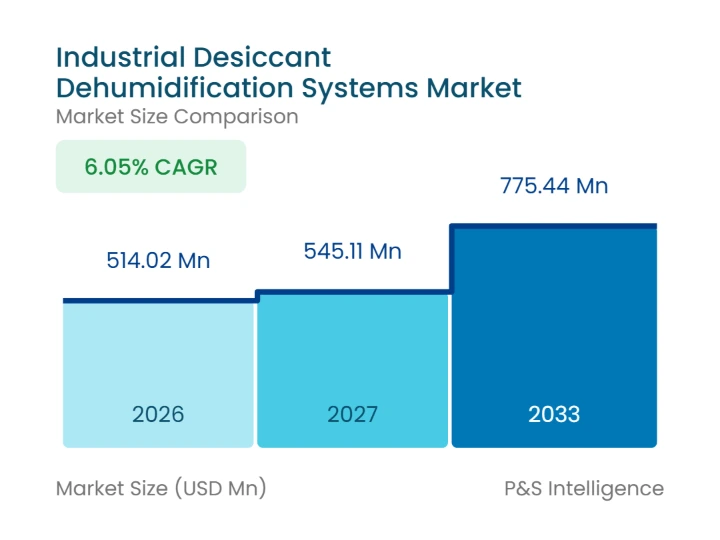
The global industrial desiccant dehumidification systems market size is estimated at USD 514.02 million in 2026 and is projected to reach USD 545.11 million in 2027. Revenue is expected to climb to USD 775.44 million by 2033, a CAGR of 6.05% during 2027-2033. The core buyers are plant owners whose process air must be drier than a refrigerant coil can deliver, including battery cell producers running dry rooms, drug makers filling moisture-sensitive powders, and food companies protecting stock in storage.
Chip and electronics plant construction is opening the fastest-growing channel for these systems, because humidity-critical process and storage areas are designed into a new plant's air handling from the start. SEMI expects 20 new 300mm fabs or lines, excluding pure R&D sites, to begin construction worldwide in 2026. Construction starts are projections, and desiccant equipment is usually ordered later in the build, when cleanroom air systems are installed. Equipment makers selling into this channel therefore receive orders in project-sized blocks that follow fab schedules.
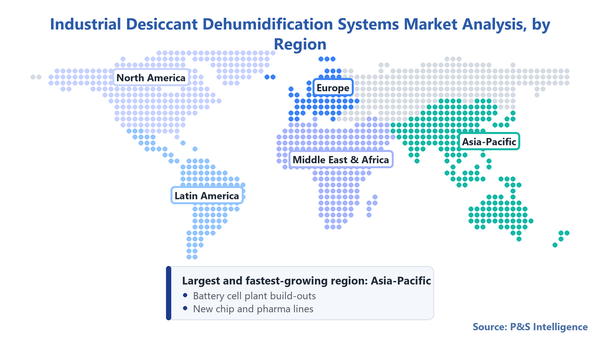
Asia-Pacific accounts for 38% of 2026 revenue and is also projected to expand fastest, at a 7.0% CAGR over 2027-2033. Battery, electronics, and pharmaceutical plants in China, Japan, and South Korea generate much of this demand, and most of it comes from new production lines. North America ranks second, and industrial desiccant dehumidification systems demand there depends more on upgrading and expanding existing battery, pharmaceutical, and food plants than on greenfield sites. Europe follows, with orders tied to pharmaceutical producers and to offshore wind projects in the North Sea.
Key market insights
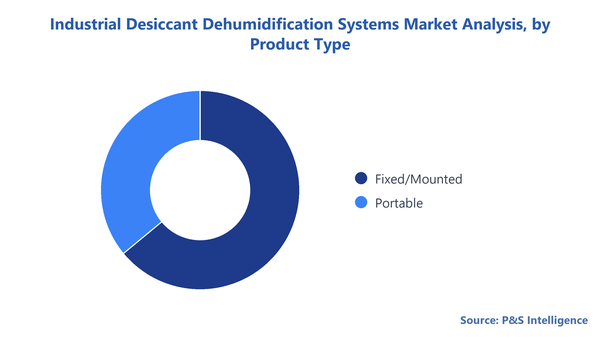
By product type, fixed/mounted systems hold 64% of 2026 revenue, and portable units are projected to post a 6.9% CAGR over 2027-2033.
By technology, rotary (desiccant wheel) systems lead in 2026, while hybrid desiccant systems are forecast to expand at an 8.1% CAGR during 2027-2033.
By application, food & pharmaceuticals generate 32% of 2026 revenue, and electronics is expected to advance at a 7.8% CAGR over 2027-2033.
By sales channel, direct sales capture 52% of 2026 revenue, while online sales are set to rise at a 7.0% CAGR during 2027-2033.
By geography, Asia-Pacific contributes 38% of 2026 revenue and is projected to grow fastest, at a 7.0% CAGR during 2027-2033.
Industrial Desiccant Dehumidification Systems Market Dynamics
Lower-temperature rotor regeneration is reshaping desiccant system specifications
Running cost now carries more weight when plant engineers compare desiccant dehumidifiers, because the heater that dries the rotor works whenever the production process does. A rotor that gives up its moisture at a lower temperature can be regenerated with recovered process heat, hot water, or a heat-pump circuit in place of a dedicated electric or gas heater. That changes the economics at sites with spare low-grade heat from ovens, compressors, or chillers, where a desiccant unit can cost less to run than a design that depends on a high-temperature heater.
Suppliers are answering with new adsorbent materials and with hybrid layouts that pair refrigerant pre-cooling with a desiccant stage and reuse waste heat for reactivation. Both approaches cut the energy a system draws per kilogram of water removed, the operating cost plant engineers weigh when comparing bids for large dry rooms. Competition is likely to shift toward rotor chemistry and heat integration, which could favor companies that develop their own rotors over assemblers that buy standard wheels. Plant owners gain a lower lifecycle cost, though only where a usable heat source exists on site.
Battery cell plant construction is driving orders for ultra-low dew point systems
Battery cell producers place some of the largest single orders in this market, because electrode handling, cell assembly, and electrolyte filling take place in dry rooms held around a minus 40°C dew point, a level refrigerant equipment cannot reach. Each new cell line therefore needs desiccant capacity sized for the room volume, the number of operators inside, and the moisture that enters through doors and conveyors. These orders are engineered and priced per project, and they are typically placed while the plant is being built, well before the first cell leaves the line.
According to the IEA, global electric car sales are expected to reach 23 million in 2026, close to 30% of new cars sold. That projection sizes the vehicle market that lithium-ion battery plants serve and does not measure dehumidifier purchases, which follow cell makers' own capacity decisions. Each cell plant is a large, discrete project, so a single postponed plant can remove a sizable order from a supplier's book. Dry-room orders therefore arrive only when cell makers move from announcement to construction, which makes order intake lumpy.
Offshore wind expansion is opening demand for corrosion-control dehumidification
Offshore wind developers and turbine makers use desiccant dehumidifiers to keep salty, humid air out of towers, nacelles, transition pieces, and foundations, where moisture can corrode steel and damage electrical equipment. Desiccant units keep removing moisture in the cold, damp conditions at sea, where refrigerant dehumidifiers lose capacity, which makes them a practical fit for these structures. Demand can arise during construction, when structures sit offshore before commissioning, and continues while each turbine operates, so every new wind farm becomes a long-lived site for dehumidification equipment.
Figures from the Global Wind Energy Council put 2025 offshore wind additions at 9.3 GW, lifting cumulative installed capacity to 92.5 GW. Each gigawatt adds dozens of large turbine structures, and every one of them is a candidate for permanent moisture control. This opening favors compact, marine-rated units that fit inside towers and can be monitored remotely, since a technician visit offshore is costly. Dehumidifier makers that qualify with turbine manufacturers early could secure repeat orders across several wind farm projects.
High reactivation energy use is limiting desiccant adoption at moderate humidity sites
The heat needed to regenerate a desiccant rotor makes these systems more expensive to run than refrigerant dehumidifiers when the target is moderate humidity at normal room temperature. Food warehouses, general manufacturing halls, and many construction sites can meet their moisture limits with refrigerant units, so desiccant equipment wins there mainly when temperatures are low or dryness requirements are strict. Where power or gas is expensive, the running-cost gap widens and finance teams take longer to approve desiccant projects that a cheaper alternative could cover.
Eurostat recorded Ireland, Cyprus, and Germany as the highest-priced EU countries for mid-sized non-household electricity users in the second half of 2025, even though the EU average fell 3.5% from the first half. Germany's position matters because its chemical, pharmaceutical, and automotive plants form one of Europe's largest industrial bases for moisture control. High power prices raise the lifecycle savings a supplier must document before a desiccant project is approved. Equipment that cannot show competitive energy use is likely to lose such tenders to refrigerant or hybrid designs.
Segmentation Outlook
Product Type
Fixed/mounted systems account for 64% of 2026 industrial desiccant dehumidification systems revenue. Pharmaceutical suites, battery dry rooms, chip fabs, and food plants need dehumidification that runs around the clock and is ducted into the building's air handling, so owners buy permanently installed units sized for each room. These units are engineered to a dew point specification and are often validated as part of the production line. Once validated, a fixed system is costly to swap, which ties the category's share closely to plant construction and expansion budgets.
Portable units are projected to expand at a 6.9% CAGR during 2027-2033. Construction contractors use trailer-mounted and wheeled desiccant dryers to dry concrete, coatings, and enclosed spaces in cold or damp weather, when refrigerant units lose capacity. Rental companies buy these units in fleets and move them between jobs, which spreads purchases across many smaller orders. Restoration firms that dry water-damaged buildings add a further group of fleet buyers. For manufacturers, fleet owners reward rugged housings, low weight, and fast parts supply more than custom engineering.
Copyright P&S Intelligence. Reuse requires attribution under CC BY 4.0.
Technology
Rotary (desiccant wheel) systems hold the largest share in 2026. The same rotor platform scales from small packaged units to the large custom air handlers that battery and pharmaceutical plants buy, and many regulated plants already hold validation records for rotor-based dryers, lowering the risk of specifying another. Seibu Giken Co. Ltd., whose dehumidifiers are built around its own honeycomb rotors, booked desiccant dehumidifier sales of USD 124.44 million (JPY 19,700 million) in 2025, per its annual securities filing. Rotors are counted in this market only when supplied within, or as the regenerating component of, an industrial desiccant system.
Hybrid desiccant systems are set to post the quickest growth, at an 8.1% CAGR during 2027-2033. A refrigerant coil removes the bulk of the moisture and a desiccant stage handles the final drying, which reduces the heat the rotor needs, and some designs reactivate with waste heat. Plants with large air volumes and strict dew points, such as battery and pharmaceutical sites, can cut running costs this way without giving up dryness. Refrigerant components in these units are counted here only when supplied as part of a hybrid desiccant system, never when sold for standalone refrigerant dehumidifiers.
Application
Food & pharmaceuticals account for 32% of 2026 revenue, the largest application share. Drug makers keep relative humidity low in tablet compression, capsule filling, powder handling, and packaging rooms, because moisture changes how powders flow and how finished products hold up in storage. Food processors use the same equipment for confectionery, dried foods, and cold stores, where frost and condensation damage product and equipment. In drug plants the humidity limit is written into the validated process, so dehumidification is bought as a quality requirement, which tends to make spending less sensitive to economic slowdowns.
Electronics, which covers semiconductor and electronics manufacturing as well as lithium-ion battery manufacturing, is projected to post a 7.8% CAGR during 2027-2033. Cell producers need ultra-dry air across electrode and assembly halls, while chip and display plants need tight humidity control in lithography, wafer storage, and packaging areas. These sites order large engineered systems in single projects, so revenue arrives in blocks tied to new capacity. Battery orders slow when cell makers delay plants, which makes this application's order flow uneven from one year to the next.
Sales Channel
Direct sales account for 52% of 2026 revenue. Engineered systems for battery plants, pharmaceutical suites, and process lines are specified, quoted, and commissioned by the manufacturer's own engineers, often with on-site start-up and validation support, so equipment makers keep these accounts in-house. Large plant owners also prefer one contract that covers design, delivery, and performance guarantees, which leaves little room for an intermediary. This channel favors manufacturers that maintain application engineering teams in the countries where new plants are being built.
Online sales are projected to grow at a 7.0% CAGR during 2027-2033. The channel mainly carries portable and smaller packaged units, which buyers can select from a published specification sheet without a site survey. Contractors, facility managers, and rental firms adding units to their fleets use manufacturer web stores and industrial e-commerce platforms to compare capacity, weight, and price quickly. Distributors and wholesalers remain important for local stock and after-sales parts, so online growth adds a route to market alongside them instead of replacing them.
The following segments are analysed in this report.
Product Type
Fixed/Mounted
Portable
Technology
Rotary (Desiccant Wheel)
Liquid Desiccant
Hybrid Desiccant
Application
Food & Pharmaceuticals
Electronics
Energy
Chemical
Construction
Others
Sales Channel
Direct Sales
Distributors/Wholesalers
Online
Geographical Analysis
Asia-Pacific industrial desiccant dehumidification systems market outlook
Asia-Pacific accounts for 38% of the market in 2026 and is projected to record the quickest growth of any region, a 7.0% CAGR during 2027-2033. China is the region's largest market. Its cell producers, display and chip makers, and pharmaceutical companies operate large humidity-controlled production halls, and each new line adds an engineered dehumidification package to the plant's construction budget. Japan and South Korea add demand from established battery and electronics manufacturers that upgrade lines as they move to new cell formats and chip generations.
Much of the regional demand comes from new production capacity, where a desiccant system is bought with the first air-handling package. Rotor makers with factories in Japan, China, and India can price close to local competitors and shorten delivery times, which matters when a cell or chip plant is working to a fixed start-up date. India's Department of Commerce puts the country's pharmaceutical exports at about USD 31 billion in fiscal 2025-26, and the plants making tablets and capsules for those markets run humidity-controlled compression and packaging rooms.
Asia-Pacific's lead is likely to hold through 2033, because new battery, semiconductor, and pharmaceutical capacity continues to be concentrated in the region. The main risk is timing, since postponed cell plant projects in China or South Korea would show up quickly in supplier order books. Suppliers with local engineering teams in these countries are better positioned to win the next round of dry-room and cleanroom projects.
Copyright P&S Intelligence. Reuse requires attribution under CC BY 4.0.
North America market analysis
North America ranks behind Asia-Pacific in revenue, and its order book rests more on existing plants than on new ones. Battery cell plants commissioned in the U.S. earlier in the decade, along with pharmaceutical fill-finish sites and food plants in humid southern states, buy upgrades and added capacity as their production lines change. Portable desiccant units sold to restoration and construction rental fleets add a steadier second channel, because water-damage drying and winter construction create demand every year.
U.S. Census Bureau data show manufacturing construction spending easing from a seasonally adjusted annual rate of USD 177.0 billion in April 2026 to USD 170.7 billion in August 2026. Slower factory construction narrows the pipeline of greenfield dry rooms and cleanrooms in the U.S., so suppliers compete harder for retrofit and expansion projects at operating plants. Manufacturers with field engineering teams close to these plants are better positioned to win that work, since retrofits depend on fast site surveys and short installation windows.
Europe market analysis
Europe trails Asia-Pacific and North America, and its demand is concentrated in pharmaceutical production, offshore wind, and a smaller group of battery cell plants. Nordic and German suppliers grew up serving these industries, and European plant owners often specify energy recovery and low regeneration temperatures, since process heat is costly across much of the region. Germany, France, and Italy hold large pharmaceutical and food manufacturing bases, while the Netherlands and the U.K. add demand tied to North Sea wind farms.
As per Cefic, EU27 chemical output in 2025 was 1.1% lower than in 2024, which holds back new equipment orders from one of the region's traditional end uses. Chemical producers running below capacity tend to defer dehumidification upgrades, so European growth depends more on pharmaceutical expansions in Germany, Italy, and Spain and on moisture protection for offshore wind operators. Suppliers with pharmaceutical validation references could capture a larger part of that work.
Latin America market analysis
Latin America holds a smaller share of the market, with demand centered on food processing, pharmaceutical production, and storage in hot, humid climates. Brazil's meat, coffee, and sugar processors and Mexico's pharmaceutical and electronics plants buy desiccant units where products absorb moisture or where cold rooms build up frost. Argentina's demand comes mainly from food and agribusiness sites that store dried products.
Purchases in the region often go through distributors, because few global suppliers keep engineering teams in every country, and project financing costs can push plant owners toward smaller, modular units. Growth in Mexico is tied to plants that supply North American customers, while Brazil and Argentina depend more on domestic food and agribusiness investment. Suppliers with local distribution partners and stock of standard units are better placed where delivery time decides the sale.
Middle East & Africa market analysis
The Middle East & Africa region contributes a smaller share of the market, although humid Gulf and Red Sea coastlines make desiccant drying useful wherever goods or equipment must be kept dry. Saudi Arabia and the U.A.E. are building domestic pharmaceutical and food manufacturing under industrial diversification programs, and new plants in Gulf coastal cities need dehumidification sized for very high outdoor moisture loads.
Power plants, desalination sites, and oil and gas facilities also buy units to protect electrical rooms and stored equipment from corrosion. South Africa adds demand from food processing, and Israel from pharmaceutical and electronics production. Projects in the Gulf are typically tendered through engineering, procurement, and construction contractors, so suppliers already on contractor approved-vendor lists have a practical advantage in reaching new sites.
The following geographies are analyzed in this report.
Asia-Pacific
China
Japan
South Korea
India
Taiwan
Vietnam
Thailand
Australia
Rest of Asia-Pacific
Europe
Germany
U.K.
France
Italy
Spain
Sweden
Netherlands
Rest of Europe
Latin America
Brazil
Mexico
Argentina
Rest of Latin America
Middle East & Africa
Saudi Arabia
U.A.E.
South Africa
Israel
Rest of Middle East & Africa
North America
U.S.
Canada
Industrial Desiccant Dehumidification Systems Market Competition Analysis
Competition in the industrial desiccant dehumidification systems market falls into two tiers. Engineered low-dew-point systems for battery, pharmaceutical, and semiconductor plants come from a small group of companies that design and make their own desiccant rotors, because rotor chemistry, reactivation design, and proven dew point performance decide whether a system qualifies for a dry room. Portable and packaged units are more open, with many regional makers competing on price, weight, and delivery. Switching is costly once a system has been validated into a production process, which keeps the engineered tier stable, while ownership keeps changing among portable unit makers.
Munters Group AB, Seibu Giken Co. Ltd., and Bry-Air (Asia) Pvt. Ltd. compete mainly in the engineered tier, supplying low-dew-point systems to battery, pharmaceutical, and semiconductor plants. Munters sells large custom systems in North America, Europe, and Asia, Seibu Giken builds on its honeycomb rotor business through subsidiaries in Asia and Europe, and Bry-Air serves pharmaceutical and industrial plants from India with rotor supply inside its own group. Condair Group AG, CAREL Industries S.p.A., STULZ GmbH, Dantherm Group A/S, Trotec GmbH, and Therma-Stor LLC compete across packaged and portable units, often alongside humidification, climate control, or building-drying ranges.
For plant owners, this structure means open bidding works well for portable and standard units, while large dry-room projects tend to go to a short list of qualified engineered suppliers. On those projects, supplier lead times and rotor availability can shape construction schedules as much as price does. Smaller suppliers entering the engineered tier usually need reference installations in a validated plant before owners will add them to that short list.
Major Companies in Industrial Desiccant Dehumidification Systems Market:
Munters Group AB
Seibu Giken Co. Ltd.
Bry-Air (Asia) Pvt. Ltd.
Condair Group AG
CAREL Industries S.p.A.
DehuTech AB
Desiccant Technologies Group UAB
STULZ GmbH
Trotec GmbH
Dantherm Group A/S
Therma-Stor LLC
Airwatergreen AB
Industrial Desiccant Dehumidification Systems Market News & Developments
In September 2026, CAREL Industries S.p.A. completed its acquisition of 100% of Cotes A/S and Tørbåd ApS, agreed in July at an enterprise value of USD 62.75 million (DKK 419 million). Cotes, a Danish desiccant dehumidifier maker with more than 120 employees, brings wind energy, pharmaceutical, food, and battery customers to a group built on humidification and controls.
In November 2025, Bry-Air (Asia) Pvt. Ltd. launched the P80x pharmaceutical dehumidifier, whose metal-organic framework rotor regenerates at 60-80°C, against 120-140°C for conventional designs, and delivers over 25% more performance than silica gel rotors, according to the company. Lower regeneration heat targets the energy cost that holds back desiccant adoption.
In October 2025, Munters Group AB received a USD 30 million order from a U.S. battery cell maker serving heavy and medium-duty vehicles, covering LDP low dew point and other desiccant dehumidifiers for delivery in the second and third quarters of 2026. The order ties U.S. dry-room equipment demand to cell production for commercial vehicles, a battery segment outside the passenger-car market.
Last Updated: October 2026
Frequently Asked Questions About This Report
What is the size of the industrial desiccant dehumidification systems market?+
The global industrial desiccant dehumidification systems market size is estimated at USD 514.02 million in 2026 and is projected to reach USD 545.11 million in 2027.
Which region dominates the industrial desiccant dehumidifier market?+
Asia-Pacific accounts for 38% of the market in 2026 and is projected to record the quickest growth of any region, a 7.0% CAGR during 2027-2033.
Who are the key players in the industrial desiccant dehumidifier market?+
Munters Group AB, Seibu Giken Co. Ltd., and Bry-Air (Asia) Pvt. Ltd. compete mainly in the engineered tier, supplying low-dew-point systems to battery, pharmaceutical, and semiconductor plants.
What are the latest trends in industrial desiccant dehumidifiers?+
Suppliers are answering with new adsorbent materials and with hybrid layouts that pair refrigerant pre-cooling with a desiccant stage and reuse waste heat for reactivation.
Why are desiccant dehumidifiers used on construction sites?+
Construction contractors use trailer-mounted and wheeled desiccant dryers to dry concrete, coatings, and enclosed spaces in cold or damp weather, when refrigerant units lose capacity.
Want a report tailored exactly to your business need?
Leading companies across industries trust us to deliver data-driven insights and innovative solutions for their most critical decisions. From data-driven strategies to actionable insights, we empower the decision-makers who shape industries and define the future. From Fortune 500 companies to innovative startups, we are proud to partner with organisations that drive progress in their industries.
Client Testimonials
Working with P&S Intelligence and their team was an absolute pleasure – their awareness of timelines and commitment to value greatly contributed to our project's success. Eagerly anticipating future collaborations.
McKinsey & Company
India
Unmatched Standards
Our insights into the minutest levels of the markets, including the latest trends and competitive landscape, give you all the answers you need to take your business to new heights
Complete Data Security
We take a cautious approach to protecting your personal and confidential information. Trust is the strongest bond that connects us and our clients, and trust we build by complying with all international and domestic data protection and privacy laws