This Report Provides In-Depth Analysis of the Cold Storage Market Report Prepared by P&S Intelligence, Segmented by Component (Facilities/Services, Equipment), Warehouse Type (Public, Private & Semi-Private), Temperature Range (Chilled (0°C to 15°C), Frozen (-25°C to -18°C), Deep-Frozen (below -25°C)), Construction Type (Production Stores, Ports, Bulk Stores, Distribution Centers), Application (Food & Beverages, Pharmaceuticals, Chemicals), and Geographical Outlook for the Period of 2019 to 2032
Explore the market potential with our data-driven report
Cold Storage Market Analysis
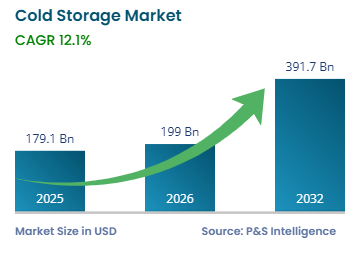
The global cold storage market size is estimated at USD 179.1 billion in 2025, which is predicted to reach USD 391.7 billion by 2032, growing at a CAGR of 12.1% during 2026–2032.
The market expansion is driven by rising demand for temperature-sensitive products, growing pharmaceutical logistics requirements, and rapid expansion of organized retail and e-commerce food delivery services worldwide.
The increasing consumption of perishable food products represents a major growth driver for the cold storage industry. According to the Food and Agriculture Organization, approximately one-third of food produced globally for human consumption is lost or wasted annually, amounting to about 1.3 billion tonnenes. Cold storage infrastructure plays a critical role in reducing post-harvest losses and extending the shelf life of perishable goods. The expansion of cold chain logistics has become essential as consumers increasingly demand fresh produce, dairy products, and frozen foods year-round, regardless of seasonal availability. The pharmaceutical sector has emerged as a significant demand driver, particularly following the global distribution requirements for temperature-sensitive vaccines and biologics.
Integration of Automation and Other Advanced Technologies Is a Key Trend
Automation reduces the need for manual work by using machines and software to perform repetitive tasks, which helps lower mistakes and speed up processes.
AI, IoT, and robots allow factories and businesses to work more efficiently and accurately.
With technology integrated into systems, companies can gather and monitor data in real-time, helping them make smarter and faster decisions.
Under the Agriculture Infrastructure Fund (AIF), the Indian government sanctioned INR 73,155 crore for around 1.27 lakh projects, including warehouses, cold storages, and other post-harvest facilities.
With a total investment of INR 1.17 lakh crore, the fund aims to strengthen rural infrastructure, reduce post-harvest losses, and promote modern, tech-enabled cold storage to improve market access for farmers.
Predictive maintenance means using data and sensors to predict when equipment might fail, so repairs can be made before breakdowns happen, avoiding costly downtime.
Automation allows companies to quickly adjust production to create customized products and respond faster to what customers want.
Technology helps track products and materials throughout the supply chain, improving inventory management and reducing delays.
Consistent use of technology ensures products are made with the same high quality every time.
The Indian government approved INR 208 crore in grants for 27 Integrated Cold Chain Projects across 11 states, leveraging a total investment of INR 743 crore.
These projects aim to build end-to-end cold chain infrastructure, including cold storage, transport, and processing, to reduce post-harvest losses and support value addition.
Automation and tech integration make it easier for businesses to grow and adapt as new technologies develop and market demands change.
Rising E-Commerce Grocery Sales Are Driving Market
More consumers are choosing to buy their groceries online, which means there is a higher need for efficient ways to deliver and package these products safely and quickly.
Online grocery shopping is seeing strong behavioral shifts worldwide.
Over 70% of consumers have tried buying groceries online, and regular users now place 1.9 to 2.3 orders monthly—up from around 1.2 previously.
Online baskets typically contain 30–40% more items than in-store purchases, driven by convenience and recommendation algorithms.
Shoppers save an average of 2–3 hours per week, and over 60% of orders now use same-day delivery or curbside pickup, highlighting a growing demand for speed and flexibility.
As e-commerce grows, grocery stores and suppliers invest in better supply chain systems and refrigerated storage to keep fresh food in good condition during delivery.
Shopping for groceries online is convenient, attracting more people to this method and driving up total sales in the market.
Under the PMKSY Cold Chain Scheme, Maharashtra received the highest grant of INR 431.62 crore to improve cold storage infrastructure, followed by Uttarakhand with INR 255.57 crore and Andhra Pradesh with INR 213.97 crore.
These funds aim to reduce post-harvest losses, enhance storage capacity, and help farmers preserve and market their perishable produce more effectively.
The increase in online grocery orders motivates companies to invest in advanced technology and logistics to handle the higher volume smoothly.
With more groceries being sold online, there’s room for creating new products designed specifically for easy and safe delivery.
Retailers are working to speed up the order processing and delivery times to keep customers satisfied with quick service.
The rise of online grocery sales leads to more competition among businesses and encourages new ways of operating, like subscription services or meal kits.
This trend also promotes the use of environmentally friendly packaging and efforts to reduce waste in the delivery process.
Cold Storage Market Segmentation Analysis
Component Insights
The facilities/services category accounts for the largest share in the cold storage market in 2025, of approximately 55%, and it is expected to maintain its dominant position throughout the forecast period. This dominance is primarily attributed to the extensive infrastructure requirements for storing large volumes of temperature-sensitive products and the growing demand for comprehensive cold chain logistics services. Refrigerated warehouses form the backbone of cold storage infrastructure, providing essential storage capacity for food distributors, pharmaceutical companies, and agricultural exporters across global supply chains.
The equipment category is projected to witness the faster growth during 2026–2032, driven by the modernization of existing facilities and construction of new automated cold storage complexes. The increasing adoption of advanced refrigeration systems with natural refrigerants, energy-efficient insulation panels, and automated material handling equipment is fueling category expansion. According to the U.S. Department of Energy (DoE), upgrading to high-efficiency refrigeration systems can reduce energy consumption in cold storage facilities by 25–40%, creating strong economic incentives for equipment investments.
Technological innovations in refrigeration equipment, including variable-speed compressors, intelligent defrost systems, and IoT-enabled monitoring devices, are enhancing operational efficiency and reducing maintenance costs. The shift toward modular cold storage construction, using prefabricated insulated panels, is accelerating deployment timelines and improving temperature consistency. Specialized equipment for ultra-low temperature storage is experiencing rapid demand growth to support pharmaceutical applications, particularly for mRNA vaccines and biologic therapeutics requiring storage below −70°C.
These components are covered:
Facilities/Services (Larger Category)
Refrigerated Warehouses
Cold Rooms
Equipment (Faster-Growing Category)
Refrigeration Systems
Insulation Panels
Doors and Loading Systems
Others
Warehouse Type Analysis
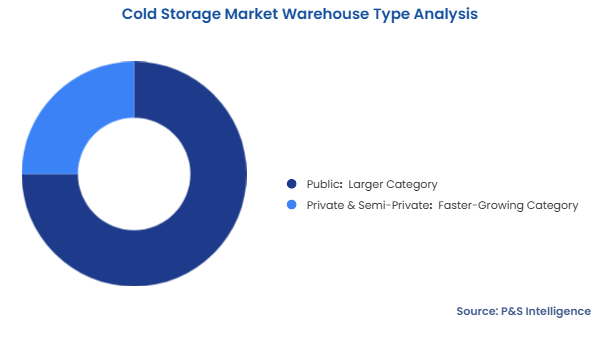
Public warehouses category accounts for the largest share in the cold storage market in 2025, of approximately 75%, reflecting the preference of businesses for flexible, cost-effective storage solutions without significant capital investment. Public warehouses operate as third-party logistics providers offering comprehensive services, including storage, handling, inventory management, and distribution for multiple clients simultaneously. This shared infrastructure model enables smaller food producers and pharmaceutical companies to access professional-grade cold storage facilities and leverage economies of scale that would be unaffordable through private ownership.
Public warehouses offer significant advantages, including flexibility to scale storage capacity based on seasonal demand fluctuations, geographic diversity without capital expenditure, and access to experienced logistics professionals. Major public cold storage operators are expanding their facility networks and investing in automation technologies to serve growing e-commerce and pharmaceutical logistics markets.
The private & semi-private category has the higher CAGR during the forecast period, driven by large corporations seeking greater control over their cold chain operations and customized facility designs. Companies in the pharmaceutical and premium food sectors are increasingly investing in dedicated cold storage infrastructure to ensure compliance with strict quality standards and protect proprietary products. The rise of contract logistics arrangements is blurring traditional boundaries between public and private models, with operators offering dedicated sections within multi-client facilities to provide customized services while maintaining cost efficiencies.
These warehouse types are covered:
Public (Larger Category)
Private & Semi-Private (Faster-Growing Category)
Temperature Range Analysis
The frozen category, maintaining temperatures between −25°C and −18°C, holds the largest market share, of approximately 60%, in 2025, and it is projected to sustain its dominance. This category serves the extensive global demand for frozen foods, including meat, seafood, vegetables, ice cream, and prepared meals, that require sub-zero temperatures to prevent bacterial growth and maintain product quality over extended storage periods. The frozen category benefits from established consumer preferences for convenient frozen food products and the logistical advantages of longer shelf life compared to fresh alternatives.
The deep-frozen category, operating below −25°C, is set to register the highest CAGR during 2026–2032, driven primarily by pharmaceutical applications and specialty food products. Ultra-low-temperature storage at −70°C or lower temperatures is critical for the distribution of mRNA vaccines, cell therapies, and biological samples, to maintain efficacy.
Production stores account for the largest share, of approximately 45%, in the cold storage market in 2025, reflecting their essential role in food processing and pharmaceutical manufacturing operations. These facilities are located at or near production sites to provide immediate temperature-controlled storage for raw materials, intermediate products, and finished goods during various production stages. Production stores enable manufacturers to optimize production schedules, manage seasonal variations in agricultural inputs, and ensure consistent product availability throughout the year, regardless of harvest cycles.
The ports category is projected to exhibit the fastest growth during the forecast period, driven by expanding international trade in perishable goods and the strategic importance of port-side cold storage infrastructure. Major port authorities worldwide are investing in cold storage facilities to capture value from growing imports and exports of frozen seafood, fresh fruits, and refrigerated pharmaceuticals.
India is making significant investments in port modernization, primarily through the Sagarmala programme, which includes 234 projects worth around INR 2.91 lakh crore. Of these, 104 projects (INR 32,653 crore) are completed, and 55 (INR 74,725 crore) are under implementation. Specifically, for major ports, 166 projects worth INR 68,281 crore are in progress, with 98 projects (INR 27,129 crore) already completed. Since FY22, projects worth INR 11,083 crore have been awarded, with INR 5,741 crore already spent, and the government aims to attract INR 50,000 crore more through public-private partnerships over the next five years.
The Blue Ports program aims to modernize fishing harbors—three pilot sites (Vanakbara, Karaikal, Jakhau) are being upgraded with cold storage and clean auctioning facilities at a cost of INR 369.8 crore. Additionally, under broader logistics and food infrastructure development, around 400 cold chain projects worth INR 11,700 crore are underway across India. These include support for farm-gate storage, refrigerated transport, and warehouse hubs, indirectly strengthening port connectivity.
These construction types are covered:
Production Stores (Largest Category)
Ports (Fastest-Growing Category)
Bulk Stores
Distribution Centers
Application Insights
The food & beverages application dominates the cold storage market in 2025 with approximately 40% share, driven by universal demand for perishable food products and the critical importance of cold chain infrastructure in preventing food spoilage and ensuring food safety. This category encompasses diverse product categories, including meat & seafood, dairy products, fruits & vegetables, processed foods, and frozen meals, each requiring specific temperature and humidity conditions to maintain quality. The food and beverages cold storage market benefits from strong regulatory frameworks mandating temperature-controlled handling of perishable foods from farm to consumer.
The pharmaceuticals category is expected to register the highest CAGR during 2026–2032, reflecting the rapid growth of temperature-sensitive drug pipelines and increasingly stringent cold chain requirements for pharmaceutical distribution. The expansion of precision medicine, cell and gene therapies, and personalized vaccines is driving demand for sophisticated cold storage facilities capable of maintaining ultra-low temperatures and providing comprehensive temperature documentation for regulatory compliance.
These applications are covered:
Food & Beverages (Largest Category)
Fruits & Vegetables
Fish, Meat & Seafood
Dairy Products
Processed Food
Bakery & Confectionery
Pharmaceuticals (Fastest-Growing Category)
Chemicals
Others
Drive strategic growth with comprehensive market analysis
Cold Storage Market Regional Outlook
North America Cold Storage Market Size
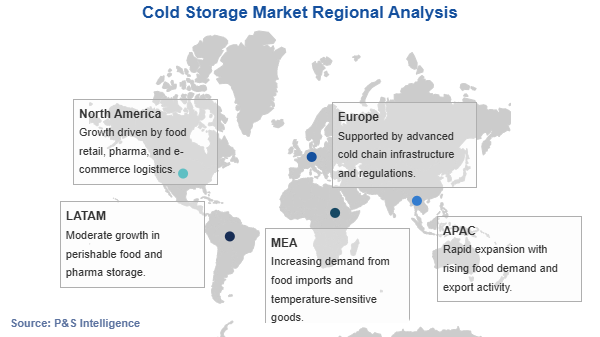
North America holds the largest share in the global cold storage market in 2025, of approximately 40%, supported by advanced logistics infrastructure, high per capita consumption of frozen and refrigerated foods, and a mature pharmaceutical industry requiring extensive cold chain capabilities. The region benefits from well-established regulatory frameworks governing food safety and pharmaceutical distribution, driving investments in quality cold storage infrastructure and monitoring systems.
The region's cold storage industry is characterized by high levels of automation and technological sophistication, with major operators deploying automated storage and retrieval systems, robotics, and advanced warehouse management platforms to enhance efficiency and reduce labor costs.
The growth of e-commerce grocery sales in North America is driving the expansion of cold storage networks in urban and suburban areas to support rapid delivery services. Major retailers and third-party logistics providers are investing in micro-fulfillment centers and last-mile cold storage facilities to meet consumer expectations for same-day or next-day delivery of fresh and frozen products. The pharmaceutical cold storage category is expanding rapidly, particularly for biologics and specialty medications, with stringent FDA requirements driving investments in validated storage facilities and qualified transportation equipment.
Asia-Pacific Cold Storage Market Growth
Asia-Pacific is projected to be the fastest-growing regional market, with a CAGR of approx. 12.5%, during 2026–2032, driven by rapid urbanization, rising middle-class populations, and increasing demand for perishable foods in emerging economies. The region faces significant food loss challenges due to inadequate cold chain infrastructure, creating substantial opportunities for cold storage development.
China Cold Storage Market Growth
China represents the largest country market in Asia-Pacific, with the government prioritizing cold chain logistics development as part of broader efforts to reduce food waste and improve food safety standards. China's cold storage market is experiencing rapid growth in both coastal regions serving import-export trade and interior provinces supporting domestic agricultural production and food processing industries.
Europe Cold Storage Market Share
Europe holds approximately 25% of the global cold storage market share in 2025, characterized by stringent food safety regulations, advanced logistics networks, and strong consumer preferences for fresh and organic foods. The European cold storage industry benefits from well-developed transportation infrastructure, including extensive rail networks and short-sea shipping connections, facilitating the efficient distribution of perishable goods across the continent. The European Union's focus on sustainability and environmental protection is driving the adoption of natural refrigerants and energy-efficient technologies in cold storage facilities.
The regions and countries analyzed in this report are:
North America (Largest Regional Market)
U.S. (Larger Country Market)
Canada (Faster-Growing Country Market)
Europe
Germany (Largest Country Market)
U.K. (Fastest-Growing Country Market)
France
Italy
Spain
Rest of Europe
Asia-Pacific (Fastest-Growing Regional Market)
Japan
China (Largest Country Market)
India (Fastest-Growing Country Market)
South Korea
Australia
Rest of APAC
Latin America
Brazil (Largest Country Market)
Mexico (Fastest-Growing Country Market)
Rest of LATAM
Middle East and Africa
Saudi Arabia (Largest Country Market)
South Africa
U.A.E. (Fastest-Growing Country Market)
Rest of MEA
Cold Storage Market Share
The global cold storage market exhibits a fragmented competitive landscape characterized by the presence of numerous regional and global players operating across different segments and geographies. The market includes large multinational cold storage operators managing extensive facility networks, regional specialists serving specific markets or product categories, and niche providers focusing on specialized applications such as pharmaceutical cold storage or ultra-low temperature facilities. Competition is based on factors, including geographic coverage, facility quality and certifications, technology capabilities, service offerings, and pricing structures.
This fragmentation reflects the capital-intensive nature of cold storage infrastructure, regional variations in food consumption patterns and regulatory requirements, and the importance of proximity to customers and transportation networks. Leading global operators are pursuing consolidation strategies through acquisitions of regional cold storage companies to expand geographic footprints and achieve economies of scale in operations and procurement.
Key Cold Storage Companies:
Americold Logistics LLC
Lineage Logistics Holding LLC
United States Cold Storage, Inc.
AGRO Merchants Group
Kloosterboer Group B.V.
Nichirei Logistics Group Inc.
VersaCold Logistics Services
Burris Logistics
Henningsen Cold Storage Co.
Congebec Logistics Inc.
Frialsa Frigorificos S.A. de C.V.
Snowman Logistics Ltd
Interstate Warehousing, Inc.
FreezPak Logistics
Barloworld Limited
Cold Storage Market News
In August 2025, Americold Realty Trust announced the opening of a new import‑export hub in Kansas City, Missouri, in partnership with Canadian Pacific Kansas City (CPKC). This facility includes on‑site USDA inspections (to reduce border delays), capacity for containers above 50,000 lbs, and serves a ~300‑mile radius regionally as a consolidation hub.
In July 2025, NewCold Advanced Cold Logistics acquired Wilhelm Schüssler Spedition GmbH, a German cold storage and logistics provider. The move strengthened NewCold's presence in the European market and expanding its automated cold storage network to serve growing e-commerce and retail customers.
In June 2024, Nichirei Corporation opened a new cold storage facility in Vietnam. This facility expands their capabilities in Southeast Asia and supports the company's strategy to meet increasing demand in the region.
Want a report tailored exactly to your business need?
Leading companies across industries trust us to deliver data-driven insights and innovative solutions for their most critical decisions. From data-driven strategies to actionable insights, we empower the decision-makers who shape industries and define the future. From Fortune 500 companies to innovative startups, we are proud to partner with organisations that drive progress in their industries.
Client Testimonials
Working with P&S Intelligence and their team was an absolute pleasure – their awareness of timelines and commitment to value greatly contributed to our project's success. Eagerly anticipating future collaborations.
McKinsey & Company
India
Unmatched Standards
Our insights into the minutest levels of the markets, including the latest trends and competitive landscape, give you all the answers you need to take your business to new heights
Complete Data Security
We take a cautious approach to protecting your personal and confidential information. Trust is the strongest bond that connects us and our clients, and trust we build by complying with all international and domestic data protection and privacy laws