This Report Provides In-Depth Analysis of the Dimethyl Carbonate Market Report Prepared by P&S Intelligence, Segmented by Grade (Industrial Grade, Pharmaceutical Grade, Battery Grade), Production Method (Oxidative Carbonylation of Methanol, Oxidative Carbonylation of Methanol via Methyl Nitrate, Ethylene Carbonate Transesterification, Methanol Phosgenation, Urea Transesterification, Direct Synthesis from CO?), Application (Polycarbonate Synthesis, Battery Electrolyte, Solvents, Reagents), Industry (Plastics, Paints & Coatings, Pharmaceuticals, Batteries, Agrochemicals), and Geographical Outlook for the Period of 2021 to 2032
Explore the market potential with our data-driven report
Dimethyl Carbonate Market Key Insights
The industrial grade commanded the largest share, of 60%.
Ethylene carbonate transesterification is forecast to have the highest growth rate of approximately 8.7%.
Polycarbonate synthesis held the largest share, of 45%.
Batteries have the strongest CAGR during 2026–2032, of approximately 8.3%,
Asia-Pacific is both the largest and fastest-growing region with 40% share and approximately 9.0% CAGR.
Dimethyl Carbonate Market Future Outlook
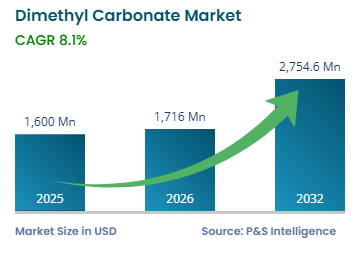
The global dimethyl carbonate (DMC) market value was USD 1,600.0 million in 2025, and it is anticipated to expand at a CAGR of 8.1% during 2026–2032, reaching USD 2,754.6 million by 2032. This growth is driven by the accelerating demand for battery-grade DMC in lithium-ion electrolyte formulations, expanding adoption as a low-toxicity green/bio-solvents alternative across paints, coatings, and adhesives, and the deepening role of DMC as a non-phosgene intermediate in polycarbonate synthesis. The process offers superior environmental compliance over conventional phosgene-based routes, which are subject to stringent global hazardous chemical regulations.
DMC’s versatility, biodegradability, minimal volatile organic compound (VOC) emissions, and low toxicity profile make it a preferred replacement for dimethyl sulfate, methyl halides, and phosgene across pharmaceutical synthesis, agrochemical manufacturing, and specialty chemical production. The International Energy Agency (IEA) reported that global electric car sales surpassed 17 million units in 2024. This shows a burgeoning demand for high-purity battery-grade DMC as an electrolyte in lithium-ion batteries.
Dimethyl Carbonate Market Trends and Drivers
Shift to CO₂-Based and Non-Phosgene Synthesis Routes Is Major Trend
DMC producers are moving away from methanol phosgenation—a hazardous, phosgene-dependent process toward cleaner synthesis routes, including oxidative carbonylation, ethylene carbonate transesterification, and direct CO₂ utilization processes. This transition is improving production safety, reducing carbon footprints, and lowering the cost of high-purity battery-grade DMC. The Asahi Kasei CO₂-based transesterification process uses CO₂ as a raw material input while achieving battery-grade product specifications. As it aligns DMC production with industrial decarbonization objectives, it is being deployed at commercial scale in China through licensing agreements with producers including Jiangsu Sailboat Petrochemical.
The Intergovernmental Panel on Climate Change (IPCC) identifies industrial CCUS technologies as important for reducing emissions from hard-to-abate industrial processes, with CO₂-to-chemicals routes representing a practical pathway for carbon utilization. As CO₂-based DMC synthesis capacity scales across Asia-Pacific, it will progressively compress production costs and expand supply availability. This will enable DMC to penetrate additional application markets where price competitiveness against conventional solvents has historically constrained adoption.
Rising Battery Manufacturing for EVs and Grid-Scale Energy Storage Drives Market
The rapid global scaling of EV production represents the most-powerful demand driver for dimethyl carbonate as an essential electrolyte in lithium-ion batteries. DMC possesses high dielectric constant, low viscosity, and chemical stability across charging cycles. As EV manufacturers scale gigafactory output across China, Europe, and North America, battery materials supply chains are deepening. This is, in turn, creating long-term demand for battery-grade DMC at purities exceeding 99.9% by weight. The IEA reports that global EV sales are projected to exceed 40% of all new car sales by 2030.
According to IEA, approximately 42 GW of new battery storage was added worldwide in 2023, bringing the cumulative installed capacity to over 85 GW. The U.S. Energy Information Administration (EIA) reports that utility‑scale battery storage capacity in the USA exceeded 26 GW by the end of 2024, with about 10.4 GW added in 2024. Moreover, developers reported 19.6 GW of planned utility‑scale additions for 2025. The U.S. Department of Energy (DOE) has announced USD 15 million for storage resilience projects and USD 28.7 million through the Grid Resilience and Innovation Partnerships program, along with substantial funding for battery manufacturing and recycling infrastructure, which strengthens supply chains for lithium‑ion technology.
Contracts for 10 GWh of contracted battery capacity addition have been awarded in Italy and 9.7 GWh of storage projects have been funded in Bulgaria. In November 2025, regulatory approval was granted for 55.5 MW of grid‑scale battery systems in Delhi to support local grid reliability. Because most of these projects will install lithium‑ion batteries, the demand for DMC as a core electrolyte will rise to enable lithium salt dissolution and ion transport.
Expanding Pharmaceutical and Agrochemical Sectors Offer Opportunities
The rapidly rising pharmaceutical and agrochemical production in Asia and Latin America is creating substantial incremental demand pathways for pharmaceutical-grade and industrial-grade DMC. India’s pharmaceutical sector is replacing dimethyl sulfate with DMC in active pharmaceutical ingredient (API) synthesis, driven by both regulatory compliance requirements and process safety improvements. The World Health Organization (WHO) projects that global pharmaceutical consumption will grow by 5–6% annually through 2030, with emerging market production accounting for a disproportionate share of volume growth.
As per the India Brand Equity Foundation, India’s pharmaceutical production is ranked third in the world by volume, and it is projected to grow at a CAGR of over 10%, reaching a market size of USD 130 billion by 2030. In FY25, the total turnover of the Indian pharmaceutical industry was around INR 2,25,000 crore (USD 26.26 billion), while domestic consumption in FY24 was approximately INR 2,01,372 crore (USD 23.5 billion). India supplies about 20% of the global demand for generic medicines and 55–60% of certain vaccines procured by international agencies. Pharmaceutical exports from India reached USD 27.8 billion in FY24, with drug formulations and biologicals accounting for 79% of the total export value, followed by drug intermediates and bulk drugs.
DMC’s role as a methoxycarbonylation and methylation agent in agrochemical intermediate synthesis is expanding with the increasing herbicide and pesticide production in major agricultural economies. In 2023, global pesticide use in agriculture reached about 3.73 million tonnes of active ingredients, more than double since 1990, applied at around 2.40 kg per hectare worldwide.
China used over 1.7 million tonnes, reflecting intensive cropping and large farmland areas. The rising agrochemical consumption is driven by the growing population, which is expected to reach 8.5 billion by 2030, as per UNESO. Thus, the OECD-FAO Agricultural Outlook expects the global demand for agricultural commodities to grow at an average of 1.2% per year between 2025 and 2034.
DMC is used in the manufacture of herbicides, insecticides, and fungicides as a reactive intermediate for methylation and carbonylation reactions and, in some cases, as a solvent during formulation. It offers low toxicity, biodegradability, and a greener profile compared to traditional methylating agents. In 2024, the global agrochemicals market was valued at about USD 236.9 billion and is projected to reach around USD 322.9 billion by 2032, growing at a compound annual growth rate (CAGR) of approximately 4.1% over the forecast period.
Dimethyl Carbonate Market Segmentation Analysis
Grade Analysis
The industrial grade (>99.0% by weight) commanded the largest share of the global DMC market in 2025, of 60%, due to its extensive application as a low-toxicity solvent in paints and coatings, adhesives, and sealants. To this effect, industrial-grade DMC serves as a direct substitute for hazardous solvents in manufacturing operations across automotive, construction, and electronics sectors. Here, its biodegradability and favorable VOC emission profile satisfy the tightening environmental compliance requirements without requiring the purer and expensive battery and pharmaceutical grades. The U.S. EPA classifies numerous conventional industrial solvents as hazardous air pollutants under the Clean Air Act, directly driving the demand for DMC and other compliant industrial-grade alternatives.
The battery grade (>99.9% by weight) is projected to register the fastest growth during 2026–2032, of approximately 8.5%, due to the growing lithium-ion battery electrolyte manufacturing. This is itself owing to the burgeoning EV production scales across Asia-Pacific, Europe, and North America. Battery-grade DMC must have moisture content below 20 ppm and metal impurities in the low ppb range to prevent electrolyte degradation and ensure cycle stability in high-performance battery cells. The IEA projects that the global EV battery demand will reach approximately 3,500 GWh annually by 2030, driving the consumption of battery-grade DMC.
The market segments into the following grades:
Industrial Grade (>99.0% by Weight) (Largest Category)
Pharmaceutical Grade (>99.5% by Weight)
Battery Grade (>99.9% by Weight) (Fastest-Growing Category)
Production Method Analysis
The oxidative carbonylation of methanol (ENI Process) held the largest share in the global DMC market in 2025. This is owing to its established commercial scale, lower capital requirements compared to transesterification routes, and widespread deployment in China and Europe. The ENI process reacts methanol with carbon monoxide and oxygen over a copper-based catalyst to yield DMC directly, offering competitive economics for industrial-grade output at large scale. Its long usage history has generated extensive operator expertise and catalyst supply infrastructure, making it the default method for established producers seeking high-volume, low-cost output for industrial and solvent applications.
The ethylene carbonate transesterification (Asahi Process) is forecast to have the highest growth rate during 2026–2032, of approximately 8.7%. This is owing to its ability to produce >99.9% pure battery-grade DMC with monoethylene glycol as a co-product. This improves the overall process economics, while meeting the stringent specification requirements of lithium-ion electrolyte customers. The Asahi process is also associated with carbonate production pathways that incorporate CO₂-derived intermediates, aligning production with industrial decarbonization strategies and circular carbon utilization initiatives. The IPCC identifies CO₂ utilization in chemical synthesis as a commercially viable carbon management pathway. The global CCUS market value will rise from USD 5.1 billion in 2024 to USD 18.0 billion by 2030.
The market segments into the following production methods:
Oxidative Carbonylation of Methanol (ENI Process) (Largest Category)
Oxidative Carbonylation of Methanol via Methyl Nitrate (UBE Process)
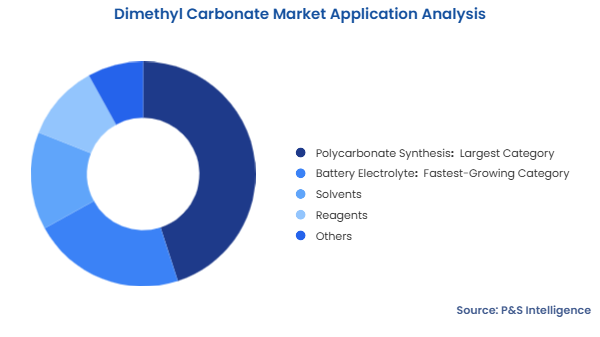
Polycarbonate synthesis held the largest share in the global DMC market in 2025, of 45%. This was due to the sustained demand for high-performance engineering plastics in automotive lightweighting, electronics enclosures, optical media, and medical device components. DMC serves as a non-phosgene carbonylation agent in the transesterification route to polycarbonate production, replacing the highly toxic phosgene-based process, which faces severe restrictions globally. The polycarbonate industry’s expansion in China, South Korea, and Japan results in high-volume DMC consumption.
Battery electrolyte is anticipated to demonstrate the highest CAGR during 2026–2032, driven by the rising lithium-ion battery manufacturing in China, the European Union, and the United States. As a co-solvent in standard LiPF₆ electrolyte formulations, the low viscosity improves ionic conductivity and enhances ion transport, contributing to improved cycle performance. In such applications, it is typically blended with ethylene carbonate and ethyl methyl carbonate.
The market segments into the following applications:
Polycarbonate Synthesis (Largest Category)
Battery Electrolyte (Fastest-Growing Category)
Solvents
Reagents
Others
Industry Analysis
Plastics captured the largest share in the global DMC market in 2025, due to the high-volume consumption of DMC in the production of polycarbonate across Asia-Pacific, Europe, and North America. Polycarbonate’s high impact resistance, optical clarity, thermal stability, and low weight drive its deployment in automotive glazing and interior components, consumer electronics casings, medical devices, and construction glazing. Such wide applications sustain a high demand for DMC as a polycarbonate synthesis intermediate.
Batteries have the strongest CAGR during 2026–2032, of approximately 8.3%, propelled by the growing EV, stationary grid storage, and consumer electronics sectors, generating high DMC demand for battery electrolyte. Battery manufacturers in China, South Korea, and Japan procure high volumes of battery-grade DMC for their gigafactories directly from integrated chemical producers.
The market segments into the following industries:
Plastics (Largest Category)
Paints & Coatings
Pharmaceuticals
Batteries (Fastest-Growing Category)
Agrochemicals
Others
Drive strategic growth with comprehensive market analysis
Dimethyl Carbonate Market Geographical Analysis
Asia-Pacific Dimethyl Carbonate Market Dynamics
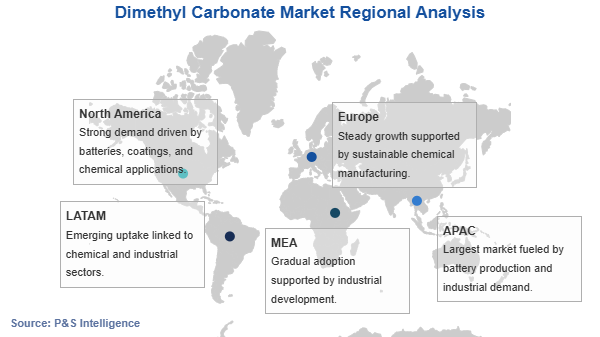
Asia-Pacific is both the largest and fastest-growing region in the global DMC market, holding 40% share in 2025 and projected to have a CAGR of approximately 9.0% during 2026–2032. This dominance is anchored in the high-volume DMC production and consumption in China. Additionally, South Korea’s advanced battery material and polycarbonate manufacturing ecosystems, while Japan’s precision chemical and battery technology sectors also contribute to APAC’s market dominance. The market is also driven by India’s rapidly expanding pharmaceutical and agrochemical industries and Australia’s growing critical minerals and energy storage sectors.
The region benefits from deeply integrated value chains connecting DMC production facilities directly to downstream polycarbonate plants, lithium-ion battery manufacturers, and electronics assembly operations at scale unavailable in any other region. As per the IEA, China accounted for approximately 60% of global EV sales in 2023, thus witnessing a massive battery-grade DMC demand for Li-ion battery electrolyte.
China Dimethyl Carbonate Market Growth
China is the largest country market globally, as Chinese producers use advanced CO₂-based and ethylene carbonate transesterification synthesis technologies at scale, offering a cost-competitive DMC supply worldwide. Domestic demand is driven by the high-volume polycarbonate production for electronics and automobiles, battery electrolyte supply for EV and grid energy storage systems, and agrochemical and pharmaceutical intermediate synthesis. Government industrial policy under Made in China 2025 and the New Energy Vehicle development roadmap continues reinforcing DMC’s strategic upstream importance across the national chemical and energy transition agendas. China’s Ministry of Industry and Information Technology (MIIT) reported that China’s new energy vehicle production reached 9.58 million units in 2023, directly establishing battery-grade DMC as a critical electrolyte chemical within China’s dominant EV supply chain.
Moreover, according to the National Medical Products Administration, China approved 76 innovative drugs for market launch in 2025, compared to 48 in 2024, reflecting the country’s accelerating pharmaceutical innovation ecosystem. DMC is used in pharmaceutical and agrochemical production as a reactive intermediate for methylation and carbonylation reactions. It also serves as a solvent in formulations, offering low toxicity, biodegradability, and a greener alternative to traditional methylating agents, enabling safer and more sustainable chemical manufacturing processes.
India Dimethyl Carbonate Market Prospects
India is the fastest-growing country market within Asia-Pacific, driven by its expanding pharmaceutical, agrochemical, and EV battery assembly activity sectors. The intensifying regulatory pressure to replace hazardous solvents with compliant green alternatives also augments the demand for dimethyl carbonate. Indian pharmaceutical manufacturers are increasingly dimethyl sulfate and other restricted methylating agents with DMC in API synthesis, as the latter is a safer reagent and solvent. The Production Linked Incentive (PLI) schemes for pharmaceuticals and advanced chemistry cell battery manufacturing propel the consumption of DMC across verticals. As per government sources, India’s pharmaceutical sector targets to reach USD 130 billion in output by 2030.
The regions and countries analyzed in this report include:
North America
U.S. (Largest Country Market)
Canada (Fastest-Growing Country Market)
Europe
Germany (Largest Country Market)
U.K.
France (Fastest-Growing Country Market)
Italy
Spain
Rest of Europe
Asia-Pacific (Largest and Fastest-Growing Region)
China (Largest Country Market)
Japan
South Korea
India (Fastest-Growing Country Market)
Australia
Rest of APAC
Latin America
Brazil (Largest Country Market)
Mexico (Fastest-Growing Country Market)
Rest of LATAM
Middle East & Africa
U.A.E. (Largest Country Market)
Saudi Arabia
South Africa (Fastest-Growing Country Market)
Rest of MEA
Dimethyl Carbonate Market Share Analysis
The global dimethyl carbonate market is fragmented, characterized by a large number of producers operating across different geographies, grades, and applications, without any single player commanding a dominant market share. This fragmentation stems from the maturity of industrial-grade DMC production technology and concentration of capacity in China, where state-owned enterprises and private chemical manufacturers have built large-scale output at competitive cost positions. The diversity of applications—from commodity solvent uses to high-purity battery electrolyte specifications—enable specializations to target distinct market niches.
Barriers to entry vary significantly by grade. Industrial-grade production is accessible to well-capitalized regional players, while battery-grade DMC requires precision synthesis technology, rigorous purity control, and established qualification relationships with EV battery manufacturers. This creates differentiation between commodity-oriented and specialty-oriented competitors.
Key Players in the Dimethyl Carbonate Market:
UBE Corporation
LOTTE Chemical Corporation
Shandong Hualu Hengsheng Group Co. Ltd.
Shinghwa Advanced Material Group Co. Ltd.
BASF SE
Merck KGaA
Mitsubishi Chemical Corporation
Saudi Basic Industries Corporation (SABIC)
Asahi Kasei Corporation
Kuraray Co. Ltd.
Tokyo Chemical Industry Co. Ltd.
Shandong Haike Chemical Industry Group Co. Ltd.
Shandong Depu Chemical Industry Science & Technology Co. Ltd.
Hi-Tech Spring Co. Ltd.
Shandong Shida Shenghua Chemical Group Co. Ltd.
Tongling Jintai Chemical Co. Ltd.
Thermo Fisher Scientific Inc.
Mitsui Fine Chemicals Inc.
The Dow Chemical Company
Huntsman Corporation
DuPont de Nemours Inc.
Dimethyl Carbonate Market News
In December 2025, Mitsubishi Chemical Corporation agreed to transfer its lithium-ion battery electrolyte manufacturing assets operated by Mitsubishi Chemical America, Inc. (Memphis, Tennessee) and Mitsubishi Chemical UK Ltd. (Billingham, United Kingdom) to Green E Origin SARL (GEO) of Luxembourg, with the transfer scheduled for completion on March 31, 2026.
In June 2025, the Japan Bank for International Cooperation (JBIC), co-financing with MUFG Bank, Mizuho Bank, and The Norinchukin Bank, signed a loan agreement of USD 400 million to finance the construction of the dimethyl carbonate and ethyl methyl carbonate facility of UBE C1 Chemicals America Inc. in Waggaman, Louisiana.
In February 2025, UBE Corporation held a groundbreaking ceremony for its USD 500-million DMC and EMC manufacturing plant at Cornerstone Energy Park in Waggaman, Louisiana. The facility is designed to produce 100,000 metric tonnes of DMC and 40,000 metric tonnes of EMC annually, using UBE’s proprietary gas-phase nitrite process, with operations expected to begin in November 2026.
In November 2024, Jiangsu Sailboat Petrochemical commenced commercial operations at a new carbonates plant in Lianyungang, Jiangsu Province, China. The facility uses process technology licensed from Asahi Kasei Corporation to produce 70,000 metric tonnes of high-purity DMC and 38,000 metric tonnes of ethylene carbonate annually, with the capacity to use 54,000 metric tonnes of CO₂ per year as feedstock.
Frequently Asked Questions About This Report
What will be the dimethyl carbonate market 2032 size?+
In 2032, the market for dimethyl carbonate will value USD 2,754.6 million.
Which grade is the most popular in the dimethyl carbonate industry?+
The industrial grade dominates the dimethyl carbonate industry with 60% revenue.
Which is the most-productive region in the dimethyl carbonate market?+
APAC is the largest market for dimethyl carbonate, with 40% share.
What are the key dimethyl carbonate industry drivers?+
The dimethyl carbonate industry is driven by booming demand for DMC for Li-ion battery electrolyte, expanding adoption in paints, coatings, adhesives, and polycarbonate, and efforts for environmental sustainability.
What is the dimethyl carbonate market nature?+
The market for dimethyl carbonate is fragmented.
Want a report tailored exactly to your business need?
Leading companies across industries trust us to deliver data-driven insights and innovative solutions for their most critical decisions. From data-driven strategies to actionable insights, we empower the decision-makers who shape industries and define the future. From Fortune 500 companies to innovative startups, we are proud to partner with organisations that drive progress in their industries.
Client Testimonials
Working with P&S Intelligence and their team was an absolute pleasure – their awareness of timelines and commitment to value greatly contributed to our project's success. Eagerly anticipating future collaborations.
McKinsey & Company
India
Unmatched Standards
Our insights into the minutest levels of the markets, including the latest trends and competitive landscape, give you all the answers you need to take your business to new heights
Complete Data Security
We take a cautious approach to protecting your personal and confidential information. Trust is the strongest bond that connects us and our clients, and trust we build by complying with all international and domestic data protection and privacy laws