This Report Provides In-Depth Analysis of the Ethylene Carbonate Market Report Prepared by P&S Intelligence, Segmented by Form (Solid, Liquid), Application (Lithium Battery Electrolyte, Lubricants, Surface Coatings, Plasticizers), End Use (Automotive, Industrial, Oil & Gas, Medical, Personal Care & Hygiene), and Geographical Outlook for the Period of 2021 to 2032
Explore the market potential with our data-driven report
Ethylene Carbonate Market Future Prospects
Ethylene Carbonate Market Key Insights
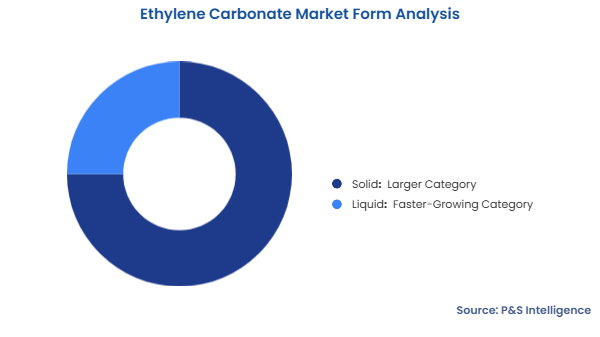
The solid form accounted for the largest revenue share in 2025, of 75%, due to its numerous physical and logistical advantages.
The liquid form is expected to register the fastest growth during 2026–2032, of approximately 10.4%.
Lithium battery electrolyte held the largest share in 2025, of 45%, and it also has the highest CAGR, of approximately 10.8%.
The automotive category commanded the largest revenue share in 2025, of 35%, and it is projected to register the fastest growth through 2032, at approximately 10.5% CAGR.
Asia-Pacific is the largest and fastest-growing regional market, with 40% share and approximately 11.0% CAGR.
Ethylene Carbonate Market Analysis
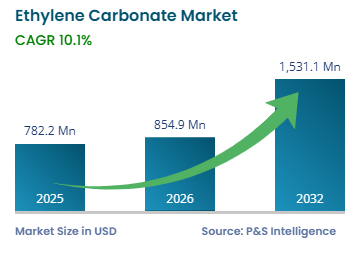
The global ethylene carbonate market valued USD 782.2 million in 2025, and it is projected to reach approximately USD 1,531.1 million by 2032, registering a compound annual growth rate of 10.1% during the forecast period of 2026–2032. The market is driven by the global energy transition and the electrification of transportation. This is because ethylene carbonate is critical for advanced battery chemistry, high-performance industrial lubrication and specialty polymer synthesis.
The primary growth engine for ethylene carbonate is its irreplaceable role as a co-solvent and solid electrolyte interphase (SEI) formation agent in lithium-ion battery electrolytes. Its exceptionally high dielectric constant (approximately 89.6 at 40°C) enables superior solvation of lithium salts. Moreover, the thin, stable SEI film it forms on graphite anodes is critical for enabling high-voltage nickel-rich cathode chemistries used in modern long-range electric vehicle battery packs, such as NCA and NCM.
Ethylene carbonate also functions as a viscosity modifier and anti-wear agent in industrial and automotive lubricants. The global lubricants market was valued at USD 143.2 billion in 2024 and it is projected to grow at a compound annual growth rate of 3.8% from 2025 to 2032, ultimately reaching USD 190.7 billion by 2032. It is also used in surface coatings, plasticizers and pharmaceutical intermediates, which propels the market.
Ethylene Carbonate Market Trends and Drivers
Battery-Grade Purity Standards and Upstream Integration Are Key Trends
A defining trend in the global ethylene carbonate supply chain is the bifurcation of the market into a high-value battery grade and a commodity/industrial grade. Lithium-ion battery manufacturers are scaling the production of high-voltage nickel-rich cathode chemistries requiring cell voltages above 4.4 V. The acceptable ethylene carbonate purity specification has tightened from the legacy 99.0% technical-grade standard to the 99.7%+ battery-grade quality.
This grade mandates moisture content below 20 ppm, metallic impurities in the parts-per-billion range and colour transparency indicating the absence of reactive degradation products. This is crucial because sub-quality ethylene carbonate can cause SEI layer inhomogeneity, accelerated capacity fade and safety incidents in densely packed battery modules. This makes qualification protocols an effective gating mechanism among major battery cell manufacturers for supply chain access.
Meeting these battery-grade specifications requires crystallization polishing, ion-exchange purification and dedicated packaging in moisture-controlled environments. This concentrates capital investments among producers with sufficient scale and technical capability. IEA reports that global battery manufacturing capacity reached 3 TWh in 2024 and that it will triple within five years, signalling that procurement of the battery grade will scale dramatically. Simultaneously, novel CO₂-based synthesis routes are introducing lower-carbon-footprint supply, which satisfies the European OEM supplier qualification criteria emphasising Scope 3 emission reduction.
Accelerating Global EV Adoption Drives Market
The most-powerful demand driver for ethylene carbonate is the accelerating global transition to electric mobility. The IEA’s Global EV Outlook 2025 report confirms that electric car sales exceeded 17 million units in 2024, surpassing 20% of total new car sales globally. China accounted for 11 million units, Europe 3 million and North America 1.7 million. Q1 2025 sales registered a 35% year-on-year growth, and full-year 2025 sales are projected to exceed 20 million units.
Government mandates drive OEM commitments to electrification timelines, which cascade into gigafactory construction and multi-year battery material supply agreements. For instance, the EU’s Regulation (EU) 2023/851 mandates a 100% CO₂ emission reduction for all new passenger cars and vans by 2035. Moreover, the U.S. Inflation Reduction Act has allocated USD 369 billion for clean energy and EV incentives. China's 14th Five-Year Plan has established NEV production targets, while India has launched PLI scheme for Advanced Chemistry Cell battery manufacturing.
Feedstock Volatility and Substitution Risk Constraining Margin Stability
The primary restraints for the ethylene carbonate market are feedstock price volatility and competition from alternative carbonates in non-battery applications. Ethylene oxide—the direct precursor for ethylene carbonate synthesis—is priced as a derivative of ethylene. This involves tracking naphtha and natural gas feedstock costs, global cracker operating rates and regional supply-demand balances. During periods of elevated crude oil or natural gas prices, non-integrated producers face significant input cost inflation, with a limited ability to pass through increases under long-term battery-grade supply contracts. The IEA's Global EV Outlook 2025 highlights that lithium mineral prices dropped by nearly 20% in 2024 from 2015, despite demand being six times higher.
In lubricant, surface coating and solvent applications, ethylene carbonate is easily substituted by dimethyl carbonate and propylene carbonate, both of which offer comparable performance at competitive prices. Propylene carbonate’s lower freezing point offers advantages in cold climates, along with an equivalent polymer solvent performance in several coating and plasticizer formulations.
Ethylene carbonate's diverse industrial applications create multiple incremental demand pathways, which broadens the addressable market. In premium lubricant formulations, such as industrial compressor oils, wind turbine gearbox lubricants and automotive drivetrain formulations, ethylene carbonate functions as a viscosity modifier and anti-wear agent. In such applications, its thermal stability and polar solvent characteristics deliver significant performance advantages. Moreover, the chemical’s low toxicity and biodegradability make it a preferred solvent carrier in controlled-release drug delivery matrices, where regulatory pressure is discouraging the use of more-toxic cyclic carbonates.
Ethylene carbonate serves as a reactive diluent in two-component polyurethane and epoxy surface coatings for automotive body panels. Here, its low viscosity and compatibility with waterborne coating systems align with VOC emission reduction requirements. According to the OICA, global motor vehicle production in 2024 was about 92.5 million vehicles, including 67.7 million passenger cars and 24.8 million commercial vehicles. In this regard, the market will grow with the expanding manufacturing sector across industries in India, Indonesia, Saudi Arabia and the UAE.
Ethylene Carbonate Market Segmentation Analysis
Form Analysis
The solid form accounted for the largest revenue share in 2025, of 75%, due to its numerous physical and logistical advantages. Its lower susceptibility to degradation, evaporation and leakage of solid ethylene carbonate make it preferred for ambient-temperature storage and long-distance transportation in bulk quantities. These advantages are particularly critical for the lubricant additives used by the industrial, oil & gas and automotive aftermarket sectors. Moreover, its compatibility with dissolution-based electrolyte synthesis protocols allows battery producers to calibrate purity and concentration with precision. The category is also driven by the high-volume consumption of the solid form as an electrolyte of Li-ion batteries.
The liquid form is expected to register the fastest growth during 2026–2032, of approximately 10.4%, driven by its advantages in the continuous-flow electrolyte manufacturing processes deployed at high-throughput gigafactories. Liquid ethylene carbonate enables direct in-line dosing, improved mixing homogeneity and faster processing cycles without the dissolution step required for solid-form inputs. This reduces preparation time and minimises contamination risk at the industrial scale.
The market segments into the following forms:
Solid (Larger Category)
Liquid (Faster-Growing Category)
Application Analysis
Lithium battery electrolyte held the largest share in 2025, of 45%, and it also has the highest CAGR, because ethylene carbonate's high dielectric constant (approximately 89.6 at 40°C) facilitates superior lithium-ion solvation. Moreover, its SEI formation capability on graphite anodes is a prerequisite for the high-voltage nickel-rich cathode chemistries (NCA, NCM) used in long-range EV battery packs. No commercial-scale substitute has replicated this electrochemical function at equivalent cost and reliability.
In 2024, the global market for hybrid and electric vehicle batteries was valued at USD 65.4 billion. It is projected to grow at a CAGR of 21.2% from 2025 to 2032, ultimately reaching USD 301.5 billion by the year 2032. Ultra-high-purity requirements (99.7%+) command significant pricing premiums over the industrial grades. Solid-state EV battery commercialisation is not predicted before 2030, ensuring the continued dominance of liquid electrolyte demand through the forecast period. Growth in stationary energy storage and grid-scale battery deployments also propels demand.
The market segments into the following applications:
Lithium Battery Electrolyte (Largest and Fastest-Growing Category)
Lubricants
Surface Coatings
Plasticizers
Others
End Use Analysis
The automotive category commanded the largest revenue share in 2025, and it is projected to register the fastest growth through 2032, at approximately 10.5% CAGR. This is due to the rising ethylene carbonate consumption in EV lithium-ion battery electrolytes and sustained demand in automotive surface coatings, lubricants and polymer-based vehicle components. The shift to electric mobility has expanded ethylene carbonate's role in the automotive value chain. Per-vehicle demand is significantly higher for BEVs than for ICE vehicles, given the quantities of electrolyte required per battery pack.
The European Commission’s Regulation (EU) 2023/851 mandates a 100% reduction in tailpipe CO₂ emissions for all new passenger cars and vans by 2035 compared to 2021 levels. This impels European automakers to accelerate electrification investments and reinforces ethylene carbonate procurement volumes across OEM supply chains. China's 14th Five-Year Plan targets and India's FAME II and PLI schemes, similarly, drive EV production. Beyond EV batteries, automotive-grade surface coatings and high-performance lubricants for EV drivetrains are incrementally expanding ethylene carbonate's addressable volume per vehicle. Here, thermal management requirements are more demanding than in ICE vehicles.
The market segments into the following end uses:
Automotive (Largest and Fastest-Growing Category)
Industrial
Oil & Gas
Medical
Personal Care & Hygiene
Others
Drive strategic growth with comprehensive market analysis
Ethylene Carbonate Market Geographical Analysis
Asia-Pacific Ethylene Carbonate Market Outlook
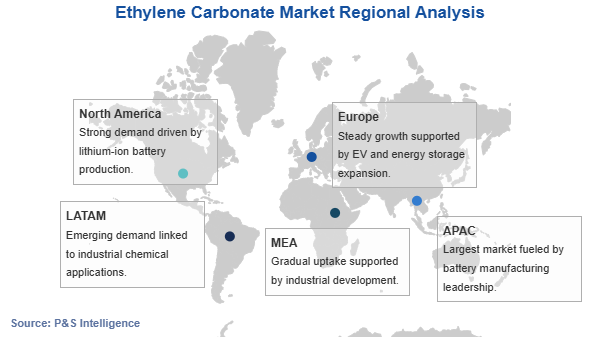
Asia-Pacific is the largest and fastest-growing regional market, with 40% share and approximately 11.0% CAGR, respectively, due to the region's deeply integrated petrochemical-to-battery manufacturing corridor. China alone accounts for over 70% of the global EV production and more than 85% of the global battery cell manufacturing capacity. This creates the world's largest concentrated demand base for battery-grade ethylene carbonate. Ethylene oxide feedstock crackers, carbonate synthesis facilities and gigafactory electrolyte blending operations are proximate within China's industrial clusters.
This reduces logistics costs by 10–12% relative to inter-regional supply configurations and enables rapid capacity adjustment in response to the burgeoning EV production. The IEA confirms that China produces over three-quarters of the world’s lithium-ion batteries, while battery prices in China fell by nearly 30% in 2024. This outpaces the cost reductions achieved in Europe and North America, driving ethylene carbonate consumption here.
India is the fastest-growing country market within the region, with PLI scheme investments targeting 50 GWh of domestic battery manufacturing capacity. Moreover, the rapidly expanding two- and four-wheeler EV adoption is driving electrolyte material demand. South Korea and Japan contribute additional demand as tier-1 manufacturers, such as LG Energy Solution, Samsung SDI, SK On and Panasonic, supply batteries to EV OEMs globally. In the same way, Australia's growing battery raw material processing sector creates incremental downstream chemical demand.
China Ethylene Carbonate Market Landscape
China represents the largest individual country market in APAC 2025, accounting for XX% share, as its vertically integrated value chain insulates Chinese producers from global feedstock price shocks and enables rapid capacity adjustment. The primary raw material, ethylene oxide, is sourced from large-scale naphtha and coal-based crackers, while carbonate synthesis happens at facilities operated by Shandong Senjie Cleantech Co., Ltd. and Shinghwa Advanced Material Group Co. Ltd. Finally, the finished ethylene carbonate is consumed at the domestic gigafactories operated by CATL, BYD and CALB.
With manufacturing capacity outpacing demand, Chinese batteries and, by extension, ethylene carbonate will increasingly serve export markets. In November 2024, Jiangsu Sailboat Petrochemical operationalised a new carbonate plant, producing 38,000 tonnes per year of high-purity ethylene carbonate from CO₂ with Asahi Kasei’s technology.
India Ethylene Carbonate Market Share
India’s ethylene carbonate market is growing the most rapidly within APAC, driven by the surge in lithium-ion battery production for EVs and energy storage systems. Domestic policies promoting EV adoption and clean energy and the investments in advanced battery manufacturing are boosting demand. According to the Vahan Portal of the Ministry of Road Transport & Highways, India’s EV sales reached around 2.3 million units in 2025, accounting for roughly 8% of all new vehicle registrations.
Moreover, Viability Gap Funding (VGF) schemes have sanctioned 30 GWh of battery storage support via the Power System Development Fund. This is in addition to the 10 GWh earmarked under the National Advanced Chemistry Cell (ACC) Battery Storage programme. The Central Electricity Authority’s National Electricity Plan projects India will require 336 GWh of energy storage capacity by 2029–30 and 411 GWh by 2031–32 to support the growing renewable penetration.
Tamil Nadu Green Energy Corporation Ltd. (TNGECL) is developing a 1,500-MWh BESS project, supported by central VGF funding, with tenders awarded and LOAs in progress. Beyond batteries, expansion in India’s polymer, coating and electronics sectors is increasing ethylene carbonate consumption as a solvent and chemical intermediate. Efforts to localize production and reduce imports are underway, supported by investments in new manufacturing capacity and favourable government initiatives.
North America Ethylene Carbonate Market Forecast
North America is the second-largest regional market, driven primarily by the expanding EV manufacturing and demand for battery-grade ethylene carbonate in the USA. Several North American-aligned EV supply chains qualify for the Inflation Reduction Act (IRA) domestic content incentives. Huntsman International LLC operates a dedicated E-GRADE ethylene carbonate purification facility in Conroe, Texas. As per the IEA, battery cell manufacturing capacity in the USA more than doubled from 2022, to exceed 200 GWh in 2024, with nearly 700 GWh of additional capacity under construction.
Canada is the faster-growing country market within North America, supported by EV battery manufacturing investments from Volkswagen, Stellantis-LG and Honda. These OEMs leverage Canada's critical mineral resource advantages in lithium, nickel and cobalt to qualify for IRA domestic content benefits.
Europe Ethylene Carbonate Market Growth
The European market’s growth is driven by the burgeoning battery energy storage deployments for grid flexibility as renewable energy capacity expands under the EU's REPowerEU plan. The EU Critical Raw Materials Act and European Battery Alliance initiatives are aimed at strengthening regional battery supply chains and accelerating localisation of battery manufacturing and critical material processing across Europe by 2030.
Germany is the largest country market, anchored by Volkswagen, BMW and BASF, which drive both OEM electrolyte demand and domestic EC production; BASF has an integrated Verbund chemical complex in Ludwigshafen. France is the fastest-growing country market, supported by Renault's EV program, and the expansion of domestic battery manufacturing, including Automotive Cells Company’s gigafactory targeting 40 GWh of annual capacity by 2030.
The regions and countries analysed in this report include:
North America
U.S. (Largest Country Market)
Canada (Fastest-Growing Country Market)
Europe
Germany (Largest Country Market)
U.K.
France (Fastest-Growing Country Market)
Italy
Spain
Rest of Europe
Asia-Pacific (Largest and Fastest-Growing Region)
China (Largest Country Market)
India (Fastest-Growing Country Market)
Japan
South Korea
Australia
Rest of APAC
Latin America
Brazil (Largest Country Market)
Mexico (Fastest-Growing Country Market)
Rest of LATAM
Middle East and Africa
Saudi Arabia (Largest Country Market)
U.A.E.
South Africa (Fastest-Growing Country Market)
Rest of MEA
Ethylene Carbonate Market Competitive Landscape
The global ethylene carbonate market is moderately fragmented, with no single producer commanding a dominant share and most revenue distributed across regional specialists, vertically integrated petrochemical groups and niche-purity producers. The battery grade of the chemical creates a distinct sub-segment where only a subset of producers can credibly compete, introducing a layered quality-based competitive bifurcation that coexists with the broader fragmented landscape.
Competitive intensity is elevated at the commodity solid-form tier, particularly in China, where overcapacity in the broader carbonate sector compresses margins and drives investment in purity-upgrade capabilities. New entrants pursuing CO₂-based synthesis routes are adding capacity with lower-carbon footprints, which is a emerging differentiation factor for European and North American OEMs. Capital investment requirements and ethylene oxide feedstock access constrain small-scale players’ entry, protecting established supply relationships. The competitive landscape may experience gradual consolidation in the battery grade as gigafactories reduce approved supplier rosters in favour of assured purity and supply continuity.
Key Players in the Ethylene Carbonate Market:
BASF SE
Huntsman International LLC
Mitsubishi Chemical Group Corporation
Oriental Union Chemical Corporation (OUCC)
Shinghwa Advanced Material Group Co. Ltd.
Merck KGaA
Toagosei Co. Ltd.
Indorama Ventures Public Company Limited
Lotte Chemical Corporation
New Japan Chemical Co. Ltd.
PANAX ETEC Co. Ltd.
Shandong Senjie Cleantech Co. Ltd.
Asahi Kasei Corporation
Solvay SA
Dow Inc.
Ethylene Carbonate Market News
In September 2025, Asahi Kasei Corporation, Mitsui Chemicals and Mitsubishi Chemical Corporation established a limited liability partnership for ethylene manufacturing facilities in western Japan. The partnership is intended to improve production efficiency, support decarbonisation initiatives and strengthen downstream petrochemical and battery chemical supply chains.
In May 2025, Huntsman International LLC commissioned new purification and packaging capability through its E-GRADE unit in Conroe, Texas, to serve semiconductor and high-purity chemical customers in North America.
In November 2024, Jiangsu Sailboat Petrochemical Co. Ltd. operationalised a new carbonates plant in Lianyungang, Jiangsu Province, China. It uses process technology licensed from Asahi Kasei Corporation to produce 38,000 tonnes per year of high-purity ethylene carbonate and 70,000 tonnes per year of dimethyl carbonate, utilising 54,000 tonnes of CO₂ annually as primary feedstock.
In May 2024, Asahi Kasei Corporation, Mitsui Chemicals Inc. and Mitsubishi Chemical Corporation initiated a joint study to evaluate pathways for achieving carbon neutrality in ethylene production at their shared manufacturing facilities in western Japan by 2050. The study focuses on biomass feedstock integration, low-carbon fuel substitution and CO₂ capture and utilisation technologies.
Frequently Asked Questions About This Report
What will be the ethylene carbonate market 2032 size?+
In 2032, the market for ethylene carbonate will value USD 1,531.1 million.
Which form is the most popular in the ethylene carbonate industry?+
The solid form dominates the ethylene carbonate industry with 75% revenue.
Which is the most-productive region in the ethylene carbonate market?+
Asia-Pacific is the largest market for ethylene carbonate, with 40% share.
What are the key ethylene carbonate industry drivers?+
The ethylene carbonate industry is driven by global energy transition and the electrification of transportation.
What is the ethylene carbonate market nature?+
The market for ethylene carbonate is moderately fragmented.
Want a report tailored exactly to your business need?
Leading companies across industries trust us to deliver data-driven insights and innovative solutions for their most critical decisions. From data-driven strategies to actionable insights, we empower the decision-makers who shape industries and define the future. From Fortune 500 companies to innovative startups, we are proud to partner with organisations that drive progress in their industries.
Client Testimonials
Working with P&S Intelligence and their team was an absolute pleasure – their awareness of timelines and commitment to value greatly contributed to our project's success. Eagerly anticipating future collaborations.
McKinsey & Company
India
Unmatched Standards
Our insights into the minutest levels of the markets, including the latest trends and competitive landscape, give you all the answers you need to take your business to new heights
Complete Data Security
We take a cautious approach to protecting your personal and confidential information. Trust is the strongest bond that connects us and our clients, and trust we build by complying with all international and domestic data protection and privacy laws