This Report Provides In-Depth Analysis of the Battery Electrolyte Market Report Prepared by P&S Intelligence, Segmented by Battery Type (Lead-Acid, Lithium-Ion, Nickel-Based, Flow Batteries, Sodium-ion), Electrotype Type (Liquid, Solid-State, Gel, Polymer, Ionic-Liquid), End User (Automotive, Consumer Electronics, Energy Storage, Industrial, Aerospace & Defense), and Geographical Outlook for the Period of 2019 to 2032
Explore the market potential with our data-driven report
Battery Electrolyte Market Overview
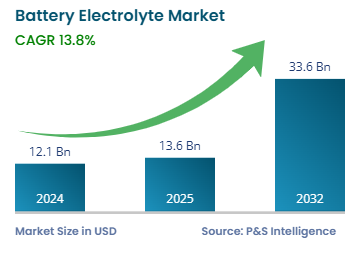
The battery electrolyte market size was USD 12.1 billion in 2024, and it will grow by 13.8% during 2025–2032, to reach USD 33.6 billion by 2032.
The market is driven by the widespread EV uptake globally and rising installation of energy storage systems. Global energy storage capacity reached approximately 85 GW of battery storage by the end of 2023, complemented by around 179 GW of pumped hydro capacity, according to the International Energy Agency (IEA). In 2024, about 175 GWh of new storage systems were added globally, with China, the Americas, and Europe contributing over 90% of the growth. China added a record 37 GW (approximately 141 GWh) of battery storage in 2024, doubling its total capacity to around 62 GW by the end of the year, while the U.S. expanded its utility-scale battery storage by 10.4 GW, reaching a total installed capacity of 26 GW by the close of 2024 (EIA).
The European Union is expanding both grid-scale batteries and pumped hydro. Long-duration storage technologies, including liquid-air and vanadium flow batteries, are also advancing. Globally, targets aim to reach around 1,500 GW of energy storage by 2030 to support renewable energy integration.
Governments around the world are launching net-zero target initiatives and low-carbon footprint strategies, which require lithium-ion and future-generation batteries; this, in turn, increases the need for safe and efficient electrolytes. India's national energy storage mission aims to install 50 GWH of battery storage by the year 2030. Moreover, India is also experiencing fast growth because of its FAME II scheme, rising demand for grid-level energy storage, and its state-level EV policies. Moreover, as per the International Renewable Energy Agency (IRENA), 858 GW of renewable capacity was added across the world in 2024, which was 90% of the total new power capacity.
Battery Electrolyte Market Growth Factors
Development of Sustainable and Safer Electrolyte Formulations Is Key Trend
The rising concern over chemical safety, ecological impact, and battery recyclability is a key trend in the market.
Authorities are providing strict regulations regarding decarbonization, electrolyte formulations, and eco-friendly components, which are shifting manufacturers to redesign electrolytes using PFAS-free and sustainable materials.
Safer, eco-friendly battery electrolytes are advancing through non-flammable, solid-state, and water-based chemistries.
BASF and Mitsubishi Chemical are developing fluorine-free and bio-based formulations.
Ongoing R&D is focused on reducing toxicity and flammability.
Solvay’s water-based electrolytes and LG Chem’s flame-retardant solutions mark key commercial steps toward sustainable battery technology.
In Europe, the EU Battery Regulation regulates eco-labeling, recycled material requirements, and chemical handling standards.
The European Chemicals Agency is reviewing a PFAS ban that will impact traditional formulations of batteries and promote the adoption of fluorine-free alternatives.
Germany supports sustainability through the EU Green Deal and Battery Passport Initiative, aiming to secure tracking, emission monitoring, and adherence across battery supply chains.
France is increasing battery production with tax incentives. These incentives aim to ban ICE vehicles by 2040, improving the demand for sustainable electrolytes.
The U.A.E.’s Energy Strategy and Masdar initiatives also promote clean energy and battery installation.
Surging Adoption of Electric Vehicles Is Biggest Driver
The rising push from ICE vehicles towards EVs creates a high demand for lithium-ion battery electrolytes, which is a key driver in the market.
Global electric vehicle (EV) sales reached 17 million units in 2024, accounting for over 20% of all car sales worldwide, according to the International Energy Agency (IEA).
This marked a 25% increase from 2023, with China leading the market at over 11 million units sold—equal to the entire global EV sales volume just two years prior.
The China Association of Automobile Manufacturers (CAAM) notes that China contributed around 80% of the global EV sales growth.
In the U.S., EVs made up about 10% of new car sales, while Europe saw nearly 20%, as reported by the European Automobile Manufacturers’ Association (ACEA).
Electrolyte batteries are used in EVs to enhance safety and ensure efficient battery performance.
These batteries withstand harsh temperatures and significantly reduce risks such as thermal runaway.
The rising focus on vehicle safety, battery range, and charging speed also increases the need to improve the electrolyte battery formulations for the next-generation AV battery development.
Governments worldwide started various policies like the EU’s FIT for 55, which provides tax incentive subsidies and emission targets that directly support EV adoption and local battery manufacturing.
According to reports, the demand for EV batteries exceeded 1 TWh in 2024, highlighting the increasing battery consumption demand.
EV companies, such as Tesla, Volkswagen, and Hyundai, are increasing their EV lineups and creating demand for high-performance battery electrolytes.
In April 2023, Neogen Chemicals and MU Ionic Solution collaborated to create the electrolytes for EV batteries in India.
According to the reports, in 2023, nearly 85% of lithium was used globally for EV batteries.
Battery Electrolyte Market Segmentation Analysis
Battery Type Analysis
The lead–acid category held the largest market share, of 35%, in 2024, due to its high durability, lower costs, and extensive usage in automotive starter systems, uninterruptible power supplies, and grid stabilization solutions required by the expanding telecom industry with growing 5G deployments. They use sulfuric acid as the electrolyte, which is capable of providing high currents, long performance, and a more-developed recycling ecosystem. According to a report from the U.S. Department of Energy, SLA batteries are recycled at a rate of 99%, which reduces ecological impact.
The lithium-ion category will have the highest CAGR, due to the increasing demand for electric vehicles, more energy storage capacity, and hybrid systems for safety and energy-density enhancement. These batteries are also promoted by R&D initiatives focused on advanced electrolyte designs, such as gel polymers, that provide better performance for the future mobility industry. The average price of lithium-ion battery packs has fallen from around USD 1,200/kWh in 2010 to approximately USD 115–USD 139/kWh by 2023–2024 a decline of roughly 90%.
The battery types analyzed in this report are:
Lead–Acid (Largest Category)
Lithium-Ion (Fastest-Growing Category)
Nickel-Based
Flow Batteries
Vanadium Redox
Zinc–Bromine
Sodium-Ion
Electrotype Type Analysis
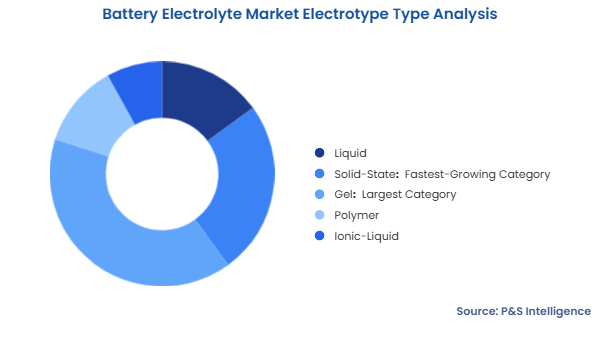
The gel category held the largest market share, of 40%, in 2024, due to the enhancing safety regulations and increasing need for stable, sealed batteries. They also have improved automotive and telecom standards that promote leak-proof designs, expanded portable electronic integration, and increased backup power use. According to the IEA, renewables’ share in the global energy mix is set to increase from 30% in 2023 to 46% by 2030, promoting the need for flexible energy storage.
The solid-state category will have the highest CAGR, of 14%, because of its better stability, safety, and high energy density. The increasing demand for safe and efficient batteries in sectors such as automotive and electronics surges the demand for solid-state batteries. Moreover, their capacity to support next-generation batteries with better performance and a long lifespan also drives the solid electrolyte market.
The electrotype types analyzed in this report are:
Liquid
Solid-State (Fastest-Growing Category)
Sulfide-based
Oxide-based
Phosphate-based
Gel (Largest Category)
Polymer
Ionic-Liquid
End User Analysis
The automotive category held the largest market share, of 45%, in 2024, as these electrolytes are extensively used in power EVs and hybrid EVs. Manufacturers are heavily investing in battery technologies for improving the performance of EVs. Also, the stringent regulation by governments for the reduction in COâ‚‚ emissions is increasing the market. For example, the European Union has targeted all new cars on sale to be zero-emission by 2035, and the California Advanced Clean Cars II rule supports the ZEV mandate to 100% by 2035.
Global transport-related greenhouse gas emissions reached 8.4 Gigatonnes in 2023, accounting for approximately 15% of total emissions, as reported by the United Nations Environment Programme. Between 2010 and 2019, the sector experienced an average annual growth rate of 1.8%, with road transport being the largest contributor. To align with the Paris Agreement's 1.5°C target, the International Energy Agency (IEA) emphasizes the need for a 25% reduction in transport emissions by 2030, necessitating rapid electrification, enhanced energy efficiency, and the adoption of low-emission fuels.
The energy storage category will have the highest CAGR, due to the strong global shift towards renewable energy resources, like solar and wind, which require a stable and reliable power supply. These renewable energies do not provide electricity 24/7, so large-scale battery storage is used to store excess electricity. The U.S. Department of Energy’s Long Duration Storage Shot aims to minimize the cost of grid storage by 90% by 2030.
Global renewable energy capacity reached 4,448 GW (GW) in 2024, marking a 15.1% increase from the previous year, with solar photovoltaics accounting for approximately 75% of this growth. China led the expansion, contributing nearly 64% of the global additions. The U.S. and the European Union also saw significant growth, with solar capacity increasing by more than 50% in the U.S. and wind capacity additions rising in the EU. Despite these advancements, the International Renewable Energy Agency (IRENA) emphasizes the need for a 16.6% annual growth rate to meet the goal of tripling renewable energy capacity by 2030.
The end users analyzed in this report are:
Automotive (Largest Category)
Consumer Electronics
Energy Storage (Fastest-Growing Category)
Industrial
Aerospace & Defense
Others
Drive strategic growth with comprehensive market analysis
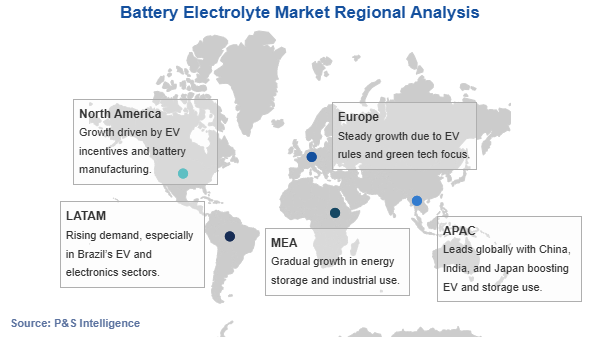
Asia-Pacific held the largest market share, of 35%, in 2024, due to its strong government policies and large-scale manufacturing process. China is the largest user of batteries due to its impressive EV sales, with over 13 million sales in 2023, and its government rule targeting 25% new electric mobility by 2025. Moreover, China’s National Energy Administration ordered to include 10–20% battery storage capacity in renewable projects to maintain grid stability. Japan has announced JPY 200-billion investment, while South Korea is investing USD 35 billion under the Green New Deal in batteries.
APAC’s energy storage capacity exceeded 35 GW by 2024, with China contributing over 60% of the new installations as reported by the International Energy Agency. Consumer electronics sales surpassed 1.5 billion units in 2024, led by smartphones and laptops, according to the World Intellectual Property Organization. Wearable medical device adoption in APAC grew by over 20% annually, led by China and Japan. Additionally, governments across APAC have committed over USD 400 billion in clean energy and healthcare technology investments to accelerate battery-dependent applications through 2030.
North America will have the highest CAGR, of 14.5%, driven by the rising financial support and growing local manufacturing. The U.S. government provides incentives, such as Inflation Reduction Act tax credits for EVs with local manufacturing, and clean energy programs by the U.S. Department of Energy are also fueling the growth of batteries in North America.
Battery electrolyte demand in North America is rising due to increasing electric vehicle (EV) adoption, expanding energy storage deployments, and growing consumer electronics usage. The U.S. Department of Energy reports that EV sales have surged significantly in recent years, supported by federal tax incentives and commitments from major automakers to electrify fleets.
The North American Electric Reliability Corporation (NERC) highlights that grid-scale battery storage installations are accelerating to enhance grid resilience and support renewable energy integration. Additionally, the U.S. Food and Drug Administration (FDA) notes growth in battery-powered wearable medical devices, driven by advances in healthcare technology and telemedicine. Together, these factors underpin strong regional growth in battery electrolyte consumption.
The geographical breakdown of the market is as follows:
North America (Fastest Regional Market)
U.S. (Larger Country)
Canada (Faster-Growing Country)
Europe
Germany (Larger Country)
U.K.
France (Fastest-Growing Country)
Italy
Spain
Rest of Europe
Asia-Pacific (Largest Regional Market)
China (Largest Country)
India (Fastest-Growing Country)
Japan
South Korea
Australia
Rest of APAC
Latin America
Brazil (Largest Country)
Mexico (Fastest-Growing Country)
Rest of LATAM
Middle East and Africa
Saudi Arabia
South Africa (Larger Country)
U.A.E. (Fastest-Growing Country)
Rest of MEA
Battery Electrolyte Market Competitive Landscape
The market is moderately fragmented because of the presence of large regional and specialized manufacturers serving a wide variety of batteries. Various applications, such as EVs, consumer electronics, and energy storage, have different formulations, and ongoing technological advancements in areas such as non-liquid and advanced electrolyte support niche and emerging suppliers. Additionally, innovation in electrolyte additives and solid-state technologies drives specialization among manufacturers. Regional preferences for lithium-ion, sodium-ion, or emerging chemistries create varied demands. Barriers to large-scale consolidation include high R&D costs and intellectual property protection. This diversity in technology and application keeps the market highly competitive and segmented globally.
Key Battery Electrolyte Companies:
Mitsubishi Chemical Group Corporation
UBE Corporation
Guangzhou Tinci Materials Technology Co., Ltd.
Shenzhen Capchem Technology Co., Ltd.
Soulbrain Co., Ltd.
Mitsui Chemicals, Inc.
GS Yuasa International Ltd.
3M Company
Targray Industries Inc.
NOHMs Technologies Inc.
NEI Corporation
Zhuhai Smoothway Electronic Materials Co., Ltd.
Battery Electrolyte Market News
In June 2025, Guangzhou Tinci Materials Technology Co. Ltd. and Moroccan authorities signed a USD 282.3-million (MAD 2.6 billion) investment agreement to build a 150,000-ton-per-year lithium-ion battery electrolyte plant.
In February 2025, Dongwha Electrolyte Co., a subsidiary of Dongwha Enterprise Co., completed the construction of a new electrolyte factory in Clarksville, Tennessee. Built with an investment of USD 70 million, this facility boasts an annual production capacity of 86,000 tons of electrolyte, enough for 2 million EVs.
In March 2024, SoulBrain Co. Ltd. created a joint venture with China’s Do-Fluoride New Materials to create lithium hexafluorosulfonate, which is a key electrolyte salt that supports global SoulBrain's electrolyte operations.
In February 2024, UBE Corporation invested USD 500 million to build a plant in Louisiana to produce dimethyl carbonate and ethyl methyl carbonate, which are critical lithium-ion battery electrolyte solvents.
Want a report tailored exactly to your business need?
Leading companies across industries trust us to deliver data-driven insights and innovative solutions for their most critical decisions. From data-driven strategies to actionable insights, we empower the decision-makers who shape industries and define the future. From Fortune 500 companies to innovative startups, we are proud to partner with organisations that drive progress in their industries.
Client Testimonials
Working with P&S Intelligence and their team was an absolute pleasure – their awareness of timelines and commitment to value greatly contributed to our project's success. Eagerly anticipating future collaborations.
McKinsey & Company
India
Unmatched Standards
Our insights into the minutest levels of the markets, including the latest trends and competitive landscape, give you all the answers you need to take your business to new heights
Complete Data Security
We take a cautious approach to protecting your personal and confidential information. Trust is the strongest bond that connects us and our clients, and trust we build by complying with all international and domestic data protection and privacy laws