This Report Provides In-Depth Analysis of the Agrochemicals Market Report Prepared by P&S Intelligence, Segmented by Product Type (Fertilizers, Pesticides, Plant Growth Regulators, Bio-Stimulants), Crop Type (Cereals & Grains, Fruits & Vegetables, Oilseeds & Pulses, Turf & Ornamentals), Mode of Application (Soil Treatment, Foliar Application, Seed Treatment, Post-Harvest Treatment), Form (Liquid, Solid, Gaseous), and Geographical Outlook for the Period of 2019 to 2032
Explore the market potential with our data-driven report
Agrochemicals Market Overview
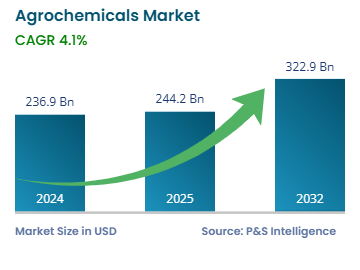
The global agrochemicals market was valued at USD 236.9 billion in 2024, and it is projected to reach USD 322.9 billion by 2032, growing at a CAGR, of 4.1%, during 2025–2032. The market growth is primarily driven by increasing global population, declining arable land per capita, and rising demand for food security across developing nations.
The surge in global population is expected to reach 9.7 billion by 2050, creating unprecedented pressure on agricultural systems to increase productivity. According to the Food and Agriculture Organization (FAO), agricultural production must increase by 70% to meet future food demands. This fundamental driver necessitates enhanced crop protection and fertilizer applications to maximize yields from limited arable land resources.
The increasing adoption of precision agriculture technologies represents a significant trend reshaping the market landscape. The integration of GPS-guided equipment, variable rate application systems, and AI-powered crop monitoring solutions enables farmers to optimize agrochemical usage while reducing environmental impact. Additionally, the growing emphasis on sustainable farming practices has accelerated the development of biological alternatives and eco-friendly formulations within the agrochemicals sector.
Agrochemicals Market Dynamics
Technological Advancement Is Revolutionizing Application Methods
Digital agriculture and precision farming technologies are transforming how agrochemicals are applied, creating opportunities for specialized products and application systems, in which farmers are adopting GPS-guided sprayers, drone application systems, and variable rate technology.
The usage of artificial intelligence in agriculture enables predictive pest management and optimal timing for agrochemical applications. Machine learning algorithms analyze vast datasets combining weather patterns, soil conditions, and historical pest pressure to recommend precise intervention strategies. These technologies reduce overall chemical usage while improving efficacy and environmental outcomes.
Sensor technologies and IoT devices provide real-time monitoring of crop health, soil nutrients, and pest populations, enabling responsive agrochemical applications based on actual field conditions rather than calendar-based schedules. Remote sensing capabilities through satellite imagery and drone surveillance allow large-scale monitoring and targeted treatments, particularly valuable for extensive agricultural operations.
Rising Global Population Is Driving Market Expansion
The expanding global population serves as the primary growth catalyst for the agrochemicals market. The United Nations projects that the world population will reach 9.7 billion by 2050, representing a 25% increase from current levels. This demographic growth translates directly into increased food demand, particularly in developing regions where population growth rates remain highest.
Asia-Pacific countries demonstrate the most significant population-driven demand growth, with India's population surpassing China's in 2023 and continuing to expand rapidly. According to the World Bank, per capita arable land continues declining globally, from 0.38 hectares in 1990 to 0.19 hectares in 2020. This reduction in available farmland per person intensifies the need for agrochemical inputs to maximize crop yields on existing agricultural areas.
The demographic transition in developing countries creates additional market opportunities as growing middle-class populations demand higher-quality foods, including fruits and vegetables that require intensive agrochemical applications. The shift from subsistence farming to commercial agriculture in regions like Sub-Saharan Africa and Southeast Asia drives modernization of farming practices and increased agrochemical adoption.
Climate variability and extreme weather events increasingly threaten global agricultural productivity, driving demand for advanced crop protection solutions. Rising temperatures expand pest and disease pressure ranges while creating new challenges for traditional farming practices. The Intergovernmental Panel on Climate Change reports that agricultural productivity growth has declined by 21% since 1961 due to climate impacts.
Drought stress affects approximately 40% of global cropland annually, necessitating drought-tolerance treatments and specialized fertilizer applications to maintain yields under water-limited conditions. Conversely, increased precipitation intensity and flooding in certain regions create favorable conditions for fungal diseases and soil nutrient leaching, requiring enhanced fungicide applications and precision fertilizer management.
Shifting pest distributions due to temperature changes force farmers to adopt new protection strategies and products. For instance, fall armyworm has expanded from the Americas to affect over 80 countries globally, creating substantial demand for effective insecticide solutions. Climate adaptation strategies increasingly rely on agrochemical inputs to maintain stable crop production despite environmental stresses.
Climate change is intensifying pest infestations in agriculture by altering ecosystems and pest behavior. Rising temperatures allow pests to expand into new regions and increase their reproductive cycles, leading to more frequent and severe outbreaks. Longer growing seasons extend pest activity, while climate-stressed crops become more vulnerable to damage. Changes in rainfall and temperature also reduce the effectiveness of traditional pest control methods. According to global studies, crop losses due to pests could rise by 10–25% with each degree Celsius of warming. This growing threat underscores the need for climate-resilient farming and adaptive pest management strategies worldwide.
Agrochemicals Market Segmentation Analysis
Product Type Analysis
The fertilizers category held the largest share in the agrochemicals market in 2024, accounting for 75% of total market value, and is expected to maintain its dominant position throughout the forecast period. This dominance stems from the essential role of fertilizers in maintaining soil fertility and supporting crop nutrition across all agricultural systems.
Plant growth regulators will witness the highest CAGR, of 4.3%, during the forecast period, driven by increasing adoption of precision agriculture practices and growing awareness of crop quality enhancement benefits. The rising demand for uniform crop maturation, improved fruit quality, and enhanced stress tolerance drives the adoption of specialized growth regulators across horticultural and field crop applications.
Cereals & grains commanded the largest market share, of 45%, in 2024, reflecting their fundamental importance to global food security and the extensive cultivation areas devoted to staple crops. Major cereal crops, including wheat, rice, corn, and barley, require substantial fertilizer inputs to achieve optimal yields, with average application rates of 145 kg per hectare globally.
As per the FAO, global cereal production is forecast to reach a record 2.925 billion tonnes in 2025, driven by higher yields in wheat, maize, and rice. Meanwhile, approximately 732 million hectares of land were under cereal cultivation in 2021. In 2023/24, global cereal production is estimated at approximately 2.846 billion tonnes, up about 1.2% from the previous year. The Food and Agriculture Organization (FAO) now forecasts a record 2.925 billion tonnes for 2025, a 2.3% increase over 2024 outputs.
Fruits and vegetables represent the fastest-growing crop segment with a projected CAGR, of 4.6%, during 2025–2032, driven by increasing health consciousness and dietary diversification in developing markets. These high-value crops justify premium crop protection investments and specialized nutrition programs to meet quality standards for fresh market sales and export opportunities.
The expanding organic food market creates additional growth opportunities within the fruits and vegetables segment, as organic production systems rely heavily on biological pest control agents and organic-approved fertilizers. Premium pricing for organic produce supports higher per-acre agrochemical investments despite restrictions on synthetic inputs.
In 2023, global production of fruits and vegetables reached approximately 2.1 billion tonnes, reflecting their critical role in global food systems. Fresh fruit alone accounted for around 952 million tonnes that year. The harvested area for fruits and berries in 2024 was estimated at about 69 million hectares, says the FAO.
These crop types are covered:
Cereals & Grains (Largest Category)
Fruits & Vegetables (Fastest-Growing Category)
Oilseeds & Pulses
Turf & Ornamentals
Others
Mode of Application Analysis
Soil treatment had the largest application share, of 50%, in 2024, as this method provides sustained nutrient release and effective pest control for root-zone protection. Pre-plant soil applications of fertilizers and pesticides offer cost-effective crop establishment and season-long protection against soil-dwelling pests and diseases.
Foliar application will demonstrate the highest growth rate, of 4.7%, through 2032, driven by precision agriculture adoption and the need for rapid nutrient correction and pest response. Foliar applications provide immediate crop response and enable targeted treatment of specific plant parts, particularly valuable for high-value horticultural crops and precision farming systems.
The increasing adoption of drone technology and precision spraying equipment enhances foliar application efficiency while reducing chemical usage and environmental exposure. Variable rate application systems enable customized treatment intensities based on real-time crop monitoring and site-specific requirements.
These application modes are covered:
Soil Treatment (Largest Category)
Foliar Application (Fastest-Growing Category)
Seed Treatment
Post-Harvest Treatment
Form Analysis
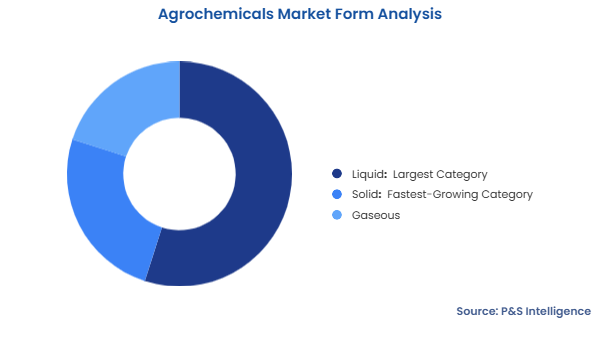
Liquid formulations held a 55% market share in 2024, as they offer advantages in handling, mixing, and application precision that support modern farming equipment and precision agriculture systems. Liquid products provide uniform distribution, reduced dust exposure, and compatibility with advanced application technologies, including drone systems and variable rate sprayers.
Solid formulations will experience the fastest growth, at 4.9% CAGR, during the forecast period, driven by controlled-release technologies and specialized coating systems that extend nutrient availability and reduce application frequency. Granular fertilizers and slow-release pesticide formulations appeal to farmers seeking labor-efficient application methods and extended crop protection.
These forms are covered:
Liquid (Largest Category)
Solid (Fastest-Growing Category)
Gaseous
Drive strategic growth with comprehensive market analysis
Agrochemicals Market Regional Outlook
APAC Agrochemicals Market Size
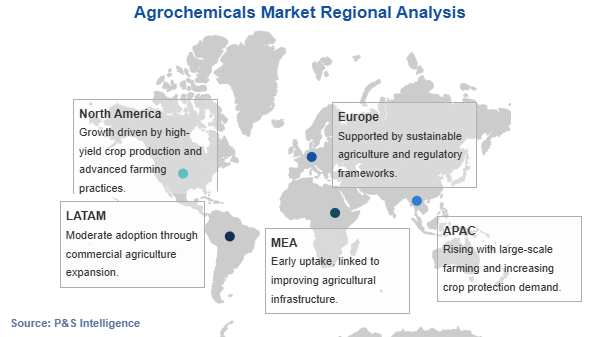
Asia-Pacific held the largest market share, of 45%, in 2024, and it is expected to maintain its dominant position throughout the forecast period. This leadership position results from the region's extensive agricultural sectors, intensive farming practices, and rapidly growing populations that drive food security concerns across major countries, including China, India, and Southeast Asian nations.
China Agrochemicals Market Size
China represents the world's largest agrochemical consumer, accounting for approximately 30% of global pesticide usage and 25% of fertilizer consumption. The country's agricultural modernization initiatives, including the promotion of large-scale farming operations and precision agriculture adoption, continue driving demand for advanced crop protection and nutrition solutions.
India Agrochemicals Market Size
India's agricultural sector demonstrates strong growth momentum, with fertilizer consumption increasing 4.5% annually as government subsidies and minimum support prices encourage intensive farming practices. The country's focus on achieving food self-sufficiency for its 1.4 billion population creates substantial demand for yield-enhancing agrochemical inputs across diverse cropping systems.
North America Agrochemicals Market Size
North America represents the second-largest regional market, with a 25% share, characterized by technologically advanced farming operations and high per-acre agrochemical usage rates. The region leads globally in precision agriculture adoption, with advanced GPS-guided equipment, variable rate application systems, and data-driven crop management becoming standard practices on commercial farms.
U.S. Agrochemicals Market Size
The U.S. maintains the world's most-productive agricultural system, with average corn yields exceeding 180 bushels per acre, supported by intensive fertilizer and pesticide applications. American farmers' focus on maximizing returns per acre drives adoption of premium crop protection products and specialized nutrition programs that optimize yields and crop quality.
Canada Agrochemicals Market Size
Canada's agricultural export orientation, particularly for wheat, canola, and pulse crops, necessitates high-quality crop production meeting international standards. This export focus drives demand for fungicides that prevent storage diseases and maintain grain quality during transportation and storage.
LATAM Agrochemicals Market Size
Latin America is expected to be the fastest-growing regional market, with a CAGR of 5.4%, during 2025–2032, driven by expanding agricultural frontiers, increasing crop intensification, and growing agricultural exports to global markets. The region's competitive advantage in land availability and favorable climate conditions supports continued agricultural expansion and modernization.
Brazil Agrochemicals Market Size
Brazil dominates the regional market as the world's largest exporter of soybeans, corn, coffee, and sugar, requiring intensive agrochemical applications to maintain crop quality and yields for international markets. The country's Cerrado region continues expanding cultivation areas while adopting advanced farming technologies and precision agriculture practices that drive premium agrochemical demand.
Argentina and Mexico contribute significantly to regional growth through their focus on export-oriented agriculture and government policies supporting agricultural modernization. Rising commodity prices and increasing global food demand create favorable conditions for continued agrochemical market expansion across Latin American countries.
Based on geography, the market has the following categories:
North America
U.S. (Larger-Country Market)
Canada (Faster-Growing Country Market)
Europe
Germany (Largest Country Market)
U.K. (Fastest-Country Market)
France
Italy
Spain
Rest of Europe
Asia-Pacific (Largest Regional Market)
Japan
China (Largest Country Market)
India (Fastest-Growing Country Market)
South Korea
Australia
Rest of APAC
Latin America (Fastest-Growing Regional Market)
Brazil (Largest Country Market)
Mexico (Fastest-Growing Country Market)
Rest of LATAM
Middle East and Africa
Saudi Arabia (Largest Country Market)
South Africa
U.A.E. (Fastest-Growing Country Market)
Rest of MEA
Agrochemicals Market Competitive Landscape
The global agrochemicals market is consolidated, with the top five companies controlling approximately 55% of total market share.
This concentration results from significant consolidation activity during 2016–2018, when major mergers created four dominant entities that now control the majority of global agrochemical sales and research capabilities.
Syngenta Group maintains market leadership with estimated 12% global share, supported by its comprehensive product portfolio spanning crop protection chemicals, seeds, and digital farming solutions.
The company's acquisition by ChemChina provided access to major growth markets while maintaining technological leadership in active ingredient development and biological solutions.
Bayer CropScience holds the second position with approximately 11% market share following its acquisition of Monsanto, creating the world's largest integrated seeds and crop protection company.
The merger combined Bayer's chemical expertise with Monsanto's genetic traits and biotechnology capabilities, though integration challenges and litigation costs have pressured financial performance.
Recent strategic activities focus on portfolio optimization and technological capability enhancement rather than major consolidation.
Companies increasingly acquire biological product specialists and precision agriculture technology providers to expand their integrated solution offerings and address growing demand for sustainable farming practices.
Top Agrochemical Companies:
BASF SE
Bayer AG
ADAMA Ltd.
The Dow Chemical Company
Yara International ASA
Syngenta Crop Protection AG
UPL Limited
Zuari Agro Chemicals LTD.
Evonik Industries AG
Sumitomo Chemical Co. Ltd.
PI Industries Ltd.
Dhanuka Agritech Ltd.
Agrochemicals Market News
In October 2024, Corteva Inc. opened a new formulation plant in Gujarat, aimed at producing customized crop protection products for Indian and Southeast Asian markets.
In September 2024, Syngenta Crop Protection AG introduced Cropwise AI at the World AgriTech Innovation Summit in London. Cropwise AI is an advanced GenAI system aimed at assisting agronomic advisors and growers in identifying the most effective crop management practices. By utilizing machine learning algorithms and data analytics, Cropwise AI provides growers with detailed insights to support decision-making, optimize crop yields, enhance sustainability, and improve profitability.
In August 2024, Dhanuka Agritech announced a ₹100 crore investment in green chemistry R&D, focusing on low-residue formulations and biologicals. The company also initiated global registration for select molecules in Africa and Latin America.
In April 2024, Bayer AG signed an agreement with the U.K.-based company Alpha BioPesticides Limited to secure an exclusive license for a new biological insecticide. The new product will be the first available for arable crops, including oilseed rape and cereals. Targeted for initial launch in 2028, pending further development and registration, this new insecticide was discovered by AlphaBio, with whom Bayer distributes FLiPPER an award-winning bioinsecticide-acaricide.
In March 2024, Best Agrolife Ltd. acquired Sudarshan Farm Chemicals India Pvt. Ltd., gaining access to formulation plants and R&D infrastructure. The acquisition strengthens BAL’s position in innovative combination products and patent registrations.
In January 2024, UPL Ltd. inaugurated its OpenAg Center in Brazil to accelerate biological R&D and sustainable crop solutions.
Want a report tailored exactly to your business need?
Leading companies across industries trust us to deliver data-driven insights and innovative solutions for their most critical decisions. From data-driven strategies to actionable insights, we empower the decision-makers who shape industries and define the future. From Fortune 500 companies to innovative startups, we are proud to partner with organisations that drive progress in their industries.
Client Testimonials
Working with P&S Intelligence and their team was an absolute pleasure – their awareness of timelines and commitment to value greatly contributed to our project's success. Eagerly anticipating future collaborations.
McKinsey & Company
India
Unmatched Standards
Our insights into the minutest levels of the markets, including the latest trends and competitive landscape, give you all the answers you need to take your business to new heights
Complete Data Security
We take a cautious approach to protecting your personal and confidential information. Trust is the strongest bond that connects us and our clients, and trust we build by complying with all international and domestic data protection and privacy laws