This Report Provides In-Depth Analysis of the Remote Diagnostics Market Report Prepared by P&S Intelligence, Segmented by Product (Hardware Devices, Software and Platforms, Mobile Health Applications, Services), Diagnostic Type (Cardiac Monitoring, Diabetes Monitoring, Respiratory Monitoring, Neurological Monitoring, Remote Imaging Diagnostics), End User (Hospitals, Homecare Settings, Diagnostic Laboratories, Ambulatory Care Centers), Technology (Internet of Things, Artificial Intelligence, Cloud Computing, Big Data Analytics, Fifth Generation and Wireless Connectivity), Mode of Delivery (Real-Time Monitoring, Hybrid Diagnostics, Store-and-Forward Diagnostics), and Geographical Outlook for the Period of 2021 to 2032
Explore the market potential with our data-driven report
Remote Diagnostics Market Overview
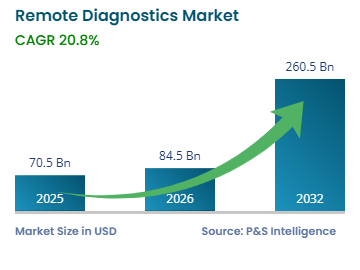
The remote diagnostics market size was USD 70.5 billion for 2025, and it will grow by 20.8% during 2026-2032, to reach USD 260.5 billion by 2032.
The remote diagnostics market is expanding as healthcare providers increasingly shift from episodic treatment models towards continuous and connected patient management. Remote diagnostic technologies allow clinicians to evaluate, monitor, and assess patient conditions without frequent in-person visits, improving access to care while supporting more efficient healthcare delivery. The growing prevalence of chronic diseases, rising demand for long-term health monitoring, and increasing preference for home-based care are accelerating adoption across healthcare systems. Healthcare organisations are also seeking solutions that improve clinical outcomes while controlling operational costs, creating stronger demand for technologies that support earlier detection, timely intervention, and proactive disease management.
The market is also benefiting from advances in connected medical devices, wearable sensors, cloud-based healthcare platforms, and artificial intelligence-enabled analytics. These technologies enable near real-time collection and interpretation of patient data, helping healthcare professionals respond more quickly to changes in health conditions. According to the International Diabetes Federation, 589 million adults aged 20–79 were living with diabetes worldwide in 2024, while approximately 252 million adults remained undiagnosed. Healthcare providers are therefore integrating remote diagnostics into routine care pathways, population health programmes, and preventive care initiatives, while expanding the use of connected technologies that support ongoing patient engagement and more personalized treatment management.
Key Market Insights
Hardware devices are the largest product category, holding a market share of 40.0%, due to their essential role in collecting physiological data for remote diagnostic workflows.
Diabetes monitoring is the fastest-growing diagnostic type category, registering a CAGR of 21.0%, driven by increasing adoption of continuous glucose monitoring and digital diabetes management solutions.
Hospitals are the largest end-user category, holding a market share of 40.0%, due to growing use of remote diagnostics for post-discharge monitoring, chronic disease management, and specialist consultations.
North America holds the largest regional market share of 45.5%, due to strong adoption of telehealth services, wearable health technologies, and connected care platforms.
Asia-Pacific is the fastest-growing regional market, registering a CAGR of 23.0%, driven by expanding digital health infrastructure and increasing access to telemedicine services.
Remote Diagnostics Market Trends and Drivers
AI-Enabled Predictive Monitoring and Intelligent Diagnostic Platforms Is Major Trend
The remote diagnostics market is increasingly shifting beyond basic remote data collection towards intelligent platforms that enable predictive analytics, clinical decision support, and proactive patient management. Healthcare organizations are adopting solutions that integrate connected sensors, wearable monitoring devices, cloud-based infrastructure, and artificial intelligence to continuously assess patient health, identify potential risks at an early stage, and prioritize patients requiring immediate clinical attention. These advanced technologies are improving diagnostic accuracy, accelerating clinical decision-making, and enabling more personalized and efficient healthcare delivery.
The growing adoption of AI-enabled diagnostic solutions is further transforming remote healthcare services. According to the U.S. Food and Drug Administration (FDA), more than 1,000 AI-enabled medical devices had been authorized through established premarket pathways by 2025, reflecting the increasing integration of artificial intelligence into diagnostic and clinical support applications. At the same time, the Global Digital Health Monitor reported that 95% of participating countries used digital health systems to monitor population health in 2024, while only 15% had established national architectures capable of seamless real-time health data sharing.
Rising Demand for Chronic Disease Management and Continuous Patient Monitoring Drives Market
The remote diagnostics market is expanding as healthcare systems face a growing burden of chronic diseases that require continuous monitoring and long-term clinical management. Conditions such as hypertension, diabetes, cardiovascular diseases, and respiratory disorders demand regular assessment beyond periodic hospital visits to enable early detection of disease progression and timely medical intervention. Remote diagnostic technologies allow healthcare professionals to continuously monitor patient health, facilitate proactive treatment decisions, and improve care coordination while reducing the need for frequent in-person consultations. These capabilities are supporting the transition towards more preventive, patient-centric, and value-based healthcare delivery models.
According to the World Health Organization (WHO), approximately 1.4 billion adults aged 30–79 years were living with hypertension worldwide in 2024, while nearly 600 million remained unaware of their condition and only 320 million had their blood pressure under control. The substantial number of undiagnosed and inadequately managed patients highlights the growing need for technologies that enable continuous health monitoring and earlier diagnosis outside conventional clinical settings. Furthermore, the World Health Organization reported that global life expectancy at birth reached 73.3 years in 2024, contributing to a steadily expanding ageing population that is more susceptible to chronic health conditions requiring long-term medical supervision.
Data Privacy, Cybersecurity, and Regulatory Compliance Challenges Limit Market Expansion
The adoption of remote diagnostics solutions is constrained by growing concerns regarding patient data privacy, cybersecurity risks, and compliance with evolving healthcare regulations. These platforms continuously collect, transmit, and store large volumes of sensitive health information across connected medical devices, cloud-based platforms, and healthcare networks, increasing the risk of data breaches and unauthorized access. As remote diagnostics becomes more integrated into routine healthcare delivery, ensuring secure data management and regulatory compliance has become a critical priority for healthcare organizations.
According to IBM's Cost of a Data Breach Report 2024, the average cost of a healthcare data breach reached USD 9.77 million in 2024, making healthcare one of the most financially affected industries by cyberattacks. The significant financial, operational, and reputational consequences associated with data breaches are making healthcare organizations more cautious when implementing large-scale remote diagnostics programmes. To mitigate these risks, providers must invest in robust cybersecurity infrastructure, secure data integration, continuous system monitoring, and compliance with healthcare data protection regulations. These additional requirements increase implementation and maintenance costs, extend deployment timelines, and create adoption barriers, particularly for healthcare organizations with limited digital capabilities and financial resources.
Expansion of Remote Healthcare Access in Underserved and Rural Communities Creates Market Opportunity
A significant opportunity for the remote diagnostics market lies in expanding access to quality healthcare services across underserved and rural communities, where access to specialists, diagnostic facilities, and advanced medical infrastructure remains limited. Remote diagnostics enables healthcare professionals to assess patient conditions, interpret diagnostic data, and support clinical decision-making without requiring patients to travel long distances to healthcare facilities. This improves access to timely diagnosis, facilitates early medical intervention, and helps reduce disparities in healthcare delivery across geographically isolated regions.
According to the International Telecommunication Union (ITU), 1.8 billion of the 2.6 billion people not using the Internet lived in rural areas in 2024, while Internet usage in rural regions reached only 48%. The limited availability of digital connectivity highlights the significant untapped potential for expanding telemedicine and remote healthcare services. As governments and healthcare organizations continue investing in broadband infrastructure, digital health initiatives, and telehealth networks, remote diagnostics is expected to play an increasingly important role in extending healthcare access to underserved populations. These developments are creating substantial opportunities for market participants to expand connected diagnostic solutions, improve early disease detection, strengthen patient monitoring, and enhance healthcare accessibility across rural and remote communities.
Remote Diagnostics Market Segmentation Analysis
Product Analysis
Hardware devices is the largest category, holding a market share of 40.0%, as remote diagnostics relies on wearable sensors, patient monitoring equipment, and connected diagnostic devices to capture and transmit real-time physiological data. Their ability to facilitate early disease detection, support timely clinical intervention, and improve patient management has significantly increased their adoption across healthcare systems. According to the U.S. Food and Drug Administration (FDA), LifeSignals' UbiqVue 2A Multiparameter System received clearance in 2024 as a wireless remote patient monitoring solution for continuous physiological data collection.
Software and platforms are the fastest-growing category, registering a CAGR of 21.9%, driven by the increasing demand for centralized patient data management, remote patient engagement, clinical decision support, and seamless interoperability across healthcare systems. Healthcare organizations are investing in advanced software platforms capable of integrating data from multiple connected devices while enabling real-time analytics, workflow automation, and virtual care delivery. The rapid adoption of artificial intelligence, cloud computing, and interoperable digital health ecosystems is further enhancing the ability of healthcare professionals to monitor patient conditions, generate actionable clinical insights, and deliver more personalized care.
The product analysed in this report are:
Hardware Devices (Largest Category)
Software and Platforms (Fastest-growing Category)
Mobile Health Applications
Services
Others
Diagnostic Type Analysis
Cardiac monitoring is the largest category, holding a market share of 35.5%, as cardiovascular diseases require continuous observation, early diagnosis, and long-term clinical management across diverse patient populations. The widespread adoption of wearable cardiac monitors, ambulatory electrocardiogram (ECG) systems, and connected cardiovascular assessment devices has strengthened the segment's market leadership. According to the World Health Organization (WHO), cardiovascular diseases were responsible for an estimated 20.5 million deaths globally in 2021, accounting for nearly one-third of all deaths worldwide.
Diabetes monitoring is the fastest-growing category, registering a CAGR of 21.0%, due to increasing adoption of continuous glucose monitoring technologies and digital diabetes management platforms. Healthcare providers are prioritising remote monitoring solutions that support frequent assessment, earlier intervention, and improved patient engagement. According to the International Diabetes Federation, diabetes caused 3.4 million deaths worldwide in 2024. The substantial clinical burden of the disease is increasing demand for connected monitoring devices that enable ongoing glucose tracking outside traditional care settings. Healthcare organisations are expanding remote diabetes programmes to support long-term disease management and improve treatment adherence.
Hospitals is the largest category, holding a market share of 40.0%, as they remain the primary centers for disease diagnosis, treatment planning, and long-term patient management. Hospitals are increasingly integrating remote diagnostics into post-discharge monitoring, specialist consultations, intensive care management, and chronic disease programmes to extend patient care beyond conventional clinical settings. According to the American Hospital Association (AHA), approximately 6,120 hospitals were operating in the United States in 2024, highlighting the extensive healthcare infrastructure supporting the deployment of remote diagnostic solutions.
Homecare settings are the fastest-growing category, registering a CAGR of 21.5%, driven by the increasing preference for patient-centric healthcare models that enable continuous monitoring outside traditional healthcare facilities. Remote diagnostics allows patients to receive ongoing health assessments while remaining in their homes, improving convenience, reducing unnecessary hospital visits, and supporting better management of chronic diseases. The expanding adoption of telehealth services, wearable medical devices, and connected health technologies is further accelerating the shift towards home-based care.
The end user analysed in this report are:
Hospitals (Largest Category)
Homecare Settings (Fastest-growing Category)
Diagnostic Laboratories
Ambulatory Care Centers
Others
Technology Analysis
Internet of Things is the largest category, holding a market share of 35.5%, as connected medical devices form the core infrastructure of remote diagnostics by enabling continuous collection, transmission, and exchange of patient health data. IoT-powered wearable sensors, remote monitoring devices, and connected diagnostic equipment facilitate real-time patient assessment, allowing healthcare professionals to monitor health conditions beyond traditional clinical settings. The seamless integration of IoT with digital health platforms enhances clinical decision-making, supports timely medical intervention, and improves care coordination across healthcare systems. According to Ericsson, global cellular IoT connections were projected to reach 4.5 billion by the end of 2025.
Artificial Intelligence is the fastest-growing category, registering a CAGR of 22.5%, driven by the increasing demand for intelligent technologies capable of analyzing large volumes of patient data and generating actionable clinical insights. AI-powered diagnostic solutions enable healthcare professionals to identify disease patterns, predict potential health risks, prioritize critical cases, and support faster clinical decision-making. The growing integration of predictive analytics, automated image interpretation, and intelligent monitoring systems is expanding the role of AI across remote healthcare applications. According to the U.S. Food and Drug Administration (FDA), more than 1,000 AI-enabled medical devices had been authorized through established premarket pathways by 2025, reflecting the rapid adoption of artificial intelligence in clinical diagnostics and patient care.
Real-time monitoring is the largest category, holding a market share of 65.0%, because healthcare providers require immediate access to patient information for timely clinical intervention and continuous health assessment. Real-time monitoring solutions support ongoing observation of vital signs and disease indicators, enabling faster response to changes in patient conditions. Their widespread use in chronic disease management, cardiac care, and high-risk patient monitoring has reinforced their importance within remote diagnostics. Continuous data availability remains a key factor supporting adoption across healthcare settings.
Hybrid Diagnostics is the fastest-growing category, registering a CAGR of 22.1%, driven by the increasing need for flexible care models that combine continuous patient monitoring with remote diagnostic review and clinical decision-making. Hybrid diagnostic solutions enable healthcare professionals to integrate real-time patient data with virtual consultations, diagnostic interpretation, and AI-assisted clinical workflows, improving both operational efficiency and quality of care. According to Philips, the company launched a web-based diagnostic viewer in 2025 that provides remote access to imaging data while integrating artificial intelligence capabilities and advanced reporting tools.
The mode of delivery analyzed in this report are:
Real-Time Monitoring (Largest Category)
Hybrid Diagnostics (Fastest-growing Category)
Store-and-Forward Diagnostics
Drive strategic growth with comprehensive market analysis
Remote Diagnostics Market Geographical Analysis
North America Remote Diagnostics Market Analysis
North America holds the largest share, of 45.5%, supported by its well-established digital healthcare ecosystem, advanced healthcare infrastructure, and widespread adoption of connected care technologies. Healthcare organizations across the region are increasingly integrating remote diagnostics into chronic disease management, post-discharge monitoring, and virtual care programmes to improve patient outcomes while reducing unnecessary hospital utilization. According to the Centers for Disease Control and Prevention (CDC), approximately 6 in 10 adults in the United States were living with at least one chronic disease in 2024, while 4 in 10 adults had two or more chronic conditions. The high prevalence of chronic diseases is increasing the demand for continuous patient monitoring, remote diagnostic solutions, and connected care technologies across hospitals, outpatient facilities, and home-based care settings.
U.S. Remote Diagnostics Market Analysis
The U.S. remote diagnostics market is driven by its highly advanced digital healthcare ecosystem, widespread adoption of connected care technologies, and strong focus on improving patient outcomes through value-based healthcare delivery. Healthcare organizations across the country are increasingly integrating remote diagnostic solutions into chronic disease management, post-discharge monitoring, preventive care, and virtual healthcare services to reduce avoidable hospital admissions and enhance care coordination. The growing adoption of wearable medical devices, remote patient monitoring systems, and telehealth platforms has further strengthened the demand for connected diagnostic solutions across hospitals, outpatient facilities, and home-based care settings. According to the Office of the National Coordinator for Health Information Technology (ONC), approximately nine out of ten U.S. hospitals enabled patients to electronically access their health information through application programming interfaces (APIs) in 2024, while nearly two-thirds supported the submission of patient-generated health data to electronic health records.
Canada Remote Diagnostics Market Analysis
Canada's remote diagnostics market is expanding as healthcare organizations increasingly adopt digital health technologies to improve access to medical services across rural, remote, and geographically dispersed communities. The country's vast geography and uneven distribution of healthcare resources have accelerated the adoption of virtual care, remote patient monitoring, and connected diagnostic solutions that reduce travel requirements while improving access to specialist consultations. These technologies are helping healthcare providers deliver timely diagnosis, strengthen continuity of care, and enhance healthcare accessibility for underserved populations. According to the Canadian Institute for Health Information (CIHI), approximately 9% of emergency department visits in Canada during 2024 involved conditions that could potentially have been managed through virtual primary care services. This highlights significant opportunities to reduce unnecessary emergency department utilization by expanding remote diagnostics and telehealth capabilities.
Asia-Pacific Remote Diagnostics Market Analysis
Asia-Pacific has the highest CAGR, of 23.0%, driven by rapid healthcare digitalization, expanding telehealth networks, and increasing investments in connected healthcare infrastructure. Rising healthcare expenditure, growing smartphone and internet penetration, and supportive government initiatives promoting digital health are accelerating the adoption of remote diagnostics across the region. According to the GSMA, mobile internet users in Asia-Pacific are projected to exceed 2.7 billion by 2030, supported by continued expansion of 4G and 5G networks across the region. The growing digital connectivity provides a strong foundation for telehealth services, remote patient monitoring, and connected diagnostic solutions. Healthcare organizations are increasingly utilizing these technologies to improve healthcare accessibility, strengthen chronic disease management, and address the growing demand for quality medical services across large and diverse patient populations.
China Remote Diagnostics Market Analysis
China's remote diagnostics market is expanding rapidly, supported by the country's advanced digital healthcare ecosystem, widespread adoption of internet-based healthcare services, and continuous investments in connected medical technologies. Healthcare organizations are increasingly integrating remote diagnostics with online healthcare platforms, artificial intelligence, and remote patient monitoring solutions to improve healthcare accessibility, enhance clinical efficiency, and address the growing demand for quality medical services. According to Xinhua News Agency, China's internet hospitals handled approximately 130 million diagnosis and treatment visits in 2024, demonstrating the country's strong adoption of digitally enabled healthcare services. The large volume of virtual consultations highlights the growing acceptance of remote healthcare delivery and provides a robust foundation for the expansion of remote diagnostics.
India Remote Diagnostics Market Analysis
India is emerging as the fastest-growing market for remote diagnostics, driven by the rapid expansion of digital healthcare services, increasing adoption of telemedicine, and growing investments in healthcare digitalization. The country's large population, rising burden of chronic diseases, and uneven distribution of healthcare infrastructure are encouraging the adoption of remote diagnostic technologies to improve access to quality healthcare, particularly across rural, semi-urban, and underserved regions. Healthcare organizations are increasingly leveraging connected diagnostic solutions to enhance early disease detection, strengthen patient monitoring, and expand access to specialist consultations without requiring extensive travel. According to the Press Information Bureau (PIB) of India, the eSanjeevani national telemedicine service delivered more than 326 million consultations in 2024 through over 130,500 spokes and 16,700 hubs. The extensive scale of telemedicine adoption demonstrates India's rapidly evolving digital healthcare ecosystem and provides a strong foundation for the expansion of remote diagnostics.
Europe Remote Diagnostics Market Analysis
Europe remains an important market for remote diagnostics due to its strong focus on healthcare modernization, aging population management, and expansion of digital healthcare services. Many healthcare systems across the region are investing in technologies that support early disease detection, remote patient supervision, and improved care coordination. Germany leads the regional market owing to its advanced healthcare infrastructure, broad adoption of digital medical technologies, and ongoing efforts to integrate connected healthcare solutions into routine clinical practice. The United Kingdom represents the fastest-growing country within the region, supported by increasing deployment of virtual care pathways, expansion of community-based healthcare services, and initiatives aimed at reducing pressure on traditional healthcare facilities. Across the region, remote diagnostics is becoming an increasingly important tool for supporting efficient and patient-centered healthcare delivery.
The regions and countries analyzed in this report are:
North America (Largest Regional Market)
U.S. (Larger Country)
Canada (Faster-Growing Country)
Europe
Germany (Largest Country)
U.K. (Fastest-Growing Country)
France
Italy
Spain
Rest of Europe
Asia-Pacific (Fastest-Growing Regional Market)
China (Largest Country)
India (Fastest-Growing Country)
Japan
South Korea
Australia
Rest of APAC
Latin America
Brazil (Largest Country)
Mexico (Fastest-Growing Country)
Rest of LATAM
Middle East and Africa
Saudi Arabia (Largest Country)
U.A.E. (Fastest-Growing Country)
South Africa
Rest of MEA
Remote Diagnostics Market Share Analysis
The remote diagnostics market is fragmented with competition distributed among established medical device manufacturers, digital health technology providers, remote patient monitoring specialists, telehealth platform companies, and healthcare software developers. Market participants compete by offering integrated solutions that combine connected diagnostic devices, artificial intelligence-enabled analytics, cloud-based healthcare platforms, and interoperable digital health systems to support continuous patient monitoring and remote clinical decision-making. As healthcare organizations increasingly adopt connected care models, vendors are focusing on delivering scalable, secure, and clinically integrated solutions that improve diagnostic accuracy, enhance patient engagement, and optimize healthcare workflows.
Key Players in the Remote Diagnostics Market:
Koninklijke Philips N.V.
GE HealthCare Technologies Inc.
Medtronic plc
Abbott Laboratories
Siemens Healthineers AG
DexCom, Inc.
AliveCor, Inc.
Boston Scientific Corporation
Masimo Corporation
BioTelemetry, Inc.
OMRON Healthcare Co., Ltd.
Withings S.A.
Remote Diagnostics Market Developments
In December 2025, DexCom, Inc. launched the Dexcom G7 15 Day Continuous Glucose Monitoring (CGM) System in the United States. Initially available through durable medical equipment providers, the extended-wear CGM system provides real-time glucose monitoring for up to 15.5 days, strengthening the company's connected diabetes management portfolio and expanding remote patient monitoring capabilities for individuals with diabetes.
In December 2025, OMRON Healthcare Co., Ltd. unveiled its Global ECG Strategy by increasing its investment in Tricog Health India Private Limited and announcing the planned transfer of the Heartnote ECG service business from JSR Corporation. The initiative strengthens the company's AI-enabled ECG diagnostics and remote cardiac monitoring capabilities, supporting the expansion of connected healthcare solutions.
In October 2025, Koninklijke Philips N.V. entered into a 10-year strategic collaboration with Hoag to standardize and modernize patient monitoring across its acute care hospitals. The partnership aims to expand connected patient monitoring capabilities, improve clinical workflows, and strengthen the adoption of integrated remote diagnostics and connected care solutions.
In July 2024, GE HealthCare Technologies Inc. acquired the clinical artificial intelligence (AI) business of Intelligent Ultrasound Group plc. The acquisition strengthened GE HealthCare's AI-enabled ultrasound portfolio by integrating advanced image analysis and workflow automation capabilities, enhancing diagnostic accuracy and supporting the expansion of connected and remote diagnostic solutions.
Frequently Asked Questions About This Report
What does the remote diagnostics market include for organizations?+
It includes tools that help clinicians evaluate symptoms, test results, images, and device readings without requiring in person visits.
What factors are driving demand in the remote diagnostics market?+
Growth is driven by telehealth adoption, connected devices, chronic disease needs, rural access gaps, and demand for faster triage.
Why are organizations adopting remote diagnostics solutions across operations?+
Providers adopt remote diagnostics to reach patients earlier, support virtual care, reduce unnecessary visits, and guide timely treatment decisions.
How do remote diagnostics solutions improve decision making and efficiency?+
These solutions improve care by collecting patient data remotely, supporting clinical review, and helping teams decide when escalation is needed.
What challenges affect adoption of remote diagnostics solutions today?+
Adoption is affected by data accuracy, device availability, patient usability, reimbursement, clinical liability, and integration with care workflows.
Want a report tailored exactly to your business need?
Leading companies across industries trust us to deliver data-driven insights and innovative solutions for their most critical decisions. From data-driven strategies to actionable insights, we empower the decision-makers who shape industries and define the future. From Fortune 500 companies to innovative startups, we are proud to partner with organisations that drive progress in their industries.
Client Testimonials
Working with P&S Intelligence and their team was an absolute pleasure – their awareness of timelines and commitment to value greatly contributed to our project's success. Eagerly anticipating future collaborations.
McKinsey & Company
India
Unmatched Standards
Our insights into the minutest levels of the markets, including the latest trends and competitive landscape, give you all the answers you need to take your business to new heights
Complete Data Security
We take a cautious approach to protecting your personal and confidential information. Trust is the strongest bond that connects us and our clients, and trust we build by complying with all international and domestic data protection and privacy laws