Energy Storage Optimisation Market Size & Share Analysis - Trends, Drivers, Competitive Landscape, and Forecasts (2026 - 2032)
This Report Provides In-Depth Analysis of the Energy Storage Optimisation Market Report Prepared by P&S Intelligence, Segmented by Component (Software, Services), Technology (Lithium-ion Batteries, Sodium-based Batteries, Flow Batteries, Lead-acid Batteries, Thermal Energy Storage, Flywheel Energy Storage, Compressed Air Energy Storage), Deployment Mode (Cloud-Based, Hybrid, On-Premises), Installation Type (Front-of-the-Meter, Co-located Energy Storage Systems, Behind-the-Meter, Microgrids, Standalone Energy Storage Systems), End User (Utilities, Data Centers, Residential, Commercial, Industrial, Transportation, Telecom), and Geographical Outlook for the Period of 2021 to 2032
Energy Storage Optimisation Market Size Estimation
Key Highlights
Study Period
2021 - 2032
Market Size in 2025
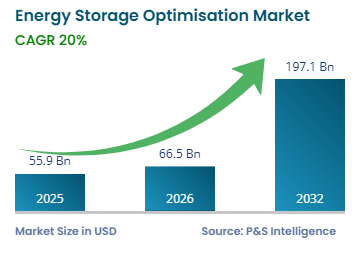
USD 55.9 Billion
Market Size in 2026
USD 66.5 Billion
Market Size by 2032
USD 197.1 Billion
Projected CAGR
20%
Largest Region
North America
Fastest Growing Region
Asia-Pacific
Market Structure
Moderately Fragmented
Market Size
Explore the market potential with our data-driven report
Energy Storage Optimisation Market Overview
The energy storage optimisation market size was USD 55.9 billion for 2025, and it will grow by 20.0% during 2026-2032, to reach USD 197.1 billion by 2032.
The market is expanding because power systems are becoming increasingly dependent on renewable electricity generation, distributed energy infrastructure, and intelligent grid management technologies. Utilities, industrial facilities, and commercial operators are deploying energy storage optimisation platforms to manage fluctuating electricity demand, improve battery efficiency, and maintain grid stability across variable operating conditions. Growing integration of solar and wind projects is increasing the requirement for technologies that can forecast energy demand, balance electricity loads, and optimise charging and discharging cycles in real time. According to the International Renewable Energy Agency, global renewable power capacity increased by 692 GW in 2025, reflecting the rapid expansion of variable renewable electricity generation across global power networks.
Energy providers are also strengthening investments in smart grid infrastructure, battery storage deployments, and cloud-connected energy management systems to improve operational visibility and reduce transmission inefficiencies. Operators are increasingly using artificial intelligence, predictive analytics, and automated dispatch platforms to extend battery lifespan, improve energy utilisation, and support uninterrupted electricity delivery across utilities, microgrids, electric vehicle charging networks, and data centres. Demand is also rising from industries that require stable backup power and flexible electricity management for energy-intensive digital infrastructure and connected industrial operations.
Key Market Insights
Software is the larger component, holding a market share of 80.0%, due to rising deployment of AI-driven battery monitoring and energy dispatch platforms.
Cloud-based is the largest deployment mode, holding a market share of 60.5%, because utilities require remote monitoring across distributed storage networks and smart grids.
Co-located energy storage systems are the fastest-growing installation type, registering a CAGR of 20.4%, driven by expanding solar and wind power integration projects.
North America holds the largest share of 45.5%, due to advanced smart grid infrastructure and large-scale utility battery storage deployment.
Asia-Pacific is the fastest-growing region, registering a CAGR of 21.5%, driven by expanding renewable energy capacity and rising grid modernisation investments.
Energy Storage Optimisation Market Trends and Drivers
AI-Integrated Battery Management and Predictive Energy Dispatch Is a Major Trend
Energy storage optimisation providers are increasingly integrating artificial intelligence, machine learning, and predictive analytics into battery management platforms to improve energy dispatch efficiency and real-time operational control. The industry is moving towards intelligent software capable of forecasting electricity demand, identifying battery degradation patterns, and balancing energy loads across connected storage assets. According to the International Energy Agency, a battery gigafactory could generate up to 10 billion data points per day in 2025, strengthening the use of AI models for battery diagnostics, fault detection, and performance prediction. Companies are also expanding cloud-connected optimisation platforms that support remote asset monitoring, virtual power plant integration, and automated grid orchestration. In 2025, Wärtsilä launched GEMS Pulse, a predictive analytics software platform for battery energy storage systems that uses anomaly detection and real-time analytics for continuous system monitoring.
Rising Renewable Energy Integration and Grid Stability Requirements Drive Market
The market is growing steadily because utilities and grid operators are managing a larger share of electricity generated from renewable energy sources such as solar and wind. These power sources often produce variable output depending on weather conditions and electricity demand patterns, increasing pressure on operators to maintain grid stability and reduce power fluctuations. According to the International Energy Agency, global generation from solar PV and wind increased by a record 670 TWh in 2024, increasing demand for storage optimisation systems that can balance variable renewable electricity. According to the International Renewable Energy Agency, renewables accounted for 49% of global installed power capacity in 2025, strengthening investments in flexible storage infrastructure, intelligent grid management systems, and battery optimisation technologies that improve charging efficiency, regulate electricity flow, and support reliable renewable energy integration across transmission and distribution networks.
High Deployment Complexity and Battery System Integration Challenges Restrain Market Growth
The market faces operational and financial barriers because energy storage optimisation systems often require integration with complex grid infrastructure, battery technologies, renewable energy assets, and legacy energy management platforms. Utilities and industrial operators frequently encounter compatibility issues between hardware systems, optimisation software, and real-time monitoring tools, increasing deployment timelines and implementation costs across large-scale storage projects. According to the International Energy Agency, 1,650 GW of solar and wind projects awaited grid connections in 2024, highlighting how grid bottlenecks continue delaying renewable and storage integration. Operators also require skilled personnel to manage predictive controls, cybersecurity risks, battery diagnostics, and energy dispatch systems across distributed storage networks. These technical and operational challenges are limiting faster adoption across developing energy markets and smaller utility systems with restricted digital infrastructure capabilities.
Expansion of Virtual Power Plants and Decentralised Energy Networks Creates Market Opportunities
The increasing deployment of virtual power plants (VPPs) and distributed energy resources is creating significant opportunities for energy storage optimisation solutions. Utilities, energy providers, and commercial operators are increasingly connecting battery storage systems, solar installations, electric vehicle charging infrastructure, and flexible electricity loads into coordinated networks rather than managing each asset independently. As the number of distributed assets increases, operators require optimisation platforms that can forecast electricity demand, determine when batteries should charge or discharge, balance electricity loads, and coordinate multiple storage assets in real time. This creates greater demand for software and analytics solutions that can improve asset utilisation and support efficient energy dispatch. The expansion of EV charging infrastructure is further increasing this opportunity because large numbers of charging points can create variable and concentrated electricity demand. According to the International Energy Agency, more than 1.3 million public charging points were added globally in 2024, increasing the need for intelligent load management as EV adoption expands.
Energy Storage Optimisation Market Segmentation Analysis
Component Analysis
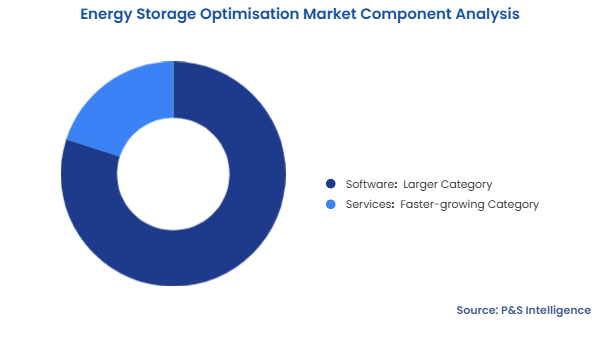
Software is the larger category, holding a market share of 80.0%, due to the increasing adoption of digital platforms for battery monitoring, energy forecasting, automated energy dispatch, and storage asset optimisation. Utilities, renewable energy developers, and commercial and industrial operators are increasingly using optimisation software to monitor battery performance, forecast electricity demand, determine optimal charging and discharging schedules, and manage energy flows across multiple storage assets. The growing integration of artificial intelligence, machine learning, predictive analytics, and cloud-based energy management platforms is further supporting demand for software-based optimisation solutions.
Services is the faster-growing category, registering a CAGR of 20.8%, as energy storage operators increasingly require system integration, implementation, consulting, maintenance, monitoring, and optimisation support. Storage projects often involve the integration of batteries with renewable energy systems, grid infrastructure, energy management platforms, and other digital technologies, creating demand for specialised technical and operational services. Service providers also support customers in configuring optimisation systems, improving battery performance, managing energy dispatch strategies, and maintaining software and connected storage assets throughout their operating life.
The components analysed in this report are:
Software (Larger Category)
Services (Faster-growing Category)
Technology Analysis
Lithium-ion Batteries are the largest category, holding a market share of 25.0%, as lithium-ion technology remains widely deployed across utility-scale energy storage, renewable energy projects, commercial and industrial facilities, and other distributed energy applications. The widespread installed base of lithium-ion storage systems creates significant demand for optimisation solutions that can monitor battery performance, manage charging and discharge cycles, forecast battery behaviour, and improve overall asset utilisation. The technology also benefits from high energy density, fast response capabilities, established manufacturing capacity, and broad compatibility with advanced battery management and energy management systems.
Sodium-based Batteries is the fastest-growing category, registering a CAGR of 20.5%, as energy storage developers and operators are increasingly exploring alternative battery technologies for large-scale stationary storage. Sodium-ion batteries can offer advantages related to material availability, supply-chain diversification, and suitability for certain stationary storage applications. According to the International Energy Agency, sodium-ion battery production remained less than 1% of lithium-ion production in 2025, indicating that the technology is still at an early stage of commercial deployment but is receiving increasing industry attention.
Cloud-Based is the largest category, holding a market share of 60.5%, because utilities and distributed energy operators increasingly prefer remote platforms that support centralised monitoring, battery diagnostics, and real-time operational control across multiple storage locations. Cloud deployment allows operators to forecast electricity demand, analyse battery performance, and optimise energy dispatch without extensive on-site infrastructure requirements. According to the International Energy Agency, global data centres consumed 415 TWh of electricity in 2024, increasing demand for cloud-connected energy management systems capable of supporting continuous operational monitoring and flexible storage control.
Hybrid is the fastest-growing category, registering a CAGR of 20.7%, due to rising demand for flexible deployment models that combine cloud scalability with secure on-premises operational control. Energy operators are increasingly adopting hybrid architectures to manage sensitive grid data locally while benefiting from cloud-based analytics, predictive maintenance, and remote asset optimisation capabilities. The segment is gaining traction across utilities, industrial facilities, and decentralised energy networks where reliable system performance, cybersecurity, and operational flexibility remain critical priorities.
The deployment modes analysed in this report are:
Cloud-Based (Largest Category)
Hybrid (Fastest-growing Category)
On-Premises
Installation Type Analysis
Front-of-the-Meter (FTM) is the largest category, holding a market share of 40.0%, as utilities and grid operators are increasingly deploying large-scale energy storage systems to support grid balancing, renewable energy integration, peak-load management, and electricity reliability. FTM storage assets are typically connected directly to the electricity grid and operate at utility or grid level, creating a strong need for optimisation platforms that can manage large-scale charging and discharging operations, forecast electricity demand, optimise energy dispatch, and support grid services.
Co-located Energy Storage Systems is the fastest-growing category, registering a CAGR of 20.4%, as renewable energy developers increasingly combine energy storage with solar and wind generation projects. Co-located systems allow excess renewable electricity to be stored and dispatched when generation is lower or electricity demand is higher, improving renewable energy utilisation and reducing the impact of variable generation. According to the International Renewable Energy Agency, solar and wind accounted for 96.8% of net renewable capacity additions in 2025, highlighting the continued expansion of variable renewable generation and the growing requirement for flexible storage solutions.
The installation types analysed in this report are:
Front-of-the-Meter (FTM) (Largest Category)
Co-located Energy Storage Systems (Fastest-growing Category)
Behind-the-Meter (BTM)
Microgrids
Standalone Energy Storage Systems
End User Analysis
Utilities is the largest category, holding a market share of 30.0%, due to the increasing deployment of energy storage systems for grid balancing, renewable energy integration, peak-demand management, and electricity reliability. Utilities are increasingly adopting energy storage optimisation solutions to monitor storage assets, forecast electricity demand, optimise charging and discharging schedules, and coordinate battery systems with renewable generation and grid operations. According to the International Energy Agency, utility-scale battery storage additions reached 63 GW in 2024, bringing global installed utility-scale battery storage capacity to 124 GW.
Data Centres are the fastest-growing category, registering a CAGR of 21.2%, as rapid expansion of digital infrastructure, cloud computing, and AI workloads is increasing electricity consumption and creating greater requirements for reliable and flexible power management. Data centre operators are increasingly deploying battery storage systems to provide backup power, manage peak electricity demand, improve energy efficiency, and integrate renewable electricity. This is creating demand for optimisation platforms capable of monitoring battery performance, forecasting power requirements, managing charging and discharging cycles, and coordinating storage with on-site power systems.
The end users analysed in this report are:
Utilities (Largest Category)
Data Centres (Fastest-growing Category)
Residential
Commercial
Industrial
Transportation
Telecom
Others
Drive strategic growth with comprehensive market analysis
Energy Storage Optimisation Market Regional Analysis
North America Energy Storage Optimisation Market Analysis
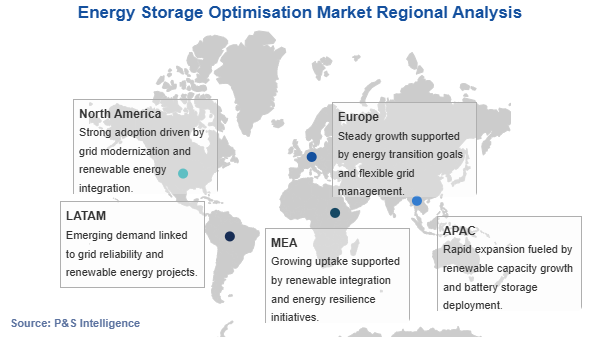
North America holds the largest share, of 45.5%, because the region has an established grid modernisation ecosystem, large-scale battery storage deployments, and strong utility investments in advanced energy management systems. Energy providers across the U.S. and Canada are actively integrating storage optimisation platforms into renewable energy projects, transmission infrastructure, and distributed power networks to improve grid resilience and operational flexibility. The region also benefits from early adoption of AI-enabled energy software, advanced battery analytics, and utility-scale storage technologies supported by favourable clean energy policies and private sector investments. In addition, growing electricity demand from data centres, EV charging corridors, and industrial operations is increasing the need for intelligent storage optimisation solutions that can manage energy loads efficiently under complex grid conditions. The presence of major technology developers, battery manufacturers, and smart grid companies further strengthens the regional market landscape.
U.S. Energy Storage Optimisation Market Analysis
The U.S. maintains a highly developed energy storage ecosystem supported by utility-scale battery deployments, advanced smart grid infrastructure, and large investments in renewable energy integration technologies. Utilities and independent power operators are increasingly implementing optimisation software to manage grid congestion, improve peak load balancing, and strengthen resilience against weather-related power disruptions. According to the U.S. Energy Information Administration, U.S. generators added 10.4 GW of new utility-scale battery storage capacity in 2024. The country is also witnessing rising demand from data centres, EV charging operators, and commercial facilities requiring intelligent energy management, backup power support, and real-time battery monitoring across expanding digital and distributed energy infrastructure networks.
Canada Energy Storage Optimisation Market Analysis
Canada is witnessing rising adoption of energy storage optimisation technologies due to expanding renewable energy projects, remote power infrastructure requirements, and increasing focus on grid reliability across harsh climatic regions. Provincial utilities and energy developers are integrating storage systems into hydroelectric, solar, and wind projects to improve electricity balancing across distributed energy networks. According to the Canada Energy Regulator, Canada had 552 MW of grid-connected energy storage capacity above 1 MW in 2024. The country is also investing in microgrid development and decentralised energy infrastructure for northern and remote communities requiring reliable battery monitoring, intelligent energy dispatch, and flexible power management across isolated electricity networks.
Asia-Pacific Energy Storage Optimisation Market Analysis
Asia-Pacific has the highest CAGR, of 21.5%, as countries across the region are rapidly expanding renewable energy capacity, battery manufacturing infrastructure, and decentralised power systems. Governments are investing heavily in grid modernisation, rural electrification, and large-scale energy transition programs, creating strong demand for storage optimisation technologies that improve energy balancing and grid reliability. China, India, Japan, and South Korea are actively deploying battery storage systems to support solar and wind integration, while urban expansion and industrial growth continue to increase electricity consumption across the region. The growing rollout of electric vehicle charging infrastructure and smart city projects is also accelerating the adoption of intelligent energy management platforms. In addition, regional battery supply chain expansion and domestic clean energy manufacturing initiatives are encouraging wider deployment of optimised storage solutions across utility, commercial, and industrial applications.
China Energy Storage Optimisation Market Analysis
China maintains a dominant position in the market because of its large-scale battery manufacturing industry, rapid renewable energy expansion, and aggressive deployment of utility-scale storage infrastructure. Energy providers are increasingly implementing optimisation platforms to manage large solar and wind installations connected to densely populated industrial and urban power networks. According to the Government of China, the installed capacity of new energy storage projects reached 73.76 million kW in 2024. The country is also accelerating deployment of virtual power plants, integrated EV charging infrastructure, and smart grid systems requiring predictive battery management, automated energy balancing, and continuous operational monitoring across large-scale renewable electricity and storage networks.
India Energy Storage Optimisation Market Analysis
India is emerging as a fast-growing market due to rising electricity demand, expanding renewable energy capacity, and increasing investment in grid modernisation initiatives. Energy storage optimisation technologies are gaining traction across solar parks, industrial facilities, and state-level utility projects requiring efficient power balancing and reliable electricity management. According to the Press Information Bureau of India, India increased the BESS VGF scheme capacity from 4,000 MWh to 13,200 MWh in 2025. The country is also witnessing the rapid expansion of EV charging infrastructure and decentralised renewable energy systems, increasing demand for intelligent storage optimisation platforms supporting real-time monitoring, automated dispatch control, and flexible energy management across distributed power networks.
Europe Energy Storage Optimisation Market Analysis
Europe is experiencing steady growth in the energy storage optimisation market as countries accelerate renewable energy deployment, modernise electricity grids, and increase the need for flexible power management. The growing share of variable renewable generation from solar and wind is creating greater requirements for technologies that can optimise charging and discharging schedules, balance electricity supply and demand, and improve the utilisation of energy storage assets. According to the European Commission's Joint Research Centre, Europe currently has around 66 GW of operational energy storage power capacity, while planned projects could increase this capacity to approximately 132 GW by 2035. The expected expansion of storage infrastructure is creating increasing demand for optimisation platforms that can monitor storage assets, automate energy dispatch, forecast electricity demand, and coordinate storage with renewable generation and grid operations.
The regions and countries analysed in this report are:
North America (Largest Regional Market)
U.S. (Larger Country)
Canada (Faster-Growing Country)
Europe
Germany (Largest Country)
U.K. (Fastest-Growing Country)
France
Italy
Spain
Rest of Europe
Asia-Pacific (Fastest-Growing Regional Market)
China (Largest Country)
India (Fastest-Growing Country)
Japan
South Korea
Australia
Rest of APAC
Latin America
Brazil (Largest and Fastest-Growing Country)
Mexico
Rest of LATAM
Middle East and Africa
Saudi Arabia (Largest and Fastest-Growing Country)
U.A.E.
South Africa
Rest of MEA
Energy Storage Optimisation Market Competitive Landscape
The energy storage optimisation market is moderately fragmented, with competition spread across specialised energy storage software providers, energy management technology companies, battery analytics providers, and integrated energy technology companies. Market participants are differentiating their offerings through advanced optimisation algorithms, artificial intelligence and predictive analytics, real-time battery monitoring, automated energy dispatch, and integration with renewable energy and grid management systems. The competitive landscape reflects the diverse requirements of energy storage operators, who need solutions compatible with different battery technologies, energy management systems, grid infrastructure, and electricity-market conditions. Smaller specialised providers compete through application-specific optimisation capabilities and customised solutions, while larger energy technology companies benefit from broader hardware, software, and system-integration capabilities.
Leading Companies in the Energy Storage Optimisation Market:
Fluence Energy, Inc.
Tesla, Inc.
Stem, Inc.
Wartsila Corporation
Schneider Electric SE
Siemens AG
ABB Ltd.
GE Vernova Inc.
Honeywell International Inc.
Eaton Corporation plc
Hitachi Energy Ltd.
Energy Vault Holdings, Inc.
Energy Storage Optimisation Market Developments
In April 2026, Schneider Electric launched Schneider Boost Pro in the U.K. as a battery energy storage system for commercial and industrial sites. The release positioned the product within building energy management, combining storage hardware with power distribution, edge control, software, and service support for local energy scheduling and site-level flexibility.
In October 2025, Honeywell entered into a global strategic collaboration with LS ELECTRIC to jointly develop and market integrated power-management solutions for data centres and commercial and industrial buildings. The collaboration includes the development of a grid- and building-aware battery energy storage system (BESS) that combines LS ELECTRIC’s energy storage technology with Honeywell’s dynamic energy control software.
In October 2025, Wartsila Corporation launched GEMS Pulse, a software product for battery energy storage analytics. The release described a platform that uses cell-to-fleet data to track asset condition, identify anomalies, and support operating decisions. It fits energy storage optimisation because it is built for performance monitoring and lifecycle control, not new battery hardware.
In September 2025, Stem, Inc. launched PowerTrack EMS, an energy management system for standalone and hybrid energy storage projects. The platform combines onsite controls with cloud-based software to optimise battery operations, coordinate grid services, and provide portfolio-level asset visibility.
Frequently Asked Questions About This Report
What does the energy storage optimization market include for organizations?+
It includes software and control systems that manage battery charging, discharging, forecasting, dispatch, and asset performance.
What factors are driving demand in the energy storage optimization market?+
Growth is driven by renewable integration, grid flexibility needs, electricity price variation, resilience goals, and storage asset deployment.
Why are organizations adopting energy storage optimization solutions across operations?+
Utilities and businesses adopt optimization tools to improve storage revenue, reliability, battery life, and coordination with generation or load.
How do energy storage optimization solutions improve decision making and efficiency?+
These solutions improve operations by forecasting demand, scheduling charge cycles, reducing degradation, and supporting better grid participation.
What challenges affect adoption of energy storage optimization solutions today?+
Adoption is affected by market rules, data quality, battery chemistry, forecasting accuracy, controls integration, and changing energy prices.
Want a report tailored exactly to your business need?
Leading companies across industries trust us to deliver data-driven insights and innovative solutions for their most critical decisions. From data-driven strategies to actionable insights, we empower the decision-makers who shape industries and define the future. From Fortune 500 companies to innovative startups, we are proud to partner with organisations that drive progress in their industries.
Client Testimonials
Working with P&S Intelligence and their team was an absolute pleasure – their awareness of timelines and commitment to value greatly contributed to our project's success. Eagerly anticipating future collaborations.
McKinsey & Company
India
Unmatched Standards
Our insights into the minutest levels of the markets, including the latest trends and competitive landscape, give you all the answers you need to take your business to new heights
Complete Data Security
We take a cautious approach to protecting your personal and confidential information. Trust is the strongest bond that connects us and our clients, and trust we build by complying with all international and domestic data protection and privacy laws