Electric Vehicle Market Size & Share Analysis - Trends, Drivers, Competitive Landscape, and Forecasts (2026 - 2032)
This Report Provides In-Depth Analysis of the Electric Vehicle Market Report Prepared by P&S Intelligence, Segmented by Component (Hardware, Software), Vehicle Type (Battery Electric Vehicles, Plug-in Hybrid Electric Vehicles, Hybrid Electric Vehicles, Fuel Cell Electric Vehicles), End-User (Passenger Transportation, Commercial Transportation, Industrial & Utility Applications), Battery Type (Lithium-ion Battery, Nickel Metal Hydride Battery, Lead Acid Battery, Solid-State Battery), Charging Type (AC Charging, DC Fast Charging), and Geographical Outlook for the Period of 2021 to 2032
Explore the market potential with our data-driven report
Electric Vehicle Market Overview
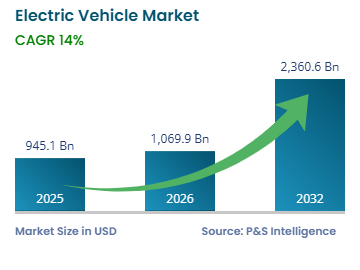
The electric vehicle market size was USD 945.1 billion for 2025, and it will grow by 14.0% during 2026-2032, to reach USD 2,360.6 billion by 2032.
The market is expanding because electric vehicles are becoming a practical shift from fuel-based transport rather than only an environmental choice. Governments are tightening emission standards, cities are supporting cleaner mobility, and automakers are increasing electric model launches to meet these policy changes. This is making electric vehicles more visible across passenger cars, commercial fleets, public transport, and shared mobility services. Buyers are also becoming more comfortable with electric vehicles as battery range improves, charging access expands, and more models enter different price ranges. According to the International Energy Agency, global electric car sales exceeded 17 million units in 2024, rising by more than 25% year-on-year. This shows that adoption is moving beyond early users and becoming part of mainstream vehicle demand.
The market is also being driven by operating cost benefits for businesses and individual users. Electric vehicles have fewer moving parts than internal combustion engine vehicles, which can reduce maintenance needs, while electricity can lower running costs compared with petrol and diesel in many markets. Fleet operators, delivery companies, ride-hailing platforms, and public agencies are adopting electric vehicles to manage fuel spending and meet sustainability targets. Moreover, investment in batteries, local manufacturing, and EV charging infrastructure is improving vehicle availability and usability. This is encouraging automakers, battery suppliers, charging companies, and energy providers to expand capacity, which supports stronger long-term market growth.
Key Market Insights
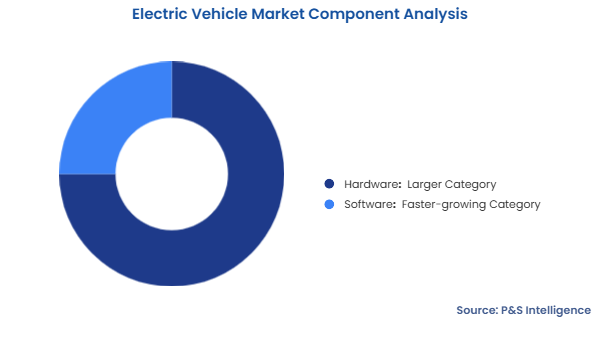
Hardware is the larger component, holding a market share of 75%, due to high reliance on batteries, motors, and power electronics
Software is the faster-growing component, registering a CAGR of approximately 14.5%, driven by increasing integration of connected features and vehicle intelligence systems
Battery Electric Vehicles are the largest vehicle type, holding a market share of 45%, due to zero-emission operation and strong government-backed adoption programs
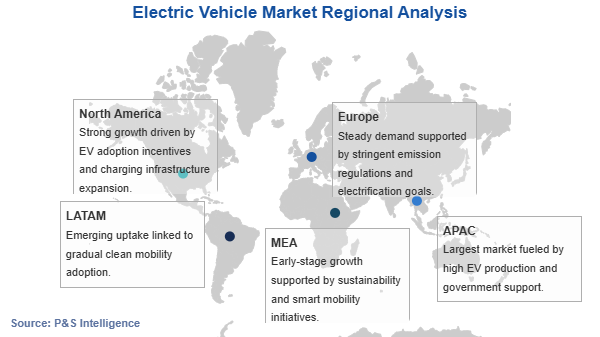
Asia-Pacific holds the largest share of 40%, due to strong local manufacturing ecosystems and large-scale domestic electric vehicle production capacity
North America is the fastest-growing region, registering a CAGR of approximately 14.9%, driven by rising fleet electrification and expansion of fast-charging infrastructure
Electric Vehicle Market Trends and Drivers
Shift toward Advanced Battery Technologies and New EV Launches Is Major Trend
The industry is shifting toward higher-performance batteries and improved electric vehicle designs to increase driving range, reduce charging time, and improve daily usability. This shift is driven by consumer concerns over range limits, long charging periods, and vehicle performance, which remain key barriers to wider electric vehicle adoption. According to the International Energy Agency, global battery demand for the energy sector reached 1 TWh in 2024, with electric vehicle battery demand rising to over 950 GWh, while more than 1.3 million public charging points were added globally, increasing by over 30% in 2024. Moreover, stronger battery capacity and wider charging access are helping automakers launch more competitive models, improve vehicle reliability, and support faster adoption across passenger cars, commercial fleets, and long-distance mobility applications.
Government Policies and Incentives Supporting EV Adoption Drive Market
The market is growing due to strong government support accelerating electric vehicle adoption across both consumer and commercial segments. This is driven by stricter emission standards, direct purchase subsidies, tax benefits, and public investment in charging infrastructure, which reduce upfront costs and improve ownership feasibility for end users. According to the International Energy Agency, electric car sales in emerging and developing economies across Asia, Latin America, and Africa grew by over 60% in 2024, while global sales of electric medium- and heavy-duty trucks increased by nearly 80% in 2024. Moreover, these policy measures are pushing automakers to scale electric vehicle production, encouraging fleet operators to replace diesel vehicles, and supporting infrastructure expansion, which together strengthen adoption across passenger mobility, logistics, and public transport applications.
High Battery Costs and Limited Charging Infrastructure
The market faces constraints due to the high upfront cost of electric vehicles and limitations in charging infrastructure. This is primarily driven by expensive battery systems, which significantly increase vehicle prices, and the limited availability of high-speed charging required for convenient long-distance travel. In 2024, battery electric heavy-duty trucks cost two to three times more than diesel equivalents due to battery expenses. According to the International Energy Agency, ultra-fast chargers accounted for only 10% of global fast charging infrastructure in 2024. The cost barriers and insufficient fast-charging availability continue to slow widespread adoption.
Expansion of Charging Networks and Integration with Renewable Energy
The market presents strong opportunities due to increasing investments in expanding charging infrastructure across regions. This is driven by the need to improve accessibility and support widespread electric vehicle adoption for daily and long-distance use. According to the International Energy Agency, the global stock of public charging points exceeded 5 million by the end of 2024, doubling since 2022. The expanding charging networks are enabling new business models such as smart charging, battery swapping, and energy integration, while improving user convenience and accelerating market growth.
Electric Vehicle Market Segmentation Analysis
Component Analysis
Hardware is the largest category, holding a market share of 75%, because electric vehicle components such as batteries, motors, and power electronics account for a significant share of total vehicle cost and value. These components account for a significant share of total vehicle cost and value, driving higher spending. According to the International Energy Agency (IEA), global electric vehicle battery demand reached around 1 TWh in 2024, with electric cars contributing over 950 GWh. Rising production volumes and continuous component upgrades sustain strong demand for hardware systems.
Software is the fastest-growing category, registering a CAGR of approximately 14.5%, because modern electric vehicles are becoming more connected and intelligent. Automakers are adding features like energy management, remote monitoring, and over-the-air updates. These systems improve performance and user experience without changing physical parts. As vehicles become more digital, demand for advanced software platforms and data-driven services is increasing rapidly across both personal and commercial use cases.
The components analysed in this report are:
Hardware (Larger Category)
Software (Faster-growing Category)
Vehicle Type Analysis
Battery Electric Vehicles are the largest category, holding a market share of 45%, because they offer a fully electric driving experience with no fuel dependency. Many governments and consumers prefer these vehicles due to lower emissions and simpler design compared to hybrid options. Improvements in battery range and charging availability have also made them more practical.
Plug-in Hybrid Electric Vehicles are the fastest-growing category, registering a CAGR of approximately 14.7%, because they offer a balance between electric driving and fuel backup. This flexibility addresses concerns related to limited charging infrastructure and range anxiety. According to the International Energy Agency, global PHEV sales grew by about 45% in 2024, compared to around 15% for battery electric vehicles. Their dual capability is accelerating adoption, particularly in regions with developing charging networks, while also increasing demand for Hybrid & EV Battery systems that support flexible mobility solutions.
The vehicle types analysed in this report are:
Battery Electric Vehicles (Largest Category)
Plug-in Hybrid Electric Vehicles (Fastest-growing Category)
Hybrid Electric Vehicles
Fuel Cell Electric Vehicles
End-User Analysis
Passenger Transportation is the largest category, holding a market share of 45%, because electric vehicles are primarily used for personal mobility and daily commuting. Strong consumer demand and a wide range of available models support this dominance. The global electric car fleet reached nearly 58 million vehicles by the end of 2024, with passenger cars accounting for the majority of light-duty electric vehicles. The continued consumer adoption and model expansion are sustaining the segment’s leading position in the market.
Commercial Transportation is the fastest-growing category, because businesses are increasingly adopting Commercial Electric Vehicles to reduce fuel and maintenance costs. Delivery services, ride-hailing, and public transport operators are adopting electric vehicles at a faster pace. These vehicles run frequently, so cost savings are more noticeable. Companies are also under pressure to reduce emissions, which is pushing faster electrification in commercial use.
Lithium-ion Battery is the largest category, because it is widely used due to its high energy density and reliability. Most electric vehicles today depend on this battery type for better range and performance. It also supports faster charging compared to older technologies. Continuous improvements and large-scale production have made it the standard choice across the industry.
Solid-State Battery is the fastest-growing category, because it offers higher energy density and improved safety compared to conventional lithium-ion systems. This is driven by increasing investments and advancements in next-generation battery technologies. According to the International Energy Agency, global battery manufacturing capacity exceeded 3 TWh in 2024, while solid-state batteries remain at the pilot stage (TRL 6) with companies targeting initial mass production between 2027 and 2028. The ongoing technological development and scaling efforts are expected to accelerate future adoption.
The battery types analysed in this report are:
Lithium-ion Battery (Largest Category)
Solid-State Battery (Fastest-growing Category)
Nickel Metal Hydride Battery
Lead Acid Battery
Charging Type Analysis
AC Charging is the larger category, holding a market share of 70%, because it is widely used in residential and workplace settings where vehicles remain parked for extended periods. Its lower installation cost and ease of deployment make it more accessible than fast charging systems. According to the International Energy Agency, slow chargers accounted for approximately 60% of the more than 5 million public charging points globally in 2024. The widespread availability and cost advantages continue to support its dominance.
DC Fast Charging is the faster-growing category, because it significantly reduces charging time and supports long-distance travel. Users who need quick top-ups during journeys rely on this option. Governments and private players are also expanding fast-charging networks along highways and urban areas. As demand for convenience increases, adoption of high-speed charging solutions is rising rapidly.
The charging types analysed in this report are:
AC Charging (Larger Category)
DC Fast Charging (Faster-growing Category)
Drive strategic growth with comprehensive market analysis
Electric Vehicle Market Geographical Analysis
Asia-Pacific Electric Vehicle Market Analysis
Asia-Pacific holds the largest share, of 40%, because the region has a large population base, rapid urbanization, rising vehicle demand, and strong government focus on clean transportation. Countries here support local battery production and vehicle assembly, which lowers costs and improves availability. Urban air quality concerns are also pushing for a faster transition to electric mobility. In addition, high population density and rising middle-class demand are increasing vehicle sales. Public and private players are actively expanding charging networks, while local brands are introducing affordable models. This combination of supply strength and demand growth keeps the region ahead in overall market size.
China Electric Vehicle Market Analysis
China leads the market due to strong government support across manufacturing, supply chains, and charging infrastructure. Large-scale domestic production reduces vehicle costs and supports widespread adoption, particularly in urban areas. The country also benefits from strong competition and continuous advancements in battery technology. Production of new energy vehicles reached 12.888 million units in 2024, increasing by 34.4% year-on-year. The high production volumes and policy-driven expansion continue to strengthen China’s dominance in the electric vehicle market.
India Electric Vehicle Market Analysis
India is experiencing rapid growth due to strong government initiatives promoting electric mobility to reduce fuel dependence and emissions. The market is driven by demand for affordable electric vehicles, particularly in two-wheelers and small passenger cars. Local manufacturing efforts are improving cost competitiveness, while infrastructure is gradually expanding. According to the Press Information Bureau, electric two-wheeler sales reached 10,42,172 units in FY 2024–25, growing by 21% over the previous year. The increasing affordability and policy support are accelerating adoption across the country.
North America Electric Vehicle Market Analysis
North America has the highest CAGR, of approximately 14.9%, because the region is seeing strong momentum from policy support, corporate fleet electrification, and growing consumer acceptance of electric vehicles. Automakers are investing heavily in new electric models and local battery production facilities. There is also a rising focus on building fast-charging corridors to support long-distance travel. Businesses are shifting toward electric delivery and logistics vehicles to manage operating costs. At the same time, technology integration in vehicles is attracting buyers. These factors together are accelerating growth at a faster pace compared to other regions.
U.S. Electric Vehicle Market Analysis
The U.S. market is driven by strong investments from automakers and rising demand for electric pickup trucks and SUVs. Expanding highway charging infrastructure and supportive federal and state policies are improving long-distance usability and adoption. Technology companies are also contributing to advancements in software and battery systems. According to the U.S. Department of Energy, plug-in electric vehicle sales reached 1,412,298 units in 2024, increasing by 9% year-on-year. The innovation and policy support continue to strengthen market growth.
Canada Electric Vehicle Market Analysis
Canada is witnessing steady growth due to government incentives and a strong focus on reducing emissions. Investments in clean energy support electric vehicle adoption, while expanding charging infrastructure improves accessibility across regions. Cold climate conditions are also driving improvements in battery performance and reliability. According to Statistics Canada, electric vehicles accounted for 5.2% of light-duty vehicle registrations in 2024, up from 3.9% in 2023. The increasing adoption and infrastructure expansion are supporting market development.
Europe Electric Vehicle Market Analysis
Europe is steadily advancing in the electric vehicle market due to strict emission regulations and clear timelines for reducing fuel-based vehicle usage. Governments are enforcing policies that push automakers to increase electric vehicle offerings. Consumers are also more aware of environmental impact, which supports adoption. The region has a well-developed charging infrastructure, especially in urban areas. Automakers in Europe are focusing on expanding electric lineups across different vehicle categories. Continuous regulatory pressure and strong sustainability goals are shaping long-term growth in this market.
The regions and countries analysed in this report are:
North America (Fastest-Growing Regional Market)
U.S. (Larger Country)
Canada (Faster-Growing Country)
Europe
Germany (Largest Country)
U.K. (Fastest-Growing Country)
France
Italy
Spain
Rest of Europe
Asia-Pacific (Largest Regional Market)
China (Largest Country)
India (Fastest-Growing Country)
Japan
South Korea
Australia
Rest of APAC
Latin America
Brazil (Largest Country)
Mexico (Fastest-Growing Country)
Rest of LATAM
Middle East and Africa
Saudi Arabia (Fastest-Growing Country)
U.A.E. (Largest Country)
South Africa
Rest of MEA
Electric Vehicle Market Share Analysis
The market is fragmented because the industry includes many different types of companies competing in separate areas such as vehicle manufacturing, batteries, charging infrastructure, software systems, and energy management solutions. Demand also differs across passenger vehicles, commercial fleets, buses, and two-wheelers, allowing multiple companies to specialize in different segments rather than one company dominating the entire market. In addition, regional preferences, government policies, pricing differences, and varying levels of charging infrastructure create opportunities for both global and local manufacturers to compete simultaneously.
Electric Vehicle Manufacturers:
BYD Company Limited
Tesla Incorporated
Volkswagen Group
Toyota Motor Corporation
Hyundai Motor Company
General Motors Company
Ford Motor Company
Stellantis
Bayerische Motoren Werke
Mercedes Benz Group
Nissan Motor Company Limited
Renault Group
SAIC Motor Corporation Limited
Zhejiang Geely Holding Group
Chery Automobile Company Limited
Electric Vehicle Market News
In March 2026, Kia Corporation began production of its EV2 compact electric SUV at its Žilina plant in Slovakia, introducing an entry-level battery electric model aimed at strengthening its affordable EV portfolio and expanding its presence in the European market.
In January 2026, Toyota Motor Corporation unveiled the Urban Cruiser electric SUV, marking its entry into India’s mass-market EV segment with a mid-size electric SUV while supporting the company’s broader strategy to expand its global electric vehicle portfolio.
In January 2025, Maruti Suzuki India Limited unveiled the eVitara, its first electric SUV, at the Bharat Mobility Global Expo, marking the company’s entry into the electric vehicle segment with a mid-size model aimed at mass-market adoption in India and global markets.
In February 2026, Tata Motors Limited launched the facelifted Tata Punch EV in India, marking the first major update since its debut. The updated model introduced enhanced features, improved battery performance, fast-charging capability, and an extended driving range, supporting the company’s strategy to improve affordability and accelerate mass-market electric vehicle adoption.
Frequently Asked Questions About This Report
What is driving growth in the electric vehicle market?+
Government policies, falling battery costs, charging expansion, and wider model availability are driving adoption across passenger cars, commercial fleets, and public transport.
Why are electric vehicles becoming popular among fleet operators?+
Fleet operators are adopting electric vehicles to reduce fuel use, lower maintenance needs, meet emission targets, and improve long-term operating efficiency.
How do government incentives support electric vehicle adoption?+
Government incentives reduce upfront purchase costs through subsidies, tax benefits, and charging support, making electric vehicles more affordable for buyers and businesses.
What are the main challenges facing electric vehicle adoption?+
High vehicle prices, charging gaps, battery performance concerns, and range anxiety remain key challenges, especially in regions with weak charging infrastructure.
Why is battery technology important for electric vehicles?+
Battery technology affects driving range, charging speed, vehicle cost, safety, and performance, making it central to electric vehicle competitiveness.
Want a report tailored exactly to your business need?
Leading companies across industries trust us to deliver data-driven insights and innovative solutions for their most critical decisions. From data-driven strategies to actionable insights, we empower the decision-makers who shape industries and define the future. From Fortune 500 companies to innovative startups, we are proud to partner with organisations that drive progress in their industries.
Client Testimonials
Working with P&S Intelligence and their team was an absolute pleasure – their awareness of timelines and commitment to value greatly contributed to our project's success. Eagerly anticipating future collaborations.
McKinsey & Company
India
Unmatched Standards
Our insights into the minutest levels of the markets, including the latest trends and competitive landscape, give you all the answers you need to take your business to new heights
Complete Data Security
We take a cautious approach to protecting your personal and confidential information. Trust is the strongest bond that connects us and our clients, and trust we build by complying with all international and domestic data protection and privacy laws