This Report Provides In-Depth Analysis of the Battery Passport Market Report Prepared by P&S Intelligence, Segmented by Battery Type (Lithium-ion Batteries, Lead-acid Batteries, Sodium-ion Batteries, Solid-state Batteries), Application (Electric Vehicles, Energy Storage Systems, Consumer Electronics, Industrial Applications), Technology (Blockchain-based, IoT & AI-integrated, Cloud/SaaS-based Platforms), Component (Software Platforms, Services), End User (Automotive OEMs, Recycling & Second-life Operators, Battery Manufacturers, Energy Utilities & Grid Operators, Regulatory Bodies & Certification Agencies), and Geographical Outlook for the Period of 2021 to 2032
Explore the market potential with our data-driven report
Battery Passport Market Overview
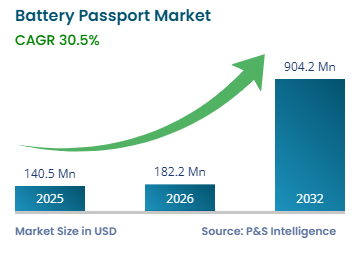
The battery passport market size was USD 140.5 million for 2025, and it will grow by 30.5% during 2026–2032, to reach USD 904.2 million by 2032.
The market growth is driven by the rapid scaling of global electric vehicle supply chains, increasing cross-border movement of lithium-ion batteries, and the tightening of regulatory requirements around battery traceability, safety, and lifecycle transparency. The market's structural expansion is strongly anchored in the global electrification momentum. The International Energy Agency reports that global electric vehicle sales surpassed 14 million units in 2023, representing nearly 18% of total automotive sales, creating significant demand for standardized battery lifecycle transparency and traceability systems across automotive supply chains.
Simultaneously, the European Commission has mandated digital battery passport implementation under its revised Battery Regulation framework, requiring full lifecycle traceability of electric vehicle and industrial batteries above specified thresholds, including carbon footprint tracking and material sourcing transparency, significantly accelerating market adoption.
Key Market Insights
The lithium-ion batteries category holds the largest market share, of 40%, in 2025, due to widespread use across EVs, energy storage, and electronics.
The sodium-ion batteries category will have the highest CAGR, of approximately 30.7%, driven by rising commercialization and investment in alternative chemistries.
The IoT & AI-integrated category will have the highest CAGR, of approximately 30.8%, driven by demand for real-time monitoring and predictive analytics.
The automotive OEMs category holds the largest market share in 2025, of 35%, due to their role in integrating batteries and managing lifecycle data.
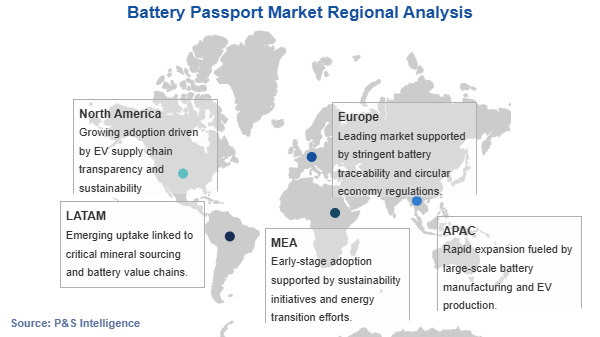
Europe holds the largest market share, of 40%, in 2025, supported by a strong automotive ecosystem and integrated battery value chains.
Battery Passport Market Trends and Drivers
Convergence of Blockchain, IoT, and AI-Driven Battery Identity Systems Is Key Trend
The battery passport market is being reshaped by the integration of blockchain-based identity frameworks, IoT-enabled battery monitoring, and AI-driven lifecycle analytics, enabling real-time verification of battery origin, composition, carbon intensity, and performance data. This transformation is converting static compliance documentation into dynamic digital identity systems embedded across the battery lifecycle. The growing adoption of digital battery identities is improving traceability, data transparency, and sustainability reporting, while enabling manufacturers, recyclers, and regulators to access verified battery information throughout the value chain. Additionally, industry-led initiatives such as those by the Global Battery Alliance are accelerating the development of standardized battery passport frameworks, promoting interoperability and consistent data exchange across global battery ecosystems.
Regulatory enforcement is accelerating this trend. The European Commission has mandated battery passport implementation from February 2027 under Regulation (EU) 2023/1542, requiring digital battery passports for electric vehicle batteries, industrial batteries above 2 kWh, and light means of transport batteries placed on the EU market. The regulation requires disclosure of information such as carbon footprint, battery composition, recycled content, and end-of-life management data, encouraging the deployment of blockchain-backed traceability platforms and connected battery monitoring systems. Compliance digitization is becoming mandatory across battery value chains, driving investments in integrated IoT, AI, and blockchain technologies that support battery lifecycle transparency and regulatory compliance.
Rapid EV Expansion and Mandatory Supply Chain Transparency Requirements Are Biggest Drivers
The primary driver is the rapid growth of electric mobility, which is increasing demand for structured battery tracking, digital identity systems, and compliance frameworks across global supply chains. The rise in EV production has created complex cross-border battery value chains, requiring standardized digital systems to ensure traceability, regulatory compliance, and lifecycle transparency. As battery supply chains become more globalized and multi-tiered, the need for verifiable data on battery origin, composition, and usage history is becoming critical for manufacturers, regulators, and recyclers.
The International Energy Agency reports that global electric vehicle stock surpassed 40 million units in recent years, significantly increasing battery lifecycle complexity and data management requirements. Additionally, policy frameworks such as the Inflation Reduction Act, with approximately USD 369 billion allocated to clean energy and EV supply chains, are reinforcing domestic sourcing, sustainability compliance, and supply chain transparency, thereby indirectly supporting the adoption of digital battery tracking and compliance systems across global battery ecosystems.
Fragmented Supplier Data and Interoperability Gaps Are Key Restraints
Despite strong regulatory and commercial demand, the implementation of battery passports is constrained by fragmented supplier data ecosystems and limited interoperability across complex multi-tier supply chains. Battery value chains span mining, refining, cell manufacturing, pack assembly, and end-of-life management across multiple geographies, with participants operating on heterogeneous data systems and varying levels of digital maturity. Research published in Frontiers in Sustainable Resource Management highlights that gaps in data availability, fragmented ICT infrastructure, lack of standardized data exchange mechanisms, and high administrative compliance burdens are key barriers to battery passport readiness, particularly among small and medium-sized enterprises with limited digital capabilities.
The challenge is further amplified at upstream levels, where mineral suppliers in regions such as Latin America and Africa often lack the infrastructure required to generate and share standardized sourcing and ESG data. In the absence of globally aligned data standards, manufacturers face divergent compliance requirements across regions, increasing integration complexity and operational costs. While standardization efforts through GS1 identifiers and EPCIS-based traceability frameworks are progressing, the pace of adoption remains uneven across the value chain, creating data consistency risks and slowing large-scale battery passport implementation.
Expansion of Circular Economy and Battery Recycling Ecosystems Are Biggest Opportunities
The rapid expansion of battery recycling, second-life usage, and circular economy systems is creating a significant opportunity for battery passport platforms to serve as foundational digital infrastructure beyond regulatory compliance. As the volume of end-of-life batteries increases, digital battery passports enable traceability of recovered materials, lifecycle emissions, battery chemistry, and reuse potential, supporting efficient resource recovery and secondary market development. This is becoming increasingly important as battery value chains transition toward closed-loop systems, where accurate lifecycle data is required to maximize material efficiency and sustainability outcomes.
The International Energy Agency reports that global battery recycling capacity exceeded 300 GWh per year in 2023, with announced projects expected to significantly expand capacity by 2030. In addition, the European Patent Office and International Energy Agency highlight that battery circularity innovation patent filings grew at an average annual rate of around 42% between 2017 and 2023. The analysis further indicates that approximately 1.2 million electric vehicle batteries are expected to reach end-of-life in 2030, increasing to around 14 million by 2040. These trends are driving the need for scalable digital systems capable of supporting battery diagnostics, second-life assessment, and optimized recycling processes, creating a strong commercial opportunity for battery passport platforms within the evolving circular battery ecosystem.
Battery Passport Market Segmentation Analysis
Battery Type Analysis
The lithium-ion batteries category holds the largest market share, of 40%, in 2025, driven by its dominant use across electric vehicles, stationary energy storage systems, and consumer electronics. Their widespread adoption across global supply chains, combined with increasing regulatory requirements for lifecycle transparency, has positioned lithium-ion batteries at the center of battery passport integration. The International Energy Agency reported that global EV sales exceeded 17 million units in 2024, further strengthening demand for lithium-ion battery traceability and lifecycle data management systems.
The sodium-ion batteries category will have the highest CAGR, of approximately 30.7%, driven by accelerating commercialization of sodium-ion technology and growing investments in alternative battery chemistries. In April 2025, Contemporary Amperex Technology Co. Limited launched its Naxtra sodium-ion battery brand, with mass production scheduled to begin in late 2025. The battery achieves an energy density of 175 Wh/kg, approaching the performance of lithium iron phosphate (LFP) batteries and supporting broader adoption across electric mobility and energy storage applications.
The electric vehicles category holds the largest market share, of 40%, in 2025, driven by large-scale global EV production and increasingly complex cross-border battery supply chains requiring traceability, compliance validation, and lifecycle tracking under evolving regulatory frameworks. EV manufacturers are the primary adopters of battery passport systems due to high-volume battery flows and strong regulatory pressure from European authorities.
The energy storage systems category will have the highest CAGR, driven by the rapid expansion of stationary battery deployments for grid stabilization and renewable energy integration. These systems fall under the scope of industrial batteries in the EU Battery Regulation, particularly those above 2 kWh, making them subject to passport requirements. In July 2025, the European Commission introduced new rules requiring recyclers to achieve 90% material recovery rates for cobalt, copper, lead, and nickel and 50% for lithium by 2027, with targets increasing to 95% and 80%, respectively, by 2031. These requirements are increasing the need for traceability, material recovery verification, and lifecycle data management across stationary battery value chains, thereby accelerating the adoption of battery passport solutions.
The applications analyzed in this report are:
Electric Vehicles (Largest Category)
Energy Storage Systems (Fastest-Growing Category)
Consumer Electronics
Industrial Applications
Others
Technology Analysis
The blockchain-based category holds the largest market share, of 40%, in 2025, driven by early regulatory enforcement in Europe, where immutable and tamper-proof digital lifecycle records are required for industrial and EV batteries. Blockchain frameworks are increasingly used to ensure transparency, traceability, and regulatory compliance across multi-stakeholder battery supply chains involving manufacturers, logistics providers, and recyclers. Additionally, companies such as Circulor have deployed blockchain-based traceability platforms for tracking raw materials like cobalt and lithium across battery supply chains, reinforcing the adoption of blockchain in compliance-driven environments.
The IoT & AI-integrated category will have the highest CAGR, of approximately 30.8%, driven by increasing demand for real-time monitoring, predictive compliance analytics, and automated reporting across global battery supply chains. These systems enable continuous tracking of battery health, location, and performance data, significantly improving operational efficiency and regulatory reporting accuracy in dynamic EV ecosystems. In 2025, companies such as Bosch continued deploying AI-driven Battery in the Cloud platforms and advanced battery management systems for electric vehicles and stationary energy storage applications, enabling real-time monitoring and predictive battery analytics.
The technologies analyzed in this report are:
Blockchain-based (Largest Category)
IoT & AI-integrated (Fastest-Growing Category)
Cloud/SaaS-based Platforms
Others
Component Analysis
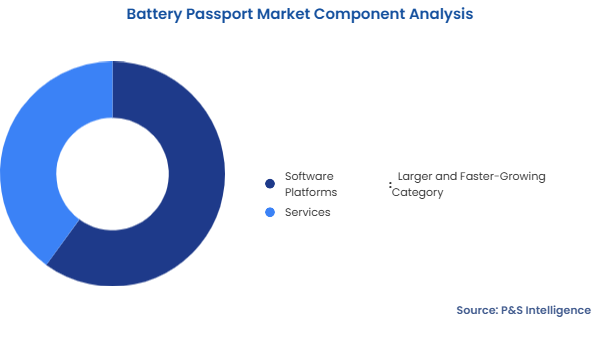
The software platforms category holds the larger market share, of 60%, in 2025, and it will have the higher CAGR, driven by rising dependence on cloud-based compliance systems, lifecycle analytics engines, and digital battery identity management platforms. Software solutions form the core intelligence layer of battery passport ecosystems, enabling integration of regulatory, manufacturing, and recycling data into unified digital frameworks used across global supply chains. In January 2025, the Battery Pass consortium published DIN DKE SPEC 99100, a standard defining the data attributes required for battery passports, further increasing the need for software platforms capable of managing, validating, and exchanging large volumes of battery lifecycle data across the value chain.
The components analyzed in this report are:
Software Platforms (Larger and Faster-Growing Category)
Services
End User Analysis
The automotive OEMs category holds the largest market share in 2025, as they are responsible for integrating battery systems into final vehicle products and ensuring the availability, accuracy, and accessibility of battery lifecycle data. OEMs operate as the central coordinators across multi-tier supply chains, requiring standardized data collection and validation from battery manufacturers and upstream material suppliers. This responsibility drives the adoption of integrated digital platforms capable of aggregating, managing, and verifying battery data across production, usage, and end-of-life stages, making OEMs the primary drivers of battery passport implementation.
The recycling & second-life operators category will have the highest CAGR, driven by increasing regulatory pressure on battery recovery, reuse, and material circularity. These stakeholders rely on accurate battery lifecycle information, including chemistry, state-of-health, and usage history, to assess reuse potential and optimize recovery pathways.
Drive strategic growth with comprehensive market analysis
Battery Passport Market Geographical Analysis
Europe Battery Passport Market Size
Europe holds the largest market share, of 40%, in 2025, supported by a well-established automotive ecosystem and strong integration of battery value chains across the region. The presence of major automotive manufacturing hubs, particularly in Germany, France, Italy, and Spain, drives large-scale battery deployment and accelerates the adoption of digital lifecycle tracking systems. France has emerged as a key battery manufacturing center, with Verkor securing more than EUR 1.3 billion in financing for its Dunkirk gigafactory, which is expected to begin producing battery cells with an initial capacity of 16 GWh per year.
Meanwhile, Italy remains an important automotive manufacturing hub, with ongoing electrification investments and battery supply chain development supporting the adoption of battery traceability and compliance systems across the region. These developments reinforce Europe's leadership in battery value chain digitalization and battery passport implementation.
Germany Battery Passport Market Size
Germany represents the largest country market within Europe for the battery passport market, driven by its dominant position in the automotive manufacturing ecosystem and its leadership in electric vehicle production and battery integration. The country serves as a central hub for EV supply chain activities, with strong integration across OEMs, battery manufacturers, and component suppliers, creating significant demand for advanced battery traceability, lifecycle documentation, and compliance systems. Germany’s strong industrial base and concentration of premium automotive manufacturers further increase the need for standardized digital battery passport deployment across production and supply chain networks. According to the German Association of the Automotive Industry (VDA), Germany produced approximately 1.22 million battery-electric vehicles in 2025, representing a record level of EV production and reinforcing the country's central role in battery value chains requiring advanced traceability, lifecycle documentation, and compliance systems.
Asia-Pacific Battery Passport Market Size
Asia-Pacific will have the highest CAGR, of approximately 31.4%, driven by its dominant position in global battery manufacturing, rapid electric vehicle production growth, and increasing investments in battery traceability infrastructure. The region hosts the world's largest battery supply chains, spanning raw material processing, cell manufacturing, battery assembly, and recycling operations, creating significant demand for lifecycle data management and digital traceability solutions. Growing regulatory focus on battery sustainability, recycling efficiency, and supply chain transparency is further accelerating the adoption of battery passport systems across the region.
China remains the primary growth engine, supported by its extensive battery manufacturing ecosystem and national battery traceability initiatives. According to the International Energy Agency, China accounted for over 60% of global electric vehicle battery production capacity in 2024, highlighting the scale of battery assets requiring traceability infrastructure. In South Korea, battery monitoring requirements were strengthened in 2025 through measures requiring battery identification and management systems in electric vehicles following battery safety incidents, increasing demand for digital battery tracking capabilities. Meanwhile, Australia is strengthening its role in battery value chains through the government's National Battery Strategy launched in 2024 to expand domestic battery manufacturing, processing, and recycling capabilities, creating new opportunities for battery passport deployment across the country's emerging battery ecosystem.
India Battery Passport Market Size
India is the fastest-growing country market in the Asia-Pacific battery passport ecosystem, driven by the rapid expansion of electric mobility across two-wheelers, three-wheelers, and passenger vehicles, which is significantly increasing the volume of batteries entering the value chain. The country is also witnessing accelerated development of domestic battery manufacturing and supply chains, supported by strong government initiatives focused on localization and energy security. The growing emphasis on battery recycling, second-life applications, and supply chain transparency is further driving the need for structured lifecycle data management systems, positioning battery passport solutions as critical infrastructure.
The growth momentum is reinforced by policy-backed investments. According to the Ministry of Heavy Industries, under the Production Linked Incentive (PLI) scheme for Advanced Chemistry Cell (ACC) battery storage, 40 GWh of battery manufacturing capacity has been awarded to four firms, with cumulative investments reaching INR 3,237 crore by December 2025. Additionally, India has announced plans for approximately 178 GWh of battery manufacturing capacity over the coming years, significantly expanding the base of batteries requiring traceability, lifecycle tracking, and compliance systems across the value chain.
These regions and countries are analysed:
North America
U.S. (Largest Country)
Canada (Fastest-Growing Country)
Europe (Largest Region)
Germany (Largest Country)
U.K. (Fastest-Growing Country)
France
Italy
Spain
Rest of Europe
Asia-Pacific (Fastest-Growing Region)
China (Largest Country)
India (Fastest-Growing Country)
Japan
South Korea
Australia
Rest of APAC
Latin America
Brazil (Largest Country)
Mexico (Fastest-Growing Country)
Rest of LATAM
Middle East and Africa
Saudi Arabia (Largest Country)
South Africa
U.A.E. (Fastest-Growing Country)
Rest of MEA
Battery Passport Market Share Analysis
The market is fragmented due to the presence of multiple technology providers, startups, and industry-led consortia offering diverse and non-standardized solutions. The market includes blockchain-based platforms, cloud providers, and IoT-enabled systems developed by companies such as Circulor, Minespider GmbH, and SAP SE, each focusing on different aspects of traceability and compliance. Additionally, organizations like the Global Battery Alliance are developing independent frameworks, further contributing to ecosystem diversity. The absence of universally adopted data standards, varying regulatory approaches across regions, and the early-stage nature of the market prevent dominance by a single player, resulting in a fragmented competitive landscape.
In February 2026, Minespider GmbH launched Recircle.market, a digital platform designed to connect EV battery reuse, repair, and recycling stakeholders. The platform integrates battery passport data to enhance transparency, improve lifecycle traceability, and strengthen secondary battery market efficiency across the global circular economy ecosystem.
In August 2025, Tata Technologies Limited introduced WATTSync, a cloud-based battery passport platform integrating AI-driven monitoring, blockchain security architecture, and multi-layer data access systems for OEMs, manufacturers, and recyclers. The platform strengthens end-to-end battery lifecycle visibility and compliance reporting across global EV supply chains.
In January 2025, Tata Elxsi Limited, in collaboration with Minespider GmbH, launched MOBIUS+, a blockchain-enabled battery lifecycle platform combining digital battery passports, advanced analytics, and real-time regulatory compliance reporting to support global battery ecosystem stakeholders, including automotive OEMs and recycling operators.
Frequently Asked Questions About This Report
What regulatory framework is accelerating battery passport adoption?+
The EU Battery Regulation is the primary driver, mandating digital passports for EV and industrial batteries with requirements on lifecycle data, carbon footprint, and responsible sourcing transparency.
What type of data is included in a battery passport?+
It includes battery composition, raw material origin, carbon footprint, state of health, performance history, and end-of-life or recycling information.
Which technologies enable battery passport systems?+
Core technologies include blockchain for secure traceability, cloud platforms for data storage, IoT for real-time tracking, and AI for analytics and lifecycle optimization.
What are the key challenges in implementing battery passports?+
Major challenges include lack of global data standardization, interoperability issues, high implementation costs, and concerns around secure data sharing.
How do battery passports support recycling and second-life applications?+
They provide detailed data on battery condition and materials, enabling efficient recycling processes and facilitating reuse in secondary energy storage systems.
How do battery passports improve supply chain transparency?+
They offer end-to-end visibility across the battery lifecycle, helping track sourcing, ensure compliance, and verify sustainability practices.
Want a report tailored exactly to your business need?
Leading companies across industries trust us to deliver data-driven insights and innovative solutions for their most critical decisions. From data-driven strategies to actionable insights, we empower the decision-makers who shape industries and define the future. From Fortune 500 companies to innovative startups, we are proud to partner with organisations that drive progress in their industries.
Client Testimonials
Working with P&S Intelligence and their team was an absolute pleasure – their awareness of timelines and commitment to value greatly contributed to our project's success. Eagerly anticipating future collaborations.
McKinsey & Company
India
Unmatched Standards
Our insights into the minutest levels of the markets, including the latest trends and competitive landscape, give you all the answers you need to take your business to new heights
Complete Data Security
We take a cautious approach to protecting your personal and confidential information. Trust is the strongest bond that connects us and our clients, and trust we build by complying with all international and domestic data protection and privacy laws