India Battery Recycling Market Size & Share Analysis - Trends, Drivers, Competitive Landscape, and Forecasts (2026 - 2032)
This Report Provides In-Depth Analysis of the India Battery Recycling Market Report Prepared by P&S Intelligence, Segmented by Battery Type (Lead-Acid, Lithium-Ion, Nickel), Application (Transportation, Consumer Electronics, Industrial), Recycling Process (Hydrometallurgical, Pyrometallurgical, Physical/Mechanical), Material (Metals, Electrolyte, Plastics), and Geographical Outlook for the Period of 2019 to 2032
Explore the market potential with our data-driven report
India Battery Recycling Market Outlook
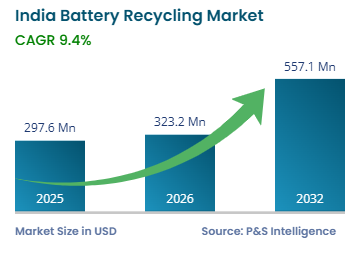
The Indian battery recycling market values USD 297.6 million in 2025, and it is projected to grow at a CAGR of 9.4% during 2026–2032, reaching USD 557.1 million by 2032. The market expansion is primarily driven by the surge in electric vehicle adoption, stringent regulatory frameworks under the Battery Waste Management Rules 2022, and the growing volume of end-of-life batteries from automotive, industrial, and consumer electronics sectors across the country.
The transportation sector represents a significant contributor to battery waste generation in India, supported by the remarkable growth in electric vehicle sales. The Indian electric car market recorded a sale of 19,778 units in 2023, which is further projected to reach 430,603 units by 2030. This accelerating adoption of electric mobility directly correlates with the increasing volume of lithium-ion batteries requiring end-of-life management, thereby propelling demand for recycling infrastructure and services.
The Indian government has established a robust regulatory ecosystem to manage battery waste effectively. The key aim of the Battery Waste Management (Amendment) Rules, 2025 is to ensure environmentally sound and accountable end-of-life management of all batteries by imposing extended producer responsibility (EPR), digital traceability, and mandated recycling or recovery — thereby minimizing pollution and advancing a circular-economy approach. This will create substantial opportunities for recyclers operating with advanced recovery technologies. Furthermore, the Ministry of Mines has launched a substantial INR 1,500 crore incentive scheme to support recyclers handling e-waste, lithium-ion batteries, and end-of-life vehicles.
India Battery Recycling Market Growth Factors
Rising Electric Vehicle Adoption Is Major Market Trend
The exponential growth of electric vehicles in India serves as a key trend in the market.
According to data from Vahan Dashboard, electric two-wheeler sales for 2025 stand at 18,522,929 units, while those of electric three-wheelers stand at 1,114,404 units.
This surge is attributable to government incentives under schemes such as PM E-DRIVE, which allocated INR 10,900 crore to promote electric mobility adoption.
The typical lifespan of lithium-ion batteries in EVs ranges from 8 to 10 years, indicating batteries from vehicles purchased during the initial EV adoption phase are now approaching end-of-life.
Industry estimates suggest that by 2030, India could witness significant volumes of EV batteries requiring recycling or repurposing, creating an unprecedented demand for sophisticated recycling facilities.
Major automotive manufacturers, including Tata Motors, MG Motor, and Hyundai, have established partnerships with recycling companies, such as Attero and Lohum, to ensure compliant management of their battery waste streams.
Stringent Environmental Regulations Are Driving Formal Recycling Adoption
The implementation of comprehensive battery waste management regulations has fundamentally transformed the recycling landscape in India.
The Battery Waste Management Rules represent a significant regulatory advancement, establishing mandatory collection and recycling targets for producers across all battery categories.
According to the Central Pollution Control Board (CPCB), producers must achieve minimum material recovery percentages that increase progressively, with EV batteries requiring 90% recovery by 2026–27.
The EPR framework mandates that battery producers register with CPCB through a centralized online portal, submit annual compliance reports, and either establish their own recycling infrastructure or partner with registered recyclers.
Non-compliance attracts environmental compensation penalties calculated based on handling, collection, and processing costs.
This regulatory pressure is compelling battery manufacturers and importers to formalize recycling arrangements, thereby shifting volumes from the informal sector to organized recycling facilities equipped with environmentally sound technologies.
Technological Advancements in Recycling Processes Present Opportunities
Significant investments in advanced recycling technologies are reshaping the Indian battery recycling industry.
Companies are deploying sophisticated hydrometallurgical and pyrometallurgical processes capable of achieving high recovery rates for critical materials, including lithium, cobalt, nickel, and manganese.
Hydrometallurgical processes, which utilize aqueous chemical solutions for metal extraction, have emerged as the preferred approach due to their lower energy consumption, higher recovery efficiency (typically 85–95%), and reduced environmental impact compared to high-temperature smelting methods.
Indian recyclers are achieving global benchmarks in material recovery.
Attero Recycling claims 98% extraction efficiency for battery materials, positioning the company among the most advanced recyclers globally.
In May 2024, Attero announced investment plans exceeding INR 8,300 crore over five years to expand e-waste and battery recycling capacity, targeting 300,000 metric tonnes of lithium-ion battery processing capability.
Similarly, in March 2024, Lohum secured USD 54 Million (INR 450 crore) in Series B Funding to scale its hydrometallurgical recycling operations and produce battery-grade materials for re-entry into the manufacturing supply chain.
India Battery Recycling Market Segmentation Analysis
Battery Type Analysis
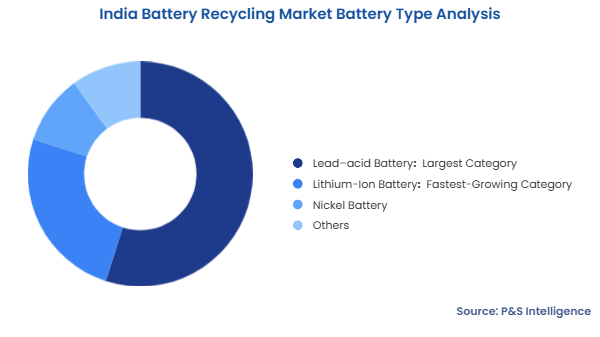
The lead–acid battery category holds the largest share, of 55%, in the Indian battery recycling market in 2025. This dominance stems from the well-established collection infrastructure, mature recycling technologies, and high recyclability rates exceeding 90% for lead–acid batteries. India possesses a robust network of registered lead–acid battery recyclers, with the CPCB listing over 670 authorized recycling units across the country with a combined annual capacity exceeding 3.5 million metric tonnes. The automotive sector remains the primary source of used lead–acid batteries, driven by the country's large vehicle population encompassing motorcycles, passenger cars, and commercial vehicles.
The lithium-ion battery category is projected to register the highest CAGR of approximately 9.6% during 2026–2032, emerging as the fastest-growing category. This acceleration reflects the exponential increase in lithium-ion battery deployment across electric vehicles, consumer electronics, and energy storage systems. According to industry estimates, India's lithium-ion battery recycling market could reach USD 4.5 billion by 2032. The transition toward electric mobility, coupled with the proliferation of smartphones and portable electronics, is generating substantial volumes of lithium-ion battery waste requiring specialized recycling infrastructure. Major recyclers, including Attero, Lohum, Exigo Recycling, and RecycleKaro, are expanding their lithium-ion processing capabilities to capture this growth opportunity.
These battery types are covered:
Lead–acid Battery (Largest Category)
Lithium-Ion Battery (Fastest-Growing Category)
Nickel Battery
Others
Application Analysis
The transportation application category dominates the Indian battery recycling market with a share of 50% in 2025, reflecting the substantial battery waste generated by the automotive sector. India's vast vehicle population, comprising over 300 million registered vehicles, ensures a continuous supply of end-of-life automotive batteries requiring recycling. The category encompasses batteries from conventional internal combustion engine vehicles (primarily lead–acid) and the growing fleet of electric vehicles (predominantly lithium-ion). Established collection networks through authorized dealers, service centers, and scrap dealers facilitate efficient battery aggregation for recycling.
The consumer electronics category is set to witness the fastest growth during the forecast period, registering a CAGR of approximately 9.5%. According to survey data, smartphones represent the most widely used consumer electronic device in India, with 97% penetration among adult users. As reported by the IBEF, the production of smartphones in India attained a value of USD 49.55 billion in FY24. The smartphone penetration rate has surged from under 10% in 2010 to over 46% by 2024, India generated approximately 1.75 million metric tonnes of electronic waste in fiscal year 2023–24, generating enormous volumes of lithium-ion batteries requiring recycling.
These applications are covered:
Transportation (Largest Category)
Consumer Electronics (Fastest-Growing Category)
Industrial
Others
Recycling Process Analysis
Physical/mechanical recycling is currently the largest process category in India, because it is far simpler, cheaper, and quicker to deploy than chemical-refining methods. These systems require lower capital investment, use widely available equipment, and allow recyclers to efficiently convert mixed battery waste into “black mass” without complex permitting or advanced chemical expertise. India’s recycling ecosystem is still young, so most operators begin with mechanical routes to establish capacity, manage diverse feedstock quality, and create a fast, scalable entry point into the value chain.
The hydrometallurgical process category is expected to grow at the fastest rate during the forecast period, driven by increasing lithium-ion battery recycling requirements. Hydrometallurgical processes utilize aqueous chemical solutions to dissolve and selectively extract metals through leaching, precipitation, and solvent extraction steps. This approach offers several advantages over pyrometallurgical methods, including higher recovery rates for lithium (which is typically lost in slag during high-temperature smelting), lower energy consumption, reduced emissions, and flexibility to process various battery chemistries. Indian recyclers have adopted hydrometallurgical technologies capable of recovering battery-grade materials with purity exceeding 99%.
These recycling processes are covered:
Hydrometallurgical (Fastest-Growing Category)
Pyrometallurgical
Physical/Mechanical (Largest Category)
Material Analysis
The metals category dominates the Indian battery recycling market with 70% value share. Battery recycling operations primarily target the recovery of valuable metals, including lead, lithium, cobalt, nickel, manganese, copper, and aluminum. Lead recovery from lead–acid batteries constitutes the most established category, with India producing significant quantities of secondary lead annually. For lithium-ion batteries, the cathode materials containing nickel, cobalt, manganese, and lithium command the highest economic value, driving recyclers to optimize extraction processes for these critical minerals.
The electrolyte category is projected to register the fastest growth as lithium-ion battery recycling volumes expand. Advanced recycling technologies are being developed to safely neutralize and recover electrolyte components, which contain lithium salts and organic solvents. The plastics category also presents growth opportunities as recyclers improve separation technologies to recover battery casings and separators for reuse in manufacturing applications.
These materials are covered:
Metals (Largest Category)
Lead
Lithium
Cobalt
Nickel
Manganese
Copper
Aluminum
Others
Electrolyte (Fastest-Growing Category)
Plastics
Others
Drive strategic growth with comprehensive market analysis
India Battery Recycling Market Geographical Analysis
Maharashtra Battery Recycling Market Size
Maharashtra holds the largest share in the Indian battery recycling market in 2025, of 20% of the total market value. The state's dominance stems from its robust industrial base, significant automobile manufacturing presence, and concentration of recycling infrastructure. Maharashtra hosts 94 registered lead–acid battery recyclers with a combined authorized capacity of approximately 350,871 metric tonnes annually, according to CPCB data. Mumbai and Pune serve as major hubs for battery collection and recycling operations, benefiting from established logistics networks and proximity to automotive manufacturing clusters.
The state's leadership in electric vehicle adoption further strengthens its position in the battery recycling ecosystem. According to Vahan portal data, Maharashtra ranked among the top three states for EV registrations in 2024 with 241,930 units sold. Several major recycling companies have established operations in the state. Tata Chemicals conducts lithium-ion battery recycling operations at a facility near Mumbai, recovering valuable metals at 99% purity levels for re-integration into battery manufacturing supply chains.
Karnataka Battery Recycling Market Forecast
Karnataka is projected to register the highest CAGR in the Indian battery recycling market during 2026–2032, driven by strong EV adoption, technology sector growth, and supportive state policies. Bengaluru has emerged as a major hub for lithium-ion battery recycling innovation, hosting companies including E-Parisaraa, TES-AMM, and Metastable Materials. The state's vibrant startup ecosystem has attracted significant investments in recycling technology development.
In April 2024, Metastable Materials announced expansion plans for its Bengaluru facility and intentions to establish an additional factory within two years, utilizing chemical-free technology for battery material extraction. Karnataka accounts for 32 registered battery recyclers with authorized capacity of approximately 419,056 metric tonnes annually. The state's strong electronics manufacturing sector, hosting major IT hardware producers, generates substantial volumes of battery waste from consumer electronics and data center applications. Karnataka also leads in public EV charging infrastructure deployment with approximately 6,097 charging stations as of mid-2025, supporting the broader electric mobility ecosystem.
These states are covered:
Maharashtra (Largest State Market)
Karnataka (Fastest-Growing State Market)
Tamil Nadu
Gujarat
Rajasthan
Uttar Pradesh
Telangana
West Bengal
Rest of India
India Battery Recycling Market Share
The Indian battery recycling market exhibits a fragmented competitive landscape characterized by the presence of established players, emerging startups, and a substantial informal sector. The organized recycling category is gaining market share as regulatory enforcement intensifies and major battery producers establish formal recycling partnerships to meet EPR obligations. Lead–acid battery recycling remains more consolidated due to established infrastructure and capital-intensive smelting operations, while lithium-ion battery recycling presents a more fragmented structure with numerous technology-focused entrants competing for market position.
Key India Battery Recycling Companies:
Attero Recycling Pvt. Ltd.
Lohum Cleantech Pvt. Ltd.
Gravita India Ltd.
Exide Industries Ltd.
Amara Raja Energy & Mobility Ltd.
RecycleKaro
Exigo Recycling Pvt. Ltd.
BatX Energies Pvt. Ltd.
ACE Green Recycling Inc.
Ziptrax Cleantech Pvt. Ltd.
SungEel Hitech Co., Ltd.
ACE Green Recycling, Inc.
Rubamin Industries Private Limited
Tata Chemicals Limited
Eco Recycling Ltd.
India Battery Recycling Market News
November 2024, Lohum Cleantech announced plans to raise USD 112 million (INR 1,000 crore) in a pre-IPO funding round led by I9 Capital and Singularity Ventures to scale its lithium-ion battery recycling operations and cathode active material production capabilities.
May 2024, Attero Recycling announced investment plans worth INR 8,300 crore over five years to ramp up e-waste and battery recycling capacity, targeting expansion to 300,000 metric tonnes of lithium-ion battery processing and 1 million metric tonnes of e-waste recycling annually.
April 2024, Amara Raja Energy and Mobility announced plans to commence operations at its newly established lead–acid battery recycling plant in Tamil Nadu through subsidiary Amara Raja Circular Solutions, featuring 100,000 metric tonnes annual capacity expandable to 150,000 metric tonnes.
April 2024, the European Union and India launched an Expression of Interest for startups operating in Battery Recycling Technologies for EVs, aimed at improving cooperation between Indian and European small and medium enterprises in green technologies.
April 2024, Metastable Materials ramped up battery recycling operations at its Bengaluru facility and announced plans to establish a new factory within two years, utilizing chemical-free technology for sustainable battery material extraction.
January 2024, Lohum Cleantech announced a partnership with Tork Motors to collect and recycle lithium-ion batteries from Tork's Kratos R electric motorcycles upon reaching end-of-life, establishing a closed-loop battery management system.
Want a report tailored exactly to your business need?
Leading companies across industries trust us to deliver data-driven insights and innovative solutions for their most critical decisions. From data-driven strategies to actionable insights, we empower the decision-makers who shape industries and define the future. From Fortune 500 companies to innovative startups, we are proud to partner with organisations that drive progress in their industries.
Client Testimonials
Working with P&S Intelligence and their team was an absolute pleasure – their awareness of timelines and commitment to value greatly contributed to our project's success. Eagerly anticipating future collaborations.
McKinsey & Company
India
Unmatched Standards
Our insights into the minutest levels of the markets, including the latest trends and competitive landscape, give you all the answers you need to take your business to new heights
Complete Data Security
We take a cautious approach to protecting your personal and confidential information. Trust is the strongest bond that connects us and our clients, and trust we build by complying with all international and domestic data protection and privacy laws