This Report Provides In-Depth Analysis of the Ultrasound Probe Covers Market Report Prepared by P&S Intelligence, Segmented by Type (Disposable/Single-Use, Reusable Probe Covers), Product Type (Latex-Free, Latex), Application (Endocavity, Exocavity), End User (Clinics, Diagnostic Imaging Centers, Hospitals, Maternity Centers, Research Institutes), and Geographical Outlook for the Period of 2019 to 2032
Explore the market potential with our data-driven report
Ultrasound Probe Covers Market Overview
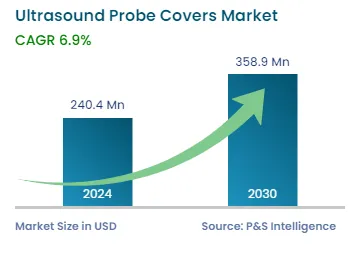
The global ultrasound probe covers market size was USD 240.4 million in 2024, which is predicted to reach USD 405.3 million by 2032, growing at a CAGR of 6.9% during 2025–2032.
The rise in day-to-day cases related to gynecological and urological disorders and infectious diseases has increased the usage of ultrasound and the development of advanced technology in ultrasonic imaging. However, there is a high chance of infection from transducers during ultrasonic imaging. After the COVID-19 outbreak, there is a high focus on the safety of patients from infectious diseases through ultrasound probes, which leads to the increased use of protective covers.
Ultrasound transducers are basically ultrasonic sensors that work on high-intensity sound waves to capture the imaging and create a picture called a sonogram. Transducer covers are generally used by doctors or medical staff to cover probes and protect them from catching contamination and infections through bacteria and pathogens. Moreover, healthcare facilities have to follow government rules for the safety of patients and also to follow medical ethics to ensure trust between the patients and the hospitals. Thus, these covers ensure the safety of both the patients and the medical staff who operates ultrasound devices.
According to the Centers for Disease Control and Prevention (CDC), on any given day, approximately one in 31 hospital patients in the United States has at least one healthcare-associated infection (HAI).
Ultrasound Probe Covers Market Emerging Trends
Technological Advancements in Ultrasound Imaging Is Major Trend
3D/4D ultrasound allows for high-resolution imaging, providing more-detailed views of the body, particularly in obstetrics and gynecology.
These advancements help in visualizing the fetus in the womb in real-time, offering better diagnostic capabilities and patient care.
Ectopic pregnancy occurs in approximately 1 to 2 percent of all pregnancies globally and represents a significant cause of maternal morbidity and mortality.
It accounts for about 6% of the maternal deaths in the first trimester.
The risk of ectopic pregnancy is higher among pregnancies conceived via assisted reproductive technologies.
Ultrasound remains the primary diagnostic tool for the early detection and management of this potentially life-threatening condition.
Portable ultrasound devices are smaller, lighter, and more affordable, making them accessible for point-of-care settings like emergency rooms, clinics, and home use.
Elastography measures tissue stiffness, commonly used in liver disease diagnosis, offering a non-invasive alternative to biopsies.
Contrast sonography uses contrast agents to improve the visualization of blood vessels and organs, enhancing detection of tumors, cardiac conditions, and vascular diseases.
AI integration into ultrasound machines enhances image analysis, automates measurements, and improves diagnostic accuracy, helping detect anomalies with greater speed and precision.
Advances in transducer technology and signal processing have led to sharper, more-detailed images for better visualization of organs and tissues.
Smaller, more flexible transducers allow ultrasound scans in challenging or hard-to-reach areas, making ultrasound more user-friendly and expanding its use in outpatient care and telemedicine.
Rising Prevalence of Chronic Diseases Is Driving Market Growth
The increasing number of chronic disease diagnoses, such as diabetes and heart disease, requires continuous monitoring and frequent diagnostic imaging, leading to higher demand for ultrasound examinations.
As chronic diseases often involve multiple organ systems, ultrasound is commonly used for monitoring these conditions, increasing the need for proper hygiene and protection during these procedures.
The growth of the aging population is directly linked to a higher prevalence of chronic conditions, further driving the demand for diagnostic imaging and ultrasound probe covers.
Patients with chronic conditions like hypertension or kidney disease often require regular ultrasound check-ups to monitor the progression of the disease, increasing the use of ultrasound and probe covers.
Heart failure: affects > 64 million people worldwide; prevalence ~1–2% in adults, rising to ≥10% in those over 70.
Valvular heart disease: overall prevalence ~2.5% in adults; degenerative aortic stenosis in ~3% of people over 75.
Congenital heart disease (CHD): global birth prevalence 8–12 per 1,000 live births; ~1.35 million babies born with CHD each year. Severe CHD: ~1.5–1.7 per 1,000 live births.
Infective endocarditis: incidence ~3–10 cases per 100,000 people annually.
Atrial fibrillation–related structural checks: lifetime AF risk ~1 in 3 for people over 55.
According to the CDC, 76.4% of U.S. adults reported having at least one chronic condition, encompassing conditions such as arthritis, cancer, chronic obstructive pulmonary disease (COPD), coronary heart disease, asthma, diabetes, hepatitis, hypertension, stroke, and kidney disease.
Liver cirrhosis accounts for over 2.05 million new cases worldwide each year with an age-standardized incidence rate of 25.35 per 100,000 people.
The leading causes include chronic hepatitis B and C infections, alcohol consumption, and non-alcoholic fatty liver disease.
Over recent decades, the incidence of cirrhosis has increased, largely driven by the growing prevalence of metabolic liver diseases such as NAFLD.
In response to the higher risk of infection among chronic disease patients, the need for effective infection control measures, such as disposable ultrasound probe covers, becomes even more critical.
With rising awareness of the importance of infection control, healthcare facilities are prioritizing the use of protective covers to prevent the transmission of healthcare-associated infections (HAIs).
Increased research and development efforts in the ultrasound field are leading to innovations in probe covers, improving both usability and infection prevention.
The growth in outpatient services and home care for chronic disease management is expanding the use of portable ultrasound devices, which require compatible probe covers to maintain hygiene.
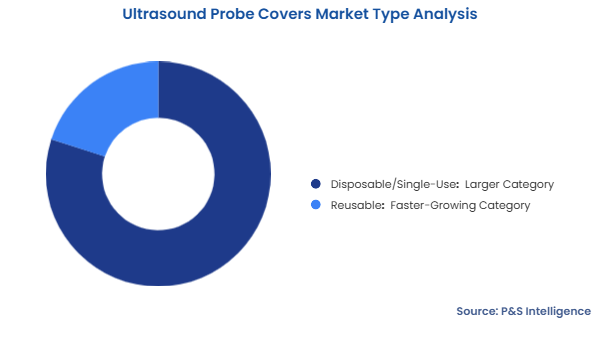
The disposable or single-use probe covers category held the larger market share, of 80.0%, in 2024, and it is expected to maintain its dominant position during the forecast period. This dominance is primarily attributed to the cost-effectiveness and enhanced infection control capabilities of disposable covers. Single-use probe covers eliminate the risk of cross-contamination between patients and reduce the burden of cleaning and sterilization processes on healthcare facilities. Their convenience and ease of use make them highly preferred by healthcare providers who prioritize operational efficiency and patient safety.
The reusable probe covers category is projected to witness the higher CAGR during the forecast period. This growth is driven by increasing environmental consciousness among healthcare institutions and the long-term cost benefits associated with reusable products. Advanced sterilization technologies and improved material durability have enhanced the appeal of reusable probe covers, particularly in high-volume healthcare settings where proper sterilization protocols can be consistently maintained.
Globally, the incidence of HAIs is estimated to be about 7% to 10% of hospitalized patients in developed countries, and can be as high as 15% or more in low- and middle-income countries. This means that approximately 1 in every 10 patients in hospitals acquires an infection during their stay.
These type categories are covered:
Disposable/Single-Use (Larger Category)
Reusable (Faster-Growing Category)
Product Type Analysis
The latex-free category dominated the market with a share of 75.0% in 2024, driven by growing awareness of latex allergies among healthcare workers and patients. The WHO emphasizes the importance of safe healthcare practices, and latex-free products help reduce the risk of allergic reactions during medical procedures. The increasing adoption of latex-free products across healthcare institutions worldwide is expected to sustain the growth of this category.
The latex category is set to register the higher CAGR of 7.0% during the forecast period. Despite growing preference for latex-free alternatives, latex probe covers remain popular in certain healthcare settings due to their cost-effectiveness and wide availability. Their superior elasticity and barrier properties make them suitable for various ultrasound applications, particularly in developing countries where cost considerations play a significant role in procurement decisions.
These product type categories are covered:
Latex-Free (Larger Category)
Latex (Faster-Growing Category)
Application Analysis
The endocavity category held the larger market share, of 70.0%, in 2024, and it is projected to maintain its leading position throughout the forecast period. Endocavity ultrasound procedures are extensively used in obstetrics, gynecology, and urology for examining internal organs such as the uterus, ovaries, prostate gland, and rectum. The increasing demand for gynecological and obstetric care, coupled with rising awareness about women's health, continues to drive the growth of this category.
The external cavity category is expected to witness the higher CAGR, during the forecast period. This growth is attributed to the expanding applications of external ultrasound in cardiology, abdominal imaging, musculoskeletal diagnostics, and emergency medicine. The increasing adoption of point-of-care ultrasound in emergency departments and critical care units has significantly boosted the demand for external cavity probe covers.
These application categories are covered:
Endocavity (Larger Category)
Exocavity (Faster-Growing Category)
End User Analysis
Hospitals dominated the market with approximately 40.0% share in 2024, driven by the high volume of ultrasound procedures performed in hospital settings and stringent infection control requirements. The CDC reports significant progress in reducing healthcare-associated infections in acute care hospitals, with hospitals increasingly investing in infection prevention measures , including the use of probe covers for ultrasound procedures.
Diagnostic imaging centers are expected to witness the fastest growth with a CAGR of approx. 7.5% during 2025–2032. The increasing establishment of standalone diagnostic facilities and the growing preference for outpatient diagnostic services are driving the demand for probe covers in these settings. The focus on providing high-quality imaging services while maintaining strict infection control standards supports the growth of this category.
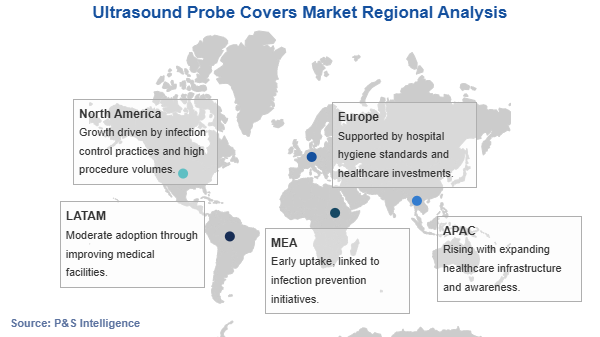
North America held the largest market share, of 40.0%, in 2024. The region's leadership is primarily attributed to the well-established healthcare infrastructure, stringent infection control regulations, and high healthcare expenditure. The presence of major market players and the widespread adoption of advanced ultrasound technologies further contribute to the market's growth in this region.
The CDC reports that more than 38,000 active hospitals, long-term care facilities, and other healthcare facilities provide data to the National Healthcare Safety Network, highlighting the comprehensive approach to infection prevention in the region. The increasing awareness about patient safety and the implementation of stringent healthcare guidelines regarding infection control have significantly boosted the demand for ultrasound probe covers in North American healthcare facilities.
The U.S. dominates the North American market, accounting for the majority of regional revenue due to its large healthcare system, high per capita healthcare spending, and robust regulatory framework for medical devices. The growing emphasis on value-based healthcare and the focus on reducing hospital-acquired infections continue to drive market growth in the country.
APAC Ultrasound Probe Covers Market Size
Asia-Pacific is projected to be the fastest-growing regional market, during 2025–2032. The rapid expansion of healthcare infrastructure, increasing healthcare investments by governments, and growing awareness about infection control practices are the primary factors driving market growth in this region. The large patient population and the increasing prevalence of chronic diseases create substantial demand for diagnostic imaging services, including ultrasound procedures.
The WHO global report on infection prevention and control emphasizes the critical importance of implementing effective infection control measures across all healthcare settings. This has led to increased adoption of probe covers in Asia Pacific countries as healthcare facilities strive to meet international standards for patient safety and infection prevention.
China represents the largest market within the Asia Pacific region, driven by significant healthcare reforms, increasing healthcare expenditure, and the expansion of medical facilities. The country's focus on improving healthcare quality and the growing adoption of advanced medical technologies support the demand for ultrasound probe covers in various healthcare settings.
The regions and countries analyzed in this report are:
The ultrasound probe covers market is fragmented due to the presence of numerous global and regional players competing across different product segments and geographical locations. The market is characterized by intense competition among established manufacturers and emerging companies, with players focusing on product innovation, strategic partnerships, and geographic expansion to strengthen their market position. Companies are increasingly investing in research and development to create advanced probe cover materials and designs that enhance barrier protection while maintaining cost-effectiveness. This focus on innovation is critical for meeting the evolving needs of the healthcare sector, where safety and functionality are top priorities. Key competitive strategies in the market include expanding product portfolios, forming strategic acquisitions, and partnering with healthcare institutions to develop tailored solutions.
Additionally, manufacturers are responding to the growing environmental awareness by focusing on developing eco-friendly and sustainable probe covers, which is increasingly important for healthcare providers. Leading companies are also leveraging their distribution networks and manufacturing capabilities to expand into emerging markets, particularly in Asia Pacific and Latin America, where the development of healthcare infrastructure is creating significant growth opportunities for probe cover manufacturers.
Key Ultrasound Probe Covers Companies:
Advance Medical Designs Inc.
CIVCO Medical Solutions
CS Medical LLC
Ecolab Inc.
Fairmont Medical Products Ltd.
Fuji Latex Co. Ltd.
Karex Berhad
Medline Industries Inc.
Nanosonics Ltd.
Parker Laboratories Inc.
PDC Healthcare
Protek Medical Products Inc.
Ultrasound Probe Covers Market News
In January 2024, Medline Industries LP introduced a line of disposable, antimicrobial ultrasound probe covers designed to reduce the risk of cross-contamination in high-volume healthcare settings. These covers offer enhanced protection and sterility for diagnostic procedures, aligning with industry trends towards infection control.
In December 2023, Teleflex Incorporated launched eco-friendly ultrasound probe covers made from biodegradable materials, catering to the growing demand for sustainable medical solutions while maintaining high levels of hygiene and safety standards.
In October 2023, Vygon SAS announced the expansion of its ultrasound probe cover product line to include customizable sizes and shapes for various specialized medical procedures, addressing the diverse needs of healthcare providers across different clinical applications.
In September 2023, CIVCO Medical Solutions received FDA approval for its new line of latex-free ultrasound probe covers featuring enhanced barrier properties and improved compatibility with advanced ultrasound transducers.
In June 2023, Ecolab Inc. entered into a strategic partnership with a healthcare technology company to develop innovative probe disinfection and cover solutions that integrate with existing ultrasound systems for improved workflow efficiency.
In April 2023, Parker Laboratories Inc. launched a comprehensive training program for healthcare professionals on proper probe cover selection and application techniques, aimed at improving infection control practices in ultrasound imaging departments.
Want a report tailored exactly to your business need?
Leading companies across industries trust us to deliver data-driven insights and innovative solutions for their most critical decisions. From data-driven strategies to actionable insights, we empower the decision-makers who shape industries and define the future. From Fortune 500 companies to innovative startups, we are proud to partner with organisations that drive progress in their industries.
Client Testimonials
Working with P&S Intelligence and their team was an absolute pleasure – their awareness of timelines and commitment to value greatly contributed to our project's success. Eagerly anticipating future collaborations.
McKinsey & Company
India
Unmatched Standards
Our insights into the minutest levels of the markets, including the latest trends and competitive landscape, give you all the answers you need to take your business to new heights
Complete Data Security
We take a cautious approach to protecting your personal and confidential information. Trust is the strongest bond that connects us and our clients, and trust we build by complying with all international and domestic data protection and privacy laws