This Report Provides In-Depth Analysis of the Sodium Tripolyphosphate Market Report Prepared by P&S Intelligence, Segmented by Form (Powder, Granules, Liquid), Grade (Technical/Industrial Grade, Food Grade), End-user (Cleaning Products, Water Treatment, Food and Beverage, Ceramics and Glass, Textiles, Paper and Pulp), Sales Channel (Direct Sales, Distributors/Wholesalers, Online Retail), and Geographical Outlook for the Period of 2021 to 2032
Explore the market potential with our data-driven report
Sodium Tripolyphosphate Market Future Outlook
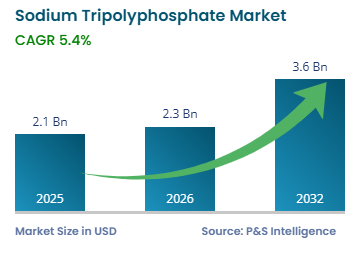
The sodium tripolyphosphate market size was USD 2.1 billion for 2025, and it will grow by 5.4% during 2026-2032, to reach USD 3.6 billion by 2032.
The market is expanding because sodium tripolyphosphate remains widely used across detergent manufacturing, food processing, ceramics, textiles, and industrial cleaning applications where water softening, dispersing, and moisture-control functions are essential. Detergent manufacturers use the compound to improve cleaning efficiency by preventing mineral deposits that reduce product performance in hard water conditions. Food processors also depend on sodium tripolyphosphate to maintain texture retention, moisture balance, and shelf stability in seafood, meat, and packaged food products. Industrial sectors such as ceramics and metal treatment continue to utilise the material because it improves processing consistency and supports stable manufacturing operations across large-scale production environments.
In 2025, global manufacturing production increased by 0.5% in the fourth quarter, according to the United Nations Industrial Development Organisation. This reflects continued industrial activity across processing industries that consume sodium tripolyphosphate in cleaning, textile treatment, ceramics, and manufacturing applications. Growing urban populations, rising hygiene awareness, and increasing consumption of household and institutional cleaning products are also supporting steady demand for phosphate-based additives across developed and emerging economies. At the same time, manufacturers are focusing on improving production quality and supply reliability as environmental regulations gradually influence phosphate usage in selected detergent applications. Demand from industrial processing, water treatment, and packaged food manufacturing continues to support market expansion because these sectors require stable and performance-oriented chemical additives for large-scale operations.
Key Market Insights
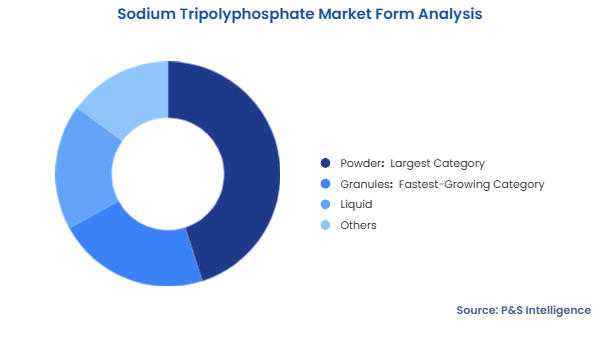
Powder is the largest form, holding a market share of 45%, due to easier bulk handling across detergent and industrial processing operations.
Food Grade is the fastest-growing grade, registering a CAGR of approximately 5.7%, driven by rising processed seafood and packaged meat production globally.
Cleaning Products are the largest application, holding a market share of 35%, due to strong detergent consumption across household and institutional cleaning sectors.
Asia-Pacific holds the largest share of 40%, due to extensive detergent manufacturing and large-scale industrial chemical production across regional economies.
India is the fastest-growing country market, driven by expanding detergent manufacturing and rising industrial cleaning demand.
Sodium Tripolyphosphate Market Trends and Drivers
Shift toward Low-Phosphate and High-Purity Product Development Is a Major Trend
Manufacturers are shifting towards cleaner and application-specific sodium tripolyphosphate formulations to meet changing food-processing and industrial treatment requirements. Producers are developing high-purity and low-impurity phosphate grades for premium detergents, seafood processing, poultry treatment, and regulated industrial applications where formulation stability and performance consistency are important. In 2024, Innophos developed Optibind, a speciality phosphate blend positioned as an alternative to sodium tripolyphosphate for poultry processors. Buyers are also preferring suppliers that provide customised phosphate solutions designed for specific processing conditions instead of standard commodity-grade materials. In 2024, Prepared Foods reported that Prayon introduced a low-sodium Carfosel phosphate solution for seafood applications. These developments indicate that manufacturers are increasingly focusing on specialised phosphate formulations that support regulatory compliance, cleaner-label requirements, and stable processing performance across food and industrial applications.
The market is growing because sodium tripolyphosphate improves cleaning efficiency in household, commercial, and industrial detergent formulations used across urban and industrial environments. The compound helps detergents perform effectively in hard water conditions by preventing mineral deposits that reduce washing performance and processing efficiency. In 2024, the global urban population reached 57.6% of the total population, according to the World Bank Group. Rising urbanisation is supporting higher consumption of household cleaning products, institutional sanitisers, and commercial laundry formulations. Industrial sectors such as textiles, ceramics, and metal treatment also utilise sodium tripolyphosphate for equipment cleaning and processing stability. In 2024, the World Integrated Trade Solution recorded export volumes of washing and cleaning preparations not put up for retail sale at 562.1 million kg for China and 502.0 million kg for the European Union. This reflects strong industrial demand for large-scale cleaning and detergent formulations that rely on performance-enhancing chemical additives.
Strict Environmental Rules on Phosphate-Based Chemicals Limiting Market Expansion
Environmental regulations linked to phosphate discharge are creating challenges for sodium tripolyphosphate manufacturers, particularly in detergent and wastewater-related applications. Many countries are tightening limits on phosphate content in cleaning products and industrial effluents because excess phosphate release contributes to water pollution and algae growth in rivers and lakes. Chemical producers are also facing higher compliance and wastewater-treatment costs in regions with strict environmental monitoring systems. In 2024, only 56% of 332 billion m³ of global domestic wastewater was safely treated, according to the United Nations Statistics Division. This reflects increasing global pressure to improve wastewater management and reduce untreated phosphate discharge into water systems. Public preference for eco-friendly and phosphate-free cleaning products is also influencing purchasing decisions in developed economies. These conditions are pushing manufacturers to modify detergent formulations and focus more on regulated industrial and food-grade phosphate applications where compliance requirements and controlled usage remain important.
Growing Use in Processed Food and Industrial Water Treatment Creating New Growth Opportunities
Expanding processed food production and rising investment in industrial water-treatment systems and water treatment chemicals are creating new opportunities for sodium tripolyphosphate manufacturers. Food processors are increasing the use of functional phosphate additives that help maintain texture stability, moisture retention, and product consistency in packaged meat, seafood, and ready-to-eat products. Industrial facilities are also upgrading water-treatment infrastructure to improve operational efficiency and comply with stricter wastewater-management standards. In 2024, global meat production reached 365 Mt, according to the Organisation for Economic Co-operation and Development and the Food and Agriculture Organisation. Rising meat processing volumes are supporting demand for food-grade phosphate additives used in preservation and moisture-control applications. Manufacturers that develop high-purity and application-specific sodium tripolyphosphate formulations are gaining stronger opportunities in regulated food-processing and industrial sectors where product quality, operational consistency, and compliance standards remain critical purchasing factors.
Powder is the largest category, holding a market share of 45%, because it offers easier storage, bulk transport, and controlled blending across detergent, ceramic, and industrial processing applications. Manufacturers prefer powder sodium tripolyphosphate due to its longer shelf stability and compatibility with automated chemical-handling systems used in large-scale production facilities. In 2024, Belgium exported 51,930,100 kg of sodium triphosphate, while Canada exported 25,129,600 kg, according to the World Integrated Trade Solution. This reflects sizeable international bulk movement of STPP used in industrial processing and detergent manufacturing, where powder formulations remain widely preferred for handling efficiency and large-volume chemical operations.
Granules are the fastest-growing category, due to increasing demand for dust-free and easy-handling chemical materials across industrial and commercial applications. Granular sodium tripolyphosphate offers better flow properties and safer handling during storage and transportation, which makes it attractive for automated manufacturing systems. Detergent and water treatment manufacturers are gradually adopting granular formats to improve operational efficiency and reduce material loss during processing. Growing focus on workplace safety and cleaner production environments is further supporting the faster adoption of granulated phosphate products.
The forms analysed in this report are:
Powder (Largest Category)
Granules (Fastest-Growing Category)
Liquid
Others
Grade Analysis
Technical/Industrial Grade is the largest category, holding a market share of 60%, because it is heavily used in detergents, ceramics, textile chemicals, metal treatment, and industrial cleaning operations. Large-scale manufacturing industries require cost-effective phosphate chemicals that can support water softening, dispersing, and cleaning functions during production processes. Industrial-grade sodium tripolyphosphate is widely available and suited for bulk-volume applications where high processing efficiency is important. Strong demand from manufacturing economies in the Asia-Pacific and expanding industrial activities across developing countries continue to maintain the segment’s leading position.
Food Grade is the fastest-growing category, due to rising demand for stabilising and moisture-retention additives across processed seafood, poultry, and packaged meat applications. Food-grade sodium tripolyphosphate helps improve texture consistency, water retention, and shelf stability in regulated food-processing operations. Demand for frozen meals, packaged protein products, and ready-to-eat foods is supporting wider use of controlled and high-purity phosphate ingredients. Global fisheries and aquaculture production reached about 193 million tonnes in 2024, according to the Organisation for Economic Co-operation and Development and the Food and Agriculture Organisation. Rising seafood-processing volumes are increasing demand for food-grade phosphate additives used in preservation and moisture-management applications.
The grades analysed in this report are:
Technical/Industrial Grade (Largest Category)
Food Grade (Fastest-Growing Category)
Others
End-user Analysis
Cleaning Products are the largest category, holding a market share of 35%, because sodium tripolyphosphate is widely used in household and industrial detergents to improve cleaning efficiency under hard water conditions. The compound prevents mineral deposits and improves surfactant performance during commercial and industrial washing operations. Demand from institutional cleaning systems, industrial sanitation chemicals, and commercial laundry applications continues to support large-scale consumption across developed and emerging markets. In 2024, exports of washing and cleaning preparations reached 1,785,720,000 kg from the European Union, 1,356,190,000 kg from China, and 1,092,180,000 kg from Poland, according to the World Integrated Trade Solution. This reflects strong global demand for large-scale detergent and cleaning formulations.
Water Treatment is the fastest-growing category, registering a CAGR of approximately 6.1%, due to rising investment in industrial and municipal water management infrastructure. Sodium tripolyphosphate is increasingly used for scale prevention, water conditioning, and maintaining processing efficiency in treatment systems. Industries are focusing more on wastewater management and operational sustainability, especially in manufacturing and utility sectors. Expanding industrialisation in emerging economies is also increasing demand for treatment chemicals that support equipment protection and stable water quality. These factors are driving faster adoption of phosphate-based additives in treatment applications.
The end-users analysed in this report are:
Cleaning Products (Largest Category)
Water Treatment (Fastest-Growing Category)
Food and Beverage
Ceramics and Glass
Textiles
Paper and Pulp
Others
Sales Channel Analysis
Direct Sales is the largest category, because large industrial buyers and detergent manufacturers usually purchase sodium tripolyphosphate directly from producers through long-term supply agreements. Direct procurement helps companies maintain stable product quality, secure bulk-volume availability, and reduce intermediary costs in industrial operations. Chemical manufacturers also prefer direct sales channels to provide customised product grades and technical support to large commercial clients. Strong demand from high-volume industrial users continues to support the dominance of direct supplier-to-customer distribution models across the market.
Distributors/Wholesalers are the fastest-growing category, registering a CAGR of approximately 5.8%, because small and medium-sized manufacturers increasingly depend on third-party suppliers for flexible procurement and faster product availability. Distributors help expand sodium tripolyphosphate access across regional and emerging markets where direct manufacturer presence remains limited. Buyers also prefer wholesalers due to lower inventory requirements and simplified purchasing processes for smaller order volumes. World merchandise trade volume grew by 4.6% in 2025, according to the World Trade Organisation. Growing cross-border industrial trade is supporting distributor-led chemical supply networks, particularly for industrial processing, detergent manufacturing, and regional chemical procurement operations across developing manufacturing economies.
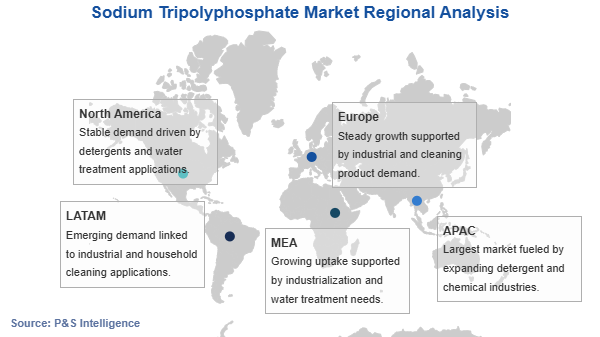
Asia-Pacific holds the largest share of 40%, and has the highest CAGR, of approximately 6.3%, because the region has a strong concentration of detergent manufacturing, industrial chemical production, and processed food industries that consume large volumes of sodium tripolyphosphate. Countries across the region continue expanding manufacturing capacity for cleaning products, ceramics, textiles, and industrial processing chemicals. Rapid urbanisation and rising household consumption are also increasing demand for packaged cleaning products and processed food items that use phosphate additives. Many regional manufacturers benefit from lower production costs and large-scale chemical supply chains, which support export activity and domestic consumption together. Governments are also investing in industrial infrastructure and water treatment facilities, creating additional demand from municipal and industrial applications. The presence of major phosphate chemical producers further strengthens regional market growth and long-term supply stability.
China Sodium Tripolyphosphate Market Analysis
China remains a major production and consumption hub for sodium tripolyphosphate due to its extensive detergent manufacturing, textile processing, and industrial chemical sectors. The country maintains strong demand from ceramics, industrial cleaning, and packaged food manufacturing industries that utilise phosphate compounds for processing and formulation stability. Large-scale manufacturing infrastructure and export-oriented industrial production continue to support steady consumption across multiple end-use applications. China produced 79.11 million tons of chemical fibre in 2024, according to the National Bureau of Statistics of China. The country’s sizeable textile-processing industry continues to support demand for industrial processing chemicals used in treatment, cleaning, and manufacturing operations.
India Sodium Tripolyphosphate Market Analysis
India is witnessing a rising demand for sodium tripolyphosphate due to expanding detergent manufacturing, industrial processing, and packaged food production activities. Growing urban populations and rising hygiene awareness are increasing the consumption of household and institutional cleaning formulations across the country. Industrial investments in textile processing, water treatment, and manufacturing infrastructure are also supporting wider use of phosphate-based processing chemicals. India’s installed capacity for Linear Alkyl Benzene reached 544.79 thousand MT in 2023–24, according to the Ministry of Chemicals and Fertilisers of India. Rising detergent intermediate production reflects the continued expansion of the country’s cleaning-products industry, which supports sodium tripolyphosphate consumption across detergent and industrial cleaning applications.
North America Sodium Tripolyphosphate Market Analysis
North America holds a significant share of the market because the region has an established food processing sector, advanced industrial cleaning standards, and strong demand for high-performance detergent formulations. Manufacturers in the region focus heavily on product quality, process efficiency, and compliance with food-grade and industrial chemical regulations. Demand from institutional cleaning, packaged food production, and water treatment operations continues to support steady consumption of sodium tripolyphosphate. The region also benefits from advanced manufacturing systems that require stable chemical additives for processing and equipment maintenance. Environmental regulations have encouraged producers to develop more specialised and controlled phosphate formulations, especially for industrial and food-related applications. Strong distribution networks and consistent demand from commercial users continue to support the regional market.
Europe Sodium Tripolyphosphate Market Analysis
Europe maintains a stable demand in the sodium tripolyphosphate market due to its developed food processing, industrial manufacturing, and speciality chemical sectors. The region shows strong usage in ceramics, metal treatment, and industrial cleaning applications where controlled chemical performance is important. Manufacturers are increasingly focusing on sustainable production methods and regulated phosphate usage, especially in detergent-related applications. Demand is also supported by packaged food manufacturing and industrial water treatment operations across several European countries. In addition, companies are investing in higher-purity and application-specific phosphate products to meet strict quality and environmental standards. The market remains more specialised compared to high-volume production regions, with greater focus on compliance, product consistency, and industrial-grade applications.
The regions and countries analysed in this report are:
North America
U.S. (Larger Country)
Canada (Faster-Growing Country)
Europe
Germany (Largest Country)
U.K. (Fastest-Growing Country)
France
Italy
Spain
Rest of Europe
Asia-Pacific (Largest and Fastest-Growing Regional Market)
China (Largest Country)
India (Fastest-Growing Country)
Japan
South Korea
Australia
Rest of APAC
Latin America
Brazil (Largest Country)
Mexico (Fastest-Growing Country)
Rest of LATAM
Middle East and Africa
Saudi Arabia (Largest Country)
U.A.E. (Fastest-Growing Country)
South Africa
Rest of MEA
Sodium Tripolyphosphate Market Share
The sodium tripolyphosphate market is fragmented because a large number of regional and international chemical manufacturers operate across different application areas and supply chains. The market includes producers focused on detergents, food-grade chemicals, industrial processing, and water treatment applications, which creates broad competition across product categories. Many companies compete through pricing, product purity, distribution strength, and application-specific formulations rather than through strong brand control alone. Regional manufacturers, especially in the Asia-Pacific region, hold an important position due to large-scale production capacity and cost advantages in raw materials and chemical processing. The presence of multiple medium-sized suppliers also increases competition in export markets. Buyers often source products from different vendors depending on application requirements, regulatory standards, and pricing conditions, which further supports the fragmented nature of the market.
Key Players in the Sodium Tripolyphosphate Market:
Wengfu Group Company Limited
Yuntianhua Group Company Limited
Hubei Xingfa Chemicals Group Company Limited
Yibin Tianyuan Group Company Limited
PhosAgro Public Joint Stock Company
Tata Chemicals Limited
Grasim Industries Limited
Prayon Societe Anonyme
ICL Group Ltd.
Nippon Chemical Industrial Co., Ltd.
Innophos Holdings, Inc.
Guizhou Chanhen Chemical Corporation
Sodium Tripolyphosphate Market News
In March 2026, Aguia Resources officially launched Pampafos, its natural phosphate fertiliser product, at the Expodireto agricultural trade fair in Brazil. The launch was announced through an ASX release as part of the company’s phosphate project development activities in Brazil.
In February 2026, Glenmark Pharmaceuticals announced the upcoming launch of Sodium Phosphates Injection USP in the United States, with commercial distribution scheduled to begin in April 2026 as part of its institutional injectable portfolio.
In March 2025, Innophos Holdings, Inc. launched LEVAIR Fortify, expanding its specialty phosphate portfolio and strengthening its position in value-added phosphate solutions for the food industry.
In July 2023, PhosAgro Public Joint Stock Company launched the Pro Agro Lectorium digital educational platform, reinforcing its broader phosphate chemicals portfolio, including sodium tripolyphosphate.
In May 2025, The Mosaic Company launched Neptunion in China through its Mosaic Biosciences business. The company introduced Neptunion as a biostimulant product added to its crop-input portfolio for agricultural applications. Official announcement
Frequently Asked Questions About This Report
What is sodium tripolyphosphate primarily used for?+
Sodium tripolyphosphate is widely used in detergents, food processing, water treatment, ceramics, and industrial cleaning because it improves cleaning efficiency, stabilizes formulations, and softens water.
Why is sodium tripolyphosphate added to food products?+
Sodium tripolyphosphate helps retain moisture, improves texture, maintains freshness, and enhances product stability in processed seafood, meat, poultry, and other approved food applications.
How does sodium tripolyphosphate improve detergent performance?+
Sodium tripolyphosphate binds calcium and magnesium ions, softens hard water, prevents mineral deposits, and allows cleaning ingredients to remove dirt and stains more effectively.
Is sodium tripolyphosphate safe for industrial and food applications?+
When used according to regulatory guidelines and approved concentration limits, sodium tripolyphosphate is considered safe for industrial processes and permitted food manufacturing applications.
What factors influence demand for sodium tripolyphosphate worldwide?+
Demand is influenced by detergent production, processed food manufacturing, industrial water treatment requirements, cleaning product consumption, environmental regulations, and growth in manufacturing activities.
Want a report tailored exactly to your business need?
Leading companies across industries trust us to deliver data-driven insights and innovative solutions for their most critical decisions. From data-driven strategies to actionable insights, we empower the decision-makers who shape industries and define the future. From Fortune 500 companies to innovative startups, we are proud to partner with organisations that drive progress in their industries.
Client Testimonials
Working with P&S Intelligence and their team was an absolute pleasure – their awareness of timelines and commitment to value greatly contributed to our project's success. Eagerly anticipating future collaborations.
McKinsey & Company
India
Unmatched Standards
Our insights into the minutest levels of the markets, including the latest trends and competitive landscape, give you all the answers you need to take your business to new heights
Complete Data Security
We take a cautious approach to protecting your personal and confidential information. Trust is the strongest bond that connects us and our clients, and trust we build by complying with all international and domestic data protection and privacy laws