This Report Provides In-Depth Analysis of the Industrial Cleaning Chemicals Market Report Prepared by P&S Intelligence, Segmented by Ingredient Type (Surfactants, Solvents, Chelating Agents, pH Regulators, Solubilizers/Hydrotropes, Enzymes), Product Type (General-Purpose Cleaners, Disinfectants and Sanitizers, Laundry Care Products, Vehicle Wash Products), Application (Commercial, Manufacturing), and Geographical Outlook for the Period of 2019 to 2032
Explore the market potential with our data-driven report
Industrial Cleaning Chemicals Market Future Outlook
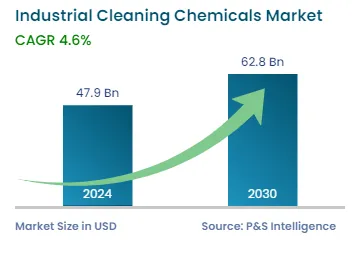
The Industrial Cleaning Chemicals Market size was USD 47.9 billion in 2024, which is predicted to reach USD 67.9 billion by 2032, growing at a CAGR of 4.6% during 2025–2032.
It is attributed to the increasing incidence of viral and bacterial diseases all around the globe, rising awareness of hygiene, government initiatives for cleaner cities, and surging demand for these agents in healthcare settings and food processing plants. At all these places, disinfectants & sanitizers are being increasingly utilized for this purpose.
In addition, the COVID-19 pandemic has heightened the importance of personnel safety and hygiene, thus leading to a surge in the demand for cleaning chemicals in industrial spaces. Further, the growing FMCG market worldwide has augmented the consumption of these agents in the retail & food service sector, while the growing industrialization level in developing countries has increased the emphasis on cleanliness and high standards of institutional hygiene.
According to the World Health Organization, about 7% of hospitalized patients in high-income countries and 15% in low- and middle-income countries experience an HAI during their visit, driving the demand for effective cleaning and disinfection solutions in medical facilities. Cleaning chemicals are utilized in a wide range of industrial settings to effectively remove chemical deposits, oil & grease, germs, and dirt from various surfaces, including factory floors as well as machines.
This way, effective cleaning plays a crucial role in enhancing the efficiency and development potential of various sectors, such as manufacturing, commercial offices, healthcare & hospitals, and retail & food services. These industries have always had to prioritize cleanliness due to their direct client interaction, a focus area that has received even more attention since the pandemic. High levels of hygiene in the general manufacturing, food processing, and automotive industries not only ensure workers’ safety but also lead to high-quality products and augmented productivity.
Moreover, government entities are actively promoting the use of synthetic cleansers to maintain the required standards of hygiene, contaminant elimination, and product and worker safety. Notably, the usage of these products has witnessed substantial growth in the food and healthcare industries in emerging economies.
Technological Innovations in Cleaning Formulations Is a Key Trend
Concentrated cleaning agents have been developed to require less product per use, which helps reduce packaging waste and lowers transportation costs.
Enzyme-based cleaners have been introduced to deliver high cleaning efficacy even at lower temperatures, significantly cutting down energy consumption in industrial processes. Smart dispensing systems and automated dosing technologies are being used to ensure precise chemical usage, minimizing waste and maintaining consistent cleaning performance.
Multi-surface and multi-purpose products have been formulated to eliminate the need for separate cleaners across different equipment and surfaces, streamlining operations.
Nanotechnology has been integrated into cleaning agents to enhance penetration, remove microscopic residues, and provide long-lasting protection.
Foam-control additives have been adopted to improve visibility during cleaning and reduce the amount of water required for rinsing.
Non-corrosive, pH-neutral solutions have been developed to clean effectively while preserving sensitive industrial equipment and surfaces.
Green solvents and biodegradable surfactants are being used to create high-performance, eco-friendly alternatives to traditional petroleum-based cleaners.
Quick-drying and residue-free formulations have been launched to improve operational efficiency in fast-paced industrial environments.
Customized chemical blends are being developed for specific applications, such as food-grade cleaners or high-temperature degreasers.
Research and development are underway into antimicrobial and odor-control agents that offer extended protection after cleaning, particularly in healthcare and food-related sectors.
Rising Stringency of Hygiene and Sanitation Standards Drives Market Growth
The heightening awareness post-COVID-19 has led industries to adopt stricter hygiene protocols to protect workers and consumers.
Regulatory authorities, such as OSHA, CDC, and WHO, have enforced hygiene standards across manufacturing, food processing, and healthcare sectors.
The increasing frequency of routine cleaning in industrial facilities, warehouses, and public infrastructure to reduce microbial contamination drives the market.
According to the Centers for Disease Control and Prevention, proper cleaning and disinfection remain critical components of infection prevention strategies, driving sustained demand for industrial-grade cleaning chemicals.
This drives the demand for disinfectants, sanitizers, and surface cleaners in sectors such as healthcare, pharmaceuticals, and food & beverage manufacturing.
Institutional facilities, including schools, airports, and transportation hubs, have scaled up cleaning practices to meet new health compliance standards.
Companies are integrating cleaning and sanitation procedures into their standard operating protocols to ensure workplace safety.
Procter & Gamble reported a 30% increase in disinfectant sales during Q1 2020 due to pandemic-driven demand, while Reckitt Benckiser experienced a 12.8% increase in hygiene business sales throughout 2020.
This demonstrates the lasting impact of enhanced hygiene consciousness on market dynamics.
The growing consumer expectations for cleanliness and hygiene are pushing manufacturers to invest in safer and more effective cleaning solutions.
The use of high-performance cleaning chemicals is increasing in cleanrooms and controlled environments where hygiene is critical.
Global supply chains and exports require hygiene certification, driving demand for compliant cleaning chemicals across industries.
Third-party audits and certifications for hygiene compliance have become essential in maintaining operational licenses and customer trust.
Surfactants represent the largest ingredient type in the industrial cleaning chemicals market, and they are expected to witness the highest CAGR, of approx. 5.5%, during the forecast period. Their dominance is attributed to their critical role in cleaning formulations, where they act as surface-active agents, enabling the effective removal of dirt, oil, and organic matter from surfaces. They are universally used across all types of cleaning products, including general-purpose cleaners, degreasers, and disinfectants.
The high consumption volume of surfactants is a result of their widespread applicability across diverse industrial environments, such as manufacturing plants, food processing units, and healthcare facilities. Their effectiveness in breaking down surface contaminants and enhancing rinseability makes them indispensable in cleaning formulations. Producers are investing heavily in the development of bio-based surfactants derived from renewable sources, such as plant oils and sugars. The trend toward low-foaming, high-efficiency cleaning agents used in automated systems further contributes to the strong growth momentum of this category.
These ingredient types are covered:
Surfactants (Largest and Fastest-Growing Category)
Solvents
Chelating Agents
pH Regulators
Solubilizers/Hydrotropes
Enzymes
Product Type Analysis
General-purpose cleaners held the largest market share, of 40%, in 2024. These products are designed for broad, routine cleaning applications across a wide range of industries. Their versatility and ease of use make them a staple in both industrial and institutional settings, including warehouses, production floors, schools, and commercial buildings. General-purpose cleaners are typically formulated to remove common contaminants such as dust, grease, and biological residues. Their consistent demand across multiple end-use industries ensures a strong and stable revenue contribution to the overall market.
The fastest-growing product type is disinfectants and sanitizers. The global pandemic significantly accelerated the demand for disinfectant products, and the trend has sustained due to heightened hygiene awareness and regulatory requirements for surface sanitation. These products are increasingly used in healthcare, food and beverage processing, hospitality, and retail environments, where infection prevention is critical. The continued emphasis on microbial control and compliance with safety protocols is expected to keep this category on a strong upward trajectory over the coming years.
These product types are covered:
General-Purpose Cleaners (Largest Category)
Disinfectants and Sanitizers (Fastest-Growing Category)
Laundry Care Products
Vehicle Wash Products
Others
Application Analysis
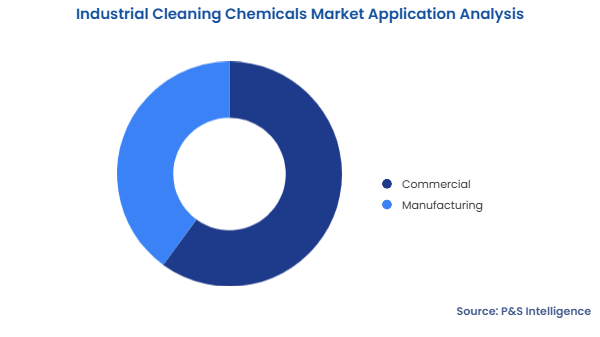
Healthcare has the largest industrial cleaning chemicals market share, of 65%, in 2024, and it is also the fastest-growing application category. The need for stringent hygiene practices in hospitals, laboratories, diagnostic centers, and clinics drives substantial consumption of specialized cleaning agents. In healthcare facilities, cleaning chemicals are used not only for general surface cleaning but also for equipment sterilization, floor disinfection, and infection control in operating rooms and intensive care units. The sector's reliance on high-performance, non-toxic, and residue-free formulations contributes significantly to market demand.
The category's growth is further fueled by global investments in healthcare infrastructure, especially in emerging economies, where new hospitals and medical centers are being established. Moreover, the rising incidence of hospital-acquired infections (HAIs) and increasing patient awareness around cleanliness and safety are prompting healthcare providers to adopt more robust cleaning protocols. As a result, the healthcare category is expected to maintain its leadership in both value and growth during the forecast period.
These applications are covered:
Commercial
Food service
Retail
Healthcare (Largest and Fastest-Growing Category)
Laundry care
Institutional buildings
Manufacturing
Food & beverage processing
Metal manufacturing & fabrication
Electronic components
Drive strategic growth with comprehensive market analysis
Asia Pacific Industrial Cleaning Chemicals Market Share
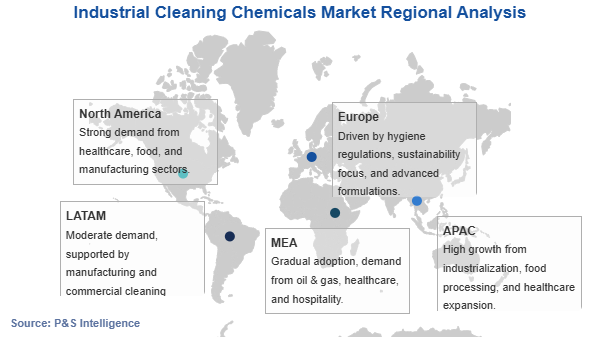
Asia-Pacific holds the largest market share, of 40%, in 2024, of the global industrial cleaning chemicals market. This is primarily due to the rapid pace of industrialization, urbanization, and infrastructure development across major economies such as China, India, and Southeast Asian countries. The growth of manufacturing sectors, coupled with increased regulatory oversight on workplace hygiene, has led to rising consumption of cleaning chemicals in this region. Moreover, the expansion of food processing and healthcare industries has further strengthened market demand in Asia-Pacific.
China Industrial Cleaning Chemicals Market Share
China's industrial cleaning industry is poised to grow by 2.2 times, between 2024 and 2034, reaching over USD 25.6 billion by 2034, according to market analysis. The country's massive manufacturing base, coupled with increasing environmental awareness and regulatory compliance requirements, drives substantial demand for industrial cleaning solutions. India's healthcare infrastructure, comprising approximately 70,000 hospitals with 63% private sector ownership, presents significant growth opportunities for specialized cleaning chemical providers.
North America Industrial Cleaning Chemicals Market Outlook
North America is emerging as the fastest-growing regional market. The U.S. and Canada are witnessing increased adoption of sustainable and high-efficiency cleaning products, driven by strict regulatory frameworks such as those established by the Environmental Protection Agency (EPA) and the Occupational Safety and Health Administration (OSHA). Furthermore, industries in this region are embracing technological advancements in cleaning, including automated dispensing systems and smart sanitation practices, which are contributing to the accelerated growth of the market. The shift toward green chemistry and higher spending on facility maintenance and hygiene management are also key factors supporting this regional growth trend.
The region's emphasis on sustainable cleaning solutions drives innovation and premium product adoption. Environmental regulations and corporate sustainability initiatives encourage the development of bio-based formulations and eco-friendly packaging solutions. The U.S. food and beverage industry, valued at USD 1.5 trillion according to the USDA, requires specialized cleaning chemicals to maintain food safety standards, creating substantial market opportunities for manufacturers offering compliant cleaning solutions.
U.S. Industrial Cleaning Chemicals Market Share
According to the Bureau of Labor Statistics, U.S. consumers spent an average of USD 169.83 on laundry and cleaning supplies in 2022, reflecting strong domestic demand for cleaning products. The Happi Magazine and Circana data revealed that all-purpose cleaners and disinfectants generated over USD 1.7 billion in sales during 2023, demonstrating the substantial market size for industrial cleaning chemicals in North America.
The regions and countries analyzed in this report are:
North America (Fastest-Growing Regional Market)
U.S. (Larger Country Market)
Canada (Faster-Growing Country Market)
Europe
Germany (Largest Country Market)
U.K. (Fastest-Growing Country Market)
France
Italy
Spain
Rest of Europe
Asia-Pacific (Largest Regional Market)
Japan
China (Largest Country Market)
India (Fastest-Growing Country Market)
South Korea
Australia
Rest of APAC
Latin America
Brazil (Largest Country Market)
Mexico (Fastest-Growing Country Market)
Rest of LATAM
Middle East and Africa
Saudi Arabia (Largest Country Market)
South Africa
U.A.E. (Fastest-Growing Country Market)
Rest of MEA
Industrial Cleaning Chemicals Market Share
The industrial cleaning chemicals market is broadly considered fragmented in nature, with competition spread across a wide array of global, regional, and niche manufacturers. Although some large multinational corporations operate in this space, no single company holds a market share significant enough to influence the entire industry's pricing, distribution, or innovation dynamics. This dispersed market structure is largely due to the diverse applications, product types, and end-use industries the sector serves, ranging from healthcare and food processing to manufacturing and institutional facilities.
The fragmentation is further reinforced by regional differences in regulatory standards, hygiene requirements, and customer preferences, which allow local and specialized companies to develop tailored solutions. These companies often focus on specific product categories or industries, offering customized cleaning chemicals designed to meet unique operational or compliance needs. As a result, even in markets where demand is high, such as healthcare or food service, the competitive landscape remains varied and regionally segmented.
Top Industrial Cleaning Chemicals Producers:
BASF SE
The Clorox Company
Clariant AG
The Dow Chemical Company
Ecolab Inc.
Evonik Industries AG
Henkel AG & Co. KGaA
Pilot Chemical Company
Procter & Gamble Company
Solvay SA
Stepan Company
3M Company
Industrial Cleaning Chemicals Market News
In January 2025, Ecolab Inc. launched ReadyDose, a compact, tablet-based cleaning solution designed to eliminate up to 98.8% of plastic packaging waste. It aims to reduce environmental impact while offering practical sanitation in institutional settings like restaurants and kitchens.
In April 2024, BASF SE introduced 20 biomass-balanced ingredients for cleaning and detergent manufacturers in Europe under its EcoBalanced lineup. These products offer reduced carbon footprints while maintaining the same performance as conventional counterparts and are TÜV Nord-certified under the REDcert² scheme.
In October 2023, Henkel AG & Co. KGaA launched Bonderite C‑AK 14415, a high-performance, boron-free cleaner for automotive aluminum components. Built for metal pretreatment, it ensures corrosion protection and strong adhesion while meeting stricter environmental and regulatory standards.
In September 2023, Dow Inc. partnered with LanzaTech Inc. to introduce EcoSense 2470, a biodegradable surfactant derived from recycled carbon, designed to support sustainability without compromising performance. This innovation reflects Dow's steps toward circular economy solutions in surfactant technologies.
In September 2023, Summit Brands acquired the Pumie line of abrasive cleaning products from the Pumice Company, expanding its professional janitorial and restaurant market presence with heavy-duty, non-toxic scouring products.
Want a report tailored exactly to your business need?
Leading companies across industries trust us to deliver data-driven insights and innovative solutions for their most critical decisions. From data-driven strategies to actionable insights, we empower the decision-makers who shape industries and define the future. From Fortune 500 companies to innovative startups, we are proud to partner with organisations that drive progress in their industries.
Client Testimonials
Working with P&S Intelligence and their team was an absolute pleasure – their awareness of timelines and commitment to value greatly contributed to our project's success. Eagerly anticipating future collaborations.
McKinsey & Company
India
Unmatched Standards
Our insights into the minutest levels of the markets, including the latest trends and competitive landscape, give you all the answers you need to take your business to new heights
Complete Data Security
We take a cautious approach to protecting your personal and confidential information. Trust is the strongest bond that connects us and our clients, and trust we build by complying with all international and domestic data protection and privacy laws