Professional Dental Care Market Size & Share Analysis - Trends, Drivers, Competitive Landscape, and Forecasts (2026 - 2032)
This Report Provides In-Depth Analysis of the Professional Dental Care Market Report Prepared by P&S Intelligence, Segmented by Service Type (Preventive Dentistry, Orthodontics, Restorative Dentistry, Periodontics, Endodontics, Prosthodontics, Oral & Maxillofacial Surgery), Treatment Mode (General Dentistry, Specialized Dentistry), End User (Dental Clinics, Hospitals, Academic & Research Institutes, Public Dental Care Centers), Practice Type (Solo Practices, Dental Service Organizations, Group Practices), Payment Coverage (Private Insurance, Out-of-Pocket Payment, Public Insurance), and Geographical Outlook for the Period of 2021 to 2032
Explore the market potential with our data-driven report
Professional Dental Care Market Overview
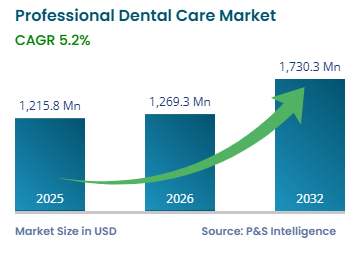
The professional dental care market size was USD 1,215.8 million for 2025, and it will grow by 5.2% during 2026-2032, to reach USD 1,730.3 million by 2032.
The market is expanding because consumers are placing greater importance on oral health and visiting dental professionals more frequently for preventive, restorative, and cosmetic procedures. Dental conditions associated with tobacco use, high sugar consumption, aging populations, and inadequate oral hygiene continue to increase across developed and emerging economies. Healthcare providers, government health agencies, and professional dental associations are strengthening oral health awareness through preventive care initiatives, regular screening programs, and patient education campaigns. Cosmetic procedures, including teeth whitening, veneers, clear aligners, and smile enhancement, are also becoming more common among younger consumers and working professionals who prioritize personal appearance and long-term oral wellness. Growing disposable incomes and the wider availability of private dental clinics are further improving access to advanced dental treatments across urban populations.
The market is also benefiting from the rapid adoption of digital dentistry technologies that improve treatment precision, clinical workflows, and patient experience. Dental practices are increasingly incorporating digital imaging systems, CAD/CAM equipment, intraoral scanners, dental lasers, and three-dimensional printing technologies to support efficient diagnosis and treatment planning. Patients are also showing a stronger preference for minimally invasive procedures with shorter recovery times, encouraging providers to expand advanced dental services. According to the World Health Organization, nearly half of the global population is affected by oral diseases. Furthermore, the 2025 Tracking Progress on the Implementation of the Global Oral Health Action Plan 2023–2030 baseline report identifies the combined global prevalence of the main oral diseases and conditions at 47%. This substantial global treatment requirement continues to encourage investments in preventive dentistry, restorative procedures, orthodontic care, cosmetic services, and digitally enabled clinical infrastructure, supporting sustained demand for professional dental care across established and developing healthcare systems.
Key Market Insights
Preventive Dentistry is the largest category, holding a market share of 30%, due to rising demand for routine oral examinations and fluoride-based preventive care.
Specialized Dentistry is the faster-growing category, registering a CAGR of approximately 5.4%, driven by increasing patient spending on orthodontic, implant, and cosmetic dental procedures.
Dental Clinics are the largest category, holding a market share of 40%, due to strong patient preference for accessible standalone and multi-speciality treatment centres.
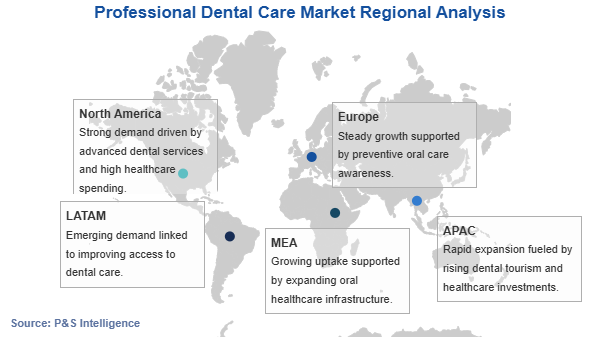
North America holds the largest share of 40%, due to high cosmetic dentistry spending and widespread adoption of digitally equipped dental clinics.
Asia-Pacific is the fastest-growing region, registering a CAGR of approximately 6.1%, driven by expanding private dental chains and rising awareness regarding preventive oral care.
Professional Dental Care Market Trends and Drivers
AI-Based Digital Dentistry Platforms Are a Major Trend
Dental clinics are increasingly adopting AI-supported digital workflows to improve diagnosis, treatment planning, and patient management. Dentists are using artificial intelligence in imaging software, orthodontic planning, cavity detection, and smile-design applications to reduce manual effort and improve treatment precision. Cloud-connected dental systems that integrate patient records, imaging, and workflow tracking are also becoming more common across digitally equipped clinics. In 2025, Planmeca introduced Romexis 7 dental imaging software with built-in AI features for imaging, anatomy recognition, implant planning, and workflow support. Dental technology providers are also expanding AI integration across treatment-planning systems. In 2025, Carestream Dental launched CS 3D Imaging Premium with AI-powered implant-planning and case-sharing functions. These developments are helping clinics improve workflow efficiency, reduce treatment time, and deliver faster and more personalised dental care services.
Rising Demand for Preventive and Cosmetic Dental Care Drives Market
The market is growing because consumers are increasingly seeking preventive and appearance-focused dental treatments before advanced oral conditions develop. Routine cleanings, oral examinations, aligners, teeth whitening, and smile correction procedures are becoming part of regular personal care among younger adults and working professionals. Poor oral hygiene, tobacco use, high sugar consumption, and changing lifestyles are also increasing demand for professional dental treatment across different age groups. According to the World Health Organization, oral diseases are estimated to affect nearly 3.7 billion people worldwide.
Furthermore, the World Health Organization estimates that severe periodontal diseases affect more than 1 billion cases globally. This extensive treatment population is encouraging dental clinics to expand preventive, restorative, orthodontic, and cosmetic service offerings while increasing investments in advanced diagnostic technologies and patient-centered care. These developments are also supporting broader adoption of professional dental services across private practices, multispecialty dental centers, and community-based oral healthcare networks as patient awareness and treatment participation continue to rise.
High Cost of Advanced Dental Procedures and Limited Insurance Coverage Restrains Market Growth
The market faces challenges because advanced dental treatments remain expensive for a large share of the population, particularly in developing countries where dental insurance coverage remains limited. Procedures such as dental implants, orthodontics, cosmetic dentistry, and full-mouth rehabilitation often require significant out-of-pocket spending, reducing treatment adoption. Smaller dental clinics also face financial pressure when investing in digital imaging systems, CAD/CAM equipment, intraoral scanners, and dental lasers because of substantial installation and maintenance costs. According to the World Health Organization, 23% of the global population was entitled to essential oral health care services under nationally defined health service packages in the 2024 global baseline for the Global Oral Health Action Plan 2023–2030. Limited coverage, combined with uneven availability of qualified dental professionals in rural and underserved areas, slows timely treatment uptake, influences patient procedure choices, and affects investments in advanced dental technologies across healthcare providers.
Expansion of Organised Dental Clinics in Emerging Cities Creates New Opportunities
The market is creating opportunities through the expansion of organized dental clinics and multispecialty dental chains across developing countries and smaller urban areas. Many regions continue to have limited access to professional dental care beyond major cities, encouraging private healthcare providers to establish franchise-based clinics and digitally equipped treatment centers. Growing internet penetration and online appointment platforms are also helping providers connect with first-time patients while promoting preventive oral healthcare programs. According to the World Health Organization, only 1% of countries included dental preparations listed in the WHO Model Lists of Essential Medicines in their national essential medicines lists in the 2024 global baseline for the Global Oral Health Action Plan 2023–2030. This substantial coverage gap is encouraging investments in organized clinic networks, affordable treatment models, local product availability, and expanded preventive services, creating opportunities for providers to reach underserved populations and broaden access to professional dental care.
Professional Dental Care Market Segmentation Analysis
Service Type Analysis
Preventive dentistry is the largest category, holding a market share of 30%, because routine examinations, professional cleaning, fluoride treatments, sealants, and early diagnosis are recommended across all age groups. These services encourage regular patient visits and support long-term oral health management before advanced treatment becomes necessary. According to the World Health Organization, 29% of countries globally had national guidance on optimal fluoride delivery for population oral health in the 2024 baseline for the Global Oral Health Action Plan 2023–2030. This continued emphasis on fluoride-based prevention supports sustained demand for routine dental visits, school oral health programs, family dental care, and insurance-backed preventive services within professional dental practices.
Orthodontics is the fastest-growing category, registering a CAGR of approximately 5.8%, because more people want correction for crooked teeth, bite problems, and smile appearance. Demand is rising among teenagers and adults, especially with clear aligners and less visible braces becoming easier to use. Social media, workplace appearance, and better awareness of dental alignment are also pushing patients toward treatment. Clinics are promoting orthodontics strongly because it offers longer treatment cycles, higher patient value, and strong demand in both developed and emerging markets.
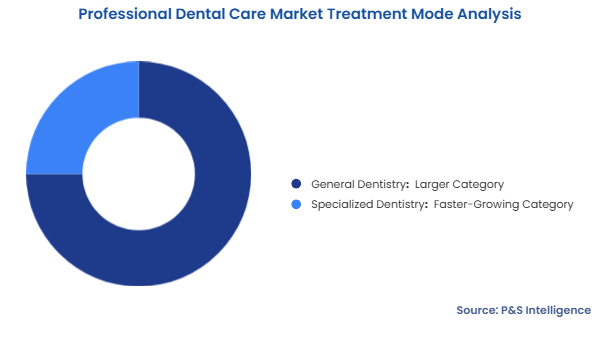
General Dentistry is the larger category, holding a market share of 75%, because it covers the basic dental needs that most patients use first. Checkups, fillings, cleaning, simple extractions, pain treatment, and oral health advice are usually handled under general dentistry. This makes it the first contact point for families, children, working adults, and elderly patients. The category remains strong because every clinic needs general dentists to manage routine cases before patients are referred for specialised care or advanced treatment.
Specialized Dentistry is the faster-growing category, registering a CAGR of approximately 5.4%, because patients are increasingly choosing implants, orthodontics, periodontal treatment, endodontics, oral surgery, and cosmetic procedures for complex clinical and aesthetic needs. Digital technologies are also improving treatment planning and workflow efficiency across specialist practices. In 2025, Align Technology announced ClinCheck Live Plan, which automatically generates an initial doctor-ready Invisalign treatment plan in about 15 minutes, with a global rollout planned from Q1 2026. This advancement strengthens digital orthodontic workflows, improves clinical efficiency, and supports broader adoption of technology-enabled specialist dental services.
The treatment modes analysed in this report are:
General Dentistry (Larger Category)
Specialized Dentistry (Faster-Growing Category)
End User Analysis
Dental clinics are the largest category, holding a market share of 40%, because most preventive, restorative, orthodontic, and cosmetic dental procedures are delivered through standalone clinics and multispecialty dental networks. Patients value clinics for convenient appointments, shorter waiting times, and direct access to dental professionals for continuing care. According to the World Health Organization, oral health care services were generally available in primary health care facilities in 81% of countries globally in the 2024 baseline for the Global Oral Health Action Plan 2023–2030. This broad availability of primary oral health services supports patient referrals, routine dental visits, and expanded service delivery through organized dental clinic networks.
Hospitals are the fastest-growing category, because more patients are using hospital dental departments for complex oral surgery, trauma care, medically linked dental conditions, and treatments that need anaesthesia or multi-speciality support. Hospitals are also expanding dental units to serve patients with diabetes, cancer, heart disease, and other health issues where oral care becomes part of wider treatment. The segment is gaining as large healthcare groups add dental services to improve patient coverage.
The end users analysed in this report are:
Dental Clinics (Largest Category)
Hospitals (Fastest-Growing Category)
Academic & Research Institutes
Public Dental Care Centers
Others
Practice Type Analysis
Solo practices are the largest category, holding a market share of 45%, because dental care is still highly local and relationship-based. Many patients continue visiting individual dentists they know and trust for routine care, pain treatment, fillings, cleaning, and family dental needs. Solo clinics are easier to set up than large dental chains and remain common in small cities, towns, and neighbourhood markets. Their strong presence is supported by a lower operating structure, direct patient relationships, and flexible service delivery.
Dental service organizations are the fastest-growing category, because organised dental groups help dentists manage staffing, billing, purchasing, marketing, technology adoption, and clinic expansion. This model allows dentists to focus more on treatment quality while the organisation handles business operations. DSOs are also expanding through multi-clinic networks, standardised care models, and digital systems that improve patient access. In 2025, Heartland Dental announced the launch of the Orahh Care Dental Community. This supports the shift towards organised dental practice support, shared resources, and wider service availability through the dental support organisation model.
The practice types analysed in this report are:
Solo Practices (Largest Category)
Dental Service Organizations (Fastest-Growing Category)
Group Practices
Others
Payment Coverage Analysis
Private Insurance is the largest category, because insured patients can access regular dental checkups, cleaning, fillings, and selected treatment services with lower direct payment pressure. Employers and family insurance plans often include dental benefits, especially in developed markets where dental visits are part of routine healthcare planning. This makes private insurance a strong payment route for repeat care. It also supports patient confidence because treatment costs become more predictable and easier to manage.
Out-of-Pocket Payment is the fastest-growing category, registering a CAGR of approximately 5.6%, because many dental procedures are still not fully covered by insurance, especially cosmetic treatments, implants, whitening, veneers, and some orthodontic services. Patients often pay directly when they want faster appointments, private clinic access, or treatments outside policy limits. This payment method is also common in emerging countries where dental insurance penetration is low. Growth is supported by rising incomes, dental tourism, and higher demand for appearance-focused services.
The payment coverages analysed in this report are:
Private Insurance (Largest Category)
Out-of-Pocket Payment (Fastest-Growing Category)
Public Insurance
Others
Drive strategic growth with comprehensive market analysis
Professional Dental Care Market Regional Outlook
North America Professional Dental Care Market Analysis
North America holds the largest share, of 40%, because the region has a highly established dental care system, strong insurance penetration, and a large base of consumers who regularly spend on preventive and cosmetic dental procedures. The presence of advanced dental clinics, organised dental service organisations, and early adoption of digital dentistry technologies continues to support market expansion across the region. Patients in North America are more likely to seek orthodontics, implants, smile correction, and minimally invasive treatments as part of routine healthcare and personal care spending. The region also benefits from a high concentration of trained dental professionals and specialised oral care centres. In addition, continuous investments in AI-based imaging systems, chairside CAD/CAM solutions, and cosmetic dentistry services are helping clinics improve treatment efficiency and patient experience. Strong awareness regarding oral hygiene and preventive dental visits further supports long-term demand for professional dental services across the region.
U.S. Professional Dental Care Market Analysis
The U.S. dental services market remains strong due to high spending on cosmetic dentistry, orthodontics, preventive care, and advanced restorative procedures. Patients actively seek smile aesthetics, routine check-ups, minimally invasive treatments, and specialised oral care through private clinics and dental service organisations. Digital dentistry adoption, including AI imaging, intraoral scanners, and chairside CAD/CAM systems, is also strengthening treatment quality and clinic efficiency. According to the American Dental Association Health Policy Institute, the U.S. had 202,485 professionally active dentists in 2024, equal to 59.5 dentists per 100,000 population. This large workforce supports broad service availability and repeated patient visits.
Canada Professional Dental Care Market Analysis
Canada’s dental services market is supported by rising access to organised dental care and strong awareness of preventive oral health. Demand remains steady for routine examinations, paediatric dentistry, restorative procedures, cosmetic treatments, and aligner services across urban and suburban clinics. Public programmes are also improving affordability for patients who previously delayed treatment due to cost barriers. According to Health Canada, more than 3.4 million Canadians were approved for the Canadian Dental Care Plan in 2025, and 1.7 million had already received dental care. This wider coverage is increasing patient access to preventive treatment, early diagnosis, and professional dental services.
Asia-Pacific Professional Dental Care Market Analysis
Asia-Pacific has the highest CAGR, of approximately 6.1%, because the region is witnessing rapid expansion of private dental clinics, rising healthcare spending, and growing awareness regarding oral hygiene and cosmetic dentistry. Large populations, changing food habits, and increasing cases of dental disorders are creating strong demand for preventive and restorative dental services across major Asian countries. Many consumers are now seeking advanced procedures such as aligners, implants, and smile correction treatments as disposable incomes improve and urban lifestyles change. The region is also seeing strong investment in modern dental infrastructure, especially in metropolitan cities where digital dentistry adoption is rising quickly. In addition, dental tourism is expanding across several Asian countries due to the availability of affordable treatments and internationally trained dental professionals. Government efforts to improve healthcare accessibility are also supporting the growth of organised dental care services in developing economies.
China Professional Dental Care Market Analysis
China’s dental services market is expanding due to rising middle-class spending, urbanisation, and stronger demand for cosmetic, orthodontic, and implant procedures. Private dental chains and digitally equipped clinics are growing across major cities, where patients increasingly seek appearance-focused and preventive oral care. Domestic dental technology providers are also improving access to digital treatment tools in metropolitan markets. According to the National Health Commission of the People’s Republic of China, medical and health institutions recorded 10.15 billion diagnosis-and-treatment visits in 2024. This broad healthcare utilisation supports patient flow across clinical service settings, including dental clinics offering advanced oral care.
India Professional Dental Care Market Analysis
India’s dental services market is growing due to expanding private healthcare infrastructure and rising awareness of preventive oral care in urban populations. Demand for affordable orthodontic, implant, restorative, and cosmetic procedures is increasing as middle-income consumers spend more on dental aesthetics and long-term oral health. Multi-speciality dental chains and franchise clinics are also improving access across tier-2 and tier-3 cities. According to the National Dental Commission, India had 330 BDS dental colleges for the 2025–26 academic year. This training infrastructure supports the country’s dental workforce pipeline and strengthens long-term service availability across private and organised dental care networks.
Europe Professional Dental Care Market Analysis
Europe has a well-developed dental care environment supported by public healthcare systems, strong clinical standards, and high awareness regarding preventive oral health management. Many countries across the region emphasise routine dental examinations and early treatment, which supports steady demand for dental services. The region also has a strong presence of specialised orthodontic, restorative, and pediatric dental clinics that cater to different patient groups. Cosmetic dentistry demand is increasing steadily, especially in urban areas where consumers are more focused on dental aesthetics and smile enhancement procedures. Dental technology adoption remains strong across Western European countries, with clinics increasingly using digital scanners, laser dentistry systems, and computer-assisted treatment planning tools. In addition, ageing populations in several European countries are increasing demand for dentures, implants, and long-term restorative dental procedures, particularly among elderly patients seeking functional and aesthetic oral rehabilitation.
The regions and countries analysed in this report are:
North America (Largest Regional Market)
U.S. (Larger Country)
Canada (Faster-Growing Country)
Europe
Germany (Largest Country)
U.K. (Fastest-Growing Country)
France
Italy
Spain
Rest of Europe
Asia-Pacific (Fastest-Growing Regional Market)
China (Largest Country)
India (Fastest-Growing Country)
Japan
South Korea
Australia
Rest of APAC
Latin America
Brazil (Largest Country)
Mexico (Fastest-Growing Country)
Rest of LATAM
Middle East and Africa
Saudi Arabia (Largest Country)
U.A.E. (Fastest-Growing Country)
South Africa
Rest of MEA
Professional Dental Care Market Share Analysis
The market is fragmented, with numerous independent dental clinics, regional dental chains, hospitals, and specialized oral care centers operating across countries and local markets. Most dental services are provided through small and medium-sized practices that serve community-based patient populations, creating a broad provider base across the industry. Patient preference for local dentists, personalized care, continuity of treatment, and long-term practitioner relationships also supports the presence of independently operated practices. Additionally, healthcare systems, reimbursement policies, pricing structures, and the availability of dental professionals differ across countries, contributing to diverse service delivery models. Organized dental service organizations and multisite clinic networks are expanding across several regions while continuing to operate alongside independent practices. Furthermore, new dental clinics and cosmetic dentistry centers are broadening service availability and increasing patient choice across urban and semi-urban markets.
Key Players in the Professional Dental Care Market:
Colgate-Palmolive Company
The Procter & Gamble Company
Koninklijke Philips N.V.
Sunstar Suisse S.A.
GC Corporation
Ultradent Products, Inc.
Young Innovations, Inc.
Solventum Corporation
Dentsply Sirona Inc.
Henry Schein, Inc.
Patterson Companies, Inc.
Kerr Corporation
DEXIS, LLC
Nobel Biocare Services AG
Align Technology, Inc.
Professional Dental Care Market News
In April 2026, Kerr Corporation launched Demi Pro, a cordless curing light for restorative procedures. The release placed the product within Kerr’s restorative line and described it as available through the company’s dental channel. The item is useful for this market news section because it is a finished chairside device, not a funding or a future plan.
In February 2026, DEXIS, LLC launched IS Connect Cloud for Labs as part of its lab-to-clinic workflow update. The company also listed new integrations with Amann Girrbach, exocad, and Labtrac. This event fits professional dental care because it adds a live digital connection layer between practices and dental laboratories, rather than a consumer-facing dental product.
In December 2025, Nobel Biocare Services AG added the DEXIS Imprevo intraoral scanner to its digital dentistry portfolio. The announcement tied the scanner to Nobel Biocare’s clinical and laboratory workflow offering. It is relevant as a provider-side portfolio launch, focused on professional scanning and case data capture inside dental practices and implant workflows.
In October 2025, Align Technology, Inc. introduced ClinCheck Live Plan for Invisalign digital treatment planning. The company described it as a feature that creates an initial doctor-ready treatment plan inside the Invisalign workflow. This news fits the market because it relates to professional orthodontic planning software used by dental providers, not a consumer campaign.
Frequently Asked Questions About This Report
What factors are driving the growth of the professional dental care market?+
The market is driven by the rising prevalence of dental diseases, increasing awareness of preventive oral healthcare, growing demand for cosmetic dentistry, expanding dental insurance coverage, technological advancements, and an aging global population.
How is digital technology transforming professional dental care?+
Digital technologies such as CAD/CAM systems, intraoral scanners, 3D imaging, digital radiography, AI-assisted diagnostics, and 3D printing are improving diagnostic accuracy, treatment planning, workflow efficiency, and patient outcomes.
What are the latest trends in professional dental care?+
Key trends include minimally invasive dentistry, digital dentistry, AI-powered diagnostics, teledentistry, same-day restorations, personalized treatment planning, and increased adoption of dental implants and clear aligners.
What challenges does the professional dental care market face?+
Major challenges include high treatment costs, limited access to dental services in rural areas, shortages of skilled dental professionals in some regions, and uneven reimbursement policies across countries.
What role does cosmetic dentistry play in market growth?+
The growing demand for teeth whitening, veneers, dental implants, clear aligners, and smile makeover procedures is increasing patient visits to dental clinics and driving the adoption of advanced dental technologies and services.
Want a report tailored exactly to your business need?
Leading companies across industries trust us to deliver data-driven insights and innovative solutions for their most critical decisions. From data-driven strategies to actionable insights, we empower the decision-makers who shape industries and define the future. From Fortune 500 companies to innovative startups, we are proud to partner with organisations that drive progress in their industries.
Client Testimonials
Working with P&S Intelligence and their team was an absolute pleasure – their awareness of timelines and commitment to value greatly contributed to our project's success. Eagerly anticipating future collaborations.
McKinsey & Company
India
Unmatched Standards
Our insights into the minutest levels of the markets, including the latest trends and competitive landscape, give you all the answers you need to take your business to new heights
Complete Data Security
We take a cautious approach to protecting your personal and confidential information. Trust is the strongest bond that connects us and our clients, and trust we build by complying with all international and domestic data protection and privacy laws