Dental Service Organization Market Size & Opportunities Analysis - Growth Strategies, Competitiveness, and Forecasts (2026 - 2032)
This Report Provides In-Depth Analysis of the Dental Service Organization Market Report Prepared by P&S Intelligence, Segmented by Service (Medical Supplies Procurement, Human Resources, Marketing and Brading, Accounting), End User (General Dentists, Dental Surgeons, Endodontists), Operation Model (Fee-for-Service, Private Equity-Backed DSOs, DSO Managed Care), Payment Method (Insurance, Financing Options, Out-of-Pocket), and Geographical Outlook for the Period of 2019 to 2032
Explore the market potential with our data-driven report
Dental Service Organization Market Outlook
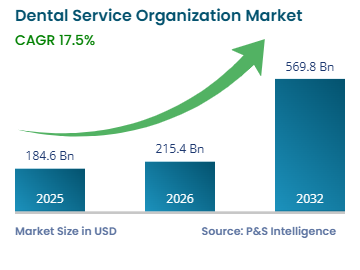
The global dental service organization market size is USD 184.6 billion in 2025, which is predicted to reach USD 569.8 billion by 2032, growing at a CAGR of 17.5% during 2026–2032.
The market growth is primarily driven by increasing prevalence of oral diseases, rising private equity investments in dental consolidation, and growing adoption of technology-enabled practice management platforms across multi-location dental networks. According to the World Health Organization (WHO), oral diseases affect around 3.5 billion people worldwide, making them one of the most common health conditions globally. The most widespread issues include dental caries (tooth decay), gum disease, tooth loss, and oral cancers.
The market is experiencing rapid consolidation driven by private equity interest in the dental sector. Private equity affiliation with dental practices nearly doubled between 2015 and 2021, increasing from 6.6% to 12.8%. DSOs provide critical administrative support, including human resources management, medical supplies procurement, marketing services, and financial operations, enabling dental practitioners to focus primarily on clinical patient care while benefiting from economies of scale in procurement and technology adoption. The growing complexity of regulatory compliance, rising operational costs, and administrative burdens are accelerating the shift toward DSO-affiliated practice models, particularly among recently graduated dentists facing substantial student debt obligations.
Dental Service Organization Market Emerging Trends
Artificial Intelligence Integration Is a Key Trend
Dental Service Organizations are increasingly using AI-powered diagnostic tools to assist dentists in identifying cavities, gum disease, and other oral conditions with higher accuracy.
In January 2025, VideaHealth raised USD 40 million in a Series B funding round to revolutionize DSO practice through AI, focusing on successful partnerships and broadening product offerings across various segments.
AI-driven dental imaging software enhances treatment planning by automatically analyzing X-rays, CT scans, and intraoral images, reducing manual effort and human error.
Automated appointment scheduling and patient communication systems use AI to improve operational efficiency and reduce no-show rates.
AI-based predictive analytics help DSOs forecast patient demand, optimize staff allocation, and improve workflow management across multiple clinic locations.
Personalized treatment recommendations are becoming more common as AI analyzes patient history, oral health data, and treatment outcomes to suggest the most suitable procedures.
AI chatbots and virtual assistants are being deployed for patient inquiries, insurance clarification, and pre-treatment guidance, enhancing customer service.
AI supports remote consultations and teledentistry platforms, allowing DSOs to expand their reach and maintain continuity of care.
Rising Private Equity Investment and Consolidation Are Major Growth Drivers
Private equity firms are increasingly acquiring multi-location dental practices and DSO groups to build larger, more efficient networks with centralized management.
Consolidation is helping DSOs reduce operational costs by sharing resources such as administrative support, HR, IT systems, marketing, and procurement.
Investors are drawn to the dental sector because of its recurring patient demand, insurance-backed revenue streams, and relatively lower economic sensitivity compared to other healthcare segments.
Larger DSOs are buying independent dental clinics to expand geographic presence and increase bargaining power with suppliers and insurance providers.
Private equity funding supports technology adoption, especially AI-based diagnostics, digital workflows, and teledentistry, to enhance clinical outcomes and patient experience.
Consolidation is accelerating the standardization of care protocols, leading to more consistent treatment quality across locations.
The trend is making it more challenging for solo practitioners to compete, encouraging more dentists to affiliate with DSOs for financial stability and operational support.
Dental Service Organization Market Segmentation Analysis
Service Analysis
The medical supplies procurement category holds the largest share in the dental service organization market in 2025, of 30%. This dominance is primarily attributable to centralized purchasing strategies that enable DSOs to negotiate favorable pricing terms with suppliers through bulk ordering commitments. DSOs maintain consistent inventory levels of essential dental materials, equipment, and consumables across their affiliated practice networks, ensuring standardized care delivery while minimizing supply chain disruptions. The procurement function generates significant cost savings for affiliated practices through economies of scale, vendor consolidation, and streamlined logistics management that individual practitioners cannot achieve independently.
The human resources segment is expected to exhibit the highest growth rate of 17.8% during the forecast period. This rapid expansion reflects the growing workforce management complexity as DSOs scale their operations across multiple states and practice locations. DSOs provide standardized employee benefits packages, professional development programs, and career advancement pathways that enhance talent attraction and retention capabilities. The HR function has become increasingly strategic for DSOs seeking to differentiate themselves in competitive labor markets and maintain consistent service quality standards across geographically dispersed practice networks.
These service categories are covered in the market:
Medical Supplies Procurement (Largest Category)
Human Resources (Fastest-Growing Category)
Marketing and Branding
Accounting
Others
End User Analysis
General dentists represent the largest category in 2025, capturing approximately 35% share. General dental practitioners constitute the majority of dental professionals and serve the broadest patient population requiring routine preventive care, basic restorative treatments, and ongoing oral health maintenance. The administrative complexity of managing solo or small group practices has intensified due to evolving regulatory requirements, insurance claim processing burdens, and rising operational costs. General dentists increasingly partner with DSOs to offload non-clinical business functions, access advanced diagnostic technologies, and benefit from centralized marketing initiatives that drive patient acquisition and retention.
The dental surgeons segment is set to demonstrate the highest growth rate of 17.7%during the forecast period. Dental surgeons specialize in complex oral and maxillofacial procedures, including extractions, implant placements, corrective jaw surgery, and trauma reconstruction. According to the study by the American Dental Association Health Policy Institute (HPI) covering U.S. dentists during 2015– 2021, the percentage of dentists affiliated with private equity (PE) increased from 6.6% in 2015 to 12.8% in 2021. DSOs targeting specialist practitioners offer access to expensive surgical equipment, specialized support staff, and referral network integration that enhances practice productivity and revenue generation potential.
These end users are covered:
General Dentists (Largest Category)
Dental Surgeons (Fastest-Growing Category)
Endodontists
Others
Operational Model Analysis
The fee-for-service model currently dominates the operational models segment with 50% share in 2025. This traditional payment structure allows DSOs and affiliated dentists to bill patients or insurance providers directly for each service rendered, maintaining flexibility in treatment planning and revenue optimization. Fee-for-service models align well with cosmetic and elective dental procedures, where patient willingness to pay supports premium pricing strategies.
Private equity-backed DSOs represent the fastest-growing operational model in the forecast period. Private equity investment provides substantial capital resources enabling rapid practice acquisition, technology infrastructure deployment, and geographic market expansion. These sophisticated ownership structures typically involve management fee arrangements where the DSO provides comprehensive administrative support in exchange for percentage-based compensation from affiliated practice revenues.
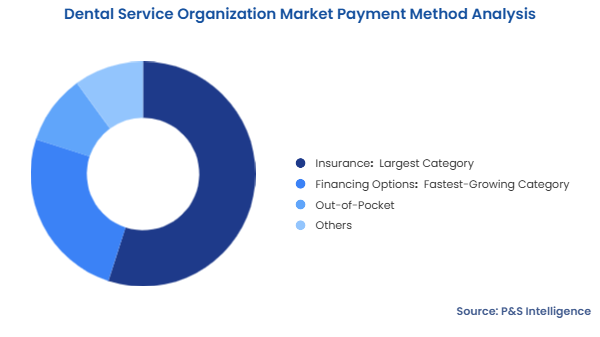
Insurance-based payments constituted the largest payment method segment in 2025, representing approximately 55% of total DSO revenues. Dental insurance coverage has expanded significantly in recent years through employer-sponsored benefits programs and Medicare Advantage plan enhancements. According to the CareQuest Institute for Oral Health’s 2024 State of Oral Health Equity in America survey, only 27% of U.S. adults, or about 72 million people, do not have dental insurance. DSOs benefit from insurance-based revenue streams through centralized credentialing processes, automated claims submission systems, and specialized staff trained in insurance authorization protocols that maximize reimbursement rates and minimize payment delays.
Financing options represent the fastest-growing payment method, as DSOs implement patient financing programs to reduce cost barriers for high-value procedures. Third-party financing partnerships enable patients to access dental treatments through installment payment plans, expanding the addressable market for complex restorative work and cosmetic procedures that exceed typical insurance coverage limits.
These payment methods are covered:
Insurance (Largest Category)
Financing Options (Fastest-Growing Category)
Out-of-Pocket
Others
Drive strategic growth with comprehensive market analysis
Dental Service Organization Market Geographical Analysis
North America Dental Service Organization Market Size
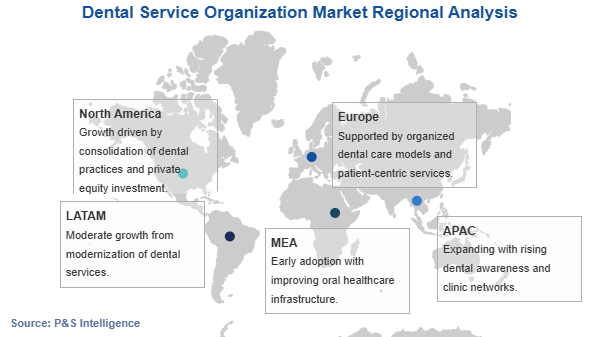
North America dominated the global dental service organization market in 2025, holding approximately 45% of total market revenue. The region's leadership position is supported by advanced healthcare infrastructure, high dental healthcare expenditure, widespread insurance coverage, and favorable regulatory environments permitting corporate ownership of dental practices in most jurisdictions. The U.S. market leads regional growth with sophisticated DSO platforms operating multi-state networks comprising hundreds or thousands of affiliated practice locations. According to the CDC’s 2024 Oral Health Surveillance Report, more than 1 in 10 children aged 2–5 years had at least one untreated cavity.
The substantial disease burden, combined with high patient awareness of preventive and cosmetic dental care, drives consistent demand for dental services. Major DSO platforms, including Heartland Dental, Aspen Dental, and Pacific Dental Services, have established dominant market positions through strategic acquisition programs and de novo practice development initiatives. Private equity investment remains concentrated in North American markets due to favorable returns, established exit strategies through secondary buyouts or initial public offerings, and mature dental services industry infrastructure.
Asia-Pacific Dental Service Organization Market Growth
Asia-Pacific is projected to exhibit the fastest regional growth, with a CAGR of 17.6%, during 2026–2032. The region's rapid expansion is driven by rising disposable incomes, increasing oral health awareness, expanding dental insurance coverage, and growing middle-class populations demanding quality dental care services. Urbanization trends concentrate populations in metropolitan areas where DSO practice networks can achieve operational efficiencies through geographic density and shared resources.
The shortage of dental professionals in rural and semi-urban areas creates opportunities for DSO expansion through multi-location practice networks and teledentistry capabilities. Government initiatives promoting healthcare affordability and expanding insurance coverage are accelerating DSO adoption throughout the region. Private equity firms and global DSO platforms are increasing investments in Asian markets to capitalize on demographic tailwinds, favorable regulatory changes permitting corporate practice models, and substantial untapped market potential as dental care penetration rates remain below developed market standards.
The regions and countries analyzed in this report are:
North America (Largest Regional Market)
U.S. (Larger Country Market)
Canada (Faster-Growing Country Market)
Europe
Germany (Largest Country Market)
U.K. (Fastest-Growing Country Market)
France
Italy
Spain
Rest of Europe
Asia-Pacific (Fastest-Growing Regional Market)
Japan
China (Largest Country Market)
India (Fastest-Growing Country Market)
South Korea
Australia
Rest of APAC
Latin America
Brazil (Largest Country Market)
Mexico (Fastest-Growing Country Market)
Rest of LATAM
Middle East and Africa
Saudi Arabia (Largest Country Market)
South Africa
U.A.E. (Fastest-Growing Country Market)
Rest of MEA
Dental Service Organization Market Share
The dental service organization market exhibits a fragmented competitive structure with numerous regional and national players competing across different service offerings, operational models, and geographic markets. The market features a diverse mix of large multi-state DSO platforms, mid-sized regional operators, and emerging specialty-focused organizations. The market can be characterized as fragmented based on competitive dynamics analysis. Individual DSO organizations maintain distinct competitive positions through differentiated service offerings, geographic focus areas, specialty concentrations, and operational philosophies. Some platforms emphasize rapid growth through aggressive acquisition strategies backed by private equity capital, while others pursue organic development through de novo practice openings and partnership models preserving greater clinical autonomy for affiliated dentists.
Leading DSO platforms compete on multiple dimensions, including scale advantages enabling superior procurement terms, technology infrastructure supporting operational efficiency, brand recognition driving patient acquisition, and talent management capabilities attracting dental professionals. The largest organizations leverage their multi-state footprints to implement standardized clinical protocols, centralized training programs, and data analytics platforms that smaller competitors cannot replicate cost-effectively. However, independent practitioners and smaller DSO networks often maintain advantages in local market knowledge, personalized patient relationships, and operational flexibility that enable competitive differentiation.
Strategic initiatives among major players include technology platform investments, specialty service expansion, geographic market penetration, and acquisition pipeline development. In June 2024, VideaHealth and vVARDIS partnered to strengthen the future of preventative oral care by combining advanced AI-driven diagnostics with innovative oral health solutions.
Key Dental Service Organization Companies:
Heartland Dental
The Aspen Group
Pacific Dental Services
Smile Brands Inc.
Dental Care Alliance
MB2 Dental
Western Dental & Orthodontics
Great Expressions Dental Centers
Benevis
Dentex Health
Colosseum Dental Group
Abano Healthcare / Maven Dental Group
Dental Service Organization Market News
In May 2025, Smile Source and ACT Dental announced their historic merger, combining Smile Source's network of independent oral care practices with ACT Dental's coaching and educational services to empower over 1,000 member dentists across 750 practices.
In March 2025, Parkview Dental Partners announced the acquisition of a periodontist practice in Brandon, Florida, by Dr. Douglas C. Wendt Jr., expanding Parkview Dental's regional footprint to operate the practice as Ross and Wendt Periodontics and Dental Implants.
In February 2025, Straine Dental Management announced a collaboration with Arkansas dentist Scott Jolly, DDS, to acquire a new dental practice in Arkansas, furthering SDM's geographic expansion strategy.
In July 2024, Dental Care Alliance partnered with Patient Prism, an advanced AI conversational intelligence platform, to enhance patient service across its network of over 400 dental practices nationwide, enabling DCA to advance dentistry and improve patient care through innovative solutions.
Want a report tailored exactly to your business need?
Leading companies across industries trust us to deliver data-driven insights and innovative solutions for their most critical decisions. From data-driven strategies to actionable insights, we empower the decision-makers who shape industries and define the future. From Fortune 500 companies to innovative startups, we are proud to partner with organisations that drive progress in their industries.
Client Testimonials
Working with P&S Intelligence and their team was an absolute pleasure – their awareness of timelines and commitment to value greatly contributed to our project's success. Eagerly anticipating future collaborations.
McKinsey & Company
India
Unmatched Standards
Our insights into the minutest levels of the markets, including the latest trends and competitive landscape, give you all the answers you need to take your business to new heights
Complete Data Security
We take a cautious approach to protecting your personal and confidential information. Trust is the strongest bond that connects us and our clients, and trust we build by complying with all international and domestic data protection and privacy laws