This Report Provides In-Depth Analysis of the Layered Double Hydroxide Market Report Prepared by P&S Intelligence, Segmented by Type (Magnesium Aluminium LDH, Nickel-Based LDH, Zinc Aluminium LDH, Calcium Aluminium LDH), Grade (Industrial Grade, High-Purity Grade, Pharmaceutical Grade, Speciality Grade), End-User (Chemicals, Electronics & Energy Storage, Plastics & Polymers, Construction, Agriculture, Pharmaceuticals, Water & Wastewater Management), and Geographical Outlook for the Period of 2021 to 2032
Explore the market potential with our data-driven report
Layered Double Hydroxide Market Future Outlook
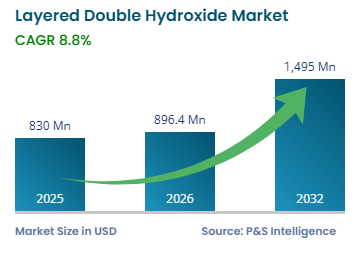
The layered double hydroxide market size was USD 830.0 million for 2025, and it will grow by 8.8% during 2026-2032, to reach USD 1,495.0 million by 2032.
The market is expanding because layered double hydroxides are gaining wider adoption across plastics, chemicals, environmental treatment, electronics, and pharmaceutical applications. These materials improve flame retardancy, thermal stability, adsorption efficiency, and chemical resistance, making them suitable for industrial processing and speciality material formulations. Manufacturers are increasingly using layered double hydroxides in polymer compounds and industrial additives to support low-toxicity and halogen-free production requirements. Demand is also increasing from plastics and speciality chemical industries, where producers require materials that can improve durability, reduce smoke generation during combustion, and maintain product performance under high-temperature processing conditions. According to the United Nations Environment Programme, humanity generated an estimated 400 million tonnes of plastic waste in 2024, increasing industrial focus on safer additives and environmentally compatible material technologies for polymer production and waste-management applications.
The market is also gaining momentum because layered double hydroxides are being adopted in water treatment systems, catalyst applications, drug-delivery technologies, and advanced energy-related materials. Their ion-exchange and adsorption capabilities support the removal of heavy metals, industrial pollutants, and hazardous chemical residues, increasing their use in environmental management projects and wastewater-treatment processes. Industrial producers are investing in multifunctional materials that can support lightweight manufacturing, thermal protection, and sustainable production methods across high-performance applications. Research activities in nanotechnology, speciality chemicals, and advanced material engineering are also strengthening product development for next-generation industrial uses. Growth in automotive manufacturing, electronics production, infrastructure activities, and speciality chemical processing across the Asia Pacific is further supporting market expansion as manufacturers continue seeking high-performance materials that combine operational efficiency with improved environmental compatibility.
Key Market Insights
Magnesium Aluminium LDH is the largest type, holding a market share of 40%, due to broad usage in flame retardants and wastewater-treatment materials.
High-Purity Grade is the fastest-growing grade, registering a CAGR of approximately 9.2%, driven by rising demand from battery and biomedical applications.
Chemicals is the largest application, holding a market share of 30%, due to extensive usage in catalysts, stabilisers, and speciality chemical processing.
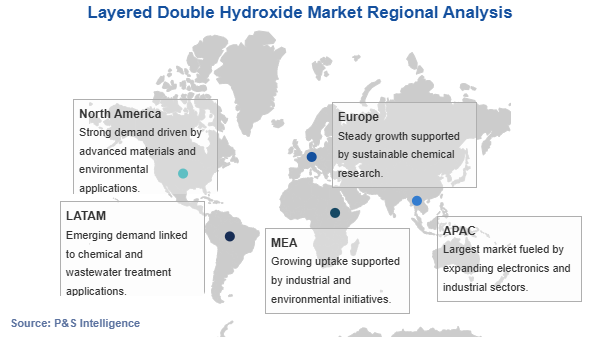
Asia-Pacific is the largest region, holding a market share of 40%, due to expanding plastics, chemicals, and electronics manufacturing activities.
India is the fastest-growing country, driven by rising chemical production and increasing industrial water-treatment investments.
Layered Double Hydroxide Market Dynamics
Halogen-Free Flame-Retardant Additives in Polymers Is a Major Trend
Manufacturers are increasingly using layered double hydroxides in halogen-free flame-retardant systems for plastics, cables, electronics, and construction materials. The industry is shifting away from conventional flame retardants that generate toxic smoke and environmental concerns during combustion. Producers are developing magnesium-aluminium and calcium-aluminium LDH formulations that improve fire resistance while maintaining thermal stability and mechanical strength in engineering plastics. Material companies are also combining LDHs with nanocomposites and hybrid additives to improve dispersion efficiency and reduce additive loading during polymer compounding. According to Plastics Europe, total global plastics production reached 430.9 million tonnes in 2024, supporting demand for additive systems used in flame-retardant plastics and polymer-processing applications. According to the International Energy Agency, global electric car sales exceeded 17 million units in 2024, increasing demand for low-toxicity flame-retardant materials used in EV cables, electronics, insulation systems, and other fire-safety-sensitive components.
Growing Demand for Advanced Water Purification Materials Drives Market
The market is growing because industries and governments are increasing investments in water purification and wastewater-treatment systems. Layered double hydroxides are widely used as adsorbent materials because they can remove heavy metals, dyes, toxic chemicals, and industrial contaminants from wastewater streams. Rising pollution from mining, textile manufacturing, chemical processing, and urban waste discharge is encouraging treatment operators to adopt advanced filtration and contaminant-removal materials with higher adsorption efficiency. Environmental regulations related to industrial discharge and hazardous waste management are also supporting demand for reusable and chemically stable treatment materials across industrial water-management systems. According to the United Nations Children’s Fund and the World Health Organisation Joint Monitoring Programme, 2.1 billion people lacked safely managed drinking water in 2024, increasing the requirement for stronger purification technologies. According to the United Nations Sustainable Development Goals Report, only 56% of global domestic wastewater generated, equal to 332 billion m³, was safely treated in 2024, strengthening demand for high-performance wastewater-treatment materials and filtration systems.
High Production Complexity and Limited Large-Scale Processing Capacity Restrains Market Growth
The market faces challenges because the production of layered double hydroxides requires controlled synthesis conditions, specialised processing methods, and consistent raw material quality. Many end-use industries require precise particle size, structural stability, and purity levels, making manufacturing more complex than conventional additives and adsorbent materials. Scaling production for large industrial applications also remains difficult because small variations during synthesis can affect final material performance and processing efficiency. Some manufacturers still depend on laboratory-scale or limited commercial-scale production systems, which slows wider industrial adoption across cost-sensitive industries. The market also faces competition from alternative adsorbent and catalyst-support materials already established in wastewater treatment, flame retardants, and industrial processing applications. According to the United States Geological Survey, world natural zeolite mine production reached 1,000,000 metric tons in 2024, highlighting the large commercial scale of competing ion-exchange and adsorption materials already integrated into industrial treatment and processing systems.
Expanding Use in Energy Storage and Biomedical Research Creates New Opportunities
The market is creating new opportunities through the growing use of layered double hydroxides in energy-storage systems, biomedical technologies, and advanced nanomaterial research. Researchers and manufacturers are exploring these materials for batteries, supercapacitors, and hydrogen-related applications because layered double hydroxides offer strong ion-exchange capability, electrochemical stability, and adaptable layered structures. Pharmaceutical and biomedical sectors are also studying these materials for controlled drug delivery, bioimaging, and targeted therapeutic applications where material stability and release control are important. According to the International Energy Agency, battery demand in the energy sector reached the 1 TWh milestone in 2024, while EV battery demand exceeded 950 GWh, strengthening research interest in advanced energy-storage materials and electrochemical technologies. Universities, speciality chemical companies, and material-science firms are increasing partnerships to develop multifunctional layered double hydroxides for next-generation applications. Growing demand for lightweight, high-efficiency, and environmentally compatible materials in clean energy and healthcare sectors is supporting wider product innovation and long-term commercial development across emerging industrial applications.
Magnesium Aluminium LDH is the largest category, holding a market share of 40%, because it is widely used in flame retardants, polymer stabilisation, wastewater treatment, and catalyst applications. The material provides strong thermal stability, low toxicity, and effective ion-exchange performance, supporting its large-scale use across plastics, coatings, and speciality chemical manufacturing. Manufacturers also prefer magnesium aluminium formulations because they are comparatively cost-effective and easier to integrate into industrial processing systems. According to the United States Geological Survey, estimated world magnesite mine production was 21.0 million metric tons in 2025, supporting raw material availability for magnesium-based layered double hydroxide production and strengthening commercial adoption across multiple industrial applications.
Nickel-Based LDH is the fastest-growing category, because it is gaining strong attention in energy storage, battery research, electrocatalysis, and advanced nanotechnology applications. These materials provide improved electrochemical performance and conductivity, which supports their use in supercapacitors, hydrogen production systems, and next-generation energy devices. Research institutions and advanced material companies are increasing investments in nickel-based layered double hydroxides for clean energy technologies. Rising interest in renewable energy storage systems and high-performance functional materials is also accelerating commercial development and industrial adoption.
The types analysed in this report are:
Magnesium Aluminium LDH (Largest Category)
Nickel-Based LDH (Fastest-Growing Category)
Zinc Aluminium LDH
Calcium Aluminium LDH
Others
Grade Analysis
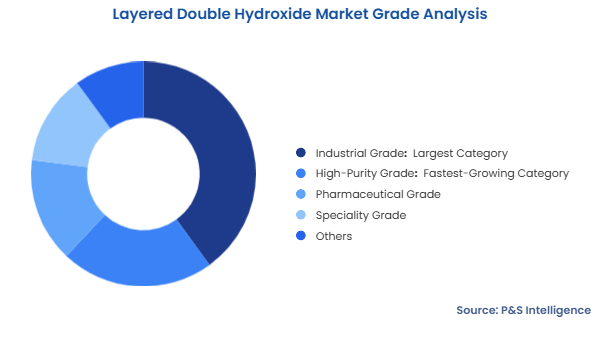
Industrial Grade is the largest category, holding a market share of 40%, due to its extensive use across plastics, chemicals, catalysts, environmental treatment, and construction-related applications. Industries require large volumes of industrial-grade layered double hydroxides for flame retardancy, adsorption, and material stabilisation processes. The grade is widely preferred because it balances performance, scalability, and production cost for commercial manufacturing operations. Growing industrialisation and increasing use of multifunctional additives in manufacturing sectors are also supporting higher demand for industrial-grade materials across developed and emerging industrial economies.
High-Purity Grade is the fastest-growing category, registering a CAGR of approximately 9.2%, because advanced applications in pharmaceuticals, electronics, biomedical research, and energy storage require highly refined and structurally stable materials. Manufacturers are focusing on high-purity formulations to improve chemical consistency, contamination control, and application efficiency in precision industrial processes. Demand is increasing in battery materials, nanotechnology research, and controlled drug-delivery systems, where material purity directly affects product performance and operational reliability. According to the International Energy Agency, global battery cell manufacturing capacity exceeded 3 TWh in 2024, supporting demand for refined materials used in advanced energy-storage systems and high-performance material applications.
The grades analysed in this report are:
Industrial Grade (Largest Category)
High-Purity Grade (Fastest-Growing Category)
Pharmaceutical Grade
Speciality Grade
Others
End-User Analysis
Chemicals is the largest category, holding a market share of 30%, because layered double hydroxides are widely used in catalysts, adsorbents, stabilisers, and speciality chemical formulations. Chemical manufacturers use these materials to improve thermal resistance, chemical stability, and processing efficiency across industrial production systems. The category also benefits from broad application diversity in polymer additives, wastewater-treatment chemicals, and industrial processing agents. Growing demand for multifunctional and environmentally compatible materials continues to support large-scale consumption across commodity and speciality chemical manufacturing. According to the United States Geological Survey, world ammonia plant production reached 150 million metric tons on a nitrogen-content basis in 2024, highlighting the large industrial scale of chemical-processing systems that use catalyst and stabiliser materials.
Electronics & Energy Storage is the fastest-growing category, because layered double hydroxides are increasingly being explored for batteries, supercapacitors, conductive materials, and energy conversion technologies. The sector requires advanced materials with strong electrochemical properties, thermal stability, and ion exchange capability, which support the use of LDH materials in emerging energy systems. Rising electric vehicle production, renewable energy investments, and expansion of battery research activities are further accelerating demand. Manufacturers and research institutions are also developing new LDH-based formulations for high-performance electronic and energy storage applications.
The end-users analysed in this report are:
Chemicals (Largest Category)
Electronics & Energy Storage (Fastest-Growing Category)
Plastics & Polymers
Construction
Agriculture
Pharmaceuticals
Water & Wastewater Management
Others
Drive strategic growth with comprehensive market analysis
Asia-Pacific holds the largest share, of 40% in 2025 and has the highest CAGR, of approximately 9.7%, because the region has a strong concentration of plastics manufacturing, speciality chemical production, electronics assembly, and industrial processing activities that actively use layered double hydroxides in additives, catalysts, and environmental applications. Countries across the region are expanding domestic production of polymers, construction materials, and electronic components, which is increasing demand for flame retardants and functional additives. The region also benefits from large-scale chemical manufacturing infrastructure and lower production costs compared to many Western markets. In addition, governments and private manufacturers are investing in wastewater treatment, clean manufacturing technologies, and advanced material research. Growing electric vehicle production and rapid expansion of industrial infrastructure are further increasing the use of high-performance and heat-resistant material solutions across multiple end-use sectors.
China Layered Double Hydroxide Market Analysis
China is the largest country in the market, because it has a large chemical manufacturing base and extensive production capacity for plastics, electronics, construction materials, and industrial additives. Domestic manufacturers are increasingly using layered double hydroxides in flame retardants, polymer stabilisation, and wastewater-treatment applications. The country is also investing heavily in advanced materials research, battery technologies, and industrial pollution-control systems, strengthening demand for multifunctional materials across industrial sectors. According to the National Bureau of Statistics of China, industrial enterprises above the designated size produced 41.51 million tons of ethylene in 2025, highlighting the country’s large petrochemical feedstock base supporting plastics, polymers, and speciality chemical manufacturing applications.
India Layered Double Hydroxide Market Analysis
India is the fastest-growing country in the market, because expanding industrial manufacturing and rising investments in water treatment and speciality chemicals are increasing demand for layered double hydroxides across multiple applications. The country is also witnessing stronger adoption of advanced materials in pharmaceuticals, agriculture, infrastructure, and environmental management activities. Government initiatives supporting domestic chemical manufacturing and industrial expansion are encouraging the use of materials with improved thermal stability and adsorption performance. According to the Government of India Ministry of Chemicals and Fertilisers, India produced 58.617 million metric tonnes of selected major chemicals and petrochemicals in FY2025, supporting the country’s expanding domestic chemical and petrochemical manufacturing base and strengthening long-term demand for speciality additive materials.
North America Layered Double Hydroxide Market Analysis
North America holds a significant position in the market because the region has a strong demand for advanced speciality materials in pharmaceuticals, environmental technologies, aerospace, and high-performance polymer applications. Companies in the region are focusing on research-driven material innovation, especially for water purification, controlled drug delivery, and sustainable additive technologies. The market is also supported by strict environmental regulations related to industrial waste treatment and safer chemical formulations, which are encouraging industries to adopt multifunctional adsorbent and flame-retardant materials. In addition, universities, chemical companies, and research laboratories are actively working on nanomaterial and catalyst development projects involving layered double hydroxides. Demand is particularly strong in applications that require high purity, stable material performance, and advanced formulation capabilities for industrial and scientific use.
Europe Layered Double Hydroxide Market Analysis
Europe maintains steady growth in the market due to the region’s focus on sustainable manufacturing, circular economy initiatives, and environmentally safer industrial materials. Industries across the region are increasingly replacing conventional additives with low-toxicity and halogen-free alternatives in plastics, coatings, and construction materials. Regulatory pressure on chemical safety and industrial emissions is also encouraging the adoption of advanced adsorption and catalyst materials in manufacturing and environmental management applications. In addition, European automotive and electronics manufacturers are using high-performance materials that can improve thermal resistance and product durability while supporting sustainability goals. Research institutions and speciality chemical producers in the region are also involved in developing advanced layered double hydroxide formulations for biomedical, energy storage, and environmental remediation applications.
The regions and countries analysed in this report are:
North America
U.S. (Larger Country)
Canada (Faster-Growing Country)
Europe
Germany (Largest Country)
U.K. (Fastest-Growing Country)
France
Italy
Spain
Rest of Europe
Asia-Pacific (Largest and Fastest-Growing Regional Market)
The market is fragmented because numerous speciality chemical manufacturers, inorganic material producers, polymer additive suppliers, and advanced material companies participate across catalyst, flame-retardant, adsorbent, water treatment, pharmaceutical, and polymer applications. Additionally, competition is driven by material purity, particle size control, ion-exchange performance, thermal stability, and formulation customization designed for specific industrial processes rather than broad product standardization. Furthermore, manufacturers continue investing in modified layered double hydroxides for nanocomposites, catalyst supports, controlled drug delivery systems, and environmental remediation technologies to strengthen their product portfolios. Similarly, universities, research institutes, and industrial manufacturers are expanding collaborative research to commercialize advanced LDH formulations with improved multifunctional performance. Asia-Pacific remains an important manufacturing base with numerous regional producers supplying application-specific grades for plastics, speciality chemicals, coatings, environmental technologies, and industrial processing, supporting a broad and competitive market structure.
Top Companies in Layered Double Hydroxide Market:
Kyowa Chemical Industry Co., Ltd.
Clariant AG
DOOBON Co., Ltd.
Shandong Repolyfine Additives Co., Ltd.
Sakai Chemical Industry Co., Ltd.
Sasol Limited
Saekyung Chemical Co., Ltd.
BASF SE
Evonik Industries AG
Dow Inc.
Sumitomo Chemical Co., Ltd.
Kisuma Chemicals B.V.
Shandong Zhongxin New Material Technology Co., Ltd.
Zhejiang Huate New Materials Co., Ltd.
Nippon Chemical Industrial Co., Ltd.
Layered Double Hydroxide Market News
In October 2025, Kisuma Chemicals B.V. launched KISUMA X and Zenthos FR at K 2025 for halogen-free flame-retardant polymer formulations across multiple polymer applications. KISUMA X was introduced for polyolefin, EVA and nylon compounds, while Zenthos FR was launched for flexible PVC formulations. Kisuma also stated that first-generation Zenthos FR grades were already commercially available.
In June 2025, Clariant AG launched its AddWorks PPA product line for polyolefin extrusion applications under its additives portfolio. The company stated that the PFAS-free range was commercially available for film and extrusion applications. The launch covered polymer processing aid products for polyolefin manufacturing and processing operations.
Frequently Asked Questions About This Report
What are layered double hydroxides, and why are they widely used?+
Layered double hydroxides are layered inorganic materials with exchangeable anions. They are widely used in catalysis, polymer additives, environmental treatment, drug delivery, and energy storage applications.
How are layered double hydroxides used in environmental remediation applications?+
Layered double hydroxides remove contaminants through anion exchange and adsorption. They help capture heavy metals, phosphates, dyes, and other pollutants from industrial wastewater and contaminated water.
Which industries commonly use layered double hydroxides in commercial applications?+
Layered double hydroxides are used across plastics, chemicals, pharmaceuticals, environmental engineering, coatings, agriculture, and energy storage industries. Their multifunctional properties support diverse industrial processes.
What advantages do layered double hydroxides offer compared with conventional materials?+
Layered double hydroxides provide high anion exchange capacity, adjustable composition, thermal stability, and good chemical compatibility. These characteristics make them suitable for many advanced material applications.
Can layered double hydroxides be used for drug delivery applications safely?+
Layered double hydroxides can carry and release therapeutic compounds in a controlled manner. Their layered structure helps protect active ingredients and supports sustained drug delivery research.
Want a report tailored exactly to your business need?
Leading companies across industries trust us to deliver data-driven insights and innovative solutions for their most critical decisions. From data-driven strategies to actionable insights, we empower the decision-makers who shape industries and define the future. From Fortune 500 companies to innovative startups, we are proud to partner with organisations that drive progress in their industries.
Client Testimonials
Working with P&S Intelligence and their team was an absolute pleasure – their awareness of timelines and commitment to value greatly contributed to our project's success. Eagerly anticipating future collaborations.
McKinsey & Company
India
Unmatched Standards
Our insights into the minutest levels of the markets, including the latest trends and competitive landscape, give you all the answers you need to take your business to new heights
Complete Data Security
We take a cautious approach to protecting your personal and confidential information. Trust is the strongest bond that connects us and our clients, and trust we build by complying with all international and domestic data protection and privacy laws