Infrastructure as Code Market Size & Share Analysis - Trends, Drivers, Competitive Landscape, and Forecasts (2026 - 2032)
This Report Provides In-Depth Analysis of the Infrastructure as Code Market Report Prepared by P&S Intelligence, Segmented by Component (Tools, Services), Deployment (Cloud, On-Premises), Organization Size (Large Enterprises, Small & Medium Enterprises), Infrastructure Type (Compute Infrastructure, Network Infrastructure, Storage Infrastructure, Security Infrastructure), End User (IT & Telecom, BFSI, Government & Public Sector, Manufacturing, Healthcare & Life Sciences, Retail & E-commerce, Transportation & Logistics, Energy & Utilities, Education), and Geographical Outlook for the Period of 2021 to 2032
Explore the market potential with our data-driven report
Infrastructure as Code Market Future Outlook
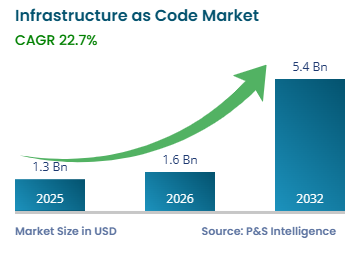
The infrastructure as code market size was USD 1.3 billion for 2025, and it will grow by 22.7% during 2026-2032, to reach USD 5.4 billion by 2032.
The market is driven by the growing transition of enterprises from manually managed infrastructure to software-defined environments that enable automated provisioning, faster application deployment, and scalable cloud operations. Organisations are increasingly adopting Infrastructure as Code (IaC) to automate infrastructure provisioning, configuration management, and application deployment across hybrid and multi-cloud environments. The growing adoption of containers, Kubernetes platforms, DevOps pipelines, and microservices architectures is further accelerating demand for automated infrastructure frameworks that improve deployment consistency, reduce configuration drift, and support continuous software delivery. As enterprises continue modernising legacy IT infrastructure, programmable environments are becoming essential for standardising infrastructure management, improving system reliability, and enabling faster software release cycles across distributed IT ecosystems.
Enterprises are accelerating their transition towards cloud-native and distributed IT environments to support rapidly expanding digital services and enterprise cloud workloads. This shift is increasing the need for scalable, repeatable, and policy-driven infrastructure management that enables consistent provisioning across hybrid and multi-cloud environments. Organisations are expanding investments in orchestration, configuration management, and infrastructure provisioning solutions to strengthen continuous integration and continuous deployment (CI/CD) workflows across public and private cloud platforms. According to the International Telecommunication Union, global fixed broadband traffic reached 7.3 zettabytes in 2025, reflecting the rapid growth of cloud-hosted applications, enterprise data traffic, and digital workloads operating across distributed infrastructure environments. This increasing scale of cloud operations is encouraging organisations to integrate Infrastructure as Code into broader DevSecOps and platform engineering strategies to enhance infrastructure governance, operational resilience, resource optimisation, and deployment automation while maintaining consistent infrastructure configurations across geographically distributed cloud environments.
Key Market Insights
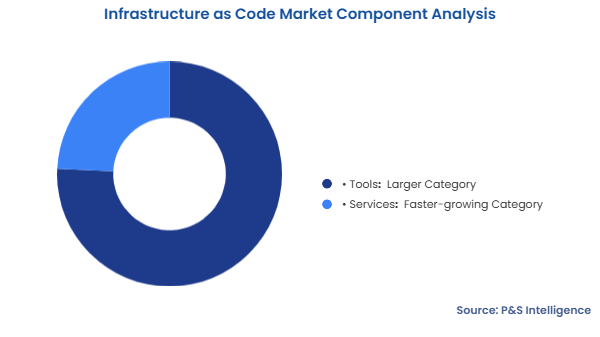
Tools is the larger component, holding a market share of 75.5%, due to rising Kubernetes orchestration and hybrid cloud automation deployment.
Cloud is the larger and faster-growing deployment, registering a CAGR of 23.9%, driven by expanding cloud-native workloads and distributed application environments.
Compute infrastructure is the largest infrastructure type, holding a market share of 45.5%, due to increasing AI workloads and scalable compute provisioning requirements.
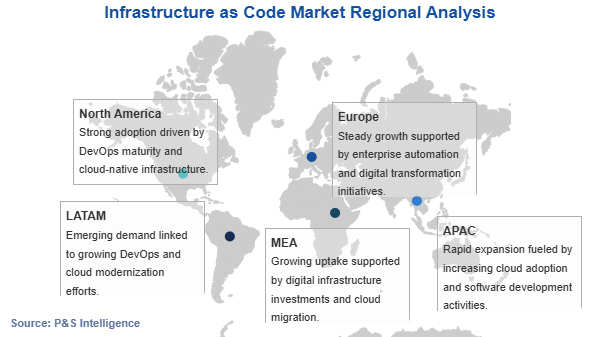
The North America. holds the largest share of 40.5%, due to mature DevOps ecosystems and expanding enterprise cloud-native infrastructure adoption.
Asia-Pacific is the fastest-growing region, registering a CAGR of 24.0%, driven by rising cloud migration and expanding enterprise digital infrastructure projects.
Infrastructure as Code Market Trends and Drivers
AI-Integrated Infrastructure Automation Platforms Are a Major Trend
Artificial intelligence is becoming an integral part of Infrastructure as Code platforms, enabling enterprises to automate infrastructure management, simplify configuration processes, and enhance cloud operations across hybrid and multi-cloud environments. Vendors are embedding AI-assisted capabilities such as infrastructure code generation, policy enforcement, predictive remediation, and intelligent workflow automation to reduce manual effort and support faster infrastructure provisioning. According to the Cloud Native Computing Foundation, 66% of organisations hosting generative AI models used Kubernetes to manage some or all inference workloads in 2025. Additionally, Flexera reported that 72% of organisations used generative AI public cloud services either extensively or sparingly in 2025, compared with 47% in 2024. The rapid adoption of AI-driven cloud workloads is encouraging enterprises to integrate GitOps practices, reusable infrastructure templates, and platform engineering frameworks that strengthen governance, standardise infrastructure provisioning, and improve automation across cloud-native environments.
Growing Enterprise Adoption of Multi-Cloud and DevOps Environments Drives Market
The market is driven by the rapid expansion of hybrid and multi-cloud environments that require faster, standardised, and more reliable infrastructure deployment. Enterprises are increasingly adopting Infrastructure as Code (IaC) to automate infrastructure provisioning, maintain configuration consistency, and reduce manual intervention across complex cloud ecosystems. According to Flexera, 89% of organisations used multi-cloud infrastructure in 2024, while 73% used hybrid cloud environments. Additionally, the Cloud Native Computing Foundation reported that 59% of organisations stated that much or nearly all development and deployment activities were cloud native in 2025. The continued shift towards cloud-native application development is encouraging enterprises to integrate Infrastructure as Code into DevOps pipelines, disaster recovery strategies, and continuous software delivery workflows to strengthen infrastructure governance, accelerate software releases, and improve the efficiency of cloud operations across distributed IT environments.
Shortage of Skilled Infrastructure Automation Professionals Restrains Market Growth
The market faces challenges due to the limited availability of professionals with expertise in infrastructure automation, cloud-native architecture, Infrastructure as Code (IaC) frameworks, and DevOps practices. Successfully implementing automated infrastructure environments requires specialised knowledge of scripting languages, orchestration platforms, configuration management tools, and cloud infrastructure, making adoption more complex for organisations transitioning from traditional IT operations. Many enterprises also face difficulties integrating Infrastructure as Code into legacy systems while establishing consistent governance and standardised automation practices across hybrid and multi-cloud environments. According to the World Economic Forum, 63% of employers in 2025 identified skills gaps as a major barrier to future-proofing operations. These workforce limitations are slowing Infrastructure as Code adoption, particularly among organisations with limited automation expertise and complex legacy infrastructure, resulting in longer implementation timelines and increased operational complexity.
Expansion of Platform Engineering and Internal Developer Platforms Creates Market Opportunities
The market is witnessing significant opportunities as enterprises expand platform engineering initiatives and internal developer platforms that rely on Infrastructure as Code (IaC) to deliver standardised, self-service infrastructure across cloud and on-premises environments. Organisations are strengthening investments in reusable infrastructure templates, automation platforms, and governance frameworks to simplify large-scale application deployment while enhancing developer productivity and infrastructure standardisation. According to the Cloud Native Computing Foundation, 58% of cloud-native innovators used GitOps principles extensively in 2025, compared with 23% of adopters. The growing adoption of GitOps-driven infrastructure management is accelerating demand for policy-based automation solutions, infrastructure observability platforms, and security-integrated deployment frameworks that strengthen governance, improve deployment traceability, and optimise infrastructure resources across hybrid and multi-cloud environments.
Infrastructure as Code Market Segmentation Analysis
Component Analysis
Tools is the larger category, holding a market share of 75.5%, because enterprises prioritise infrastructure provisioning, orchestration, and configuration management solutions to automate complex hybrid and multi-cloud environments. These platforms enable organisations to standardise infrastructure deployment, minimise manual configuration errors, and support continuous software delivery across distributed IT environments. According to the Cloud Native Computing Foundation, 82% of container users ran Kubernetes in production in 2025. The widespread adoption of Kubernetes is increasing demand for integrated Infrastructure as Code tools that simplify workload orchestration, strengthen infrastructure governance, and support scalable cloud-native application management across enterprise environments.
Services is the faster-growing category, registering a CAGR of 23.5%, because enterprises are increasingly seeking specialised expertise to implement, integrate, and manage complex Infrastructure as Code environments. Many organisations lack in-house cloud automation and DevOps capabilities, creating strong demand for consulting, integration, and managed support services. Growing investments in hybrid and multi-cloud infrastructure are also encouraging enterprises to adopt customised automation strategies that align with existing cloud platforms, security frameworks, and enterprise applications.
The component analysed in this report are:
Tools (Larger Category)
Infrastructure Provisioning
Configuration Management
Orchestration & Automation
Services (Faster-growing Category)
Consulting Services
Integration & Implementation Services
Support & Maintenance Services
Deployment Analysis
Cloud is the larger and faster-growing category, holding a market share of 80.5% and registering a CAGR of 23.9%, because enterprises are expanding cloud-native infrastructure to support scalable, automated, and flexible IT operations. Cloud deployment enables faster infrastructure provisioning, efficient resource utilisation, and seamless management of geographically distributed applications across hybrid and multi-cloud environments. The increasing adoption of containers, microservices architectures, and distributed workloads is further accelerating demand for Infrastructure as Code solutions that automate cloud infrastructure management. According to the Organisation for Economic Co-operation and Development, cloud computing adoption exceeded 50% on average among enterprises with 10 or more employees in 2024. As enterprises continue modernising cloud environments, Infrastructure as Code is becoming a core component of cloud strategies by enabling infrastructure standardisation, efficient resource management, and automated deployment across distributed computing environments.
The deployment analysed in this report are:
Cloud (Larger and Faster-growing Category)
On-Premises
Organisation Size Analysis
Large Enterprises is the larger category, holding a market share of 85.0%, because large organisations require automated infrastructure management to support extensive cloud environments, distributed applications, and enterprise-scale IT operations. Infrastructure as Code enables these organisations to standardise infrastructure provisioning, strengthen governance, and accelerate software delivery across multiple business functions and cloud platforms. Large enterprises are also making significant investments in DevOps transformation, cloud modernisation, cybersecurity, and platform engineering, further driving the adoption of advanced infrastructure automation solutions.
Small & Medium Enterprises (SMEs) are the faster-growing category, registering a CAGR of 22.9%, because cloud-based Infrastructure as Code solutions allow smaller organisations to automate infrastructure management without maintaining large in-house IT teams. These platforms simplify resource provisioning, standardise application environments, and enable faster software deployment while reducing operational complexity. According to the Organisation for Economic Co-operation and Development, 35% of surveyed SMEs integrated digital tools across business functions, including cloud computing, mobile technology, and e-commerce, in 2025.
The organization size analysed in this report are:
Large Enterprises (Larger Category)
Small & Medium Enterprises (SMEs) (Faster-growing Category)
Infrastructure Type Analysis
Compute Infrastructure is the largest category, holding a market share of 45.5%, because enterprises require automated provisioning of virtual machines, containers, cloud instances, and compute resources to support large-scale digital workloads. Infrastructure as Code enables organisations to standardise compute deployment across hybrid and multi-cloud environments while improving infrastructure scalability and operational efficiency. According to the International Energy Agency, data centres consumed around 415 TWh of electricity in 2024, accounting for nearly 1.5% of global electricity consumption.
Network Infrastructure is the fastest-growing category, registering a CAGR of 23.0%, because enterprises are automating network provisioning, configuration management, and policy enforcement across increasingly distributed cloud and edge computing environments. The expansion of hybrid work models, multi-cloud deployments, and software-defined networking is increasing the complexity of enterprise networks, creating greater demand for Infrastructure as Code solutions that standardise network management and automate infrastructure changes. Rising investments in software-defined networking (SDN), 5G infrastructure, and cloud connectivity platforms are further supporting the adoption of automated network infrastructure management across modern enterprise environments.
The infrastructure type analysed in this report are:
Compute Infrastructure (Largest Category)
Network Infrastructure (Fastest-growing Category)
Storage Infrastructure
Security Infrastructure
End User Analysis
IT & Telecom is the largest category, holding a market share of 25.0%, because the sector operates large-scale cloud infrastructure, distributed networks, and dynamic application environments that require automated infrastructure provisioning and continuous deployment. Infrastructure as Code enables technology companies and telecommunications providers to standardise infrastructure management, accelerate software releases, and efficiently manage cloud-native workloads across multiple environments.
BFSI is the fastest-growing category, registering a CAGR of 23.3%, because banks, insurers, and fintech companies are modernising IT infrastructure to support digital payments, real-time transaction processing, and cloud-based financial services. Infrastructure as Code enables financial institutions to standardise infrastructure deployment, strengthen regulatory compliance, and reduce configuration risks across hybrid cloud environments. According to the Bank for International Settlements, more than 120 fast payment systems were operating worldwide in 2024.
The end user analysed in this report are:
IT & Telecom (Largest Category)
BFSI (Fastest-growing Category)
Government & Public Sector
Manufacturing
Healthcare & Life Sciences
Retail & E-commerce
Transportation & Logistics
Energy & Utilities
Education
Others
Drive strategic growth with comprehensive market analysis
Infrastructure as Code Market Regional Analysis
North America Infrastructure as Code Market Analysis
North America holds the largest share, of 40.5%, because the region has a well-established cloud computing ecosystem supported by widespread enterprise adoption of DevOps, hybrid cloud infrastructure, and advanced automation technologies. Enterprises across technology, financial services, healthcare, and other industries are adopting Infrastructure as Code (IaC) to automate infrastructure provisioning, standardise configuration management, and accelerate software delivery across cloud environments. The strong presence of hyperscale cloud providers, leading software companies, and large-scale data centre operators continues to drive demand for infrastructure automation solutions. According to the U.S. Government Accountability Office (GAO), private sector companies identified 19 leading practices across acquisition, cybersecurity, and workforce development for successful cloud computing adoption in 2025, with the majority of surveyed organisations considering these practices very or extremely important for effective cloud adoption. This strong focus on cloud modernisation, cybersecurity, and workforce capability is accelerating Infrastructure as Code adoption across enterprise IT environments.
U.S. Infrastructure as Code Market Analysis
The U.S. is the largest country market, because enterprises operate highly advanced cloud, software development, and DevOps ecosystems supported by hyperscale cloud providers and large technology companies. Organisations across finance, healthcare, retail, and telecommunications sectors increasingly adopt Infrastructure as Code to automate hybrid cloud management, Kubernetes orchestration, and security-focused deployment operations. According to the United States Census Bureau, nearly 9.5% of U.S. businesses used artificial intelligence in producing goods or services in 2025. Enterprises expanding AI-driven operations are increasing investments in programmable infrastructure environments that improve deployment scalability, operational coordination, and infrastructure reliability across large-scale digital service ecosystems.
Canada Infrastructure as Code Market Analysis
Canada is the fastest-growing country market, because enterprises are modernising public and private cloud infrastructure across banking, telecommunications, and government sectors that require secure and standardised deployment environments. Organisations are increasing investments in managed cloud services, infrastructure automation, and compliance-focused cloud operations to improve infrastructure reliability across distributed enterprise systems. Regional growth in cloud migration projects and data centre development is also strengthening demand for automated provisioning and configuration management platforms. According to Statistics Canada, 25.7% of Canadian businesses using artificial intelligence purchased cloud services or cloud storage in 2025. Enterprises expanding cloud-based AI operations are increasing adoption of Infrastructure as Code frameworks that support scalable infrastructure deployment and operational governance across hybrid cloud environments.
Asia-Pacific Infrastructure as Code Market Analysis
Asia-Pacific has the highest CAGR, of 24.0%, because enterprises across the region are rapidly modernising IT infrastructure and expanding investments in cloud-native application development. Businesses in countries such as China, India, Japan, and South Korea are increasingly adopting Infrastructure as Code (IaC) to automate infrastructure provisioning across digital services, e-commerce platforms, manufacturing systems, and telecommunications networks. The region is also witnessing significant growth in hyperscale data centre investments and public cloud deployments as governments and enterprises accelerate digital transformation initiatives. According to the United Nations Economic and Social Commission for Asia and the Pacific (UN ESCAP), the digital economy contributes more than 15% of GDP in several Asia-Pacific economies, highlighting the region's accelerating digital transformation and increasing reliance on cloud-based infrastructure. This expanding digital ecosystem is driving demand for Infrastructure as Code solutions that enable standardised infrastructure management, cloud automation, and scalable application deployment across enterprise IT environments.
China Infrastructure as Code Market Analysis
China is the largest country market, because enterprises are rapidly expanding cloud-native infrastructure environments across digital commerce, telecommunications, fintech, and industrial automation sectors. Organisations increasingly deploy Infrastructure as Code frameworks to support high-volume computing workloads, artificial intelligence applications, and distributed cloud operations that require scalable and standardised infrastructure management. Growing investments in edge computing, semiconductor capabilities, and enterprise software development are also strengthening demand for programmable infrastructure environments across domestic technology ecosystems. According to the Government of China, the country’s “east data, west computing” project exceeded 1.95 million data centre racks in 2024. Enterprises managing large-scale compute environments are increasing investments in automated infrastructure provisioning systems that improve workload scalability and deployment consistency across cloud infrastructure networks.
Japan Infrastructure as Code Market Analysis
Japan is the fastest-growing country market, because enterprises are modernising legacy IT infrastructure and expanding cloud transformation initiatives across manufacturing, financial services, and telecommunications sectors. Organisations increasingly adopt Infrastructure as Code to improve operational resilience, disaster recovery readiness, and deployment standardisation across complex enterprise technology environments. Demand is also increasing for automated infrastructure management frameworks supporting smart factory operations, connected industrial systems, and cloud-native application environments. According to the Government of Japan, 80.6% of Japanese enterprises used cloud services in 2024. Enterprises expanding cloud adoption are increasing investments in programmable infrastructure management platforms that improve infrastructure stability, operational precision, and deployment efficiency across digitally connected business operations.
Europe Infrastructure as Code Market Analysis
Europe is experiencing steady market growth due to the increasing focus on regulatory compliance, secure cloud infrastructure, and enterprise digital transformation. Organisations across the region are adopting Infrastructure as Code (IaC) to standardise infrastructure provisioning, automate configuration management, and reduce manual intervention across hybrid and multi-cloud environments. Demand is particularly strong among financial services providers, industrial manufacturers, and public sector organisations that require policy-driven and highly governed IT environments. According to Eurostat, 45.2% of enterprises in the European Union purchased cloud computing services in 2023, reflecting the region's continued transition towards cloud-based digital infrastructure. The growing adoption of sovereign cloud strategies, cloud modernisation initiatives, and energy-efficient data centre operations is further accelerating demand for Infrastructure as Code solutions that support secure, scalable, and standardised infrastructure management across Europe.
The regions and countries analysed in this report are:
North America (Largest Regional Market)
U.S. (Larger Country)
Canada (Faster-Growing Country)
Europe
Germany (Largest Country)
U.K.
France (Fastest-Growing Country)
Italy
Spain
Rest of Europe
Asia-Pacific (Fastest-Growing Regional Market)
China (Largest Country)
India
Japan (Fastest-Growing Country)
South Korea
Australia
Rest of APAC
Latin America
Brazil (Largest and Fastest-Growing Country)
Mexico
Rest of LATAM
Middle East and Africa
Saudi Arabia (Largest and Fastest-Growing Country)
U.A.E.
South Africa
Rest of MEA
Infrastructure as Code Market Share Analysis
The market is fragmented, with the presence of global cloud providers, DevOps platform vendors, infrastructure automation companies, and open-source technology providers competing across diverse enterprise requirements. Competition is driven by innovation in infrastructure provisioning, configuration management, orchestration, security integration, artificial intelligence capabilities, and support for hybrid and multi-cloud environments. Open-source frameworks continue to play a significant role by accelerating innovation and lowering entry barriers for emerging technology vendors. Companies are also strengthening their market positions through strategic partnerships, product enhancements, platform integrations, and acquisitions that expand Infrastructure as Code capabilities and improve interoperability across modern cloud ecosystems. The growing emphasis on platform engineering, DevSecOps, Kubernetes, and policy-driven automation is further encouraging vendors to differentiate their offerings through advanced governance, scalability, and cloud management capabilities.
Key Players in the Infrastructure as Code Market:
Amazon Web Services
Microsoft Corporation
IBM Corporation
Oracle Corporation
Google LLC
Broadcom Inc.
GitLab Inc.
Pulumi Corporation
Progress Software Corporation
Perforce Software, Inc.
Alibaba Group Holding Limited
Dell Technologies Inc.
Rackspace Technology, Inc.
Hewlett Packard Enterprise Company
ServiceNow, Inc.
Infrastructure as Code Market Developments
In September 2025, Pulumi Corporation launched Pulumi Neo, the industry's first AI-powered platform engineer, enabling developers to generate, manage, and troubleshoot Infrastructure as Code while automating cloud infrastructure operations across multi-cloud environments.
In March 2025, Amazon Web Services enhanced AWS CloudFormation by introducing targeted resource scans in the IaC Generator, enabling organizations to generate Infrastructure as Code templates for selected AWS resources more efficiently and migrate existing cloud infrastructure into AWS CloudFormation and AWS Cloud Development Kit (CDK) applications.
In May 2025, Dell Technologies Inc. introduced software-driven disaggregated infrastructure innovations that automate the deployment and management of private cloud and edge environments, enabling organizations to simplify infrastructure operations and accelerate modern data center deployments.
Frequently Asked Questions About This Report
What does the infrastructure as code market include for organizations?+
It includes tools that define, provision, and manage infrastructure using code, templates, version control, and automated workflows.
What factors are driving demand in the infrastructure as code market?+
Growth is driven by cloud adoption, DevOps practices, repeatable deployments, configuration consistency, and need for faster infrastructure delivery.
Why are organizations adopting infrastructure as code solutions across operations?+
Organizations adopt infrastructure as code to reduce manual setup, improve reliability, support audits, and scale environments consistently.
How do infrastructure as code solutions improve decision making and efficiency?+
These tools improve operations by making infrastructure changes reviewable, repeatable, testable, and easier to roll back when needed.
What challenges affect adoption of infrastructure as code solutions today?+
Adoption is affected by coding skills, governance, secrets management, drift control, module quality, and coordination between development and operations.
Want a report tailored exactly to your business need?
Leading companies across industries trust us to deliver data-driven insights and innovative solutions for their most critical decisions. From data-driven strategies to actionable insights, we empower the decision-makers who shape industries and define the future. From Fortune 500 companies to innovative startups, we are proud to partner with organisations that drive progress in their industries.
Client Testimonials
Working with P&S Intelligence and their team was an absolute pleasure – their awareness of timelines and commitment to value greatly contributed to our project's success. Eagerly anticipating future collaborations.
McKinsey & Company
India
Unmatched Standards
Our insights into the minutest levels of the markets, including the latest trends and competitive landscape, give you all the answers you need to take your business to new heights
Complete Data Security
We take a cautious approach to protecting your personal and confidential information. Trust is the strongest bond that connects us and our clients, and trust we build by complying with all international and domestic data protection and privacy laws