This Report Provides In-Depth Analysis of the Multi-Cloud Networking Market Report Prepared by P&S Intelligence, Segmented by Component (Solution, Services), Deployment Model (Hybrid, Edge-Integrated, Public, Private), Organization Size (Large Enterprises, SMEs), End-Use Industry (IT & Telecom, Healthcare & Life Sciences, Banking, Financial Services & Insurance (BFSI), Government & Public Sector, Retail & E-Commerce, Manufacturing & Industrial, Energy & Utilities, Education & Research, Transportation & Logistics), and Geographical Outlook for the Period of 2021 to 2032
Explore the market potential with our data-driven report
Multi-Cloud Networking Market Analysis
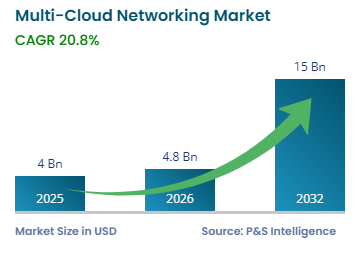
The multi-cloud networking market size was USD 4.0 billion for 2025, and it will grow by 20.8% during 2026-2032, to reach USD 15.0 billion by 2032.
The market is expanding rapidly as many organizations are using cloud environments to enhance performance, reliability, cost, and rule compliance. Companies now run their apps and data across public, private, and hybrid clouds. Therefore, they require simple methods to connect, view the network, and control policies. With the expansion of digital business operations across geography and platforms, traditional single-cloud networking is no longer sufficient. Multi-cloud networking assists organizations in managing traffic, security, and performance in multiple clouds.
As per Cisco, 97% of global IT leaders now identify a modernized network as critical to supporting distributed cloud and AI workloads, signaling a decisive shift away from legacy infrastructure.
Key Market Insights
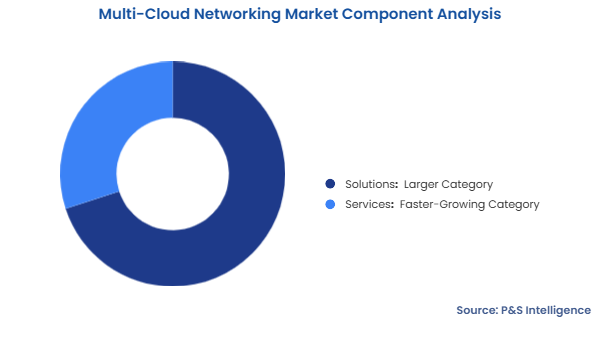
Solutions dominate the market with 70% share, serving as the primary tool for integrating diverse cloud systems.
Services are the fastest-growing component, with 21.1% CAGR, as organizations hire experts to manage complex security and performance configurations.
Hybrid networking holds the largest share, of 45%, while edge-integrated networking grows fastest, with 21.0% CAGR, to support real-time distributed applications.
IT & Telecom is the largest end-use sector, with 65% share, requiring flexible networking to manage global traffic and cloud systems.
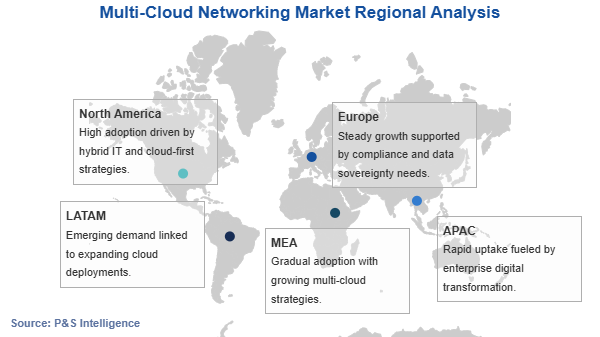
North America leads the market with 40% share due to robust infrastructure, while Asia-Pacific grows fastest, with 20.9% CAGR, due to rapid digital expansion.
Multi-Cloud Networking Market Trends & Drivers
Automated, Policy-Driven Management for Cloud Environments is Major Trend
The adoption of automated, policy-driven management across multiple clouds is a major trend in multi-cloud networking. This enables seamless connectivity and performance management without human intervention. Enterprises are shifting from static, manually configured cloud networks to dynamic networks that monitor and adjust networking policies and paths according to real-time conditions and business policies. Another trend is the increased use of intent-based networking, centralized visibility into multiple clouds, and automatic remediation of network problems. With workload and traffic distribution becoming more widespread, multi-cloud networking is evolving to enable more intelligent, context-aware routing, security policy distribution, and consistent services across multiple clouds. Almost 96% of organizations are now using or planning to use operational telemetry to drive automation, moving beyond basic monitoring to real-time network adjustments.
Increasing Complexity and Distribution of Enterprises Workloads Drive Market
The increasing complexity and distribution of enterprises workloads across multiple cloud providers drives the market. Due to the increasing use of multiple cloud vendors, to prevent vendor lock-in and improve regional performance, the complexity of the networks is also increasing. As a result, there is a growing need for solutions that can ensure consistent policies, visibility, and control across multiple cloud environments. Furthermore, the increasing need for application availability, security across multiple clouds, and real-time access to data is also encouraging enterprises to invest in networking solutions that can adapt to evolving business requirements. The average enterprise now runs workloads across 12 cloud platforms, and 88% report growing complexity in their tech stacks.
Multi-Cloud Networking Market Segmentation and Category Analysis
Component Analysis
Solutions is the largest category, holding a market share of 70%. Enterprises use networking solutions to connect applications and workloads across cloud platforms. They are the primary tool used by organizations for multi-cloud networking, integrating various systems from different providers into a single network layer. Solutions assist with network abstraction, providing visibility, and enabling actions, and they are typically introduced early in the digital transformation process for a business.
As more businesses adopt multiple clouds, solutions are widely used to ensure consistency for connectivity and governance across different platforms, making them the primary component of multi-cloud networking. As per Cisco, 91% of global IT leaders plan to increase networking budgets, and 97% cite modernized networks as critical for scaling cloud and AI workloads.
Services are the fastest-growing category, registering a CAGR of 21.1%, because organizations are increasingly turning to external experts to set up and manage multi-cloud environments. The complexity of multi-cloud configurations, such as security policies, connecting locations, and optimizing performance, are causing people to turn to external experts for consulting and managed services. These services allow organizations to set up faster and optimize network configurations to ensure that everything is working well as applications and workloads are moved between cloud vendors. Almost 64% of organizations report critical skill gaps, forcing them to rely on external teams to manage multi-cloud estates.
The components analyzed in this report are:
Solutions (Larger Category)
Services (Faster-Growing Category)
Deployment Analysis
Hybrid is the largest category, holding a market share of 45%, because many organizations are transitioning from being on-premises or cloud-based to being multi-cloud. They continue to run critical applications on their on-premises infrastructure and leverage public clouds for business growth and reduced costs. This approach leads to a constant need for a single set of connections and rules for both the private and public clouds. As a result, the trend in hybrid multi-cloud networking remains the same and helps on-premises infrastructure to seamlessly integrate with multiple clouds. Almost 90% of global IT leaders now prefer hybrid multi-cloud, driving adoption of integrated private and public cloud architectures.
Edge-integrated is the fastest-growing category, registering a CAGR of 21.0%, because digital services require fast processing close to users. With edge computing for IoT, real-time analytics, and distributed applications, businesses extend edge locations directly into multi-cloud networks. This enhances responsiveness and enables local processing to occur while maintaining centralized policy control and security. As businesses operate workloads in both edge and core cloud platforms, edge-integrated networking is more quickly adopted than traditional methods. Interconnection bandwidth at the edge is growing 20% faster than at the core as businesses deploy distributed infrastructure for real-time workloads.
The deployment modes analyzed in this report are:
Hybrid (Largest Category)
Edge-Integrated (Fastest-Growing Category)
Public
Private
Organization Analysis
Large enterprises are the largest category, holding a market share of 65%, as they have the largest number of dispersed IT systems and multiple cloud services. They also have more digital tools and budgets to invest in sophisticated networking. They prefer using multiple clouds to meet different business needs due to varying business requirements, legacy systems that need to be compatible, and the need for high performance. Their complex systems need advanced multi-cloud networking to handle traffic, maintain consistency in policies, and maintain reliable connectivity. Therefore, large companies constitute the largest market share for multi-cloud networking technologies. 62% of large companies run active multi-cloud and AI projects, compared to 36% of smaller organizations.
SMEs are the fastest-growing category, because more of them are adopting multi-cloud environments. This allows them to be flexible, save money, and scale quickly without having to make significant capital outlays. Small and medium-sized businesses are agile, so they can easily adopt new networking and bypass legacy systems that hold back larger organizations. As they adopt cloud-native architectures and hybrid models, SMEs require simple-to-use networking solutions and strong support to help them handle complex systems. This is why the segment is expanding so rapidly. 79% of growing businesses now integrate cloud-based AI and infrastructure, up from 49% last year.
The enterprise sizes analyzed in this report are:
Large Enterprises (Larger Category)
SMEs (Faster-Growing Category)
End-Use Industry Analysis
IT & telecom is the largest category, because this sector requires effective and flexible networking solutions in order to provide services, connect people, and enhance the performance of cloud systems. Multi-cloud networking is important for service providers and technology companies that require connecting various systems, providing a consistent experience for their customers, and managing traffic in global networks. Since cloud and networking services are core to the business operations of the IT and Telecom sector, there is constant attention to multi-cloud networking solutions. As per GSMA, Mobile operators globally were projected to spend USD 180 billion in 2025, mainly on 5G and cloud-native network transformations.
Healthcare & life sciences is the fastest-growing category, because it involves more cloud platforms for electronic health records, telemedicine, data analysis, and reporting for regulatory compliance. There is a need for hospitals to have secure and reliable connectivity between different cloud platforms and also to adhere to stringent data privacy and regulatory requirements, hence the rapid adoption of multi-cloud networking. With the modernization of applications and the interconnection of systems within hospitals, there is a need for networking that is unified and supports good performance, hence the fast growth of this category.
Oracle’s work with Cerner shows that healthcare organizations are moving workloads to the cloud to ensure secure, unified data access. As per industry forecasts, global digital health spending could reach USD 1,269.08 billion by 2032, eclinical solution sales value USD 31.9 billion, and 5G in healthcare market size USD 31.9 billion by 2032.
IT & Telecom (Largest Category)
Healthcare & Life Sciences (Fastest-Growing Category)
Banking, Financial Services & Insurance (BFSI)
Government & Public Sector
Retail & E-Commerce
Manufacturing & Industrial
Energy & Utilities
Education & Research
Transportation & Logistics
Others
Drive strategic growth with comprehensive market analysis
Multi-Cloud Networking Market Regional Outlook
North America Multi-Cloud Networking Market Analysis
North America is the largest regional market, capturing a share of 40%, because it has a large number of large data centers, robust interconnection infrastructure, and early adoption of multi-cloud models by enterprises. Well-defined regulations, a large number of SaaS vendors, and highly developed carrier-neutral infrastructure make cross-cloud networking easier for financial, government, and online services.
U.S. Multi-Cloud Networking Market Growth
The United States maintains its lead as the global leader in massive cloud infrastructure and business software. Large technology hotspots have many connection points that facilitate complex cloud routing. Government institutions, military projects, and other regulated sectors use distributed cloud configurations. As such, they require defined cross-cloud networking policies. Global content companies, fintech companies, and digital media companies also contribute to complex cloud traffic management.
In addition, the United States enjoys carrier neutrality, well-defined cloud networking APIs, and a well-established industry of cloud networking software vendors experienced in multi-cloud networks. According to the U.S. Government Accountability Office, the U.S. Department of Defense planned to invest USD 10.9B from 2023–2025 on IT and cloud programs, showing the scale of distributed infrastructure.
Canada Multi-Cloud Networking Market Growth
The drivers of growth for Canada are cross-border business operations and a strong public sector cloud modernization initiative. Banks and healthcare organizations are adopting hybrid models, which require synchronized networking between Canadian and US cloud regions. Data residency regulations promote distributed models, rather than a single cloud model. The tech hubs in the Toronto, Montreal, and Vancouver regions are increasing their interconnection capacity.
The emphasis of Canada on digital public services, research computing, and smart infrastructure initiatives has increased the demand for policy-driven traffic management on multiple cloud platforms, making Canada a rapidly growing multi-cloud networking market. According to the Government of Canada, CAD 2.4 billion has been allocated for five years beginning in 2024–25 to build domestic computing capabilities, fueling demand for multi-cloud networking.
Asia-Pacific is the fastest-growing region, with 20.9% CAGR, because there is a quick expansion of digital platforms, and the infrastructure is regionally varied in a way that promotes hybrid networking. Data localization regulations, the mobile-first approach to app development, and the rise of regional cloud providers accelerate the need to manage multi-cloud traffic in a large number of national markets.
China Multi-Cloud Networking Market Growth
China is a leader in the Asia-Pacific region because its giant cloud companies and digitization initiatives are strong. Large manufacturing hubs have hybrid models that link factory infrastructure with regional cloud infrastructure, requiring network coordination. Data localization policies promote the development of distinct multi-cloud systems instead of a single public cloud system. Telecom companies in the country are developing interconnection layers for government, business, and industry clouds.
The increasing adoption of smart manufacturing, logistics systems, and data centers along the economic corridors in the eastern region increases the demand for managed connections between clouds. According to the China Academy of Information and Communications Technology, China’s cloud market reached 616.5B yuan in 2023 and is projected to triple by 2027, driven by industrial integration.
India Multi-Cloud Networking Market Growth
The rapid growth in India is due to the country’s digital public infrastructure and large-scale modernization in banking, retail, and government services. Cloud regions within the country, together with international cloud services, are being adopted to manage costs, minimize latency, and comply with regulations. Most developers are creating cloud-native applications that are designed to work well on more than one cloud service.
Telecommunications infrastructure development and data center construction in smaller cities are causing distributed architectures to become common. Public infrastructure for identity, payments, and healthcare is using interoperable cloud infrastructure, which is accelerating the adoption of multi-cloud networking. Adani Enterprises and Google Cloud announced a USD 15-billion partnership in 2025 to build India’s largest hyperscale data center park in Visakhapatnam, expanding capacity beyond metro hubs.
The regions and countries analyzed in this report are:
North America (Largest Regional Market)
U.S. (Larger Country)
Canada (Faster-Growing Country)
Europe
Germany (Largest Country)
U.K. (Fastest-Growing Country)
France
Italy
Spain
Rest of Europe
Asia-Pacific (Fastest-Growing Regional Market)
China (Largest Country)
India (Fastest-Growing Country)
Japan
South Korea
Australia
Rest of APAC
Latin America
Brazil (Largest Country)
Mexico (Fastest-Growing Country)
Rest of LATAM
Middle East and Africa
Saudi Arabia (Largest Country)
U.A.E. (Fastest-Growing Country)
South Africa
Rest of MEA
Multi-Cloud Networking Market Share
The market for multi-cloud networking is quite fragmented, and no particular company or few companies control it. This is because multi-cloud networking involves a lot of domains, such as the management of connections, security policies, traffic observation, and blending on different clouds, and each domain has its own set of specialized companies with different capabilities. Also, companies and service providers use multi-cloud networking in very specific ways, depending on their cloud strategies, network designs, compliance requirements, and geographical locations. This results in small niche companies and large platform companies coexisting in the market, and no few companies capture the majority of the market. The most prominent characteristic of the current market is fragmentation.
Key Multi-Cloud Networking Companies:
Amazon Web Services (AWS)
Microsoft (Azure)
VMware (Broadcom)
Juniper Networks
Hewlett Packard Enterprise (HPE)
Cloudflare
Equinix
IBM
Citrix
Nutanix
Akamai Technologies
Versa Networks
Alkira
Prosimo
Multi-Cloud Networking Market Developments
In January 2026, F5 announced Runtime Protection for enterprise AI deployments to provide in-environment security for detecting and preventing threats to AI workloads.
In December 2025, Megaport completed the acquisition of Extreme IX, adding seven internet exchanges and expanding its presence across more than 40 data centers in the Indian market.
In November 2025, Aviatrix launched Zero Trust for Workloads within its Cloud Native Security Fabric to support granular security policy enforcement across multi-cloud environments.
In October 2025, Arista Networks Inc. introduced the R4 Series routing platforms designed for data centers and routed backbone networks supporting high-performance AI infrastructure.
In September 2025, Cisco Systems Inc. announced prototypes of quantum networking software designed to support distributed quantum computing networks and emerging data center connectivity requirements.
Frequently Asked Questions About This Report
What are the primary benefits of adopting a multi-cloud networking strategy?+
Multi-cloud networking enhances flexibility, prevents vendor lock-in, and optimizes costs by allowing enterprises to select the best specific services from different cloud providers.
What are the biggest challenges organizations face with multi-cloud networking?+
Managing multiple clouds creates complexity in security consistency, operational visibility, and skill gaps, often requiring specialized tools to unify diverse provider environments effectively.
How does multi-cloud networking differ from a hybrid cloud architecture?+
Hybrid cloud connects on-premise private infrastructure with public clouds, whereas multi-cloud involves using services from multiple different public cloud providers simultaneously for various workloads.
Why is "observability" a critical concern in multi-cloud networking environments?+
Traditional tools cannot track traffic across different providers, so specialized observability platforms are needed to spot performance issues and security threats across fragmented networks.
How can organizations effectively manage security across different cloud providers?+
Security must be decoupled from individual cloud providers by using centralized "Zero Trust" platforms that enforce consistent policies and identity controls across all environments.
What role does cost management play in multi-cloud networking decisions?+
Multi-cloud strategies help avoid price hikes from single vendors, but they require careful monitoring to prevent "egress fees" when moving data between different clouds.
Want a report tailored exactly to your business need?
Leading companies across industries trust us to deliver data-driven insights and innovative solutions for their most critical decisions. From data-driven strategies to actionable insights, we empower the decision-makers who shape industries and define the future. From Fortune 500 companies to innovative startups, we are proud to partner with organisations that drive progress in their industries.
Client Testimonials
Working with P&S Intelligence and their team was an absolute pleasure – their awareness of timelines and commitment to value greatly contributed to our project's success. Eagerly anticipating future collaborations.
McKinsey & Company
India
Unmatched Standards
Our insights into the minutest levels of the markets, including the latest trends and competitive landscape, give you all the answers you need to take your business to new heights
Complete Data Security
We take a cautious approach to protecting your personal and confidential information. Trust is the strongest bond that connects us and our clients, and trust we build by complying with all international and domestic data protection and privacy laws