This Report Provides In-Depth Analysis of the Imaging Chemicals Market Report Prepared by P&S Intelligence, Segmented by Product Type (Printing Inks, Image Developers), Application (Printing & Packaging, Medical Diagnostics, Textile Processing), and Geographical Outlook for the Period of 2021 to 2032
Explore the market potential with our data-driven report
Imaging Chemicals Market Overview
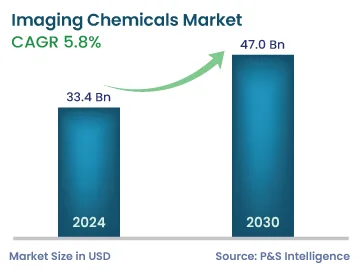
The imaging chemicals market size was USD 35.0 billion for 2025, and it will grow by 5.9% during 2026–2032, to reach USD 52.2 billion by 2032.
This is attributed to the various applications of these chemicals, such as printing, packaging, medical diagnostics, and textiles. The increasing prevalence of cancer, brain disorders, and many other diseases drives the requirement for diagnostic imaging tests, such as X-rays, magnetic resonance imaging (MRI), and computed tomography (CT). Imaging chemicals, including film developers, are essential for enhancing the visibility of anatomical structures and detecting abnormalities in medical images.
The expanding scope of medical imaging procedures and the need for more-effective diagnostic tools drive the demand for innovative imaging chemicals in the healthcare sector. In this regard, the rising geriatric population all around the world is driving the growth as it is at a perpetual risk of serious health conditions. The imaging chemicals market is itself undergoing various advancements, driven by the increasing demand of the medical sector for better images for diagnostics, disease staging, and therapeutic effect monitoring. Advanced chemicals decrease the time in the processing of the images and also provide clarity. In the same way, the imaging chemicals are widely used on textiles. The increasing global demand for textiles, evolving fashion trends, and rising popularity of e-commerce are adding fuel for the growth of the market in this regard.
Key Market Insights
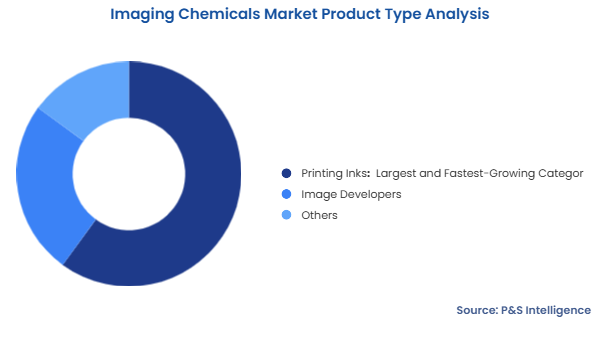
The printing inks category holds the largest market share, of 60%, in 2025, and it will have the highest CAGR, of approximately 6.4%, due to their wide range of applications in the coloring of paper, metals, plastics, glass, and textiles.
The printing & packaging category holds the largest market share, of 45%, in 2025, due to the increasing demand for printing and packaging around the world.
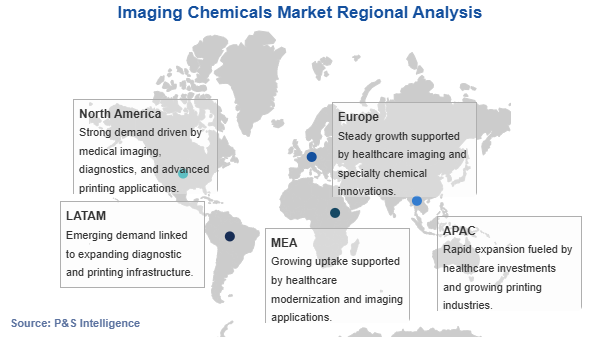
Asia-Pacific held the largest share at 40% in 2025 and is expected to record the fastest CAGR of approximately 6.8%, driven by economic growth, expanding production capacity, and increasing investments by key players.
India is the fastest-growing country for the Asia-Pacific imaging chemicals, driven by expanding packaging, e-commerce, healthcare, and printing industries.
The U.S. is the larger country for the North America imaging chemicals, driven by its large printing and packaging industry, advanced healthcare infrastructure, and strong demand for imaging and printing technologies.
Imaging Chemicals Market Trends and Drivers
Safer Chemistry Certification and Reformulation Are Key Trends
A defining trend reshaping the imaging chemicals market is the shift from conventional solvent-based formulations toward certified, safer-chemistry alternatives. Manufacturers are increasingly redesigning formulations to qualify under recognized safer-chemistry certification frameworks, reflecting broader regulatory and customer pressure to eliminate hazardous solvents and heavy-metal pigments from imaging chemical supply chains.
The U.S. Environmental Protection Agency's Safer Choice program illustrates the scale of this shift, with nearly 2,000 products across chemical-intensive categories now qualifying for the Safer Choice label. Within imaging chemicals specifically, this certification-driven reformulation trend is prompting manufacturers to redesign product lines around water-based and bio-based chemistries. As certification frameworks expand geographically, reformulated, certified imaging chemical portfolios are expected to become a standard competitive requirement rather than a differentiating feature.
Rising Diagnostic Imaging Procedure Volumes Is Biggest Driver
Escalating diagnostic imaging procedure volumes across radiology, cardiology, and oncology are supporting demand for imaging chemicals used in medical diagnostics. Aging populations and rising chronic disease prevalence are compelling healthcare systems to expand diagnostic imaging capacity, creating additional demand for chemicals used in imaging and image-development applications.
According to the OECD Health at a Glance 2025, data for 2023 show that CT, MRI, and PET examination rates remained high across OECD countries, while the use of diagnostic technologies continued to increase in several countries over the 2013–2023 period. The WHO also reports that more than 4.2 billion diagnostic radiology examinations are performed worldwide annually, demonstrating the substantial scale of global diagnostic imaging activity. As diagnostic imaging capacity continues to expand, particularly in emerging healthcare markets, demand for imaging chemicals used in medical diagnostic applications is expected to increase.
Expanding REACH SVHC Restrictions Is Key Restraint
Expanding chemical restrictions under the European Union's REACH framework are creating increasing constraints on formulation flexibility for imaging chemical manufacturers, particularly those producing printing inks and other chemical formulations containing substances subject to regulatory scrutiny. Compliance with evolving requirements requires continuous reformulation, testing, safety assessments, and supply-chain documentation, increasing development costs and potentially extending product qualification timelines.
The identification of substances of very high concern (SVHCs) under REACH can require manufacturers to reassess the use of certain chemical components and develop safer alternatives to maintain regulatory compliance and meet customer requirements. These requirements can increase the regulatory burden on manufacturers, particularly smaller producers with limited regulatory and R&D resources, compared with larger chemical companies that can distribute compliance and reformulation costs across broader product portfolios. As chemical regulations become more stringent, formulation constraints are expected to intensify, favoring manufacturers with established low-hazard chemistries, alternative raw-material capabilities, and mature regulatory-compliance infrastructure.
Plastic-to-Paper Packaging Substitution Is Biggest Opportunity
The accelerating shift toward more recyclable and fiber-based packaging formats is creating growth opportunities for water-based and substrate-compatible printing inks. In the EU, Regulation (EU) 2025/40 on Packaging and Packaging Waste entered into force on 11 February 2025 and will generally apply from 12 August 2026, introducing requirements covering packaging sustainability, recyclability, reuse, and waste prevention. The regulation notes that 40% of plastics and 50% of paper used in the EU are used for packaging, highlighting the substantial role of packaging materials in the circular-economy transition.
This packaging transition creates opportunities for imaging chemical producers capable of supplying inks optimized for paper, corrugated board, and other fiber-based surfaces, which require suitable adhesion, drying, and recyclability characteristics. Cepi's 2024 statistics show that paper and board production in its member countries reached 78.7 million tonnes in 2024, while packaging paper and board production reached approximately 49.6 million tonnes. Producers with established water-based and low-migration ink platforms are therefore positioned to benefit from the growing emphasis on recyclable packaging and evolving regulatory requirements.
Imaging Chemicals Market Segmentation Analysis
Product Type Analysis
The printing inks category holds the largest market share, of 60%, in 2025, and it will have the highest CAGR, of approximately 6.4%, due to their wide range of applications in the coloring of paper, metals, plastics, glass, and textiles. Moreover, the increasing popularity of digital printing, because it is faster and more efficient than conventional methods, is propelling the growth of this category. The popularity of digital printing is also increasing due to the changing demands of customers. According to the U.S. Census Bureau, U.S. retail e-commerce sales reached USD 1,192.6 billion in 2024, supporting demand for digitally printed packaging and labels.
The product types analyzed in this report are:
Printing Inks (Largest and Fastest-Growing Category)
Image Developers
Others
Application Analysis
The printing & packaging category holds the largest market share, of 45%, in 2025, and it will have the highest CAGR, due to the increasing demand for printing and packaging around the world. The Flexible Packaging Association reports that the U.S. flexible packaging industry reached USD 42.6 billion in sales in 2024, up from USD 41.4 billion in 2023, representing a 2.9% increase and reflecting sustained demand across food, industrial, and consumer applications. For instance, in February 2023, hubergroup Print Solutions launched a line of heat-set and cold-set inks for food-compliant paper packaging, to make the entire process creative and sustainable. Moreover, increasing adoption of sustainable packaging solutions and demand for water-based and low-migration inks are creating additional growth opportunities for imaging chemical manufacturers.
The applications analyzed in this report are:
Printing & Packaging (Largest and Fastest-Growing Category)
Medical Diagnostics
Textile Processing
Others
Drive strategic growth with comprehensive market analysis
Imaging Chemicals Market Geographical Analysis
Asia-Pacific Imaging Chemicals Market Size
Asia-Pacific holds the largest market share, of 40%, in 2025, and it will have the highest CAGR, of approximately 6.8%, because of the growing economy, increasing number of production facilities of imaging chemicals, and rising efforts of the key players to expand their share in this region. In addition, the robust growth of the packaging industry will be a major driving factor for the APAC market. The development of the food & beverage, healthcare, and consumer goods industries has raised the use of these formulations. Moreover, the growing awareness of the harmful effects of volatile organic compound (VOC) emissions and the increasing concerns about the presence of heavy metals in printing inks are resulting in the widespread adoption of bio-based and water-borne products across APAC.
China's vast manufacturing base, combined with e-commerce-driven parcel volume growth, sustains outsized ink demand, while government-led healthcare infrastructure expansion across China, India, and Southeast Asia broadens diagnostic imaging chemical consumption. National Bureau of Statistics of China reports that the country's secondary industry, which includes manufacturing, grew 5.3% year-on-year in 2024, reflecting sustained industrial output that supports printing and packaging chemical demand.
India Imaging Chemicals Market Size
India is the fastest-growing country in the Asia-Pacific imaging chemicals market, driven by its expanding packaging industry, growing healthcare infrastructure, and rising demand for medical imaging. India's packaging industry was valued at USD 84 billion in 2024 and is projected to reach USD 143 billion by 2029, registering a CAGR of 11.0%, supported by growth in food & beverage, pharmaceuticals, personal care, consumer goods, and e-commerce. In addition, India's e-commerce industry was valued at USD 125 billion in 2024 and is projected to reach USD 345 billion by 2030, expanding at an 18.4% CAGR, which is expected to support packaging and printing-ink demand.
North America Imaging Chemicals Market Size
North America represents an established, technologically mature imaging chemicals market, because of the presence of highly advanced healthcare infrastructure in the region, as well as the rising consumer expenditure on healthcare. Demand is reinforced by stringent air-quality regulation pushing ink formulators toward low-VOC, water-based chemistries, alongside sustained diagnostic imaging volumes supported by broad insurance coverage. Rapid e-commerce parcel growth is further sustaining demand for high-performance inks in corrugated and flexible packaging. U.S. Census Bureau data shows that U.S. retail e-commerce sales reached USD 1,192.6 billion in 2024, accounting for over 16% of total retail sales, sustaining demand for printed packaging materials.
The regions and countries analyzed in this report are:
North America
U.S. (Larger Country)
Canada (Faster-Growing Country)
Europe
Germany (Largest Country)
U.K.
France
Italy
Spain (Fastest-Growing Country)
Rest of Europe
Asia-Pacific (Largest and Fastest-Growing Regional Market)
China (Largest Country)
India (Fastest-Growing Country)
Japan
South Korea
Australia
Rest of APAC
Latin America
Brazil (Largest Country)
Mexico (Fastest-Growing Country)
Rest of LATAM
Middle East and Africa
Saudi Arabia (Largest Country)
South Africa
U.A.E. (Fastest-Growing Country)
Rest of MEA
Imaging Chemicals Market Competitive Landscape
The market is fragmented because it serves a wide range of applications, including printing and packaging, medical diagnostics, textile processing, each requiring different chemical formulations and performance characteristics. The market includes large multinational chemical and imaging companies as well as regional and specialized manufacturers that focus on specific product categories or applications. Key companies such as FUJIFILM, Eastman Kodak, DIC, Flint Group, Siegwerk, and Sakata INX contribute through printing inks, imaging chemicals, coatings, developers, and other specialized formulations across diverse end-use applications. Differences in printing technologies, substrate requirements, regulatory standards, and customer specifications further increase product specialization and limit standardization. In addition, the transition from conventional to digital printing has created opportunities for specialized ink, toner, developer, and coating manufacturers, allowing smaller companies to compete in niche applications. Regional demand patterns and the presence of numerous local suppliers also contribute to competitive diversity.
Top Companies in the Imaging Chemicals Market:
FUJIFILM Holdings Corporation
Eastman Kodak Company
Agfa-Gevaert NV
DIC Corporation
Flint Group
Siegwerk Druckfarben AG & Co. KGaA
Sakata INX Corporation
T&K TOKA Corporation
artience Co., Ltd.
ALTANA AG
hubergroup Deutschland GmbH
Kao Corporation
Imaging Chemicals Market Developments
In October 2025, FUJIFILM North America Corporation launched the ACUITY TR roll-fed wide-format printer in the U.S., powered by its AQUAFUZE water-based UV ink technology. The technology combines water-based and UV-curing characteristics while providing adhesion, scratch resistance, and low-odor performance across multiple substrates, strengthening Fujifilm's position in sustainable digital printing.
In July 2025, Sakata INX Corporation, TOYO INK CO., LTD., and DIC Graphics Corporation announced a joint logistics initiative for offset inks and related products in the Tokyo metropolitan area, with joint delivery scheduled to begin in November 2025. The initiative aims to improve logistics efficiency, reduce delivery vehicles and CO₂ emissions, and address Japan's truck-driver shortage following tighter overtime regulations.
In August 2025, Siegwerk Druckfarben AG & Co. KGaA agreed to acquire Allinova, a Netherlands-based specialty chemicals company specializing in water-based dispersions, polymer dispersions, wax emulsions, and adhesives. The acquisition strengthens Siegwerk's packaging-coatings portfolio and supports its focus on sustainable and circular packaging solutions.
In January 2025, hubergroup Deutschland GmbH launched the DYNAMICA Ink Series, a cobalt- and mineral-oil-free, fast-setting ink range designed for commercial printing and high-speed printing machines. The launch reflects the industry's movement toward more sustainable and high-performance ink formulations.
Frequently Asked Questions About This Report
What factors are driving the growth of the imaging chemicals market?+
Growth is driven by increasing demand for digital and high-quality printing, expansion of packaging and commercial printing, technological advances in inkjet and imaging systems, and increasing demand for efficient imaging solutions.
What are the major trends in the imaging chemicals market?+
Key trends include the shift toward digital printing, development of water-based and UV-curable formulations, increasing adoption of sustainable and low-VOC chemicals, and advances in high-performance imaging technologies.
What are the key challenges facing the imaging chemicals market?+
Major challenges include stringent environmental regulations, fluctuations in raw-material prices, pressure to reduce hazardous substances and VOC emissions, competition from digital alternatives, and the technical complexity of developing high-performance formulations.
How is digital printing affecting the imaging chemicals market?+
The growth of digital printing is increasing demand for specialized inks, toners, coatings, and other high-performance imaging chemicals while encouraging manufacturers to develop faster-drying, more durable, and environmentally sustainable formulations.
How are environmental regulations affecting the imaging chemicals market?+
Stricter environmental regulations are encouraging manufacturers to develop low-VOC, water-based, and environmentally safer formulations while reducing the use of hazardous substances in imaging and printing processes.
Want a report tailored exactly to your business need?
Leading companies across industries trust us to deliver data-driven insights and innovative solutions for their most critical decisions. From data-driven strategies to actionable insights, we empower the decision-makers who shape industries and define the future. From Fortune 500 companies to innovative startups, we are proud to partner with organisations that drive progress in their industries.
Client Testimonials
Working with P&S Intelligence and their team was an absolute pleasure – their awareness of timelines and commitment to value greatly contributed to our project's success. Eagerly anticipating future collaborations.
McKinsey & Company
India
Unmatched Standards
Our insights into the minutest levels of the markets, including the latest trends and competitive landscape, give you all the answers you need to take your business to new heights
Complete Data Security
We take a cautious approach to protecting your personal and confidential information. Trust is the strongest bond that connects us and our clients, and trust we build by complying with all international and domestic data protection and privacy laws