Hybrid IT Management Market Size & Share Analysis - Trends, Drivers, Competitive Landscape, and Forecasts (2026 - 2032)
This Report Provides In-Depth Analysis of the Hybrid IT Management Market Report Prepared by P&S Intelligence, Segmented by Component (Software, Consulting Services), Management Type (Security & Compliance Management, Automation & Orchestration Management, Operations Management, Infrastructure Management, Performance Management, Cost & Resource Optimization Management), Deployment Type (Cloud-Based, On-Premises), Enterprise Size (Large Enterprises, Small & Medium Enterprises), End User (Banking, Financial Services, and Insurance, Healthcare, Retail & E-Commerce, IT & Telecom, Government & Public Sector, Manufacturing, Energy & Utilities), and Geographical Outlook for the Period of 2021 to 2032
Explore the market potential with our data-driven report
Hybrid IT Management Market Future Outlook
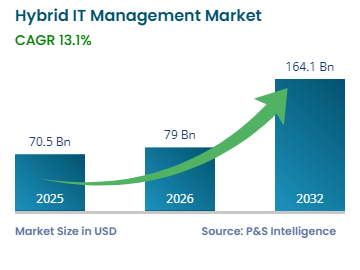
The hybrid IT management market size was USD 70.5 billion in 2025, and it will grow by 13.1% during 2026-2032, to reach USD 164.1 billion by 2032.
The hybrid IT management market is expanding as organisations manage increasingly complex technology environments that span on-premises infrastructure, private clouds, public clouds, edge systems, and multiple cloud providers. Enterprises are accelerating digital transformation programmes while seeking greater visibility, governance, and operational control across distributed assets. Traditional management approaches are becoming less effective as applications, workloads, and data move continuously between different environments. Hybrid IT management platforms help organisations unify monitoring, automation, security, compliance, and performance management, enabling more efficient administration of diverse infrastructure while supporting changing business and operational requirements.
The market is gaining momentum from growing investments in cloud-native applications, containerised workloads, artificial intelligence, and data-intensive operations. Organisations are placing greater emphasis on operational resilience, cybersecurity, regulatory compliance, and data governance, increasing the need for platforms that can enforce consistent policies across hybrid environments. According to the International Telecommunication Union, around 6 billion people, representing approximately three-quarters of the global population, used the Internet in 2025, highlighting the expanding scale of digital services, connected applications, and online business operations that enterprises must support. This growth is increasing infrastructure complexity across industries and encouraging organisations to adopt unified management platforms that improve workload visibility, resource utilisation, operational efficiency, and governance across interconnected hybrid ecosystems while supporting evolving technology strategies and business priorities.
Key Market Insights
Software is the larger component, holding a market share of 70.0%, due to its role in centralising visibility, governance, security, and workload management across hybrid environments.
Automation & Orchestration Management is the fastest-growing management area, registering a CAGR of 13.2%, driven by rising adoption of automated workflows, Kubernetes platforms, and AI-enabled operations.
Cloud-Based is the larger and faster-growing category, holding a market share of 85.0% and registering a CAGR of 13.9%, due to rising enterprise cloud adoption and growing demand for centralised management across distributed IT environments.
North America holds the largest market share at 45.5% in 2025, driven by mature enterprise technology, widespread cloud adoption, advanced data centre infrastructure, and high digitalisation.
Asia-Pacific has the highest CAGR, of 14.0%, owing to rapid digital infrastructure expansion and increasing enterprise cloud adoption.
Hybrid IT Management Market Trends and Drivers
AI-Powered Automation and Autonomous IT Operations Are a Major Trend
The hybrid IT management market is shifting from manual monitoring toward AI-led automation and autonomous operations as enterprises manage workloads across on-premises systems, public clouds, private clouds, and edge locations. IT teams need platforms that can detect anomalies, predict infrastructure issues, automate remediation, and optimise workload placement without constant manual intervention. According to Cisco’s 2025 Networking Research, 98% of surveyed leaders said AI-native, autonomous networks were essential to future growth, while only 41% had deployed intelligent capabilities such as segmentation, visibility, and control. According to Nutanix’s 2025 Enterprise Cloud Index, 94% of respondents in 2024 agreed that cloud-native architectures with containerisation were needed to deploy and support GenAI and other modern AI applications at scale. This is increasing demand for hybrid IT management platforms that combine automation, predictive analytics, and cloud-native control across complex infrastructure.
Growing Adoption of Hybrid and Multi-Cloud Infrastructure Strategies Drives Market
The rising adoption of hybrid and multi-cloud strategies is driving demand for hybrid IT management solutions as organisations spread applications, data, and workloads across multiple computing environments. Enterprises use this approach to avoid dependence on one provider, keep sensitive workloads on private infrastructure, and place applications where performance, cost, and compliance requirements are best met. Managing multi-cloud networking across these environments has become increasingly important for maintaining connectivity, application performance, security, and operational consistency. According to Red Hat’s 2025 virtualisation survey, 72% of organisations used multiple clouds, and 85% used a hybrid cloud model. According to Thales’s 2025 Cloud Security Study, 55% of enterprises reported that securing cloud environments was more complex than securing on-premises environments. These conditions are increasing the need for centralised platforms that provide visibility, governance, policy control, and workload management across cloud and private infrastructure.
Integration Complexity Across Diverse IT Environments Limits Market Expansion
A major restraint for the hybrid IT management market is the difficulty of integrating legacy infrastructure, private systems, public clouds, and cloud-native applications into a unified managed environment. Different platforms often use distinct tools, architectures, policies, and security controls, making consistent monitoring, governance, and workload coordination difficult for IT teams. According to IBM Institute for Business Value research, nearly 67% of surveyed executives believe their organisations need better integration across hybrid cloud, AI, and security platforms, highlighting the persistent complexity of managing interconnected technology environments. The skills gap further intensifies this challenge. According to ISC2, 90% of respondents reported skills gaps within their cybersecurity teams in 2024, while 67% reported staffing shortages. These integration and skills challenges can increase implementation complexity, slow modernisation efforts, and strengthen the need for managed services, specialised expertise, and automation tools that simplify the management of heterogeneous IT environments.
Expansion of Edge Computing and Distributed IT Infrastructure Creates Growth Opportunities
The growth of edge computing is creating opportunities for hybrid IT management providers as organisations increasingly move applications, data processing, and connected systems closer to users and operational sites. Edge environments expand the number of locations and technology assets that IT teams need to monitor, secure, automate, and govern alongside cloud and on-premises infrastructure. According to the International Telecommunication Union, 5G networks covered 55.1% of the world's population in 2025, while 5G coverage reached 70.4% in Asia-Pacific, 73.8% in Europe, and 59.9% in the Americas. The ITU also reported that around 3 billion 5G subscriptions were in use globally in 2025, representing about one-third of all mobile broadband subscriptions.
The expansion of 5G connectivity and distributed digital services is supporting the deployment of connected devices, low-latency applications, and edge computing environments. As these environments become more distributed, organisations require hybrid IT management platforms that provide centralised visibility, policy enforcement, workload coordination, security, and performance management across cloud, data centre, and edge infrastructure. The increasing volume and geographic distribution of edge infrastructure therefore creates significant opportunities for solutions that enable consistent management and operational control across heterogeneous IT environments.
Hybrid IT Management Market Segmentation Analysis
Component Analysis
Software is the larger category, holding a market share of 70.0%, because enterprises use software platforms as the main control layer for hybrid IT environments. These platforms centralise monitoring, policy control, workload visibility, security oversight, performance tracking, and data center infrastructure management (DCIM) across cloud and on-premises systems. In 2025, the European Commission Eurostat reported that 96.44% of EU enterprises using paid cloud services purchased at least one cloud Software as a Service application.
Services are the faster-growing category, registering a CAGR of 13.3%, because organisations need external expertise to plan, integrate, operate, and maintain hybrid IT environments. Many enterprises lack internal teams with experience across legacy infrastructure, cloud platforms, security tools, and automation systems. This creates demand for consulting, deployment, managed services, support, and training. Service providers also help companies reduce implementation risk and manage ongoing operational complexity, especially as hybrid architectures become more distributed and difficult to administer internally.
The components analysed in this report are:
Software (Larger Category)
Cloud Management
Data Centre Management
Network Management
Security Management
Application Performance Management
IT Operations Management
Services (Faster-growing Category)
Consulting Services
Integration & Deployment Services
Managed Services
Support & Maintenance Services
Training & Education Services
Management Type Analysis
Security & Compliance Management is the largest category, holding a market share of 35.5%, because hybrid IT environments create higher exposure across cloud platforms, private infrastructure, remote access points, and distributed applications. Enterprises need consistent controls for identity, data protection, audit readiness, policy enforcement, and risk monitoring. Regulated industries such as BFSI, healthcare, government, and energy depend heavily on security-led management to protect sensitive workloads.
Automation & Orchestration Management is the fastest-growing category, registering a CAGR of 13.2%, because enterprises are reducing manual administration across hybrid infrastructure. IT teams need automated workflows to provision resources, coordinate workloads, resolve incidents, and apply policies across cloud, data centre, and edge systems. According to the Cloud Native Computing Foundation, 82% of container users ran Kubernetes in production in 2025. This shows that live enterprise environments are already using orchestration layers at scale, increasing demand for hybrid IT management tools that can support automated control, workload coordination, and operational consistency across dynamic infrastructure.
Cloud-Based is the larger and faster-growing category, holding a market share of 85.0% and registering a CAGR of 13.9%, because organisations prefer deployment models that support remote access, faster updates, scalability, and lower infrastructure maintenance. Cloud-based management platforms fit hybrid environments where workloads operate across public cloud, private cloud, SaaS, and edge systems. In 2025, the European Commission's Eurostat reported that 52.74% of EU enterprises used paid cloud computing services. This adoption base supports demand for cloud-based hybrid IT management, as enterprises need centralised visibility and policy control without relying heavily on on-premises management infrastructure.
The deployment types analysed in this report are:
Cloud-Based (Larger and Faster-growing Category)
On-Premises
Enterprise Size Analysis
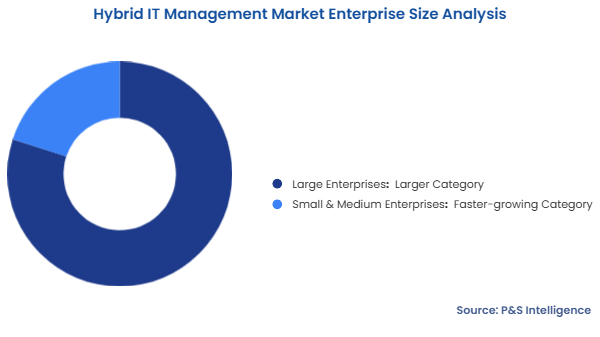
Large Enterprises is the larger category, holding a market share of 80.0%, because large organisations operate complex IT estates across multiple business units, geographies, data centres, and cloud platforms. They require advanced management tools for governance, performance, security, cost control, and workload coordination. These enterprises also have higher budgets and stronger compliance requirements, which support wider adoption of hybrid IT management platforms. Their need to modernise legacy systems while maintaining operational continuity makes them the main demand base for this market.
Small & Medium Enterprises are the faster-growing category, registering a CAGR of 13.5%, because SMEs are adopting cloud services, SaaS tools, managed IT models, and remote-work systems without building large internal technology teams. Hybrid IT management solutions help these businesses improve visibility, reduce manual administration, and manage distributed digital tools through simplified platforms. In 2024, the European Commission Eurostat reported that 73% of EU SMEs reached at least a basic level of digital intensity.
The enterprise sizes analysed in this report are:
Large Enterprises (Larger Category)
Small & Medium Enterprises (Faster-growing Category)
End User Analysis
Banking, Financial Services, and Insurance is the largest category, holding a market share of 30.0%, because financial institutions operate complex IT environments that combine legacy systems, private infrastructure, public cloud platforms, and digital banking applications. The growing use of digital financial services is further increasing the need for reliable and well-governed hybrid IT infrastructure. According to the World Bank, 61% of adults in low- and middle-income economies made or received digital payments in 2024, reflecting the continued expansion of digital financial services and the underlying technology infrastructure required to support them.
Healthcare is the fastest-growing category, registering a CAGR of 13.7%, driven by the rapid digitisation of healthcare services, increasing use of electronic health records, telemedicine, connected healthcare applications, and cloud-based healthcare platforms. According to the Government of India, as of August 2025, more than 79.9 crore Ayushman Bharat Health Accounts (ABHAs) had been created, while over 67.19 crore health records had been linked with ABHAs, demonstrating the rapid expansion of digital health infrastructure.
The end users analysed in this report are:
Banking, Financial Services, and Insurance (BFSI) (Largest Category)
Healthcare (Fastest-growing Category)
Retail & E-Commerce
IT & Telecom
Government & Public Sector
Manufacturing
Energy & Utilities
Others
Drive strategic growth with comprehensive market analysis
Hybrid IT Management Market Regional Analysis
North America Hybrid IT Management Market Analysis
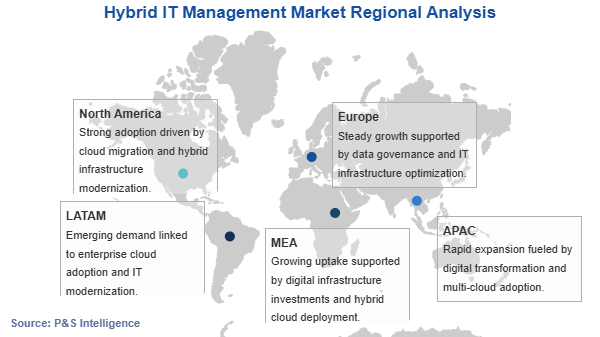
North America holds the largest share of the hybrid IT management market, accounting for 45.5% in 2025, supported by its mature enterprise technology ecosystem, widespread adoption of cloud and hybrid infrastructure, advanced data centre capabilities, and high levels of digitalisation. Organisations across the region increasingly operate workloads across on-premises infrastructure, private clouds, public clouds, and edge environments, creating demand for integrated platforms that provide infrastructure visibility, automation, security, compliance, and performance management. According to the U.S. Census Bureau, 59.0% of U.S. businesses considered cloud-based technology very important to their business processes or methods, highlighting the importance of cloud infrastructure within the region's business environment. The strong presence of cloud providers, enterprise technology vendors, and managed service providers, combined with continued investment in AI, cybersecurity, cloud modernisation, and IT automation, is further supporting the adoption of hybrid IT management solutions across North America.
U.S. Hybrid IT Management Market Analysis
The U.S. has a significant share of the hybrid IT management market, as enterprises operate highly complex hybrid environments across multiple cloud platforms, data centres, and on-premises systems. Organisations are investing heavily in automation, observability, cybersecurity integration, and AI-enabled operations to improve infrastructure management. According to the Congressional Research Service, 18.1% of firms in the U.S. Information sector used artificial intelligence in 2024, the highest among major industries. The growing use of AI applications, cloud-native workloads, and distributed infrastructure is increasing demand for hybrid IT management platforms that provide visibility, governance, automation, and workload optimisation.
Canada Hybrid IT Management Market Analysis
Canada is the fastest-growing country market, because organisations are expanding cloud adoption across government agencies, financial institutions, healthcare providers, and industrial sectors. Businesses are modernising infrastructure while strengthening data governance, operational continuity, and cybersecurity management across distributed environments. According to Statistics Canada, 25.7% of Canadian businesses that used artificial intelligence purchased cloud services or cloud storage after AI implementation in 2025. This relationship between AI deployment and cloud adoption is increasing the need for hybrid IT management solutions that coordinate workloads, monitor performance, and maintain control across interconnected cloud and on-premises environments.
Asia-Pacific Hybrid IT Management Market Analysis
Asia-Pacific has the highest CAGR, of 14.0%, owing to rapid digital infrastructure expansion, increasing enterprise cloud adoption, and large-scale technology modernisation initiatives across developing and developed economies. Businesses throughout the region are expanding digital operations while managing increasingly diverse technology environments that combine traditional infrastructure with cloud-based platforms. According to the International Telecommunication Union, 5G networks covered 70.4% of the population in Asia and the Pacific in 2025, highlighting the region’s expanding digital connectivity and infrastructure capabilities. This growing connectivity is supporting the expansion of cloud-based applications, distributed IT environments, and digital services across the region, increasing the need for hybrid IT management solutions that provide centralised visibility, automation, security, and operational control.
China Hybrid IT Management Market Analysis
China is the largest country market, because large enterprises, telecommunications providers, manufacturers, and public institutions operate extensive digital infrastructure across the country. Organisations are deploying advanced computing resources, connected industrial systems, and cloud platforms that require unified management and operational oversight. According to the National Data Administration of China, the country's total computing power reached 280 EFLOPS in 2024. The expansion of high-performance computing, industrial digitalisation, and large-scale data processing environments is increasing demand for hybrid IT management platforms that support workload coordination, infrastructure visibility, resource optimisation, and operational governance.
India Hybrid IT Management Market Analysis
India is the fastest-growing country market, because enterprises are accelerating cloud adoption, digital transformation programmes, and software-driven business operations. The country's expanding startup ecosystem and growing digital economy are creating increasingly diverse IT environments that require scalable management capabilities. According to the Press Information Bureau of India, India had 157,706 DPIIT-recognised startups in 2024. The expansion of technology-focused businesses is increasing the deployment of cloud services, digital applications, and distributed infrastructure, creating stronger demand for hybrid IT management solutions that simplify administration, improve visibility, and support rapidly evolving operational requirements.
Europe Hybrid IT Management Market Analysis
Europe represents a steadily expanding market supported by a strong regulatory focus on data governance, digital sovereignty, operational resilience, and secure digital transformation. Organisations across the region are increasingly implementing hybrid IT strategies to balance cloud innovation with requirements related to data control, cybersecurity, and regulatory compliance. According to Eurostat, 52.74% of EU enterprises used paid cloud computing services in 2025, an increase of 7.42 percentage points compared with 2023, highlighting the continued expansion of cloud adoption across the European business environment. The increasing use of cloud-based applications and distributed digital infrastructure is creating more complex technology environments that require centralised visibility, workload management, automation, security, and compliance across interconnected systems.
The regions and countries analysed in this report are:
North America (Largest Regional Market)
U.S. (Larger Country)
Canada (Faster-Growing Country)
Europe
Germany (Largest Country)
U.K.
France (Fastest-Growing Country)
Italy
Spain
Rest of Europe
Asia-Pacific (Fastest-Growing Regional Market)
China (Largest Country)
India (Fastest-Growing Country)
Japan
South Korea
Australia
Rest of APAC
Latin America
Brazil (Largest Country)
Mexico (Fastest-Growing Country)
Rest of LATAM
Middle East and Africa
Saudi Arabia (Fastest-Growing Country)
U.A.E. (Largest Country)
South Africa
Rest of MEA
Hybrid IT Management Market Competitive Landscape
The hybrid IT management market is fragmented in nature, with a wide range of global technology vendors, cloud platform providers, infrastructure management specialists, software companies, and managed service providers competing across different areas of the value chain. The market covers multiple functions, including cloud management, infrastructure monitoring, automation, security management, application performance management, and IT operations, creating opportunities for both large enterprise software vendors and niche solution providers. Continuous technological change encourages new entrants to develop specialised platforms focused on automation, observability, artificial intelligence, security, and multi-cloud management. Vendors frequently differentiate themselves through platform capabilities, integration flexibility, industry expertise, and service offerings rather than competing solely on scale.
Top Companies in the Hybrid IT Management Market:
Dell Technologies Inc.
IBM Corporation
Microsoft Corporation
Broadcom Inc.
Cisco Systems Inc.
ServiceNow Inc.
BMC Software Inc.
OpenText Corporation
Hewlett Packard Enterprise Company
Nutanix Inc.
SolarWinds Corporation
Flexera Software LLC
Dynatrace Inc.
Oracle Corporation
Datadog Inc.
Hybrid IT Management Market News
In June 2026, Flexera launched comprehensive AI Cost Management capabilities within Flexera One, providing visibility, governance, and optimisation of AI spending across applications, agents, models, data platforms, and compute. The company also introduced FinOps Assist and expanded automation capabilities to help organisations identify and act on cost-saving opportunities.
In May 2026, Dell announced the next evolution of Dell Automation Platform, along with Dell Automation Studio and continued development of Dell Private Cloud and Dell Distributed Private Cloud. Dell said the enhancements were aimed at making complex, distributed, AI-driven IT environments more automated and continuously optimized.
In April 2026, Microsoft announced the limited preview of Azure Virtual Desktop for hybrid environments, enabling organisations to run Azure Virtual Desktop session hosts on existing on-premises infrastructure through Azure Arc. The capability supports Microsoft Hyper-V, Nutanix AHV, VMware vSphere, and physical Windows Servers, allowing organisations to extend Azure-based desktop management across on-premises environments while benefiting from unified identity, policy, and virtual-machine management.
In August 2025, Broadcom announced that VMware Private AI Services would become a standard component of VMware Cloud Foundation 9.0, making VCF an AI-native private-cloud platform. The platform enables organisations to run, govern, and scale AI workloads alongside traditional applications while providing unified infrastructure operations, security, governance, and workload management.
Frequently Asked Questions About This Report
What does the hybrid information technology management market include for organizations?+
It includes tools and services for managing applications, infrastructure, data, security, and operations across on premises and cloud environments.
What factors are driving demand in the hybrid information technology management market?+
Demand is driven by cloud migration, legacy modernization, distributed workloads, cost control, and need for unified operational visibility.
Why are organizations adopting hybrid information technology management solutions across operations?+
Organizations adopt hybrid management tools to coordinate resources, monitor performance, manage costs, and reduce complexity across environments.
How do hybrid information technology management solutions improve decision making and efficiency?+
These solutions improve operations by providing unified dashboards, policy control, automation, and service management across mixed infrastructure.
What challenges affect adoption of hybrid information technology management solutions today?+
Adoption is affected by legacy dependencies, skill gaps, inconsistent tooling, data movement, security policy alignment, and vendor coordination.
Want a report tailored exactly to your business need?
Leading companies across industries trust us to deliver data-driven insights and innovative solutions for their most critical decisions. From data-driven strategies to actionable insights, we empower the decision-makers who shape industries and define the future. From Fortune 500 companies to innovative startups, we are proud to partner with organisations that drive progress in their industries.
Client Testimonials
Working with P&S Intelligence and their team was an absolute pleasure – their awareness of timelines and commitment to value greatly contributed to our project's success. Eagerly anticipating future collaborations.
McKinsey & Company
India
Unmatched Standards
Our insights into the minutest levels of the markets, including the latest trends and competitive landscape, give you all the answers you need to take your business to new heights
Complete Data Security
We take a cautious approach to protecting your personal and confidential information. Trust is the strongest bond that connects us and our clients, and trust we build by complying with all international and domestic data protection and privacy laws