Data Center Infrastructure Management Market Size & Share Analysis - Trends, Drivers, Competitive Landscape, and Forecasts (2026 - 2032)
This Report Provides In-Depth Analysis of the Data Center Infrastructure Management Market Report Prepared by P&S Intelligence, Segmented by Component (Solutions, Services), Application (Asset Management, Capacity Planning, Power Monitoring, Environmental Monitoring, Business Intelligence and Analytics), Data Center Type (Enterprise Data Center, Managed Data Center, Colocation Data Center, Cloud and Edge Data Center), Deployment Model (On-Premises, Cloud), Organization Size (Large Enterprises, Small and Medium-Sized Enterprises), Vertical (Banking, Financial Services and Insurance, Government and Public Sector, IT and Information-Technology-Enabled Services, Manufacturing, Healthcare and Life Sciences, Telecommunications), and Geographical Outlook for the Period of 2021 to 2032
Data Center Infrastructure Management Market Size Forecast
Key Highlights
Study Period
2021 - 2032
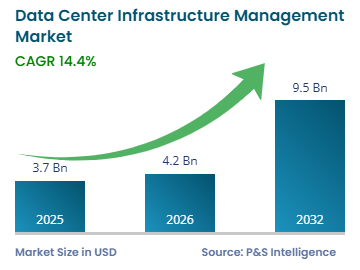
Market Size in 2025
USD 3.7 Billion
Market Size in 2026
USD 4.2 Billion
Market Size by 2032
USD 9.5 Billion
Projected CAGR
14.4%
Largest Region
North America
Fastest-Growing Region
Asia-Pacific
Market Structure
Semi-Consolidated
Market Size
Explore the market potential with our data-driven report
Data Center Infrastructure Management Market Overview
The data center infrastructure management market size was USD 3.7 billion for 2025, and it will grow by 14.4% during 2026–2032, to reach USD 9.5 billion by 2032.
The market is primarily driven by the rapid expansion of data center capacity, increasing AI and high-performance computing workloads, rising rack power densities, and growing electricity consumption. The increasing deployment of hyperscale, colocation, edge, and enterprise data centers is creating greater complexity in managing power, cooling, space, capacity, and IT assets. The International Energy Agency (IEA) estimates that global data center electricity consumption could more than double to around 945 TWh by 2030, largely supported by AI and other digital services. In the U.S., the U.S. Department of Energy estimates that data centers accounted for about 4.4% of total electricity consumption in 2023 and could reach 6.7%–12% by 2028. These developments are increasing demand for real-time infrastructure monitoring, capacity optimization, energy management, and predictive maintenance.
The market is further supported by increasing pressure on data center operators to improve energy efficiency, reduce operating costs, maintain uptime, and meet sustainability objectives. Power availability constraints and the growing energy intensity of AI infrastructure are encouraging operators to adopt advanced monitoring, analytics, automation, and predictive capabilities to optimize cooling and power utilization. The increasing complexity of distributed data center environments, including edge facilities and hybrid infrastructure, is also strengthening the need for centralized infrastructure visibility and capacity planning. In addition, the adoption of cloud-based DCIM, AI-enabled analytics, and digital-twin technologies is expanding the capabilities of infrastructure management platforms and supporting more proactive and automated data center operations.
Key Market Insights
The solutions category holds the larger market share, of 75%, in 2025, driven by strong spending on core hardware, software, sensors, meters, and monitoring platforms.
The asset management category holds the largest market share, of 35%, in 2025, driven by the need to track equipment, location, and connectivity before optimizing data center operations.
The on-premises category holds the larger market share, of 80%, in 2025, driven by greater control, data security, low latency, and integration with existing data center infrastructure.
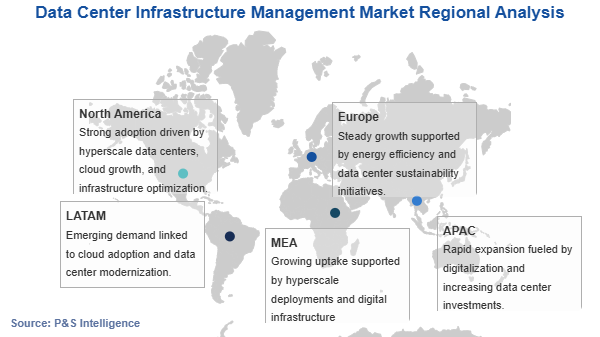
North America holds the largest market share, of 40%, in 2025, driven by its mature data center ecosystem and strong cloud, AI, and HPC adoption.
Asia-Pacific will have the highest CAGR, of approximately 15.3%, driven by rapid data center expansion, cloud adoption, and AI workloads.
Data Center Infrastructure Management Market Trends and Drivers
AI-Driven Infrastructure Density and Hybrid Cloud Integration Are Key Trends
The market is being reshaped by the increasing deployment of AI workloads that require higher rack power densities and the growing adoption of hybrid and multi-cloud IT environments. Enterprises are increasingly distributing workloads across on-premises infrastructure, colocation facilities, and public cloud platforms, increasing the need for unified visibility into infrastructure capacity, power consumption, cooling requirements, and asset utilization. According to Eurostat, the share of EU enterprises purchasing paid cloud computing services increased by 7.4 percentage points between 2023 and 2025 to 52.7%, while adoption among large enterprises reached 84.7% in 2025.
The increasing power and cooling requirements associated with AI infrastructure are encouraging DCIM vendors to expand platforms with AI-assisted capacity forecasting, predictive analytics, digital-twin capabilities, and higher-frequency infrastructure monitoring. Modern DCIM platforms are increasingly integrating facility-side information, such as power, cooling, and environmental conditions, with IT-side information, including assets, racks, and workloads, to provide a more comprehensive view of data center operations. As data center environments become more distributed and infrastructure becomes increasingly heterogeneous, demand is rising for DCIM platforms capable of centralized monitoring, capacity planning, energy optimization, and infrastructure management across multiple sites and deployment environments.
Escalating Power Demand and Regulatory Reporting Mandates Are Biggest Drivers
Data centers face a rapid increase in electricity demand as AI workloads scale, and this pressure is translating into greater demand for infrastructure management technologies. The International Energy Agency projects that global electricity consumption from data centers will more than double from approximately 485 TWh in 2025 to around 945 TWh by 2030. The IEA also reports that electricity demand from data centers increased by 17% in 2025, significantly faster than overall global electricity demand, which grew by approximately 3%. This sharp increase in electricity requirements is encouraging operators to adopt continuous monitoring of rack-level power, power distribution units (PDUs), cooling systems, and other infrastructure to improve capacity utilization and energy efficiency.
Regulatory requirements are further supporting DCIM adoption. Under the European Union's recast Energy Efficiency Directive, data centers with an installed IT power demand of 500 kW or more are subject to reporting requirements covering energy-performance and sustainability indicators through a common European database. The reporting framework includes metrics related to energy performance, renewable energy use, water consumption, and other sustainability indicators. This recurring reporting requirement is increasing the importance of automated infrastructure monitoring and data collection, as DCIM platforms can help operators consolidate infrastructure data and support the calculation and reporting of metrics such as PUE and WUE. As data center sustainability and energy-efficiency requirements expand across jurisdictions, demand for automated monitoring, reporting, and optimization capabilities is expected to increase.
Persistent Staffing and Skills Shortages Are Key Restraints
Despite strong demand fundamentals, the market faces a structural constraint in the shortage of qualified personnel needed to deploy and operate DCIM platforms effectively. Nearly half of data center operators report difficulty finding qualified candidates for open roles, and more than a third struggle to retain existing staff, with skills gaps most acute in operations management and the electrical and mechanical trades needed to configure and maintain sensor-based monitoring infrastructure.
This constraint limits DCIM value realization in two ways: understaffed teams often lack the bandwidth to configure platforms beyond basic monitoring, leaving advanced capacity-planning and analytics modules underutilized, and the departure of experienced staff erodes institutional knowledge of how facility-specific configurations were set up. Vendors are responding by simplifying deployment through pre-built templates, low-code integration, and increasingly automated anomaly detection that reduces dependence on specialist interpretation. As training pipelines and vendor-delivered managed services expand, this constraint is expected to moderate gradually, though the underlying trades shortage is likely to persist through the medium term given the multi-year lead time required to build technician pipelines at scale.
Colocation and Edge Build-Out Are Biggest Opportunities
The expansion of colocation and edge data center infrastructure is creating additional demand for DCIM solutions and services beyond traditional enterprise-owned facilities. Increasing cloud adoption, AI workloads, and demand for low-latency computing are encouraging organizations to use colocation and distributed edge facilities, where operators require centralized visibility into power, cooling, capacity, assets, and environmental conditions. According to the Synergy Research Group, hyperscale operators accounted for approximately 48% of global data center capacity in 2025, while colocation and other third-party data center providers continued to expand capacity to support cloud and AI infrastructure. The increasing scale and complexity of multi-tenant facilities are creating demand for DCIM platforms that can provide operators with detailed infrastructure visibility and enable customers to monitor their allocated power, space, and equipment.
Edge deployments further increase the need for remote monitoring and automated infrastructure management because many edge facilities are smaller, geographically distributed, and operate with limited on-site personnel. Cloud-based DCIM platforms can enable centralized monitoring, automated alerts, remote troubleshooting, and capacity management across distributed locations. As colocation and edge infrastructure expand alongside cloud and AI deployments, demand is increasing for DCIM services, cloud-based deployment, remote monitoring, asset management, and predictive maintenance capabilities.
Data Center Infrastructure Management Market Segmentation Analysis
Component Analysis
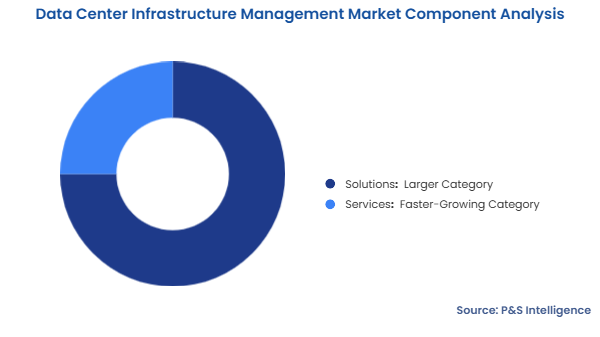
The solutions category holds the larger market share, of 75%, in 2025, reflecting the fact that most operators still prioritize spend on core hardware and software instrumentation, sensors, power meters, and monitoring platforms, before layering on advisory or managed services. This dominance stems from solutions being the technical foundation of DCIM deployments, as actionable capacity and power data require instrumentation across racks, PDUs, and cooling systems, making solutions the core component of DCIM deployments.
The services category will have the higher CAGR, of approximately 14.6%, as facilities increasingly outsource DCIM configuration, integration, and ongoing tuning work that in-house teams lack the specialized bandwidth to perform. This acceleration is driven by the growing complexity of hybrid, multi-vendor environments, which require consulting and managed-service expertise to translate raw telemetry into usable capacity and sustainability reporting.
The components analyzed in this report are:
Solutions (Larger Category)
Services (Faster-Growing Category)
Application Analysis
The asset management category holds the largest market share, of 35%, in 2025, as it addresses the foundational need every data center has; knowing precisely what equipment exists, where it sits, and how it is connected before any power, capacity, or environmental optimization can occur. Asset management modules typically represent the first DCIM capability operators deploy, since inaccurate or manual asset records create compounding errors across every other operational function. The U.S. Department of Energy emphasizes accurate metering and infrastructure baselines for data center energy efficiency, supporting reliable infrastructure data for optimization.
The business intelligence and analytics category will have the highest CAGR, as operators move beyond raw monitoring toward predictive, AI-assisted decision-making. This acceleration is driven by rising demand for capacity forecasting and anomaly detection that reduces reliance on manual interpretation of monitoring data.
The applications analyzed in this report are:
Asset Management (Largest Category)
Capacity Planning
Power Monitoring
Environmental Monitoring
Business Intelligence (BI) and Analytics (Fastest-Growing Category)
Others
Data Center Type Analysis
The enterprise data center category holds the largest market share, of 45%, in 2025, supported by the sheer installed base of owner-operated facilities that large organizations have built over decades and continue to instrument with DCIM tools for compliance, capacity, and cost-control purposes. Enterprise operators tend to have the largest existing capital investment in physical infrastructure and correspondingly greater incentive to protect that investment through structured monitoring rather than ad hoc oversight.
The cloud and edge data center category will have the highest CAGR, of approximately 14.6%, driven by the same AI-driven capacity build-out reshaping the broader digital infrastructure landscape. The increasing deployment of cloud and edge infrastructure across geographically distributed locations is creating greater demand for remote monitoring, automated alerting, centralized infrastructure management, and capacity optimization, particularly where on-site staffing is limited.
The data center types analyzed in this report are:
Enterprise Data Center (Largest Category)
Managed Data Center
Colocation Data Center
Cloud and Edge Data Center (Fastest-Growing Category)
Deployment Model Analysis
The on-premises category holds the larger market share, of 80%, in 2025, as large enterprises and regulated industries continue to favor direct control over monitoring infrastructure for latency, data sovereignty, and security reasons. Organizations with extensive existing data center infrastructure also prefer on-premises DCIM deployments because they provide greater control over infrastructure data, system configuration, and integration with existing facility-management systems. FedRAMP reported that fewer than 350 cloud services had completed the federal authorization process over its first 13 years, highlighting the extensive security and authorization requirements associated with cloud adoption in U.S. government environments.
The cloud category will have the higher CAGR, as vendors increasingly deliver DCIM as a subscription service, lowering upfront capital barriers and enabling centralized visibility across dispersed colocation and edge sites without dedicated on-site servers. The increasing adoption of cloud computing by enterprises is also expanding the addressable environment for cloud-based DCIM platforms, as organizations increasingly manage infrastructure across distributed and hybrid environments.
The deployment models analyzed in this report are:
On-Premises (Larger Category)
Cloud (Faster-Growing Category)
Organization Size Analysis
The large enterprises category holds the larger market share, of 70%, in 2025, reflecting their greater capital budgets, larger and more complex facility footprints, and correspondingly stronger need for structured infrastructure oversight across multiple sites and business units. Large organizations also tend to face more stringent internal governance and external compliance requirements that favor investment in dedicated monitoring platforms over informal tracking methods.
The small and medium-sized enterprises category will have the higher CAGR, as cloud-delivered, subscription-priced DCIM tools lower the traditional cost and complexity barriers that kept smaller operators reliant on spreadsheets and manual processes. The OECD reports that SMEs continue to lag larger enterprises in the adoption of digital technologies, highlighting the significant scope for further digitalization among smaller businesses.
The organization sizes analyzed in this report are:
Large Enterprises (Larger Category)
Small and Medium-Sized Enterprises (SMEs) (Faster-Growing Category)
Vertical Analysis
The IT and information-technology-enabled services category holds the largest market share, of 35%, in 2025, as these organizations operate substantial data center infrastructure and have significant requirements for uptime, infrastructure visibility, capacity management, and operational efficiency. IT and ITeS organizations also tend to be early adopters of infrastructure management technologies because data center availability and performance directly support their core digital services. According to the U.S. General Services Administration (GSA), the federal government had approximately 1,500 data centers across agencies as of 2024, highlighting the substantial infrastructure base requiring monitoring, optimization, and modernization.
The government and public sector category will have the highest CAGR, driven by increasing digitalization, modernization of government IT infrastructure, cybersecurity requirements, and growing emphasis on data center energy efficiency and infrastructure optimization. In the United States, the Office of Management and Budget's Data Center Optimization Initiative (DCOI) establishes requirements for federal agencies to improve data center utilization, energy efficiency, performance, and infrastructure management, increasing the need for monitoring and optimization capabilities across government data center environments.
The verticals analyzed in this report are:
Banking, Financial Services and Insurance (BFSI)
Government and Public Sector (Fastest-Growing Category)
IT and Information-Technology-Enabled Services (Largest Category)
Manufacturing
Healthcare and Life Sciences
Telecommunications
Others
Drive strategic growth with comprehensive market analysis
Data Center Infrastructure Management Market Regional Analysis
North America Data Center Infrastructure Management Market Size
North America holds the largest market share, of 40%, in 2025, owing to the presence of a highly developed data center ecosystem, a large concentration of hyperscale and colocation facilities, and strong adoption of cloud computing, AI, and high-performance computing technologies. The region's growing data center capacity and increasing power and cooling requirements are driving demand for advanced infrastructure monitoring, capacity management, energy optimization, and predictive maintenance solutions.
The region's leadership is further supported by its extensive data center capacity and investment activity. According to the U.S. Department of Energy, U.S. data center electricity consumption is expected to increase substantially through 2028, reflecting continued expansion of data center infrastructure and growing demand for power-intensive computing. In addition, the U.S. hosts a significant concentration of global data center capacity, particularly across major hubs such as Northern Virginia, Dallas, Silicon Valley, and Phoenix, increasing the need for centralized infrastructure monitoring, capacity planning, and energy management.
Canada Data Center Infrastructure Management Market Size
Canada is the fastest country market in North America for data center infrastructure management (DCIM), supported by the expansion of AI and cloud infrastructure, increasing deployment of hyperscale and colocation facilities, and rising demand for high-performance computing. The country's availability of relatively low-carbon electricity and favorable conditions for data center development are also attracting investment in large-scale computing infrastructure. According to the Canada Energy Regulator (CER) 2026, data center electricity demand is expected to increase by an additional 1.5 GW by 2030 under its Current Measures scenario, with most of the growth concentrated in Ontario, Alberta, and Quebec.
The increasing scale and power intensity of Canadian data centers is strengthening demand for DCIM solutions for power and cooling optimization, capacity planning, asset monitoring, and energy management. The Government of Canada is also supporting the development of sovereign AI infrastructure, with proposed AI data centers expected to have planned capacities exceeding 100 MW, further increasing the need for sophisticated infrastructure-management capabilities.
Asia-Pacific Data Center Infrastructure Management Market Size
Asia-Pacific will have the highest CAGR, of approximately 15.3%, driven by rapid expansion of data center capacity, accelerating cloud adoption, increasing AI workloads, and large-scale digitalization across China, India, Japan, South Korea, and Australia. The region is witnessing substantial investment in hyperscale, colocation, and edge data centers to meet rising demand for cloud computing, AI, e-commerce, digital payments, and online services. This expansion is increasing the complexity of managing power, cooling, capacity, and infrastructure assets, thereby driving demand for DCIM solutions.
The growth is further supported by rising data center electricity demand and infrastructure investment. The International Energy Agency (IEA) projects that electricity consumption from data centers in Southeast Asia is expected to more than double by 2030, while China and other Asian markets are also experiencing significant growth in data center capacity. In India, the government's IndiaAI Mission includes an investment of approximately INR 10,372 crore to strengthen the country's AI ecosystem, including access to AI computing infrastructure. These developments are increasing demand for real-time infrastructure monitoring, energy optimization, predictive maintenance, capacity planning, and automated infrastructure management.
China Data Center Infrastructure Management Market Size
China is the largest market in the Asia Pacific Data Center Infrastructure Management Market, driven by its extensive data center infrastructure, rapid adoption of cloud computing and AI, increasing digitalization, and continued investment in computing facilities. The country's large-scale deployment of hyperscale and high-performance computing infrastructure is increasing the complexity of managing power, cooling, capacity, and IT assets, creating greater demand for DCIM solutions. According to China’s Ministry of Industry and Information Technology (MIIT), more than 8.8 million standard racks were in use at computing centers in China at the end of 2024, while total computing power increased by 16.5% year-on-year. The continued expansion of China's computing infrastructure is increasing demand for infrastructure monitoring, capacity planning, power and cooling optimization, energy management, and predictive maintenance.
The regions and countries analyzed in this report are:
North America (Largest Regional Market)
U.S. (Larger Country)
Canada (Faster-Growing Country)
Europe
Germany (Largest Country)
U.K. (Fastest-Growing Country)
France
Italy
Spain
Rest of Europe
Asia-Pacific (Fastest-Growing Regional Market)
China (Largest Country)
India (Fastest-Growing Country)
Japan
South Korea
Australia
Rest of APAC
Latin America
Brazil (Largest Country)
Mexico (Fastest-Growing Country)
Rest of LATAM
Middle East & Africa
Saudi Arabia (Largest Country)
South Africa
U.A.E. (Fastest-Growing Country)
Rest of MEA
Data Center Infrastructure Management Market Competitive Landscape
The market is semi-consolidated, with competition led by established global vendors alongside specialized and regional technology providers. Major companies such as Schneider Electric, Vertiv, Siemens, Eaton, ABB, and Nlyte offer DCIM platforms covering infrastructure monitoring, asset management, capacity planning, power management, and environmental monitoring. These companies benefit from established relationships with hyperscale, colocation, enterprise, and government data center operators, as well as broad infrastructure and software portfolios. At the same time, specialized providers compete through cloud-based DCIM, AI-enabled monitoring, predictive analytics, automation, and digital-twin capabilities. Regional vendors also serve specific geographic markets and customer requirements. The presence of established global providers alongside specialized and regional companies creates a competitive landscape with multiple participants across different technology and customer segments.
Top Companies in the Data Center Infrastructure Management Market:
Schneider Electric SE
Vertiv Group Co.
Siemens AG
Huawei Technologies Co., Ltd.
Johnson Controls International plc
Eaton Corporation plc
ABB Ltd.
Nlyte Software Limited
Sunbird Software, Inc.
Device42, Inc.
FNT GmbH
Cormant, Inc.
Data Center Infrastructure Management Market Developments
In April 2026, Johnson Controls International plc acquired Nantum AI, a New York-based provider of proprietary AI algorithms for building energy optimization, to strengthen the AI-driven control and monitoring capabilities of its OpenBlue digital ecosystem, extending automated infrastructure management further into predictive, algorithm-driven operations.
In December 2025, Sunbird Software, Inc. released dcTrack 9.3, introducing enhanced location hierarchies, more flexible environment modeling, improved integrations, and other enhancements designed to simplify data center management and automate routine work.
In November 2025, Schneider Electric SE launched EcoStruxure Foresight Operation, an AI-powered platform for energy, power, and building systems that blends machine learning and predictive analytics to cut engineering workloads by up to 40% and boost operational efficiency by up to 50%, with the company citing data centers among the primary target facility types.
In November 2025, Siemens AG signed a long-term partnership with Samsung C&T's Engineering & Construction Group to deliver digital infrastructure projects, including data centers, combining Siemens' Building X, Electrification X, and Gridscale X platforms with Samsung C&T's global construction capabilities, with data centers forming a core part of the initial project wave.
In August 2025, Vertiv Holdings Co. acquired Waylay NV, a Belgium-based hyperautomation and generative AI software provider, to strengthen AI-driven monitoring, predictive maintenance, and performance optimization capabilities across its power and cooling infrastructure management portfolio.
Frequently Asked Questions About This Report
Want a report tailored exactly to your business need?
Leading companies across industries trust us to deliver data-driven insights and innovative solutions for their most critical decisions. From data-driven strategies to actionable insights, we empower the decision-makers who shape industries and define the future. From Fortune 500 companies to innovative startups, we are proud to partner with organisations that drive progress in their industries.
Client Testimonials
Working with P&S Intelligence and their team was an absolute pleasure – their awareness of timelines and commitment to value greatly contributed to our project's success. Eagerly anticipating future collaborations.
McKinsey & Company
India
Unmatched Standards
Our insights into the minutest levels of the markets, including the latest trends and competitive landscape, give you all the answers you need to take your business to new heights
Complete Data Security
We take a cautious approach to protecting your personal and confidential information. Trust is the strongest bond that connects us and our clients, and trust we build by complying with all international and domestic data protection and privacy laws