Logo - P&S Intelligence
  • Home
  • Report Store
    • Report Store
      • Consumer Products
      • Life Sciences
      • ICT and Media
      • Semiconductor and Electronics
      • Chemicals and Materials
      • Automotive and Transportation
      • Power and Energy
      • Heating & Cooling
      • Aerospace & Defense
      • Construction & Heavy Machinery
    • Back
  • Services
  • Knowledge Center
    • Knowledge Center
      • Press Journals
      • Blogs
      • Case Studies
    • Back
  • About Us
  • Contact Us
EV Battery Thermal Management System Market
  • Buy Report
  • Home
  • Automotive and Transportation
  • New Energy Vehicles
  • EV Battery Thermal Management System Market

Electric Vehicle Battery Thermal Management System Market Size & Share Analysis - Trends, Drivers, Competitive Landscape, and Forecasts (2024 - 2030)

Get a Comprehensive Overview of the Electric Vehicle Battery Thermal Management System Market Report Prepared by P&S Intelligence, Segmented by Vehicles Type (Passenger, Commercial), Propulsion (BEV, HEV, PHEV, FCEV), Type (Active, Passive, Hybrid), Battery Type (Conventional, Solid-State), Technology (Liquid Cooling & Heating, Air Cooling & Heating, Phase Change Material), and Geographic Regions. This Report Provides Insights From 2019 to 2030.

  • Published: May 2024
  • Pages: 350
  • Report Code: 13027
Share:
  • Order this report
  • Inquire Before Ordering
Build Data-Driven Growth Strategies

This report contains the pivotal information you need to refine and strengthen your business strategy.

Need Assistance?
  • +91 93541 34657
  • [email protected]
  • Report Summary
  • Table of Contents
  • Sample Pages

Electric Vehicle Battery Thermal Management System Market Size

Market Statistics

Study Period 2019 - 2030
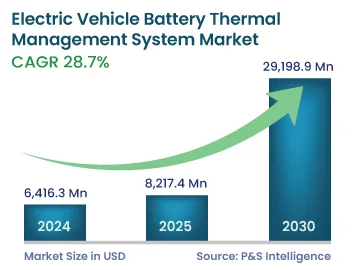
2024 Market SizeUSD 6,416.3 Million
2025 Market SizeUSD 8,217.4 Million
2030 ForecastUSD 29,198.9 Million
Growth Rate(CAGR) 28.7%
Largest RegionAsia-Pacific
Fastest Growing RegionAsia-Pacific
Nature of the Market Consolidated
Largest Battery Type Conventional

Growth Forecast

EV Battery Thermal Management System Market Size

Key Players

EV Battery Thermal Management System Market Players

Key Report Highlights

  • Value Chain Analysis
  • Regulatory Landscape
  • Pricing Analysis
  • Companies’ Recent Strategic Developments
  • Key Stakeholders
  • Voice of Industry Experts
  • Future Opportunity

Explore the market potential with our data-driven report

Electric Vehicle Battery Thermal Management System Market

The electric vehicle battery thermal management system market is set to grow from USD 6,416.3 million in 2024 to USD 29,198.9 million in 2030, at a CAGR of 28.7%. The BTMS is used to manage the operating temperature of EV batteries, to prevent them from damage due to overheating. Without it, electric vehicle battery’s life could shorten, reducing performance and increasing the chances of explosion.

The increasing demand for EVs due to climate concerns primarily affects the demand for BTMS. In EVs, batteries are the main source of propulsive power. Long-range travel, harsh climates, fast charging capability, heavy load, and other conditions can increase the battery temperature, which can be dangerous.
Electric Vehicle Battery Thermal Management System Market Trends & Drivers

Longer Battery Life is Major Trend

  • The battery life is important for any EV, which the BTMS helps ensure. Consumers are looking for more-efficient and longer-lasting batteries in EVs for longer driving ranges without recharging and low maintenance needs.
  • Many new EVs offer a longer distance coverage, which impacts the life of the battery due to over usage. This can cause overheating and shorter the life of the battery; hence, the demand for a better and longer-lasting battery in EVs is the key trend.
  • The battery life can also shorten with repeated charging cycles as EVs travel longer distances more frequently.

Increasing Demand for Electric Vehicles Is Key Driver

  • The key factor driving this market is the rapid shift of people toward EVs, as they are more efficient and have zero carbon emissions and a lower running cost than automobiles driven by the conventional internal combustion engine.
  • EVs mostly run on lithium-ion batteries, which discharge heat. As a result, BTMS is used to maintain the temperature of these components and extend the life of the entire electric vehicle.
  • Many countries are investing in the EV industry and making people aware of their benefits for the environment.
  • Moreover, many vehicle companies are increasing their EV output to meet the demand for these automobiles. This will propel the demand for EV batteries and, in turn, for performance and safety management technologies.
  • In India, EV sales rose by 49.25% year-on-year, to 15,29,947 units in 2023 from 10,25,063 units in 2022, according to the Federation of Automation Dealers’ Association (FADA). The greatest increase was seen in passenger car sales, which rose to 82,105 units from 38,240 during 2022– 2023.
  • In the U.S., the combined sales of plug-in hybrid vehicles, battery electric vehicles, and hybrid vehicles made up 16.3% of the total new light-duty vehicle purchases in 2023.
  • The Federal Government of the U.S. has set a goal to make half of the new vehicles sold in U.S. in 2030 zero-emission vehicles and erect up to 500,000 charging stations, sanctioning USD 7.5 billion for the process in 2021.
  • In Brazil, sales of electric vehicles almost doubled to 93,927 units in January 2024 from 49,245 units the previous year. The federal government’s program to accelerate the decarbonization of the environment will allow companies to prepare their investment plans.
  • In Saudi Arabia, with Vision 2030, the government has set a target to reduce carbon emissions by 278 mtpa by 2030. Further, with the goal of boosting EV adoption in the country, the government has made an agreement with Lucid to purchase at least 50,000 EVs.

Design Complexity and Expensiveness of BTMS Are Main Challenges

  • The design of a battery thermal management system is complex due to the requirement to manage the temperature of every pack of batteries, which requires a complex network of coolant. Since water is used as the coolant, any leakage can cause a short circuit or even an explosion in the battery.
  • Due to these design complexities, the BTMS and its maintenance are expensive. Further, it also requires regular maintenance for better battery efficiency, which leads to even higher operational expenses for EV owners.

Electric Vehicle Battery Thermal Management System Market Analysis

Vehicle Insights

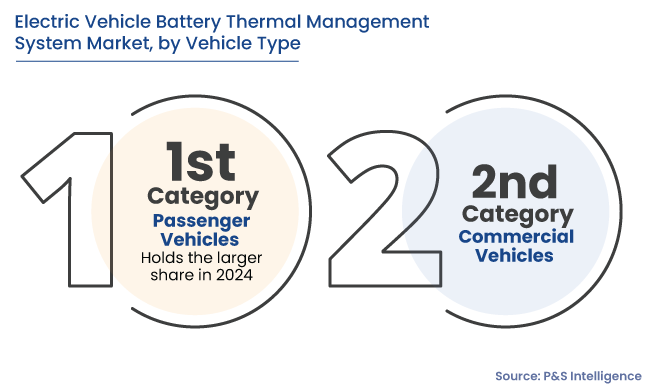
  • Passenger vehicles are the larger and faster-growing category in this market, with a share of 65% in 2024 and a CAGR of 29.0% during 2024–2030, respectively. As the automotive technology advances, people demand cars with more features. This trend is translating into the integration of ADAS, in-vehicle connectivity, V2V/V2I communication, and self-driving features in electric cars.
  • With people’s rising income, they are better able to afford such expensive vehicles.
  • Due to the rising cost of fuel, consumers are moving toward passenger EVs, such as electric cars, motorcycles, and scooters. Thus, with the rising demand for passenger vehicles, there will be a great scope for battery thermal management systems in this category.
  • In addition, with consumers’ rising demand, for cost-effective, convenient, and on-demand transportation, taxi services are proliferating around the world. Further, several app-based taxi firms in India, such as BluSmart, Lithium Urban, GoGreen Cabs, Evera Cabs, and eee-Taxi, have EVs in their fleets.
  • Commercial EVs also hold a significant share in this market. Commercial vehicles, including trucks and buses, are mostly medium- and heavy-duty vehicles running on diesel, which is why they pollute more than cars and two/three-wheelers. Hence, governments around the world are banning old diesel vehicles and urging public transportation agencies, industrial companies, and freight & logistics firms to adopt EVs instead.
  • Companies including Flipkart, BigBasket, Zomato, and Amazon have started utilizing EVs for delivery and freight transport. Hence, BTMS makers can target commercial vehicle OEMs and companies that make batteries for medium- and heavy-duty EVs to increase their sales.

EV Battery Thermal Management System Market Segments

Below are the vehicle types covered in the report:

  • Passenger Vehicles (Larger and Fastest-Growing Category)
  • Commercial Vehicles

Propulsion Insights

  • The battery electric vehicle (BEV) category holds the largest market share, of around 50%, in 2024. Fully electric vehicles are the most-commonly used electric propulsion because it releases zero carbon emissions.
  • Compared to those with other propulsion types, BEVs have a longer driving range, which is why they need heavy-duty batteries, which run continuously, releasing a significant amount of heat during operation.
  • The Government of India is supporting green mobility with customs duty exemption on the import of capital goods and machinery for manufacturing lithium-ion batteries for EVs, reduced GST on EVs from 12% to 5%, and a lower tax on EVs chargers and charging stations from 18% to 5%.

Below are the propulsions covered in the report:

  • Battery Electric Vehicle (BEV) (Largest and Fastest-Growing Category)
  • Hybrid Electric Vehicle (HEV)
  • Plug-in Hybrid Electric Vehicle (PHEV)
  • Fuel Cell Electric Vehicle (FCEV)

Type Insights

  • The active category holds the largest share, of around 45%, in 2024. A simple and effective way to maintain the optimum temperature in electric vehicles is by using fluids, including water or chemical coolants.
  • As this method pumps coolant fluid through pips from battery packs, it is simple, which is why many carmakers, such as Tesla, Toyota, and Audi, use it for their electric vehicle BTMS.
  • This variant can transfer heat efficiently with a pipe network, which makes it more suitable for use in battery packs for electric vehicles.
  • According to studies, heat transfer by using active BTMS can increase the battery life by up to 10 years.

Below are the BTMS types considered in the report:

  • Active (Largest and Fastest-Growing Category)
  • Passive
  • Hybrid

Battery Insights

  • The conventional category is the larger market in 2024. Conventional batteries mainly include lithium-ion batteries, which are extensively used in EVs as they have been around for a while and continue to witness advancements.
  • With enhanced density, high discharge tolerance, long cycle life, and short recharge time, these conventional batteries have become the backbone of the EV market.

Below are the battery types for which BTMS is used:

  • Conventional (Larger and Faster-Growing Category)
  • Solid-state

Technology Insights

  • The liquid cooling & heating category dominates the market, and it is expected to witness the highest CAGR, of 29.2% during the forecast period. This is because of the extensive usage of this technology for controlling the battery temperature in electric vehicles. Liquid cooling and heating methods offer superior heat dissipation, making them increasingly popular in EVs.
  • High-speed charging generates heat, and this method provides an efficient management system for it. Moreover, in cold regions, this method maintains a favorable temperature for the battery to operate.
  • Phase-change materials are expected to witness significance growth in this market during the forecast period, as they keep the battery temperature uniform without drawing extra power.

Below are the technologies used in BTMS:

  • Liquid Cooling & Heating (Largest and Fastest-Growing Category)
  • Air Cooling & Heating
  • Phase-Change Material

Drive strategic growth with comprehensive market analysis

APAC Holds Largest Share in Market

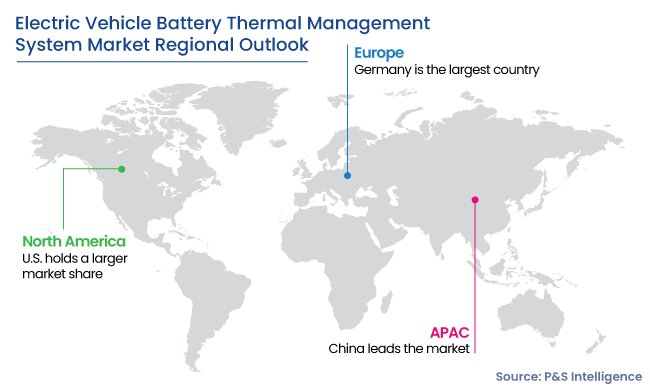
  • APAC is the largest region in this market, and it will hold a around 55% share in 2030, due to the growing EV manufacturing here. For instance, the Indian government is pushing toward sustainable mobility, thereby driving the sale of EVs.
  • India’s FAME scheme is a key strategy in this regard as it offers subsidies on the purchase of electric two-, three-, and four-wheelers, as well as offering incentives for the setup of the charging infrastructure.
  • China is the leader of the global EV and EV battery industries, which is why its demand for BTMS is also the highest in the world.

EV Battery Thermal Management System Market Regional Analysis

The countries and regions analyzed in this report are:

  • North America
    • U.S. (Larger and Faster-Growing Country Market)
    • Canada
  • Asia-Pacific (APAC) (Largest and Fastest-Growing Regional Market)
    • China (Largest Country Market)
    • India (Fastest-Growing Country Market)
    • South Korea
    • Japan
    • Australia
    • Rest of APAC
  • Europe
    • Germany (Largest Country Market)
    • U.K. (Fastest-Growing Market)
    • France
    • Spain
    • Italy
    • Rest of Europe
  • Latin America (LATAM)
    • Brazil (Largest and Fastest Growing Country Market)
    • Mexico
    • Rest of Latin America
  • Middle East & Africa (MEA)
    • U.A.E. (Fastest Growing Country Market)
    • Saudi Arabia (Largest Country Market)
    • South Africa
    • Rest of MEA

EV Battery Thermal Management System Market Share

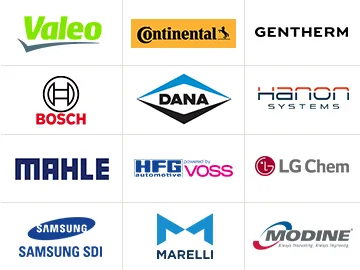
Currently, the EV BTMS market is consolidated because it is dominated by some major key players, such as Gentherm, Valeo, Continental, Robert Bosch GmbH, Dana Limited, Hanon System, and VOSS Automotive. Their Stronghold on the market makes it challenging for new manufacturers to enter and survive it. With the current level of advancement in technology, it is quite challenging for new players to enter the market. They need to enhance their product quality in order to stay in the market and compete with the established players.

EV Battery Thermal Management System Companies:

  • Valeo SA
  • Continental AG
  • Gentherm Inc
  • Robert Bosch GmbH
  • Dana Inc
  • Hanon Systems
  • MAHLE GmbH
  • VOSS Automotive GmbH
  • LG Chem Ltd
  • Samsung SDI Co. LTD.
  • Marelli Corporation
  • Modine Manufacturing Company

EV Battery Thermal Management System Market News

  • In April 2024, Valeo made an announcement to merge its powertrain and thermal businesses into a single entity.
  • In February 2024, Continental made an announcement about increasing the R&D efficiency in automotive group sector.
  • In July 2020, Robert Bosch GmbH made the announcement to consolidate its software and electronics expertise into a single division, in order to offer digitalized vehicle functions.
  • In February 2024, Hanon System Limited inaugurated a new engineering center in Portugal.
  • In August 2023, Mahle achieved a technological leap forward with its bionic battery cooling plate, which causes the coolant flow differently. As a result, the battery can be reliably and homogeneously changed with reduced pressure.
  • In April 2023, with an investment of KRW 1.2 trillion, LG Chem partnered with China’s Huayou Cobalt precursor plant in Saemangeum National Industrial Complex, Korea, to reinforce its battery material supply chain.

Want a report tailored exactly to your business need?

Request Customization

Empowering Leaders Across the Globe

Leading companies across industries trust us to deliver data-driven insights and innovative solutions for their most critical decisions. From data-driven strategies to actionable insights, we empower the decision-makers who shape industries and define the future. From Fortune 500 companies to innovative startups, we are proud to partner with organisations that drive progress in their industries.

Client Partners
Client Partners (mobile view)
Testimonials
Client Testimonials

Working with P&S Intelligence and their team was an absolute pleasure – their awareness of timelines and commitment to value greatly contributed to our project's success. Eagerly anticipating future collaborations.

McKinsey & Company

India
Unmatched Standards
Unmatched Standards

Our insights into the minutest levels of the markets, including the latest trends and competitive landscape, give you all the answers you need to take your business to new heights

Data Security
Complete Data Security

We take a cautious approach to protecting your personal and confidential information. Trust is the strongest bond that connects us and our clients, and trust we build by complying with all international and domestic data protection and privacy laws

  • Request Customization
  • Request Free Sample
close

Customize the Report to Align with Your Business Objectives

*
*
*
close

Request the Free Sample Pages

*
*
*
Connect with us
Quick Links
  • Research Methodology
  • Career
  • Media Citations
  • FAQs
  • Events and Conferences
Find Help
  • How to Order
  • Privacy Policy
  • Terms & Conditions
  • Sitemap
24/7 Customer Support
  • India: +91 93541 34657
  • For business enquiries - [email protected]
  • For career enquiries - [email protected]
  • Dun-Verified
  • Paypal-Secure

©2026 P&S Intelligence. All Rights Reserved.

We use cookies to enhance your experience. By continuing to use this site you consent to our use of cookies. Privacy Policy