Energy Consulting Market Size & Share Analysis - Trends, Drivers, Competitive Landscape, and Forecasts (2026 - 2032)
This Report Provides In-Depth Analysis of the Energy Consulting Market Report Prepared by P&S Intelligence, Segmented by Service Type (Energy Efficiency Consulting, Sustainability & ESG Consulting, Renewable Energy Consulting, Energy Procurement Consulting, Regulatory & Compliance Consulting, Carbon Management Consulting), Enterprise Size (Large Enterprises, Small & Medium Enterprises), End User (Utilities & Power Companies, Government & Public Sector, Industrial, Commercial, Residential), and Geographical Outlook for the Period of 2021 to 2032
Explore the market potential with our data-driven report
Energy Consulting Market Future Outlook
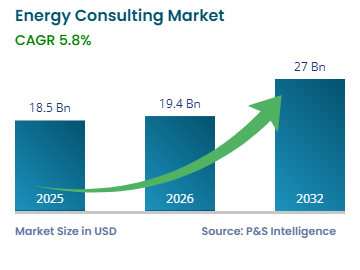
The energy consulting market size was USD 18.5 billion for 2025, and it will grow by 5.8% during 2026-2032, to reach USD 27.0 billion by 2032.
The market is expanding as organizations across industrial, commercial, and public sectors work to control power costs, reduce emissions exposure, and meet stricter sustainability requirements. Rising electricity price volatility, changing procurement models, and more detailed ESG reporting rules are making internal energy decisions harder to manage with basic facilities teams alone. Consulting providers are therefore being used to assess consumption profiles, redesign sourcing strategies, evaluate efficiency upgrades, and align capital projects with long-term decarbonization goals. This creates a clearer link between day-to-day cost control and broader sustainability programs, because companies now need advice that connects utility bills, emissions reporting, equipment performance, and regulatory compliance within one decision framework.
Renewable integration, electrification, and digital energy management are expanding the scope of consulting beyond traditional audits. Companies need support to evaluate solar procurement, power purchase agreements, fleet and heat electrification, smart meters, energy storage, and real-time monitoring platforms. According to the International Energy Agency, total energy-related CO2 emissions reached 37.8 Gt CO2 in 2024. This is the official statistic; the related market implication is that higher emissions pressure is increasing demand for advisory services that translate energy data into reduction roadmaps, investment priorities, and compliance actions. Digitalization, AI-based analytics, and data-driven monitoring are also reshaping consulting work, as firms now help clients forecast load patterns, detect inefficiencies, model decarbonization scenarios, and improve energy decisions across complex operating sites.
Key Market Insights
Energy Efficiency Consulting is the largest category, holding a market share of 35.0%, due to rising industrial demand for energy audits and operational efficiency optimisation.
Small & Medium Enterprises (SMEs) are the faster-growing category, registering a CAGR of 6.8%, driven by rising energy costs and expanding sustainability compliance requirements.
Utilities & Power Companies is the largest category, holding a market share of 35.5%, due to increasing investments in grid modernisation and renewable energy integration projects.
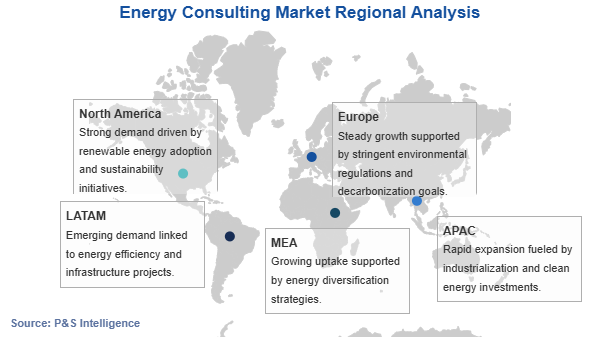
North America holds the largest share of 45.5%, due to advanced energy infrastructure and strong corporate sustainability compliance across industrial sectors.
Asia-Pacific is the fastest-growing region, registering a CAGR of 7.0%, driven by rapid renewable energy expansion and rising industrial energy demand across developing economies.
Energy Consulting Market Trends and Drivers
AI-Driven Energy Optimisation and Decarbonization Advisory Is a Major Trend
Energy consulting firms are integrating artificial intelligence, digital analytics, and real-time monitoring platforms as clients require more continuous control over consumption, emissions, and asset performance. This shift is moving advisory work beyond periodic audits and procurement support toward predictive load analysis, automated fault detection, carbon tracking, and data-backed investment prioritization across industrial, commercial, and digital infrastructure sites. Technology adoption is therefore changing the consulting model itself, as providers combine sustainability strategy with software-enabled diagnostics, power market insight, and performance benchmarking.
According to the International Energy Agency, data centers consumed around 415 TWh of electricity globally in 2024, equal to about 1.5% of global electricity consumption. This is the official statistic; the related consulting demand is a market analysis based on rising digital infrastructure power intensity. As AI workloads, cloud services, and high-density computing increase electricity exposure, enterprises need advisors to model demand, improve cooling strategies, assess renewable procurement, and manage emissions reporting. AI-driven digitalization is reshaping the Energy Consulting Market by turning consulting from one-time advisory support into ongoing, data-led energy performance management.
Rising Corporate Pressure to Reduce Energy Costs and Meet Sustainability Targets Drives Market
Organizations across industrial, commercial, and public sectors are increasing spending on energy consulting services as energy costs, carbon reduction commitments, and compliance duties become harder to manage internally. Volatile fuel and electricity prices are forcing companies to review procurement contracts, consumption patterns, and efficiency investments, while sustainability targets require stronger emissions tracking and reduction strategies. This combination is expanding demand for consultants that can connect cost control, regulatory compliance, energy audits, renewable sourcing, and long-term transition programs into practical business decisions.
According to the Organisation for Economic Co-operation and Development, companies representing 91% of global listed-company market capitalization disclosed sustainability-related information in 2024. According to the International Energy Agency, over 50 countries submitted concrete, quantified energy-efficiency targets in their updated Nationally Determined Contributions ahead of COP30. These are supporting statistics; the rise in consulting demand is market analysis. As disclosure rules and efficiency targets become more detailed, organizations are relying more on external advisors to interpret regulations, prepare ESG data, model emissions pathways, evaluate renewable integration, and convert sustainability obligations into investment-ready energy strategies.
High Consulting Costs and Internal Capability Gaps Limit Market Adoption
High consulting costs and limited internal readiness restrain adoption of energy consulting services, especially among small and medium-sized organizations with tight sustainability budgets. Advanced advisory projects require metered data, site-level baselines, digital systems, and staff able to execute consultant recommendations. When clients lack energy managers, reliable asset data, or budget authority, audit findings and decarbonization roadmaps often remain unfunded or move into small pilots, reducing full-service consulting uptake. According to the International Energy Agency, global primary energy intensity improved by only around 1% in 2024. This statistic shows that efficiency gains are progressing slowly; the market restraint is that slow progress reflects execution barriers that make companies cautious about larger engagements. Many organizations therefore prioritize basic compliance, bill review, and short-payback measures over broader transition programs.
Expansion of Renewable Energy Infrastructure and Net-Zero Transition Creates New Growth Opportunities
The rapid expansion of renewable energy projects and long-term decarbonization programs is creating strong opportunities for energy consulting providers as companies need expert support to move projects from targets to execution. Businesses, utilities, and public authorities require advisory services for feasibility studies, grid connection planning, permitting, renewable procurement, power purchase agreements, storage integration, and performance monitoring. According to the International Energy Agency, global annual renewable capacity additions reached 666 GW in 2024, with solar PV and wind expected to account for most additions through 2030. This is the official statistic; the related market implication is that higher project volume increases demand for consultants that can manage technical, financial, and regulatory complexity. Consulting firms are therefore gaining opportunities in project design, infrastructure optimization, grid-readiness assessment, and operational improvement across renewable-heavy energy systems.
Energy Consulting Market Segmentation Analysis
Service Type Analysis
Energy Efficiency Consulting is the largest category, holding a market share of 35.0%, because organizations are under pressure to reduce power costs, improve facility performance, and meet stricter efficiency requirements across industrial and commercial operations. According to the International Energy Agency, governments introduced more than 250 new or updated energy-efficiency-related policies worldwide in 2025. These policies increase demand for Energy Efficiency Consulting because businesses need external experts to interpret standards, assess site-level gaps, calculate savings potential, and convert regulatory requirements into practical upgrade programs.
Sustainability & ESG Consulting is the fastest-growing category, registering a CAGR of 6.5%, because organizations face stronger pressure from investors, regulators, and customers to improve environmental accountability. Businesses are seeking specialist guidance for ESG strategy, emissions reduction, climate risk assessment, sustainability disclosure, and net-zero execution. As reporting frameworks become more detailed, companies are using long-term ESG engagements to connect sustainability targets with capital allocation, supplier evaluation, and decarbonization decisions.
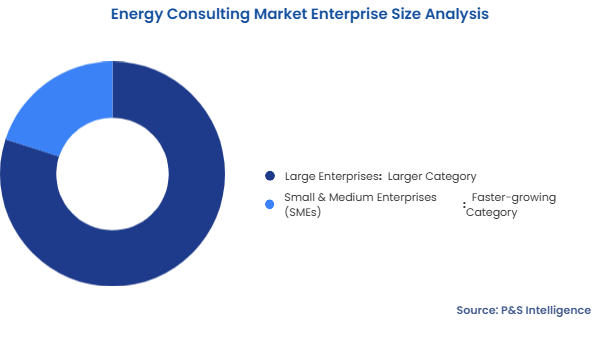
Large Enterprises is the largest category, holding a market share of 80.0%, because large organizations manage high energy consumption across multiple sites, business units, and jurisdictions. Their operations often involve complex procurement contracts, production assets, building portfolios, emissions reporting requirements, and regional compliance obligations that are difficult to coordinate internally. This increases reliance on external energy consultants for portfolio-level audits, power sourcing strategy, carbon reduction roadmaps, infrastructure modernization, and performance monitoring. Large enterprises also have stronger investment capacity, allowing them to adopt advanced energy management systems and long-term decarbonization programs supported by specialist advisors.
Small & Medium Enterprises are the fastest-growing category, registering a CAGR of 6.8%, because scalable consulting models are making energy advisory services more accessible to cost-sensitive businesses. Standardized audits, subscription-based energy monitoring, remote assessments, packaged compliance support, and financing-linked efficiency programs reduce upfront advisory costs and shorten decision cycles. According to the World Bank Group, SMEs represent around 90% of businesses worldwide, creating a large addressable base for energy efficiency, sustainability, and cost-reduction services.
The enterprise size analysed in this report are:
Large Enterprises (Larger Category)
Small & Medium Enterprises (SMEs) (Faster-Growing Category)
End User Analysis
Utilities & Power Companies is the largest category, holding a market share of 35.5%, because they are continuously investing in grid modernization, renewable integration, and power system transformation. Rising electricity use increases the complexity of load forecasting, transmission planning, grid resilience, and distributed resource management, which creates stronger need for external energy consulting expertise. According to the International Energy Agency, global electricity consumption increased by 1,080 TWh in 2024.
Government & Public Sector is the fastest-growing category, registering a CAGR of 6.1%, because public institutions are turning climate policies into energy projects across buildings, transport, utilities, and community infrastructure. As governments introduce stricter efficiency targets, clean energy programs, and carbon reduction mandates, agencies require consultants to design implementation roadmaps, assess project feasibility, manage compliance, and align public spending with long-term energy transition goals.
The end user analysed in this report are:
Utilities & Power Companies (Largest Category)
Government & Public Sector (Fastest-Growing Category)
Industrial
Commercial
Residential
Others
Drive strategic growth with comprehensive market analysis
Energy Consulting Market Regional Outlook
North America Energy Consulting Market Analysis
North America holds the largest share, of 45.5%, because the region has a mature energy services market, higher consulting expenditure, advanced regulatory frameworks, and strong corporate demand for decarbonization support. Utilities, manufacturers, commercial real estate owners, and public infrastructure operators are investing in energy procurement, efficiency upgrades, emissions reporting, and clean power sourcing. The region also has established consulting firms, advanced digital energy platforms, utility incentive programs, and sophisticated ESG reporting practices, which make companies more willing to use external advisors for complex energy decisions. Grid reliability concerns, power price exposure, and clean energy procurement are further expanding demand for consulting services related to load management, carbon strategy, infrastructure assessment, and regulatory alignment across North American operations.
U.S. Energy Consulting Market Analysis
The U.S. maintains a strong position due to its large corporate energy market, advanced utility sector, and rising investment in grid transformation projects. Industrial manufacturers, data centers, utilities, and commercial facilities are using consultants to manage power procurement, improve energy productivity, and prepare for stricter reporting requirements. According to the U.S. Energy Information Administration, utility-scale solar projects added a record 30 GW to the U.S. grid in 2024. This statistic supports the scale of clean power deployment; the consulting demand is market analysis, as higher solar additions require interconnection studies, grid impact assessments, storage evaluation, power purchase agreement structuring, permitting support, and long-term electricity cost modeling.
Canada Energy Consulting Market Analysis
Canada is experiencing growing demand for energy consulting services because of its clean electricity base, provincial climate policies, industrial decarbonization needs, and increasing focus on grid flexibility. Utilities, mining companies, public agencies, and commercial operators are seeking support for efficiency upgrades, low-carbon infrastructure, electrification, and energy storage deployment. According to the Canada Energy Regulator, Canada had 552 MW of grid-connected energy storage capacity above 1 MW at the end of 2024. This supports the country’s shift toward more flexible electricity systems, the market implication is that consultants are needed for storage feasibility, rate design analysis, renewable procurement, reliability assessment, and project execution across provincial power markets.
Asia-Pacific Energy Consulting Market Analysis
Asia-Pacific has the highest CAGR, of 7.0%, because rapid industrialization, urban infrastructure growth, government clean energy initiatives, and expanding manufacturing investments are increasing the need for energy advisory services. The region includes large industrial economies, fast-growing electricity markets, export-focused manufacturing hubs, and cities investing in smart infrastructure. Companies are seeking consultants to reduce power costs, improve factory efficiency, manage electrification, and meet customer-driven sustainability expectations across global supply chains. Governments are also promoting renewable power, efficient buildings, industrial energy management, and clean mobility, which increases the need for technical and regulatory guidance. As manufacturing capacity expands and energy systems become more decentralized, consulting providers gain opportunities in energy audits, captive power strategy, demand management, digital monitoring, and infrastructure upgrade support.
China Energy Consulting Market Analysis
China remains a major market because of its large industrial base, rapid clean power deployment, and continuous upgrades across electricity networks and industrial parks. Manufacturers, utilities, and public authorities are seeking consulting support to reduce energy intensity, manage renewable curtailment risks, improve load flexibility, and align operations with evolving environmental rules. According to China’s National Energy Administration, the country’s installed solar power capacity reached about 890 GW in 2024. This statistic supports the scale of China’s solar buildout; the consulting demand is market analysis, as large renewable capacity increases the need for grid stability studies, storage sizing, dispatch optimization, industrial efficiency programs, and low-carbon project execution.
India Energy Consulting Market Analysis
India is witnessing rapid market growth as rising electricity demand, industrial expansion, urban development, and clean energy targets increase the need for structured energy management services. Businesses and public institutions are using consultants for solar procurement, open-access power strategy, efficiency audits, smart infrastructure, and compliance with evolving sustainability requirements. According to the Press Information Bureau of India, installed renewable energy capacity reached 220.10 GW in 2025. This statistic supports India’s expanding clean power base, the market implication is that larger renewable capacity creates consulting opportunities in evacuation planning, hybrid project design, distribution-level integration, storage assessment, and energy cost optimization across industrial, commercial, and utility sectors.
The regions and countries analysed in this report are:
North America (Largest Regional Market)
U.S. (Larger Country)
Canada (Faster-Growing Country)
Europe
Germany (Largest Country)
U.K.
France
Italy
Spain (Fastest-Growing Country)
Rest of Europe
Asia-Pacific (Fastest-Growing Regional Market)
China (Largest Country)
India (Fastest-Growing Country)
Japan
South Korea
Australia
Rest of APAC
Latin America
Brazil (Largest Country)
Mexico (Fastest-Growing Country)
Rest of LATAM
Middle East and Africa
Saudi Arabia (Largest Country)
U.A.E. (Fastest-Growing Country)
South Africa
Rest of MEA
Energy Consulting Market Share Analysis
The market is fragmented because energy consulting demand is spread across many client types, regulatory environments, project sizes, and technical requirements. Global consulting firms usually compete for large enterprise transformation programs, cross-border ESG mandates, and multi-country decarbonization strategies, while regional advisory companies retain strong positions through local tariff knowledge, policy interpretation, and utility program familiarity. Engineering service providers focus on technical studies, facility upgrades, renewable project design, and infrastructure execution, whereas niche specialists target areas such as energy audits, carbon accounting, procurement, building performance, and digital monitoring. The entry of technology-focused firms is increasing competition by adding software platforms, AI-based analytics, automated reporting, and real-time energy intelligence to traditional advisory models.
Leading Companies in the Energy Consulting Market:
Deloitte Touche Tohmatsu Limited
Accenture Public Limited Company
Boston Consulting Group Incorporated
Siemens AG
WSP Global Incorporated
Ramboll Group AS
Schneider Electric SE
Black and Veatch Corporation
McKinsey and Company Incorporated
PricewaterhouseCoopers International Limited
Ernst and Young Global Limited
Wood Mackenzie Limited
Guidehouse Incorporated
Baringa Partners Limited Liability Partnership
Bain and Company Incorporated
Energy Consulting Market News
In January 2025, ICF International, Inc. acquired Applied Energy Group (AEG), an energy technology and advisory services company, from Ameresco, Inc. The acquisition added more than 100 utility management and demand-side energy experts to ICF and expanded its technology and advisory capabilities for electric and gas utilities, government agencies, and energy offices.
In August 2024, Ramboll Group A/S acquired K2 Management, a global consultancy specializing in wind and solar energy. The acquisition strengthened Ramboll’s renewable energy consulting capabilities by combining its expertise in wind project design and execution with K2 Management’s capabilities in strategic advisory and project development, expanding its ability to support clients across all stages of wind energy projects globally
In April 2024, Ernst & Young Global Limited (EY) and sustainability consulting firm denkstatt joined forces, with denkstatt becoming part of the EY network across Austria, Bulgaria, Romania, Hungary, and Slovakia. The strategic development strengthened EY’s ESG and sustainability consulting capabilities, including advisory services related to decarbonization and the energy transition.
Frequently Asked Questions About This Report
What does the energy consulting market include for organizations?+
It includes advisory services for energy strategy, procurement, efficiency, renewables, emissions reduction, compliance, and operational improvement.
What factors are driving demand in the energy consulting market?+
Demand is driven by energy price volatility, decarbonization goals, complex regulations, renewable sourcing, and need for expert planning.
Why are organizations adopting energy consulting solutions across operations?+
Organizations use energy consultants to assess opportunities, compare technologies, manage projects, and design practical energy roadmaps.
How do energy consulting solutions improve decision making and efficiency?+
Consulting improves operations by turning energy data into recommendations, implementation plans, vendor choices, and measurable performance improvements.
What challenges affect adoption of energy consulting solutions today?+
Adoption is affected by budget limits, internal alignment, data quality, changing policies, project complexity, and confidence in consultant expertise.
Want a report tailored exactly to your business need?
Leading companies across industries trust us to deliver data-driven insights and innovative solutions for their most critical decisions. From data-driven strategies to actionable insights, we empower the decision-makers who shape industries and define the future. From Fortune 500 companies to innovative startups, we are proud to partner with organisations that drive progress in their industries.
Client Testimonials
Working with P&S Intelligence and their team was an absolute pleasure – their awareness of timelines and commitment to value greatly contributed to our project's success. Eagerly anticipating future collaborations.
McKinsey & Company
India
Unmatched Standards
Our insights into the minutest levels of the markets, including the latest trends and competitive landscape, give you all the answers you need to take your business to new heights
Complete Data Security
We take a cautious approach to protecting your personal and confidential information. Trust is the strongest bond that connects us and our clients, and trust we build by complying with all international and domestic data protection and privacy laws