This Report Provides In-Depth Analysis of the GCC Decarbonization Market Report Prepared by P&S Intelligence, Segmented by Technology (Renewable Energy, Carbon Capture, Utilization, and Storage (CCUS), Energy Efficiency, Electrification, Sustainable Transportation), End User (Power Generation, Oil & Gas, Manufacturing & Industrial, Transportation, Buildings & Construction, Healthcare & Pharmaceuticals), Service Type (Implementation & Integration, Consulting & Advisory, Monitoring & Verification, Operation & Maintenance), and Geographical Outlook for the Period of 2019 to 2032
Explore the market potential with our data-driven report
GCC Decarbonization Market Overview
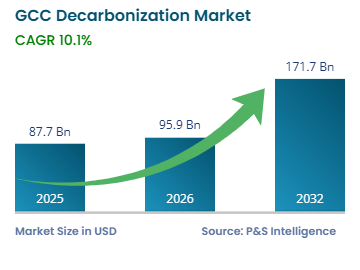
The GCC decarbonization market size will be an estimated USD 87.7 billion for 2025, and it will grow by 10.1% during 2026–2032, to reach USD 171.7 billion by 2032.
The key factors propelling the growth of the market include accelerating government commitments toward net-zero emissions targets, substantial investments in renewable energy infrastructure, and the strategic development of carbon capture, utilization, and storage (CCUS) technologies across the region.
The GCC energy landscape is evolving due to the intersection of national economic diversification strategies and global decarbonization goals. According to the World Health Organization, depression affects approximately 5.7% of adults globally, highlighting the importance of sustainable development that considers both environmental and social well-being. The GCC nations are leveraging their unique advantages in renewable energy potential, particularly solar and wind resources, to position themselves as global leaders in clean energy production while maintaining their role as energy suppliers to the world. The region's commitment to decarbonization extends beyond renewable energy deployment, encompassing comprehensive strategies for industrial transformation, sustainable transportation, and the development of green hydrogen as a future export commodity.
The strategic importance of decarbonization in the GCC region is underscored by the establishment of ambitious national targets and comprehensive policy frameworks. Saudi Arabia's Vision 2030, the UAE's Net Zero 2050 Strategy, and similar initiatives across other GCC states demonstrate a regional consensus on the necessity of transitioning toward sustainable energy systems. This collective commitment has catalyzed unprecedented levels of investment in clean technologies, with governments, sovereign wealth funds, and international partners mobilizing resources to support the energy transition while ensuring economic resilience and competitiveness in a rapidly evolving global energy market.
GCC Decarbonization Market Trends and Growth Drivers
Carbon Capture Technologies Are Key Trends
The development of CCUS infrastructure has become a cornerstone of GCC decarbonization strategies, particularly for hard-to-abate industrial sectors.
Saudi Aramco's Jubail CCUS Hub, being built with a planned capacity of 9 million tonnes, is set to be the largest of its kind in the region.
CCUS is strategically important not only for reducing emissions but also for preserving the economic value of hydrocarbon assets via blue hydrogen production and enhanced oil recovery.
The maturation of the CCUS sector is evidenced by expanding project pipelines and technological advancement.
Future projections indicate substantial capacity expansion, with Qatar targeting 7 million tonnes per annum captured and the UAE 5 million tonnes per annum by 2030, while Saudi Arabia intends to reach 44 million tonnes per annum by 2035.
These developments position the GCC as a global leader in industrial-scale carbon management, creating opportunities for technology export and knowledge transfer.
Growing Government Commitments and Investments Are Biggest Drivers
The GCC decarbonization market is driven by strong government support and ambitious climate targets, alongside rapid growth in renewable energy capacity.
Saudi Arabia and the UAE have announced net-zero emissions targets for 2060 and 2050, respectively, with Oman also committing to net zero by 2050, creating a strong policy foundation for decarbonization investments.
These targets are supported by significant funding, with the UAE pledging USD 163 billion; however, independent analysis indicates a total requirement of USD 680 billion, leaving a shortfall exceeding USD 500 billion.
The implementation of these policies extends beyond aspirational targets to concrete regulatory measures and incentive structures.
In 2024, the UAE issued legislations aligning its climate actions with international commitments, establishing a carbon credit registry and greenhouse gas reporting framework to achieve Net Zero by 2050.
Similarly, Saudi Arabia has integrated decarbonization objectives into its economic diversification plans, with the kingdom committing to have 50% of its power generated from renewable sources by 2030.
These policy measures create a favorable investment environment while establishing clear market signals for private sector participation in decarbonization projects.
This expansion is driven by large-scale solar and wind projects that leverage the region's abundant natural resources and declining technology costs.
The Mohammed bin Rashid Al Maktoum Solar Park in Dubai and Saudi Arabia's NEOM renewable energy projects exemplify the scale of ambition, with individual projects reaching multi-gigawatt capacities.
Investment patterns reveal a sophisticated approach to renewable energy deployment, combining public sector leadership with private sector participation through innovative financing models.
Furthermore, the integration of energy storage solutions and smart grid technologies enhances the value proposition of renewable energy investments, addressing intermittency challenges while improving grid stability and efficiency.
In January 2025, Qatar achieved its target of electrifying 25% of its public transit bus fleet, demonstrating tangible progress in sustainable transportation while introducing green financing options to accelerate broader EV adoption across the transportation sector.
GCC Decarbonization Market Segmentation Analysis
Technology Analysis
The renewable energy solutions category holds the largest market share, of 30%, in 2025, and it will have the highest CAGR during the forecast period, due to the massive investments in solar and wind projects, favorable natural conditions for renewable energy generation, and the strategic priority placed on clean energy development across all GCC nations. The segment benefits from continuously declining costs, with solar photovoltaic technology achieving grid parity in multiple markets, making it economically competitive with conventional power generation even without subsidies.
In 2024, GCC nations had developed nearly 62.1 GW of renewable energy projects, though only about 19.3 GW had been connected to the grid by mid‑2025 toward a collective 2030 target of 165 GW. Saudi Arabia alone needs to deliver 78 GW more by 2030 to meet its goals. In 2024, Saudi Arabia’s total operated capacity from renewables was 6,551 MW (mostly solar, plus a 400-MW wind project) across ten projects.
The MENA region saw renewable installations hit 30.3 GW by the end of 2024, up by 119% from 2020; the UAE led with 6.3 GW, while Saudi Arabia registered 4.5 GW. In terms of the share in electricity mix in 2022, renewables accounted for only 3% of the GCC’s generation capacity, showcasing a huge potential for capacity expansion in the near future. The UAE’s renewable share in the energy mix was 7.2%, whereas Saudi Arabia's was 0.5% in 2020, with higher target shares planned by 2030.
The technologies analyzed in this report are:
Renewable Energy (Largest and Fastest-Growing Category)
Carbon Capture, Utilization, and Storage (CCUS)
Energy Efficiency
Electrification
Sustainable Transportation
Others
End User Analysis
The power generation category holds the largest market share, of 45%, in 2025, driven by the fundamental transformation of electricity systems across the GCC region. The sector's dominance stems from ambitious renewable energy targets, grid modernization initiatives, and the strategic importance of clean electricity as an enabler for broader decarbonization efforts across other sectors. Integrating renewable energy into power grids, along with investments in transmission and storage, underscores the sector’s pivotal role in the regional energy transition.
The transportation category will have the highest CAGR, of 10.4%, due to strong government support for electric vehicles, expansion of charging infrastructure, and electrification of public transport systems. National strategies like Saudi Arabia’s Vision 2030 and UAE Energy Strategy 2050 drive rapid emission reductions. With high baseline emissions, even moderate adoption of clean mobility technologies significantly accelerates decarbonization in the region.
In the UAE, EVs made up 13% of new car sales in 2023, up from 0.7% in 2021. Dubai had about 25,929 EVs by December 2023, up from 15,100 in 2022. UAE’s goal is for EVs to make up more than 15% of new vehicle sales by 2030, rising to 25% by 2035, equivalent to 110,500 EVs. In Saudi Arabia, new EV sales crossed 11,000 units in 2024, almost a tenfold increase from the previous year. Across the GCC, EV/plug‑in hybrid vehicles’ share in all vehicle sales rose from 2% to 4% in one year. Moreover, the UAE aims to introduce B7 biodiesel blend by 2030 and B20 by 2050 for land transport.
The end users analyzed in this report are:
Power Generation (Largest Category)
Oil & Gas
Manufacturing & Industrial
Transportation (Fastest-Growing Category)
Buildings & Construction
Healthcare & Pharmaceuticals
Others
Service Type Analysis
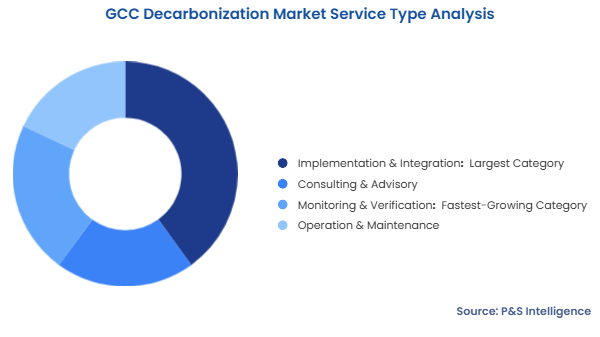
The implementation & integration category holds the largest market share, of 40%, in 2025, reflecting the operational phase of numerous large-scale decarbonization projects across the region. This segment encompasses the deployment of renewable energy systems, installation of CCUS facilities, and integration of energy efficiency technologies across industrial and commercial sectors. The dominance is attributed to the transition from planning to execution phases for major national initiatives, with substantial capital deployment in physical infrastructure and technology systems.
The monitoring & verification category will have the highest CAGR, of 10.2%, driven by regulatory requirements for emissions reporting and the increasing sophistication of carbon management systems. The UAE's new climate legislation mandates that businesses establish greenhouse gas emissions monitoring and reporting systems and develop decarbonization strategies. The rapid growth reflects the critical importance of accurate emissions measurement, verification of carbon credits, and performance monitoring of decarbonization investments.
Saudi Arabia holds the largest market share, of 45%, in 2025. The kingdom's dominance is underpinned by its comprehensive Saudi Green Initiative, massive renewable energy projects, and substantial investments in CCUS infrastructure. By 2060, Saudi Arabia aims to achieve net-zero greenhouse gas emissions, targeting 50% renewable energy and reducing 278 million tonnes of CO2 equivalent annually by 2030 under Vision 2030. The scale of Saudi Arabia's decarbonization efforts is exemplified by NEOM, which includes plans to export green ammonia by 2025, positioning the kingdom as a future global supplier of clean energy carriers.
The kingdom's decarbonization strategy leverages its vast land resources and exceptional solar irradiation levels to develop utility-scale renewable projects while maintaining its position in global energy markets through low-carbon hydrocarbon products. Furthermore, Saudi Arabia's focus on industrial decarbonization through CCUS technology addresses the challenge of maintaining economic competitiveness while meeting climate objectives, with an average CO2 capture cost of USD 69/tCO2 identified across various industries.
UAE Decarbonization Market Size
UAE will have the highest CAGR, of 10.3%, driven by the nation's proactive policy framework, strategic positioning as a regional hub for clean technology, and substantial investments in renewable energy and green hydrogen infrastructure. The UAE's decarbonization efforts are characterized by comprehensive integration across multiple sectors and innovative financing mechanisms. ADNOC has raised its low-carbon budget to USD 23 billion through 2030, up from USD 15 billion, to fund CCUS, electrification, hydrogen, and renewables.
The country's strategic advantages include world-class solar resources, established financial centers facilitating green finance, and a regulatory environment conducive to rapid technology deployment. Additionally, the UAE Net Zero by 2050 Strategy positions renewable energy as central to long-term economic planning, with projects like the Mohammed bin Rashid Al Maktoum Solar Park and Masdar City reflecting the country's shift toward sustainability.
These countries are covered:
Saudi Arabia (Largest Market)
UAE (Fastest-Growing Market)
Qatar
Kuwait
Oman
Bahrain
GCC Decarbonization Market Share
The market is fragmented due to the lack of a unified regulatory and policy framework across member countries. Each nation, Saudi Arabia, UAE, Qatar, Kuwait, Oman, and Bahrain, pursues its own energy transition strategies, carbon reduction targets, and renewable energy initiatives, resulting in inconsistent market practices. The carbon credit and voluntary carbon markets are not standardized regionally, causing differences in verification, pricing, and trading mechanisms. Furthermore, varying levels of technological adoption, infrastructure readiness, and private sector engagement hinder seamless integration, keeping the market highly decentralized.
Key GCC Decarbonization Companies:
Abu Dhabi National Oil Company (ADNOC)
Saudi Aramco
Masdar
ACWA Power Company
Siemens Energy AG
ENGIE SA
BP p.l.c.
TotalEnergies SE
Linde plc
Gulf Cryo Holding Co. K.S.C.C.
Bee
Regional Voluntary Carbon Market Company (RVCMC)
GCC Decarbonization Market News
In October 2025, the Global Carbon Council launched its digital carbon market infrastructure solution, including a formalized approval process for Digital Measurement, Reporting, and Verification solution providers, boosting transparency and reliability in GCC carbon credit transactions.
In October 2025, Gotion High-Tech globally debuted its All-Scenario Zero-Carbon Solution and 20-MWh Battery energy storage system at the Solar & Storage Live KSA 2025, offering scalable zero-carbon technologies to advance Saudi Arabia’s Vision 2030 decarbonization goals.
In September 2025, EMSTEEL Group unveiled the TrueGreen sustainability initiative for decarbonization in the MENA region. Through TrueGreen, EMSTEEL provides developers, contractors, and financiers with globally acknowledged sustainability credentials, enabling them to achieve emissions targets, enhance proposals in sustainability-focused tenders, and adhere to international regulations, such as the European Union’s CBAM. Each TrueGreen steel product is accompanied by independently verified Environmental Product Declarations (EPDs) and supported by digital monitoring systems that deliver batch-specific carbon data.
In July 2025, Cundall Johnston & Partners LLP announced a partnership with Msheireb Properties to implement decarbonization strategies across its entire portfolio located in Msheireb Downtown Doha. As part of this initiative, Cundall performed a comprehensive carbon footprint assessment of more than 100 buildings, over 800 residential units, and upwards of 300 retail spaces.
In April 2025, Hydrom (Hydrogen Oman SPC) signed agreements worth USD 11 billion with Electricité de France to develop two green hydrogen production projects, representing one of the region’s largest green hydrogen investments and supporting Oman’s goal to become a global hydrogen export hub.
Want a report tailored exactly to your business need?
Leading companies across industries trust us to deliver data-driven insights and innovative solutions for their most critical decisions. From data-driven strategies to actionable insights, we empower the decision-makers who shape industries and define the future. From Fortune 500 companies to innovative startups, we are proud to partner with organisations that drive progress in their industries.
Client Testimonials
Working with P&S Intelligence and their team was an absolute pleasure – their awareness of timelines and commitment to value greatly contributed to our project's success. Eagerly anticipating future collaborations.
McKinsey & Company
India
Unmatched Standards
Our insights into the minutest levels of the markets, including the latest trends and competitive landscape, give you all the answers you need to take your business to new heights
Complete Data Security
We take a cautious approach to protecting your personal and confidential information. Trust is the strongest bond that connects us and our clients, and trust we build by complying with all international and domestic data protection and privacy laws