Digital Trust Market Size & Share Analysis - Trends, Drivers, Competitive Landscape, and Forecasts (2026 - 2032)
This Report Provides In-Depth Analysis of the Digital Trust Market Report Prepared by P&S Intelligence, Segmented by Component (Solutions, Services), Technology (Artificial Intelligence and Machine Learning, Blockchain, Big Data Analytics, Cloud Computing, Internet of Things), Enterprise Size (Large Enterprises, Small and Medium Enterprises), Deployment Mode (Cloud-Based, On-Premises), End User (Banking, Financial Services, and Insurance, Retail and E-Commerce, IT and Telecom, Healthcare, Government and Public Sector, Manufacturing, Energy and Utilities), and Geographical Outlook for the Period of 2021 to 2032
Explore the market potential with our data-driven report
Digital Trust Market Future Outlook
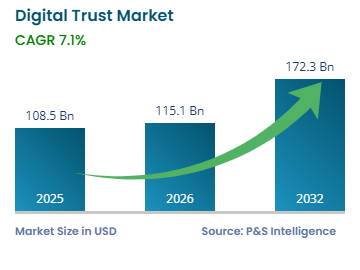
The digital trust market size was USD 108.5 billion for 2025, and it will grow by 7.1% during 2026-2032 to reach USD 172.3 billion by 2032.
The digital trust market is expanding as digital interactions become increasingly central to business operations, financial transactions, public services, and consumer engagement. Organisations are relying more heavily on cloud platforms, connected devices, digital payment ecosystems, remote access environments, and third-party digital services that require the secure and trusted exchange of information. As cyber threats become more sophisticated, enterprises are strengthening identity protection, access management, fraud prevention, and data integrity measures across complex digital environments. The growing use of artificial intelligence, application programming interfaces, and interconnected digital ecosystems is further increasing demand for trust frameworks capable of verifying users, devices, applications, and transactions in real time. Businesses are also recognising digital trust as an important factor influencing customer confidence, brand reputation, and the long-term adoption of digital services.
The market is also benefiting from stronger regulatory attention towards cybersecurity, privacy protection, digital identity, and data governance. According to the International Telecommunication Union, 6 billion people used the Internet globally in 2025. The scale of digital participation highlights the growing volume of online interactions, transactions, and digital services that require secure authentication, trusted communications, and effective risk management. Organisations across banking, healthcare, retail, manufacturing, and government sectors are therefore increasing investments in technologies that improve transparency, compliance, identity verification, and digital security.
Key Market Insights
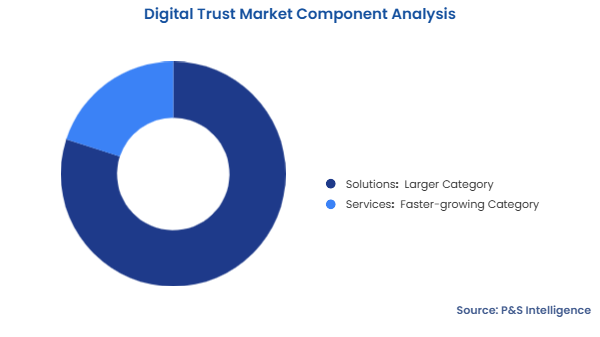
Solutions is the larger component, holding a market share of 80.0%, due to rising demand for identity protection, compliance management, and integrated digital trust platforms.
Blockchain is the fastest-growing technology category, registering a CAGR of 7.5%, driven by demand for transparent transaction validation and decentralised trust mechanisms.
Large Enterprises are the larger enterprise size category, holding a market share of 85.0%, because extensive digital infrastructures require advanced security and governance controls.
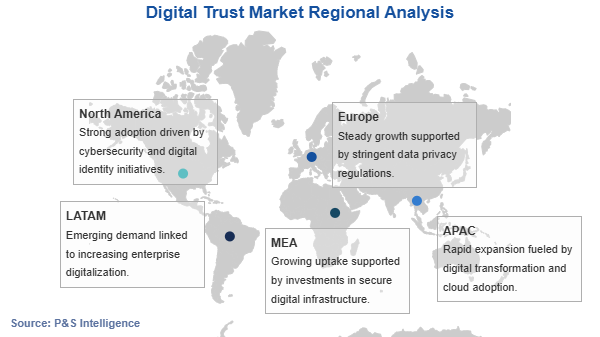
North America holds the largest share of 45.0%, due to widespread adoption of zero-trust architectures and advanced identity governance frameworks.
Asia-Pacific is the fastest-growing region, registering a CAGR of 8.5%, driven by expanding digital payment ecosystems and growing adoption of digital identity programmes.
Digital Trust Market Trends and Drivers
AI-Powered Digital Identity Verification and Continuous Trust Assessment Is a Major Trend
Organisations are increasingly adopting AI-driven digital trust frameworks that continuously verify users, devices, applications, and transactions throughout the digital interaction lifecycle. Traditional authentication methods are being supplemented by behavioural analytics, risk-based authentication, biometric verification, and machine-learning models that assess trust levels in real time. Integrated platforms combining identity management, fraud prevention, privacy controls, and compliance monitoring are gaining wider adoption across cloud, hybrid, and remote environments. According to the World Economic Forum, 66% of organisations expected AI to have a major impact on cybersecurity in 2025, while only 37% had processes to assess AI tool security before deployment. According to Cisco, 86% of surveyed organisations experienced AI-related security incidents during the previous 12 months in 2025. These developments are increasing investment in continuous verification, AI-enabled identity intelligence, automated trust decision-making, and adaptive security controls that strengthen trust across increasingly complex digital ecosystems.
Escalating Cybersecurity Threats and Data Privacy Risks Drive Market
The growing frequency and sophistication of cyberattacks are driving demand for digital trust solutions across public and private sector organisations. Businesses are managing larger volumes of customer, financial, and operational data through digital platforms, increasing exposure to phishing attacks, identity theft, data breaches, and unauthorised access. Organisations are therefore strengthening identity protection, fraud prevention, and governance capabilities to secure digital interactions and maintain customer confidence. According to the World Economic Forum, 42% of organisations reported phishing and social-engineering incidents in 2024. Cybersecurity risks continue to escalate. According to Verizon's Data Breach Investigations Report, 22,052 real-world security incidents were analysed in 2025, including 12,195 confirmed data breaches. Growing threat exposure is encouraging broader adoption of digital trust technologies that improve authentication, protect sensitive information, support compliance requirements, and strengthen operational resilience across digital environments.
Complex Integration Requirements and Legacy Infrastructure Limit Adoption
Implementing digital trust solutions remains challenging because organisations often need to integrate security, identity, privacy, and governance technologies across complex IT environments. Many enterprises continue to operate legacy infrastructure that was not designed to support modern digital trust frameworks, creating compatibility and deployment difficulties. Integration becomes more complicated when organisations connect on-premises systems, cloud platforms, third-party applications, and distributed digital ecosystems. According to the World Economic Forum, two out of three organisations reported moderate-to-critical cybersecurity skills gaps in 2025, while only 14% were confident that they had the people and skills needed to meet their cybersecurity objectives. The shortage of specialised cybersecurity expertise further increases implementation complexity and extends deployment timelines, particularly for organisations modernising legacy infrastructure while integrating multiple digital environments. These challenges may slow digital trust adoption, particularly for organisations with limited technical expertise, modernisation resources, or cross-functional implementation capabilities.
Expansion of Digital Identity Ecosystems Creates Significant Growth Opportunities
The growing adoption of digital identity programmes is creating substantial opportunities for digital trust providers across government, financial services, healthcare, and digital commerce sectors. Organisations are seeking secure methods to verify identities, manage credentials, and support trusted digital interactions across multiple services and platforms. Demand is expanding as emerging economies accelerate digital public services, online banking, digital payments, and citizen identity initiatives. According to the World Bank’s Identification for Development (ID4D) Global Dataset, at least 2.8 billion people do not have access to a government-recognized digital identity to securely transact online. This gap is creating opportunities for identity verification, credential management, trust orchestration, and interoperable digital trust frameworks that support secure participation in increasingly connected digital ecosystems.
Digital Trust Market Segmentation Analysis
Component Analysis
Solutions is the larger category, holding a market share of 80.0%, due to strong enterprise demand for identity protection, fraud prevention, data security, and compliance management technologies. Organisations increasingly prefer integrated digital trust platforms that combine risk assessment, access control, and continuous monitoring capabilities within a unified framework. According to the International Telecommunication Union, 177 countries had at least one regulation related to personal data protection, privacy protection, or breach notification in force or in progress in 2024.
Services are the faster-growing category, registering a CAGR of 7.9%, because organisations often require specialised expertise to deploy, integrate, manage, and optimise digital trust frameworks across complex IT environments. Many enterprises lack internal resources to handle evolving cybersecurity, identity management, and compliance requirements effectively. Demand for consulting, managed services, and implementation support is increasing as businesses modernise infrastructure, migrate workloads to cloud environments, and adopt advanced trust technologies
Artificial Intelligence and Machine Learning is the largest category, holding a market share of 35.5%, as organizations increasingly rely on intelligent systems to identify anomalies, detect fraud, assess risk, and automate trust-related decision-making processes. These technologies improve threat detection accuracy and enable real-time analysis of user behavior, transactions, and network activities. Their ability to strengthen security while reducing operational burden has made them a core component of modern digital trust strategies.
Blockchain is the fastest-growing category, registering a CAGR of 7.5%, because organisations are seeking tamper-resistant records, transparent transaction validation, and decentralised trust mechanisms. The technology is gaining adoption across digital identity management, secure data exchange, auditability, and multi-party transaction environments. According to the Bank for International Settlements, 85 of 93 surveyed central banks were exploring retail CBDCs, wholesale CBDCs, or both in 2024.
The technology analysed in this report are:
Artificial Intelligence and Machine Learning (Largest Category)
Blockchain (Fastest-growing Category)
Big Data Analytics
Cloud Computing
Internet of Things
Others
Enterprise Size Analysis
Large Enterprises are the larger category, holding a market share of 85.0%, because they manage extensive digital infrastructures, large volumes of sensitive information, and complex compliance obligations. These organisations face significant cybersecurity exposure and therefore invest heavily in identity governance, fraud prevention, data protection, and risk management technologies. According to Eurostat, 99.11% of large enterprises in the European Union used at least one ICT security measure in 2024.
Small and Medium Enterprises are the faster-growing category, registering a CAGR of 8.2%, as growing digitalisation is increasing awareness of cybersecurity, privacy protection, and identity security requirements among smaller organisations. Cloud-based trust solutions have improved accessibility by reducing implementation complexity and upfront investment needs. SMEs are increasingly adopting digital trust technologies to protect customer information, strengthen business credibility, and comply with evolving regulatory expectations.
The enterprise size analysed in this report are:
Large Enterprises (Larger Category)
Small and Medium Enterprises (Faster-growing Category)
Deployment Mode Analysis
Cloud-Based is the larger category, holding a market share of 80,0%, due to its scalability, flexibility, and ability to support digital trust functions across distributed environments. Organizations are increasingly shifting applications, data, and business processes to cloud platforms, creating strong demand for cloud-native identity management, security, and compliance solutions. Cloud deployment enables faster implementation, centralized management, seamless software updates, and easier integration with evolving digital ecosystems.
On-Premises is the faster-growing category, registering a CAGR of 7.3%, because organisations handling highly sensitive information continue to prioritise direct control over infrastructure, security operations, and governance processes. Growing concerns regarding data sovereignty, regulatory compliance, and protection of critical digital assets are encouraging investments in modernised on-premises environments across highly regulated industries such as government, banking, healthcare, and defence.
The deployment mode analysed in this report are:
Cloud-Based (Larger Category)
On-Premises (Faster-growing Category)
End User Analysis
Banking, Financial Services, and Insurance is the largest category, holding a market share of 30.0%, as financial institutions depend on secure digital interactions, trusted authentication, fraud prevention, and regulatory compliance. Banks, insurers, and financial service providers process substantial volumes of sensitive customer and transaction information, making trust a critical operational requirement. According to the World Bank Global Findex database, 42% of adults worldwide made a digital payment to a merchant in 2024. Rising digital financial activity is increasing demand for authentication, identity verification, fraud management, and digital trust technologies that support secure and reliable financial interactions.
Retail and E-Commerce are the fastest-growing category, registering a CAGR of 7.6%, because businesses are increasingly focused on securing online transactions, protecting customer identities, and maintaining consumer confidence across digital channels. Rapid growth in digital commerce has expanded exposure to fraud, account takeovers, payment security risks, and privacy concerns. Retailers are adopting advanced trust technologies to deliver secure purchasing experiences while supporting seamless customer engagement. The continued expansion of omnichannel commerce, digital payments, and personalised online services is creating strong momentum within this segment.
The end user analysed in this report are:
Banking, Financial Services, and Insurance (Largest Category)
Retail and E-Commerce (Fastest-growing Category)
IT and Telecom
Healthcare
Government and Public Sector
Manufacturing
Energy and Utilities
Others
Drive strategic growth with comprehensive market analysis
Digital Trust Market Regional Outlook
North America Digital Trust Market Analysis
North America holds the largest share, of 45.0%, because the region has an established digital trust ecosystem supported by strong cybersecurity spending, widespread adoption of cloud-based services, and early implementation of advanced identity and data protection frameworks. Enterprises across financial services, healthcare, government, and technology sectors place significant emphasis on secure digital interactions, privacy management, and regulatory compliance. The region is also home to many leading cybersecurity, identity management, and cloud service providers that continuously introduce new trust-focused technologies and platform capabilities. The U.S. contributes substantially through large-scale enterprise investments in zero-trust architectures, digital identity systems, and cyber resilience initiatives. Canada supports regional growth through expanding privacy governance programs, digital government modernisation efforts, and increasing adoption of trusted digital identity infrastructure across both public and private sectors.
U.S. Digital Trust Market Analysis
The U.S. is the largest country market, because it possesses a highly developed cybersecurity ecosystem and extensive adoption of digital technologies across enterprises and public institutions. Organisations are increasingly implementing zero-trust architectures, advanced identity governance systems, and AI-enabled threat detection platforms to secure complex digital environments. According to the Federal Bureau of Investigation's Internet Crime Complaint Center (IC3), 859,532 complaints of suspected internet crime were received in 2024. The high volume of cybercrime activity is increasing investment in identity protection, fraud prevention, authentication technologies, and digital trust platforms that strengthen security, compliance, and confidence across digital interactions.
Canada Digital Trust Market Analysis
Canada is experiencing strong growth in digital trust adoption due to increasing investment in privacy protection, secure digital identities, and trusted online services. Public-sector modernisation initiatives and expanding digital service delivery are encouraging broader deployment of authentication and identity-verification frameworks across the economy. According to the Canadian Anti-Fraud Centre, 108,878 fraud reports were received in 2024. The continued prevalence of fraud is encouraging organisations to strengthen digital identity management, authentication controls, fraud detection capabilities, and secure access frameworks that improve customer confidence while supporting compliance and digital service expansion.
Asia-Pacific Digital Trust Market Analysis
Asia-Pacific has the highest CAGR, of 8.5%, as governments, enterprises, and digital service providers continue expanding large-scale digital ecosystems across the region. Rapid growth in digital payments, online public services, e-commerce platforms, and mobile-first business models is increasing the need for trusted digital environments. Countries throughout the region are strengthening cybersecurity frameworks and investing in identity verification, fraud prevention, and secure access technologies to support growing digital participation. China represents the largest market within Asia-Pacific due to its extensive digital economy, broad adoption of digital platforms, and strong focus on cybersecurity governance. India is the fastest-growing country, driven by expanding digital public infrastructure, increasing online financial activity, and rising adoption of identity-based digital services across government and commercial sectors.
China Digital Trust Market Analysis
China is experiencing significant growth due to its vast digital economy, extensive use of digital payments, and widespread adoption of connected services. Businesses and government agencies continue to prioritise technologies that strengthen identity verification, cybersecurity oversight, and secure data management across digital platforms. According to the State Council of the People's Republic of China, the number of 5G base stations reached 4.25 million in 2024. The expansion of digital connectivity infrastructure is supporting broader adoption of online services and digital platforms, increasing demand for trust technologies that secure digital identities, protect transactions, and strengthen confidence across interconnected digital ecosystems.
India Digital Trust Market Analysis
India is the fastest-growing country market, driven by rapid digital transformation, expanding digital public infrastructure, and increasing adoption of secure digital services across financial, government, and commercial sectors. The widespread use of digital identity, digital payments, and cloud-based platforms is accelerating demand for identity verification, authentication, and cybersecurity solutions. According to the National Payments Corporation of India (NPCI), Unified Payments Interface (UPI) processed approximately 18,587 crore transactions during FY 2024–25, reflecting the rapid expansion of India's digital payments ecosystem. The continued growth of digital transactions and government-led digital initiatives is creating significant opportunities for digital trust technologies that strengthen security, privacy, and user confidence across digital ecosystems.
Europe Digital Trust Market Analysis
Europe remains an important market for digital trust solutions due to its strong focus on data privacy, digital sovereignty, and regulatory compliance. Organisations across the region are investing in technologies that improve transparency, identity assurance, and secure information exchange to meet evolving governance requirements. Germany leads the regional market because of its large industrial base, advanced enterprise technology landscape, and strong emphasis on cybersecurity and secure digital operations across manufacturing, financial services, and public institutions. France is emerging as the fastest-growing country within the region, supported by increasing investments in digital identity initiatives, cloud security modernisation, and national efforts to strengthen trusted digital infrastructure. Growing adoption of privacy-enhancing technologies and secure digital services continues to support demand across the broader European market.
The regions and countries analysed in this report are:
North America (Largest Regional Market)
U.S. (Larger Country)
Canada (Faster-Growing Country)
Europe
Germany (Largest Country)
U.K.
France (Fastest-Growing Country)
Italy
Spain
Rest of Europe
Asia-Pacific (Fastest-Growing Regional Market)
China (Largest Country)
India (Fastest-Growing Country)
Japan
South Korea
Australia
Rest of APAC
Latin America
Brazil (Largest Country)
Mexico (Fastest-Growing Country)
Rest of LATAM
Middle East and Africa
Saudi Arabia (Fastest-Growing Country)
U.A.E. (Largest Country)
South Africa
Rest of MEA
Digital Trust Market Share Analysis
The digital trust market is fragmented in nature, because it consists of numerous global and regional companies offering specialized solutions across different areas such as identity and access management, cybersecurity, digital certificates, privacy, governance, compliance, cloud security, and fraud prevention. No single company dominates the entire market, as organisations typically adopt solutions from multiple vendors based on their specific security, regulatory, and operational requirements. The market is also characterised by continuous technological innovation, strategic partnerships, mergers and acquisitions, and frequent product launches, which intensify competition and enable both established technology providers and niche specialists to maintain significant market positions.
Top Companies in the Digital Trust Market:
Microsoft Corporation
Amazon Web Services, Inc.
Cisco Systems, Inc.
DigiCert, Inc.
Entrust Corporation
IBM Corporation
Oracle Corporation
OneTrust LLC
RSA Security LLC
Salesforce, Inc.
Broadcom Inc.
Sophos Ltd.
Thales SA
Fortinet, Inc.
Okta, Inc.
Trellix Corporation
Digital Trust Market Developments
In April 2026, DigiCert made Content Trust Manager available within the DigiCert ONE platform. The solution adds cryptographic content credentials to digital media, allowing organisations to sign and verify content origin, integrity, and authorship through managed infrastructure instead of building their own signing systems across internal and external content workflows.
In March 2026, Entrust and Veyco delivered an integrated qualified electronic signature and identity verification workflow for UK property transactions. The release connected identity verification with qualified signature issuance inside Veyco’s Know Your Customer platform, enabling digital signing for contracts and legal documents used in regulated property processes and mortgage workflows.
In January 2026, Microsoft announced progress under its Secure Future Initiative (SFI), reporting that more than 94% of Microsoft Entra ID security tokens are now validated using standardized SDKs. The initiative strengthens identity security by reducing risks associated with custom authentication code and supports secure identity management across enterprise cloud environments.
Frequently Asked Questions About This Report
What does the digital trust market include for organizations?+
It includes technologies and practices that verify identities, secure transactions, protect data, manage consent, and build confidence online.
What factors are driving demand in the digital trust market?+
Growth is driven by digital commerce, cyber risk, identity fraud, privacy expectations, and need for trusted online interactions.
Why are organizations adopting digital trust solutions across operations?+
Organizations adopt digital trust solutions to prove authenticity, secure exchanges, reduce fraud, and strengthen confidence among customers and partners.
How do digital trust solutions improve decision making and efficiency?+
These solutions improve operations by combining identity, encryption, certificates, privacy controls, and transaction assurance into digital services.
What challenges affect adoption of digital trust solutions today?+
Adoption is affected by fragmented identity systems, regulatory differences, user experience, interoperability, security maturity, and trust governance.
Want a report tailored exactly to your business need?
Leading companies across industries trust us to deliver data-driven insights and innovative solutions for their most critical decisions. From data-driven strategies to actionable insights, we empower the decision-makers who shape industries and define the future. From Fortune 500 companies to innovative startups, we are proud to partner with organisations that drive progress in their industries.
Client Testimonials
Working with P&S Intelligence and their team was an absolute pleasure – their awareness of timelines and commitment to value greatly contributed to our project's success. Eagerly anticipating future collaborations.
McKinsey & Company
India
Unmatched Standards
Our insights into the minutest levels of the markets, including the latest trends and competitive landscape, give you all the answers you need to take your business to new heights
Complete Data Security
We take a cautious approach to protecting your personal and confidential information. Trust is the strongest bond that connects us and our clients, and trust we build by complying with all international and domestic data protection and privacy laws