This Report Provides In-Depth Analysis of the Clinical Workflow Solutions Market Report Prepared by P&S Intelligence, Segmented by Solution Type (Data Integration Solutions, Care Collaboration Solutions, Real-Time Communication Solutions, Workflow Automation Solutions, Enterprise Reporting and Analytics Solutions), Deployment Mode (On-Premise, Cloud-Based, Hybrid), Component (Software, Services), Organization Size (Large Enterprises, Small and Medium Enterprises), End User (Hospitals, Ambulatory Care Centers, Long-Term Care Facilities, Specialty Clinics), and Geographical Outlook for the Period of 2021 to 2032
Explore the market potential with our data-driven report
Clinical Workflow Solutions Market Overview
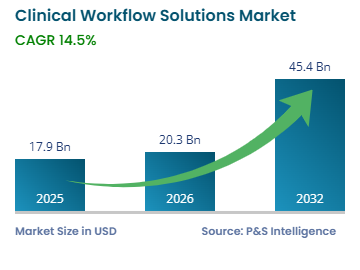
The clinical workflow solutions market size was USD 17.9 billion for 2025, and it will grow by 14.5% during 2026-2032, to reach USD 45.4 billion by 2032.
Healthcare providers are increasingly investing in clinical workflow solutions to improve care coordination, reduce administrative workload, and manage rising patient volumes without affecting operational efficiency. Hospitals, outpatient centres, and speciality care facilities are adopting workflow platforms to streamline scheduling, clinical documentation, patient monitoring, communication, and information exchange across departments. The growing use of electronic health records, connected medical devices, and digital care platforms has increased the need for integrated systems that support real-time clinical decision-making and coordinated patient management. Healthcare organisations are also focusing on workflow optimisation to reduce treatment delays, minimise documentation errors, and improve patient outcomes across complex care environments.
Healthcare digitalisation initiatives and the growing integration of automation technologies are further supporting market expansion. Providers are investing in cloud-based workflow platforms, interoperability solutions, and AI-enabled applications to improve operational visibility and strengthen collaboration between clinical teams. The expansion of telehealth services, remote patient monitoring, and smart hospital infrastructure is increasing demand for flexible workflow management systems capable of supporting distributed healthcare operations. According to the Global Digital Health Monitor, 95% of participating countries used digital health systems to monitor population health in 2024, highlighting the growing reliance on connected healthcare infrastructure and integrated clinical data exchange platforms. Healthcare organisations are also prioritising solutions that improve access to patient information, support regulatory compliance, and simplify repetitive operational processes, encouraging broader adoption of workflow technologies across modern healthcare settings.
Key Market Insights
Data Integration Solutions are the largest solution, holding a market share of 35.5%, because connected clinical data enables workflow automation.
Cloud-Based is the fastest-growing deployment, registering a CAGR of 14.9%, driven by remote access and multi-site clinical coordination.
Software is the larger offering, holding a market share of 80.5%, because documentation, scheduling, and care coordination depend on platforms.
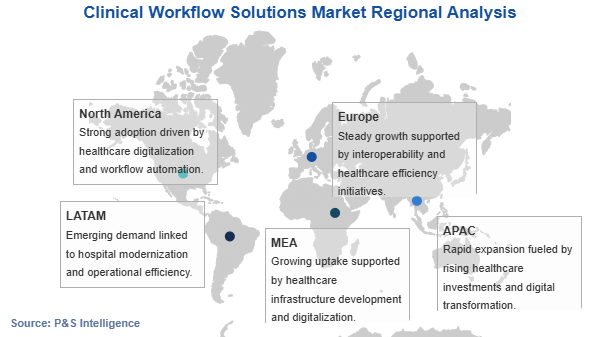
North America holds the largest share, of 45.0%, because the region has a highly developed healthcare IT ecosystem and strong adoption of integrated clinical technologies.
Asia-Pacific has the highest CAGR, of 15.5%, as healthcare providers across the region are rapidly modernising hospital infrastructure and expanding digital healthcare capabilities.
Clinical Workflow Solutions Market Trends and Drivers
AI-Enabled Clinical Documentation Automation Is a Major Trend
Healthcare providers are increasingly adopting AI-powered workflow platforms to automate clinical documentation, patient intake, scheduling, and administrative coordination across care environments. Hospitals are moving beyond basic digitisation and integrating intelligent workflow systems that support faster clinical decision-making, reduce manual processes, and improve clinician productivity. Healthcare organisations are also deploying ambient listening tools, voice-enabled documentation, and predictive workflow applications within electronic health record environments to reduce documentation fatigue and improve care coordination between departments.
In 2025, Oracle Corporation introduced Oracle Health EHR for ambulatory providers in the U.S., using contextual AI and voice-enabled commands within the electronic health record environment to improve clinical documentation and workflow integration. In 2025, athenahealth launched its AI-native Clinical Encounter within athenaOne, using ambient technology and embedded workflow intelligence to support care coordination, clinical documentation, and clinician workflow management. These developments reflect growing industry demand for interoperable workflow platforms that combine communication, analytics, automation, and AI-assisted clinical operations within connected healthcare ecosystems.
Rising Pressure to Improve Hospital Operational Efficiency Drives Market
Healthcare organisations are investing in clinical workflow solutions to manage operational complexity, rising patient admissions, staff shortages, and increasing administrative workloads across healthcare settings. Hospitals and care centres require workflow platforms that improve patient throughput, reduce delays in treatment processes, strengthen communication between departments, and minimise documentation errors. Providers are also focusing on reducing clinician burnout by automating repetitive operational tasks and improving access to real-time patient information within connected care environments.
In 2025, GE HealthCare launched Imaging 360 powered by AI for radiology operations, using AI-driven insights for scheduling gaps, fleet performance, remote collaboration, and resource allocation to improve operational efficiency across imaging departments. In 2025, Siemens Healthineers introduced AI-enabled radiology services and operational simulations supporting scheduling, image acquisition, reporting, and departmental workflow management across hospitals. These developments reflect growing demand for workflow technologies that support coordinated clinical operations, optimise workforce utilisation, and improve operational visibility across increasingly complex healthcare environments.
High Integration Complexity and Data Interoperability Challenges Restrain Market Growth
Clinical workflow solutions face adoption challenges because many healthcare providers operate with fragmented IT environments and outdated legacy systems that require complex integration across departments. Integration with electronic health records, diagnostic platforms, communication systems, and connected medical devices often requires substantial technical coordination and implementation efforts. Healthcare organisations are also focusing on cybersecurity, system migration, customisation, training, and long-term maintenance when deploying workflow platforms. According to the Global Digital Health Monitor, 42% of participating countries had a fully established national health information exchange system in 2024, highlighting the scope for further development of interoperable healthcare infrastructure. Healthcare organisations are therefore prioritising workflow platforms that support seamless data exchange, secure connectivity, and integration across clinical systems, creating opportunities for broader adoption as digital infrastructure continues to advance.
Expansion of Remote and Decentralised Care Delivery Creates Market Opportunities
The growing shift toward remote healthcare delivery is creating opportunities for clinical workflow solution providers across telehealth, home-based care, and remote patient monitoring environments. Healthcare organisations are investing in workflow platforms that support virtual consultations, remote clinical documentation, patient engagement, and centralised access to medical information across distributed care settings. Demand is also increasing for cloud-native and mobile-enabled workflow applications that improve coordination between physicians, laboratories, pharmacies, nurses, and patients outside traditional hospital environments. According to the International Telecommunication Union, 6 billion people worldwide were online in 2025, expanding the digital foundation supporting telehealth services, remote monitoring, and cloud-based healthcare coordination platforms. Healthcare providers are increasingly prioritising scalable workflow systems capable of supporting connected care delivery across multiple digital healthcare channels and treatment locations.
Data Integration Solutions are the largest category, holding a market share of 35.5%, because healthcare workflow platforms depend on connected clinical data across electronic health records, imaging systems, laboratory platforms, medical devices, and hospital information systems. Integration remains essential for workflow automation, analytics, care coordination, and communication tools to function across departments. In 2025, InterSystems Corporation launched HealthShare AI Assistant within its HealthShare ecosystem, helping clinicians and administrators retrieve and understand patient information through conversational queries.
Care Collaboration Solutions are the fastest-growing category, registering a CAGR of 14.6%, due to the rising need for coordinated care across physicians, nurses, pharmacists, laboratories, and patients. Healthcare delivery is moving beyond single-department workflows, so providers need tools that support team communication, medication coordination, patient handoffs, and remote follow-up. Growth is also supported by patient-centred care models, where clinical teams need shared visibility into care plans and faster response during treatment journeys.
The solution types analysed in this report are:
Data Integration Solutions (Largest Category)
Care Collaboration Solutions (Fastest-growing Category)
Real-Time Communication Solutions
Workflow Automation Solutions
Enterprise Reporting and Analytics Solutions
Others
Deployment Mode Analysis
On-Premise is the largest category, holding a market share of 65.5%, because many hospitals still prefer direct control over clinical systems, patient data, and internal IT environments. Large healthcare facilities often operate complex legacy infrastructure and strict data security processes, making on-premise deployment a practical choice for sensitive workflows. It also supports customised integrations with existing EHRs, diagnostic systems, and hospital networks, especially where providers want tighter control over system performance and compliance.
Cloud-Based is the fastest-growing category, registering a CAGR of 14.9%, because healthcare providers require flexible workflow platforms that support remote access, multi-site coordination, telehealth integration, and mobile clinical communication. Cloud deployment also reduces dependence on heavy internal infrastructure and allows faster implementation across expanding healthcare networks. In 2025, Microsoft Corporation expanded Dragon Copilot with nursing workflow support and partner AI extensions, allowing healthcare organisations to connect third-party AI applications and workflow agents within the platform. The expansion highlights increasing adoption of cloud-connected workflow systems that support broader care-team collaboration, remote workflow management, and integrated clinical communication environments.
The deployment modes analysed in this report are:
On-Premise (Largest Category)
Cloud-Based (Fastest-growing Category)
Hybrid
Component Analysis
Software is the larger category, holding a market share of 80.5%, because clinical workflow platforms rely on software to manage scheduling, documentation, communication, reporting, analytics, and care coordination across healthcare departments. Hospitals and clinics increasingly depend on software-driven workflow automation to improve operational efficiency and information accessibility within connected healthcare environments. In 2025, eClinicalWorks introduced its AI Document Insights Assistant at Ferris Family Medicine, enabling providers to summarise and review clinical documents directly within patient charts. The deployment reflects growing reliance on workflow software that supports documentation management, clinical information handling, and operational coordination across healthcare settings.
Services are the faster-growing category, registering a CAGR of 15.2%, due to increasing demand for implementation, integration, training, customisation, maintenance, and technical support. Clinical workflow systems usually need to connect with existing EHRs, medical devices, imaging platforms, and communication tools, which creates a strong demand for specialist services. As hospitals adopt more advanced workflow platforms, vendors are also supporting upgrades, cloud migration, cybersecurity alignment, and workflow redesign for different clinical settings.
The components analysed in this report are:
Software (Larger Category)
Services (Faster-growing Category)
Organisation Size Analysis
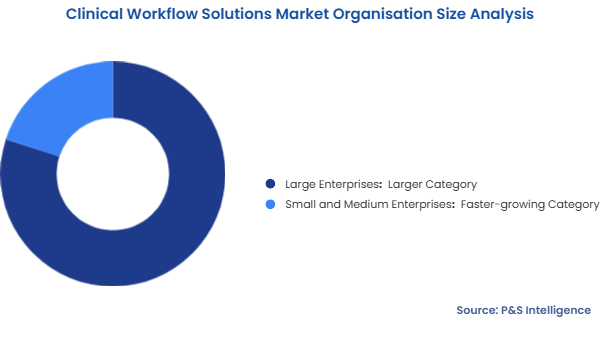
Large Enterprises are the larger category, holding a market share of 80.0%, because large hospitals, hospital groups, and integrated delivery networks manage complex clinical operations across many departments and locations. These organisations have stronger budgets, larger IT teams, and higher demand for enterprise-grade workflow platforms. Their need for interoperability, patient flow management, secure communication, analytics, and compliance support makes them early adopters of advanced clinical workflow systems.
Small and medium enterprises are the faster-growing category, registering a CAGR of 14.8%, because smaller healthcare providers are adopting affordable cloud-based and modular workflow platforms to improve scheduling, communication, patient follow-up, and administrative coordination. Subscription-based deployment models and reduced infrastructure requirements are also encouraging adoption across clinics, speciality centres, and mid-sized hospitals. In 2026, Greenway Health launched its Agentic AI Factory in collaboration with Amazon Web Services, supporting AI agent development for ambulatory healthcare operations and administrative workflow tasks.
The organization sizes analysed in this report are:
Large Enterprises (Larger Category)
Small and Medium Enterprises (Faster-growing Category)
End User Analysis
Hospitals are the largest category, holding a market share of 40.5%, because hospitals manage high patient admissions, complex clinical coordination, diagnostic workflows, medication management, and large volumes of healthcare data across departments. They require integrated workflow systems that connect physicians, nurses, laboratories, pharmacies, imaging units, and administrative teams in real time. In 2026, Koninklijke Philips N.V. presented platform-based care intelligence at HIMSS, connecting enterprise patient monitoring systems with diagnostic information and clinical applications across hospital environments.
Ambulatory Care Centres are the fastest-growing category, registering a CAGR of 15.1%, due to the shift of many procedures and consultations from hospitals to outpatient settings. These centres need workflow systems that support appointment scheduling, patient intake, clinical documentation, billing coordination, and communication with external providers. Growth is also supported by demand for faster patient turnaround, lower operating burden, and better digital coordination between ambulatory facilities, hospitals, pharmacies, and diagnostic service providers.
The end users analysed in this report are:
Hospitals (Largest Category)
Ambulatory Care Centres (Fastest-growing Category)
Long-Term Care Facilities
Speciality Clinics
Others
Drive strategic growth with comprehensive market analysis
North America Clinical Workflow Solutions Market Analysis
North America holds the largest share, of 45.0%, because the region has a highly developed healthcare IT ecosystem and strong adoption of integrated clinical technologies across hospitals and outpatient networks. Healthcare providers in the region are investing heavily in workflow optimisation tools to manage clinician workload, improve care coordination, and support value-based healthcare delivery. The widespread use of electronic health records, connected medical devices, and enterprise communication systems has increased demand for interoperable workflow platforms capable of supporting complex clinical operations. According to the Office of the National Coordinator for Health Information Technology, approximately 9 in 10 U.S. hospitals enabled patients to access their health information through an application programming interface (API) in 2024, while 7 in 10 hospitals used standards-based APIs for this access.
U.S. Clinical Workflow Solutions Market Analysis
The U.S. represents the largest country-level market due to extensive deployment of healthcare IT systems across hospitals, ambulatory care centres, and integrated delivery networks. Healthcare providers are increasingly implementing AI-enabled documentation, interoperability platforms, and patient throughput management systems to improve operational productivity and reduce physician burnout. According to the Office of the National Coordinator for Health Information Technology, 76% of U.S. non-federal acute care hospitals engaged in all four interoperability domains in 2025, including sending, receiving, finding, and integrating electronic health information. Strong digital healthcare infrastructure and continued investment in connected clinical operations are supporting wider adoption of advanced workflow technologies across healthcare environments.
Canada is experiencing growing adoption of clinical workflow technologies because healthcare providers are modernising digital infrastructure to improve care coordination across geographically dispersed populations. Hospitals and healthcare networks are investing in interoperable health information systems, virtual care integration, and centralised patient management platforms to improve clinical communication and accessibility. According to Statistics Canada, 92% of Canadian healthcare providers had access to a digital health system in 2024. Government-supported digital healthcare initiatives and broader adoption of connected healthcare platforms are encouraging healthcare organisations to strengthen workflow automation, improve information accessibility, and modernise operational management across clinical environments.
Asia-Pacific has the highest CAGR, of 15.5%, as healthcare providers across the region are rapidly modernising hospital infrastructure and expanding digital healthcare capabilities. Governments and private healthcare organisations are increasing investments in smart hospitals, telehealth platforms, and connected care systems to improve healthcare accessibility and operational efficiency. According to the World Health Organization, 129 countries globally had established national digital health strategies by 2025, reflecting the increasing institutionalisation of digital health and creating a stronger foundation for connected healthcare systems across regions including Asia-Pacific. The region is also witnessing strong demand for workflow solutions that can support large patient populations, rise healthcare utilisation, and expand healthcare networks. Many healthcare facilities are transitioning from paper-based and fragmented systems toward centralised digital workflows, creating opportunities for cloud-based and mobile-enabled clinical platforms.
China Clinical Workflow Solutions Market Analysis
China is expanding rapidly in this market because healthcare providers are increasing the deployment of smart hospital technologies, workflow automation systems, and digital healthcare infrastructure across urban medical centres. Hospitals are adopting connected workflow platforms to manage rising patient volumes, strengthen operational efficiency, and support centralised healthcare data management. According to the State Council of the People’s Republic of China, more than 3,000 medical institutions in China offered online medical and nursing services in 2024. Growing adoption of AI-supported healthcare systems and broader hospital digitalisation programmes are supporting demand for workflow technologies that improve coordination, patient management, and connected clinical operations.
India Clinical Workflow Solutions Market Analysis
India is emerging as a fast-growing market because hospitals and healthcare networks are increasingly adopting digital platforms to improve operational efficiency, patient management, and clinical coordination. Private healthcare providers are investing in cloud-based workflow systems, telehealth integration, and mobile-enabled healthcare applications to support expanding healthcare services and multispecialty hospital operations. According to the Press Information Bureau of India, 1,59,020 health facilities in India used ABDM-enabled software in 2025. Expanding digital healthcare infrastructure and wider adoption of connected healthcare platforms are encouraging healthcare organisations to strengthen workflow management, improve interoperability, and support coordinated care delivery across healthcare environments.
Europe Clinical Workflow Solutions Market Analysis
Europe is witnessing steady growth in the clinical workflow solutions market due to increasing focus on healthcare interoperability, patient safety, and coordinated care delivery. Healthcare providers across the region are modernising clinical infrastructure to improve efficiency in hospitals and reduce administrative burden on medical staff. According to the European Commission, the EU-27 achieved an average eHealth maturity score of 87% in 2025, reflecting continued progress in electronic health record access and the digitalisation of healthcare services across Europe. The region is also emphasising cross-platform data exchange and standardised digital healthcare frameworks, encouraging adoption of integrated workflow management systems. Demand for remote care coordination, electronic prescribing, and digital patient management platforms is increasing as healthcare systems address ageing populations and rising chronic disease cases. In addition, hospitals are prioritising workflow technologies that support compliance with healthcare data protection regulations and improve communication between multidisciplinary care teams. Continued investments in hospital digitisation and public healthcare modernisation programs are supporting long-term market development across Europe.
The regions and countries analysed in this report are:
The market is fragmented, with the presence of multiple healthcare IT providers, workflow software developers, communication platform vendors, and specialized clinical solution companies competing across different application areas. The industry includes both large healthcare technology firms with broad enterprise platforms and smaller vendors focused on niche workflow functions such as patient flow management, care coordination, scheduling, and clinical communication. Market competition is driven by product customisation capabilities, interoperability support, cloud integration, and the ability to address specific operational requirements across hospitals and outpatient facilities. Vendors are also expanding through partnerships, acquisitions, and integration agreements to strengthen their healthcare software ecosystems and improve compatibility with electronic health record platforms. As healthcare providers continue to demand tailored workflow solutions for different clinical settings, the market is witnessing continuous entry of specialised technology providers, contributing to a highly competitive and diversified industry structure.
Leading Companies in the Clinical Workflow Solutions Market:
Oracle Corporation
Veradigm Inc.
NextGen Healthcare, Inc.
McKesson Corporation
Koninklijke Philips N.V.
Baxter International Inc.
Cisco Systems, Inc.
GE HealthCare Technologies Inc.
Stryker Corporation
Ascom Holding AG
Becton, Dickinson and Company
Nextech Systems LLC
Sectra AB
Epic Systems Corporation
Siemens Healthineers AG
Clinical Workflow Solutions Market Developments
In April 2026, Becton, Dickinson and Company launched the BD Pyxis Pro Dispensing Solution and BD Incada Connected Care Platform in Europe. The release links automated medication cabinets with connected data tools for hospital pharmacy and point-of-care teams. It fits clinical workflow solutions because it supports medication access, storage, inventory checks, and staff review inside care settings.
In January 2026, Nextech Systems LLC launched Cora Scribe, an AI clinical documentation tool built inside the Nextech EHR for specialty practices. The first release focused on ophthalmology. It turns patient-provider conversations into structured clinical notes, placing the product in clinical documentation, specialty EHR, and practice workflow for medical practices and care teams.
In November 2025, Sectra AB launched Sectra Reporting in the U.S. market. The product is a built-in reporting tool for medical imaging workflows. It brings image review and reporting into one diagnostic application, so radiologists can complete reporting work without moving between separate systems during routine imaging review for radiology teams.
In October 2025, Ascom Holding AG launched Silent ICU at the ESICM LIVES Congress in Munich with partner device makers. The solution connects bedside medical devices with alarm management software. It routes ICU alarms to dashboards and staff mobile devices, placing the product in clinical alarm management, critical care coordination, and nurse workflow.
Frequently Asked Questions About This Report
What does the clinical workflow solutions market include for organizations?+
It includes digital tools that organize tasks, communication, scheduling, documentation, alerts, and care coordination for clinical teams.
What factors are driving demand in the clinical workflow solutions market?+
Demand is driven by clinician workload, patient volume, quality goals, digital records, and the need for smoother care coordination.
Why are organizations adopting clinical workflow solutions across their operations?+
Healthcare providers adopt workflow solutions to reduce delays, standardize tasks, support handoffs, and improve visibility across care teams.
How do clinical workflow solutions improve decision-making and efficiency?+
These tools improve care by guiding tasks, routing information, reducing missed steps, and helping clinicians focus on patients.
What challenges affect the adoption of clinical workflow solutions today?+
Adoption is affected by workflow fit, integration with records, alert fatigue, training, clinician acceptance, and configuration complexity.
Want a report tailored exactly to your business need?
Leading companies across industries trust us to deliver data-driven insights and innovative solutions for their most critical decisions. From data-driven strategies to actionable insights, we empower the decision-makers who shape industries and define the future. From Fortune 500 companies to innovative startups, we are proud to partner with organisations that drive progress in their industries.
Client Testimonials
Working with P&S Intelligence and their team was an absolute pleasure – their awareness of timelines and commitment to value greatly contributed to our project's success. Eagerly anticipating future collaborations.
McKinsey & Company
India
Unmatched Standards
Our insights into the minutest levels of the markets, including the latest trends and competitive landscape, give you all the answers you need to take your business to new heights
Complete Data Security
We take a cautious approach to protecting your personal and confidential information. Trust is the strongest bond that connects us and our clients, and trust we build by complying with all international and domestic data protection and privacy laws