This Report Provides In-Depth Analysis of the Healthcare Interoperability Solutions Market Report Prepared by P&S Intelligence, Segmented by Component (Solutions, Services), Interoperability Type (Structural Interoperability Solutions, Semantic Interoperability Solutions, Organizational/Process Interoperability Solutions), Deployment Mode (Cloud-Based Interoperability Platforms, On-Premise Interoperability Systems, Hybrid Interoperability Environments), End-User (Hospitals & Health Systems, Physician Practices & Clinics, Pharmaceutical & Biotechnology Companies, Payers & Insurance Providers, Government & Public Health Agencies, Diagnostic & Imaging Centers, Healthcare IT Vendors & Integrators), and Geographical Outlook for the Period of 2021 to 2032
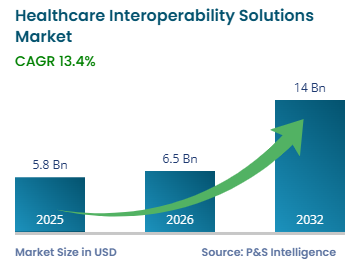
The healthcare interoperability solutions market size was USD 5.8 billion for 2025, and it will grow by 13.4% during 2026-2032, to reach USD 14.0 billion by 2032.
The healthcare interoperability market is primarily driven by the widespread adoption of electronic health records, government regulations and incentives promoting data sharing, the need for coordinated care and value-based healthcare, and rising demand for seamless exchange of patient data across providers and systems. As healthcare systems shift from independent clinical systems to connected digital ecosystems, demand for healthcare interoperability solutions is increasing dramatically. Increasingly utilized electronic health records, telehealth platforms, population health initiatives, and data-based care methodologies require that the exchange of information occurs without interruption across all areas of delivery.
Organizations that provide, pay for, or support public health are increasingly feeling the pressure to create secure channels for the movement of patient information across clinical, administrative, and analytical domains. As the healthcare system continues becoming collaborative and digitally enabled, solutions that allow healthcare networks to collaborate and provide care for patients will be crucial to their continued success. They will also serve as the foundation for facilitating regulatory alignment and enabling operations within highly complex networks.
According to the Office of the National Coordinator for Health IT (ONC), 70% of U.S. hospitals routinely engage in all four domains of interoperable exchange finding, sending, receiving, and integrating patient data. According to the ONC, nearly 75% of non-federal acute-care hospitals now electronically report public health data, reflecting rising institutional pressure to support population health and regulatory reporting.
Key Market Insights
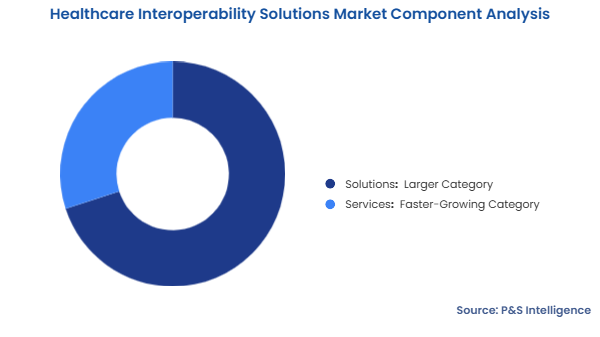
Solutions are the largest component with 70% share, forming the core platforms for establishing secure and standardized healthcare data connectivity.
Services are the fastest-growing component with 13.6% CAGR, driven by rising demand for system integration, regulatory compliance, and ongoing optimization.
Structural interoperability is the dominant type with 50% share, enabling consistent and reliable data exchange across heterogeneous healthcare systems.
Hospitals & health systems hold the largest end-user sector with 50% share, acting as the primary hubs for connecting diverse clinical and administrative information systems.
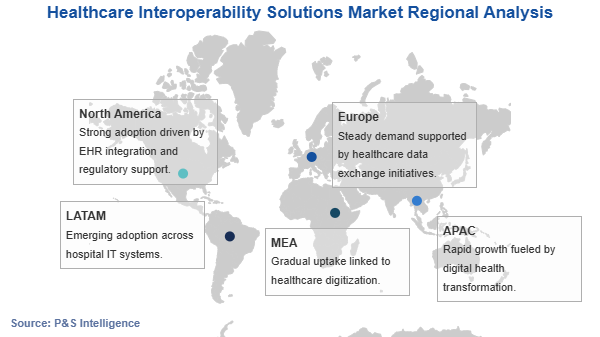
North America leads the market with 40% share, while Asia-Pacific is the fastest-growing region with 13.5% CAGR due to expanding government investment in national digital health infrastructure.
Standards-Based APIs and Modular Integration Are Major Trends
One key trend in healthcare interoperability is the increasing use of standards-based application programming interfaces (APIs) and modular integration frameworks to allow for real-time exchanges between clinical and administrative data across systems. As health systems, insurers, and digital health platforms all move towards a common set of data standards and service architectures, we see improved connectivity between electronic health records, diagnostic systems, and care management tools. The use of event-driven interoperability, in which data is synchronized, is rising as users perform actions.
The emergence of ecosystem platforms that allow for the integration of data from multiple vendors and devices to create a single view of the patient. This trend demonstrates the evolution of healthcare interoperability towards a composable, scalable architecture. According to the ASTP/ONC, adoption of standardized FHIR-based APIs in U.S. inpatient settings rose to 69%, confirming rapid movement toward standards-based interoperability architectures. According to the ASTP/ONC, 81% of U.S. hospitals now allow third-party application access to health records, enabling modular, multi-vendor ecosystem connectivity.
Continuity of Care and Value-Based Healthcare Delivery Drives Market
Healthcare interoperability market growth is primarily driven by the increased focus on continuity of care and value-based healthcare delivery. It is dependent on having easy access to patient information across care settings and to all parties involved in the patient care team. Healthcare organizations must establish easy access to accurate patient data at all points of care to reduce clinical mistakes, improve coordination of care among providers, and avoid duplication of testing.
Regulatory and quality reporting requirements are also driving the demand for systems that can seamlessly share structured data among electronic health records, diagnostic systems, and networks of care. Growing investment in interoperability solutions is driven by increasing demand for integrated, longitudinal patient records and coordinated workflows. According to the ONC, 70% of U.S. hospitals actively exchange interoperable data across all core domains, reinforcing interoperability as a foundation for coordinated care delivery.
Solutions is the largest category, holding a market share of 70%, since they are the basis for hospitals' investments in platforms that facilitate the seamless movement of data throughout their network of clinical information systems. Because interoperability barriers primarily consist of technology-related issues, the greatest need is for software that provides a means of establishing connections, normalizing disparate data formats, and providing a secure source of data access. According to the ONC, adoption of standardized FHIR-based APIs reached 69% in inpatient settings, validating software platforms as the backbone of modern interoperability. At scale, healthcare networks now process tens of millions of standardized clinical documents per month, demonstrating the central role of software solutions in healthcare data flow.
Services are the faster-growing category, registering a CAGR of 13.6%, because many healthcare organizations struggle with managing complex integrations, regulatory compliance and continually optimizing their systems after installing interoperability solutions. Instead of being perceived as a one-time installation, interoperability is increasingly being perceived as an ongoing process that includes continual configuration, upgrades, and performance tracking. Over 85% of healthcare CIOs now plan to increase spending on interoperability and integration services to manage system complexity and regulatory change. Around 92% of healthcare leaders consider automation and interoperability services critical for reducing administrative burden and workforce strain.
The component types analyzed in this report are:
Solutions (Larger Category)
Services (Faster-Growing Category)
Interoperability Analysis
Structural interoperability solution is the largest category, holding a market share of 50%, as it makes it possible for systems to share and consume data in a consistent and usable way. Structural interoperability solutions will generally be easier to implement and will have a greater degree of applicability across hospitals, laboratories, pharmacies, and insurance providers. It is important to establish the foundational layer of structural interoperability in order to provide the ability for higher-level data interpretation. Healthcare data networks now facilitate over 27 billion health data transactions annually. According to the ONC, standardized FHIR-based APIs have been adopted by 69% of inpatient systems, establishing them as the foundational layer for data connectivity.
Semantic interoperability solutions is the fastest-growing category, registering a CAGR of 13.7%, as healthcare moves from simply sharing information to utilizing it for clinical decision-making. For analytics, providing clinical decision support (CDS), managing the population's health, and regulatory reporting, it is essential that all clinical data is standardized. Therefore, organizations require solutions that provide standard terminology, clinical code sets, as well as contextual definition of terms with all of their clinical data across multiple systems.
According to the ONC, expanded national data standards now mandate additional semantic data classes to ensure clinical data is computationally usable for analytics and decision support. Healthcare systems generate tens of millions of standards-conformant clinical documents monthly, validating reliance on semantic normalization for downstream care and reporting.
The interoperability types analyzed in this report are:
Cloud is the largest category, holding a market share of 55%. This is due to their scalability as an easily managed central point and the ease with which users can establish connections between different locations of healthcare organizations. As the ability to exchange information between multiple parties is part of the definition of interoperability, cloud computing platforms are ideal for facilitating real-time information exchange. Nearly 80% of healthcare organizations now identify hybrid multicloud as their preferred operating model to support interoperability and AI workloads. National health data networks process over 27 billion secure digital health transactions annually, confirming cloud platforms as the dominant engine for real-time data exchange.
Hybrid is the fastest-growing category, registering a CAGR of 13.8%, as organizations look to maximize both scalability and strict data management controls. The hybrid model combines the above benefits while enabling organizations to comply with applicable data protection regulations and allow for the exchange of data across regional and national networks. Nearly 80% of healthcare organizations prefer hybrid multicloud to balance system flexibility with strict patient data security requirements. The average cost of a healthcare data breach has reached nearly USD 10 million, reinforcing demand for secure, compliant hybrid infrastructures.
Hospitals & health systems is the largest category, holding a market share of 50%. They are the key components that provide connectivity between physicians, labs, radiology centers, pharmacies, and health insurers. Additionally, large health systems have complex IT infrastructures that rely on and require the transfer of data continuously between departments and between affiliated facilities. According to the ONC, 70% of U.S. hospitals actively engage in full-spectrum interoperable exchange, positioning hospitals as the primary hubs of data connectivity. According to the ONC, 69% of hospitals have implemented standardized FHIR-based APIs to enable continuous, automated data transfer across departments and external systems.
Government & public health agencies is the fastest-growing category, with government priorities based on using healthcare data for planning, surveillance and for emergency response. By utilizing interoperability, public health agencies have the ability to combine input from hospital systems, lab systems, and clinic systems, so that they can monitor disease trends, create policies and oversee health systems. With an ever-increasing focus on the importance of a robust digital public health infrastructure, the adoption rates for digital public health infrastructure are growing rapidly in both government and public sector organizations.
According to the Centers for Disease Control and Prevention (CDC), over half of public health jurisdictions can now receive electronic case reports for most reportable conditions, accelerating automated surveillance. According to the ASTP/ONC, nearly all U.S. hospitals now electronically report core public health data, validating nationwide digital public health infrastructure.
The end user types analyzed in this report are:
Hospitals & Health Systems (Largest Category)
Government & Public Health Agencies (Fastest-Growing Category)
Physician Practices & Clinics
Pharmaceutical & Biotechnology Companies
Payers & Insurance Providers
Diagnostic & Imaging Centers
Healthcare IT Vendors & Integrators
Others
Drive strategic growth with comprehensive market analysis
Healthcare Interoperability Solutions Market Regional Outlook
North America Healthcare Interoperability Solutions Market Analysis
North America has the largest share, of 40%, due to the early implementation of technology in the medical record-keeping process, strong governmental support for sharing medical information, and a common set of health information systems used across medical facilities. Additionally, North America has developed well-established vendor ecosystems, an extensive payer-provider network, and ongoing collaboration between governmental entities and private sector companies to support the development of national health information exchange initiatives.
U.S. Healthcare Interoperability Solutions Market Growth
The USA leads the market due to the digitalization of the healthcare industry and the focus on interoperability in federal regulations and incentive programs. Numerous large EHR providers, extensive health information networks, and a multitude of interoperability consortia form a complex yet fully developed system for clinical data sharing. As a result, the deep involvement from payers, providers, and the life sciences community drives interoperability in population health management, value-based care models, and the use of real-world evidence.
Through the enforcement of patient data access rights and the need for regulatory bodies to enforce them, the utilization of standardized data sharing methods via APIs has become an attractive investment opportunity for organizations. National health information exchange services now facilitate access to more than 3.5 billion patient record links annually, supporting population health and value-based care programs.
The development of Canada's rapidly growing economy is being influenced by the establishment of a nationally coordinated healthcare system and the desire for the transmission of healthcare information across provinces. Digital health agencies in each province have developed frameworks to enhance the ability for health providers to communicate and cooperate across provincial boundaries. With the adoption of virtual care models, expansion of national patient registries, and various modernization initiatives in the public sector, there is now high demand for secure methods of sharing patient information.
Public health services and private IT vendors are collaborating to bridge the divide between hospital systems, primary care networks, and PHIs. According to the Canadian Institute for Health Information (CIHI), while over 90% of primary care physicians use electronic records, less than one-third can electronically share patient summaries externally.
APAC has the highest CAGR, of 13.5%, due to the growth in healthcare infrastructure, hospital digitization, and investments by governments in national health information systems. Several countries are developing their interoperability frameworks from the ground up, thus providing an opportunity for quick adoption of modern cloud-first/API-driven healthcare data platforms.
China Healthcare Interoperability Solutions Market Growth
China is the leader in the Asia-Pacific region due to the magnitude of its hospital system and an aggressively digitizing health care policy. Centralized health information systems are being utilized by large public hospitals and regional health authorities to consolidate clinical, insurance, and public health data into a single source. Strong leadership of the Chinese government with regard to developing smart health care has established standardized data architectures among urban health care systems.
The focus of developing smart health care by integrating hospital information systems with national health insurance has made interoperability an essential building block of health care and a required first step for new hospitals and new health systems. According to the National Healthcare Security Administration (NHSA), China’s national health information platform connects over 520,000 medical institutions and nearly 500,000 pharmacies, enabling real-time data exchange for more than 1.3 billion citizens.
India Healthcare Interoperability Solutions Market Growth
India has the highest regional CAGR due to a national digital health architecture based on standardized health IDs, registries, and open APIs among public and private care providers. This ability to build interoperability into the healthcare ecosystem allows for rapid structural adoption, as it is being implemented in an early stage. The rapid growth of the market is driven by the need to connect fragmented provider networks (especially between rural and urban systems) and the increased digitization of private and public hospitals in India.
As a result of government-backed digital public infrastructure, there is a surge in demand for scalable and low-cost interoperability platforms to create an efficient, accessible, and sustainable healthcare system. According to the Ministry of Health and Family Welfare (MoHFW), over 79 crore digital health accounts and 65 crore linked health records have been generated under the National Digital Health Mission.
The regions and countries analyzed in this report are:
The healthcare interoperability solutions market is fragmented due to the many different types of companies that are active. Global technology firms, specialized health IT vendors, systems integrators, and regional suppliers have different business models, data standards, deployment models, clinical specialty areas, regulatory compliance requirements, and other areas of focus. As such, there is no one company that dominates over all layers of interoperability. Vendors that focus on specific functions such as data exchange, integration middleware, identity management, and care coordination are not typically providing a complete integrated solution.
Vendors work together to serve the healthcare sector’s interoperability needs, thus creating a multi-supplier ecosystem. New entrants with niche capabilities such as API integration, public health connectivity and payer-provider data exchange are continuing to enter the market furthering its fragmentation. The large number of suppliers and the variation among different local markets with respect to healthcare policy and the maturity of the available infrastructure inhibits consolidation among a small number of players and perpetuates the ongoing fragmentation of the market.
In November 2025, Oracle Health was designated as a Qualified Health Information Network (QHIN) under the TEFCA framework, enabling standardized nationwide health data exchange across providers, payers, and government entities.
In October 2025, InterSystems and Google Cloud announced the integration of InterSystems HealthShare with Google Cloud Healthcare API to support unified, cloud-based interoperability and standardized healthcare data exchange.
In September 2025, InterSystems expanded enterprise imaging interoperability by embedding imaging workflows directly into EHRs using SMART on FHIR applications, improving clinician access within clinical workflows.
In August 2025, NextGen Healthcare achieved HTI-1 compliance for its Enterprise EHR platform, aligning data exchange capabilities with updated U.S. federal interoperability standards ahead of regulatory deadlines.
In June 2025, Altera Digital Health selected Health Gorilla to enhance EHR interoperability, expanding secure health data exchange and supporting compliance with evolving interoperability mandates.
Frequently Asked Questions About This Report
What are the primary benefits of achieving healthcare interoperability?+
Interoperability improves care coordination, reduces medical errors, lowers operational costs, and empowers patients by ensuring data follows them across different providers.
What are the biggest challenges facing healthcare interoperability today?+
Major barriers include incompatible legacy systems, inconsistent data standards, high integration costs, and strict privacy regulations like HIPAA that complicate data sharing.
How does the TEFCA framework impact healthcare data exchange?+
TEFCA establishes a universal floor for interoperability, creating a secure, nationwide network that allows different health information networks to share data seamlessly.
What is the difference between syntactic and semantic interoperability?+
Syntactic interoperability ensures systems can exchange data formats, while semantic interoperability ensures the receiving system can actually understand and interpret the data's meaning.
How does interoperability support value-based care models?+
It enables the comprehensive data sharing required to track patient outcomes across populations, which is essential for reimbursement models based on quality rather than volume.
What role does blockchain play in healthcare interoperability?+
Blockchain offers a decentralized, tamper-proof ledger that can securely manage patient consent and ensure the integrity of health records across fragmented systems.
Want a report tailored exactly to your business need?
Leading companies across industries trust us to deliver data-driven insights and innovative solutions for their most critical decisions. From data-driven strategies to actionable insights, we empower the decision-makers who shape industries and define the future. From Fortune 500 companies to innovative startups, we are proud to partner with organisations that drive progress in their industries.
Client Testimonials
Working with P&S Intelligence and their team was an absolute pleasure – their awareness of timelines and commitment to value greatly contributed to our project's success. Eagerly anticipating future collaborations.
McKinsey & Company
India
Unmatched Standards
Our insights into the minutest levels of the markets, including the latest trends and competitive landscape, give you all the answers you need to take your business to new heights
Complete Data Security
We take a cautious approach to protecting your personal and confidential information. Trust is the strongest bond that connects us and our clients, and trust we build by complying with all international and domestic data protection and privacy laws