This Report Provides In-Depth Analysis of the Butyraldehyde Market Report Prepared by P&S Intelligence, Segmented by Product Type (N-Butyraldehyde, Isobutyraldehyde), Application (Chemical Intermediates, Synthetic Resins, Rubber Accelerators, Plasticizers), Grade (Industrial Grade, Pharmaceutical Grade), End-User (Construction, Healthcare, Automotive, Agriculture, Food and Beverage, Cosmetics), and Geographical Outlook for the Period of 2021 to 2032
Explore the market potential with our data-driven report
Butyraldehyde Market Future Outlook
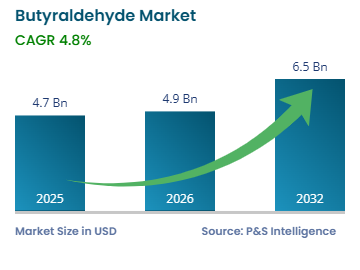
The butyraldehyde market size was USD 4.7 billion for 2025, and it will grow by 4.8% during 2026-2032, to reach USD 6.5 billion by 2032.
The market is expanding because butyraldehyde remains an important intermediate for producing oxo-alcohol derivatives, plasticisers, synthetic resins, coatings, industrial solvents, and rubber-processing chemicals. Demand is increasing as manufacturers continue to strengthen supply chains for downstream materials used across construction, automotive, packaging, and consumer goods industries. Rising industrial production activity in emerging economies is also supporting higher consumption of aldehyde-based intermediates, particularly where infrastructure development and manufacturing investments are accelerating. Chemical producers are also improving production integration and catalyst efficiency to maintain stable raw material availability for downstream chemical applications.
The market is also gaining support from the expansion of specialty chemical manufacturing and the increasing use of high-performance industrial materials. Flexible plastics, adhesives and sealants, industrial lubricants, and surface coatings continue to require chemical intermediates that improve formulation stability, processing efficiency, and product durability. Manufacturers are simultaneously investing in cleaner production technologies and energy-efficient processing systems to comply with stricter environmental standards while maintaining output consistency. According to the International Energy Agency, global refinery crude throughput was forecast to average 83.5 million barrels per day in 2025, supporting stable availability of petrochemical feedstocks used in oxo-chemical and aldehyde derivative production. This is encouraging chemical companies to expand integrated production networks and strengthen long-term supply reliability for downstream industrial applications.
Key Market Insights
N-Butyraldehyde is the larger type, holding a market share of 75%, due to strong demand from plasticisers, coatings, solvents, and oxo-chemical production.
Synthetic Resins is the fastest-growing application, registering a CAGR of approximately 5.2%, driven by rising demand for engineered coatings, adhesives, and composite materials.
Industrial Grade is the largest grade, holding a market share of 60%, due to widespread utilisation across bulk chemical processing and industrial manufacturing operations.
Asia-Pacific held the largest market share of 40% in 2025 and registering the highest CAGR of approximately 5.7% during 2026–2032, driven by its strong petrochemical manufacturing base, integrated chemical production clusters, and growing demand from plastics, coatings, and industrial materials.
China holds the largest share in Asia-Pacific butyraldehyde market, due to integrated refinery capacity and extensive downstream demand for oxo-chemical derivatives.
Butyraldehyde Market Trends and Drivers
Shift toward Integrated Oxo-Alcohol Production and Low-Emission Processing Is Major Trend
The industry is increasingly shifting toward integrated production systems where butyraldehyde manufacturing is connected directly with downstream oxo-alcohol and plasticiser facilities to improve operational efficiency and strengthen supply stability. Chemical producers are modernising plants with advanced catalyst systems, digital process monitoring, and energy-efficient separation technologies to reduce operating costs and maintain consistent production quality. According to the International Energy Agency, industry accounted for nearly 40% of global final energy consumption in 2024, while energy-intensive industries represented about three-fourths of industrial energy demand, increasing pressure on chemical manufacturers to improve process efficiency. Producers are therefore investing in lower-energy production systems and integrated operations to strengthen long-term competitiveness across industrial chemical supply chains.
The market is also witnessing stronger focus on sustainable feedstock optimisation and lower-carbon chemical processing, particularly in regions with tighter industrial emission regulations. Major chemical companies are expanding specialty derivative production and upgrading facilities to improve environmental compliance and strengthen their position in performance chemicals. Manufacturers are also forming long-term supply partnerships with coatings, construction, and flexible materials companies to stabilise downstream demand and improve production planning. According to the Organisation for Economic Co-operation and Development, 110 parties covering 88% of global greenhouse gas emissions had pledged net-zero targets by 2024, accelerating the transition toward lower-carbon industrial processing and stricter environmental compliance standards. This is encouraging chemical producers to prioritise cleaner technologies, emission-control investments, and sustainable production strategies across butyraldehyde manufacturing operations.
Rising Demand for Plasticizers and Industrial Coatings Drives Market
The market is growing steadily due to rising consumption of downstream chemicals used in plasticisers, paints and coatings, industrial coatings, adhesives, and synthetic lubricants across industrial sectors. Butyraldehyde remains an important raw material for oxo-alcohol derivatives widely used in packaging materials, industrial surface treatments, and flexible plastics applications. Expanding manufacturing activity and infrastructure development are increasing demand for coatings, laminates, and industrial packaging products that require chemical intermediates with strong formulation stability and processing performance. According to the Food and Agriculture Organization, global paper and paperboard production reached 423 million tonnes in 2024, supporting higher consumption of packaging materials, coatings, adhesives, and related industrial chemical applications. Chemical manufacturers are therefore increasing production integration and downstream supply capabilities to support growing industrial material demand.
Demand is also increasing due to higher automotive production and stronger consumption of industrial surface-treatment chemicals across transportation manufacturing. Butyraldehyde derivatives are widely used in automotive coatings, interior materials, flexible plastics, and performance additives that improve durability and chemical resistance. Vehicle manufacturers continue to increase procurement of lightweight materials and specialised coatings to improve efficiency and product performance across modern transport systems. According to the International Organization of Motor Vehicle Manufacturers, global vehicle production reached 96.4 million units in 2025, supporting demand for automotive coatings, engineered plastics, adhesives, and industrial chemical intermediates. This is encouraging producers to expand oxo-chemical capacity and strengthen long-term supply relationships with downstream automotive and industrial materials manufacturers.
Stringent Environmental Handling Requirements and Feedstock Volatility Limit Market Expansion
Market growth is being constrained by strict environmental and workplace safety regulations associated with the handling, storage, and transportation of hazardous chemical intermediates used in butyraldehyde production. The compound’s volatile characteristics and flammability risks are increasing compliance costs for manufacturers operating under tightening industrial emission standards and chemical safety regulations. Producers are also required to invest continuously in specialised storage systems, monitoring equipment, and process-safety infrastructure to reduce operational risks during transportation and industrial processing. According to the 2024 Emergency Response Guidebook (ERG), ERG Guide 129 recommends an initial downwind evacuation distance of at least 300 meters for a large butyraldehyde spill, highlighting the strict safety controls required during handling and transport operations. These compliance requirements are increasing operational expenditure across chemical manufacturing facilities.
The market is also facing pressure from fluctuations in petrochemical feedstock prices and increasing competition from lower-toxicity chemical alternatives. Variability in raw material costs is creating uncertainty in production planning and affecting profit margins for manufacturers operating integrated oxo-chemical facilities. Smaller producers are particularly affected because rising energy prices and emission-control investments are increasing financial pressure across industrial operations. Demand from some downstream industries is gradually shifting toward environmentally preferred materials and sustainable formulations that require lower hazardous chemical exposure. This is encouraging chemical manufacturers to reassess production economics, optimise feedstock sourcing strategies, and increase investment in cleaner processing technologies to maintain long-term competitiveness.
Expansion of Specialty Chemical and High-Performance Material Applications Creates New Growth Opportunities
The market is creating new opportunities through the increasing development of specialty chemicals used in advanced coatings, engineered plastics, industrial additives, and high-performance lubricants. Manufacturers are expanding investment in value-added downstream applications where butyraldehyde derivatives improve chemical stability, flexibility, durability, and formulation efficiency. Demand is also increasing from sectors requiring specialised performance materials capable of supporting lightweight structures, corrosion resistance, and long-term processing reliability. According to the International Energy Agency, global electric car sales increased to 21 million units in 2025, strengthening demand for automotive coatings, engineered plastics, adhesives, and advanced performance materials. This is encouraging chemical companies to expand production of customised oxo-alcohol derivatives for specialised industrial and automotive applications.
Growth opportunities are also increasing across Southeast Asia, the Middle East, and Latin America, where industrialisation and specialty chemical manufacturing investments continue to expand. Chemical producers are establishing regional production facilities and long-term supply agreements to strengthen downstream distribution networks and improve supply-chain responsiveness for local manufacturers. Interest in cleaner industrial processing and bio-based chemical development is also creating opportunities for companies investing in sustainable feedstock technologies and next-generation intermediates. Producers focusing on advanced catalyst systems, lower-emission manufacturing processes, and specialised downstream materials are strengthening their position in high-value industrial chemical applications across global markets.
Butyraldehyde Market Segmentation Analysis
Product Type Analysis
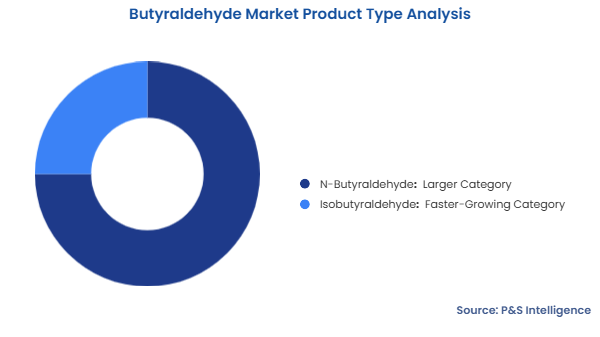
N-Butyraldehyde is the larger category, holding a market share of 75%, because it is widely used across large-volume oxo-chemical and industrial synthesis routes. Manufacturers utilise it for producing n-butanol, 2-ethylhexanol, plasticisers, synthetic resins, solvents, and rubber-processing chemicals that support downstream industrial applications. Its demand remains strong where packaging materials, coatings, flexible plastics, and industrial additives require stable chemical intermediates with established processing economics. According to Plastics Europe, world plastics production reached 430.9 million tonnes in 2024, supporting downstream demand for plasticisers, resins, packaging materials, and industrial additives. This is strengthening long-term consumption of n-butyraldehyde across integrated chemical manufacturing and industrial materials supply chains.
Isobutyraldehyde is the faster-growing category, registering a CAGR of approximately 5.0%, because its role is moving beyond basic aldehyde supply into higher-value specialty chemistry. It is a key raw material for isobutanol, neopentyl glycol, coalescing agents, and selected pharmaceutical and agrochemical intermediates. Demand is strengthening as resin producers require better durability, weather resistance, and coating performance. Since the segment starts from a smaller base, capacity additions and wider use in specialty derivatives are supporting faster percentage growth.
The product types analysed in this report are:
N-Butyraldehyde (Larger Category)
Isobutyraldehyde (Faster-Growing Category)
Application Analysis
Chemical Intermediates is the largest category, holding a market share of 40%, due to butyraldehyde’s central role as a building block rather than a final-use chemical. Manufacturers use it to produce alcohols, acids, amines, esters, plasticizers, resins, solvents, and crop-protection intermediates. This creates steady consumption across multiple downstream industries. The category also benefits from integrated chemical plants that convert aldehydes directly into higher-value derivatives, reducing handling complexity and supporting reliable industrial-scale demand.
Synthetic Resins is the fastest-growing category, because resin manufacturers are increasing the use of aldehyde-based intermediates in coating resins, adhesives, engineered plastics, and composite materials. Butyraldehyde derivatives help improve flexibility, adhesion strength, chemical resistance, and processing stability in industrial resin systems used across automotive, construction, and maintenance applications. Demand is increasing where manufacturers require durable surface coatings and lightweight engineered materials for specialised industrial use. According to the International Energy Agency, global electric car sales exceeded 17 million units in 2024, increasing demand for coatings, engineered plastics, adhesives, and composite materials used in automotive production. Chemical producers are therefore expanding resin-intermediate capacity and strengthening supply relationships with downstream coatings and engineered materials manufacturers.
The applications analysed in this report are:
Chemical Intermediates (Largest Category)
Synthetic Resins (Fastest-Growing Category)
Rubber Accelerators
Plasticizers
Others
Grade Analysis
Industrial Grade is the largest category, holding a market share of 60%, as most butyraldehyde consumption is linked with bulk chemical conversion and continuous industrial processing operations. This grade is preferred for producing plasticisers, coatings intermediates, solvents, rubber chemicals, agrochemical building blocks, and synthetic resins where cost efficiency and stable supply are prioritised over ultra-high purity specifications. Integrated oxo-chemical facilities also depend on industrial-grade material to maintain large-scale production continuity across downstream manufacturing applications. According to the World Steel Association, global crude steel production reached 1,849.4 million tonnes in 2025, supporting demand for industrial coatings, protective coating formulations, and related chemical intermediates used across heavy manufacturing. This is sustaining large-scale procurement of industrial-grade butyraldehyde across heavy manufacturing and industrial materials sectors.
Pharmaceutical Grade is the fastest-growing category, because high-purity aldehyde intermediates are gaining importance in drug synthesis, specialty solvents, sterilization-related chemicals, and medical formulation inputs. Healthcare manufacturers require tighter impurity control, reliable documentation, and cleaner processing routes than standard industrial users. Growth is further supported by expanding pharmaceutical production in emerging markets and stronger demand for intermediates used in advanced therapies, diagnostics, and controlled medical environments. This raises demand for higher-specification butyraldehyde grades.
The grades analysed in this report are:
Industrial Grade (Largest Category)
Pharmaceutical Grade (Fastest-Growing Category)
Others
End-User Analysis
Construction is the largest category, because butyraldehyde derivatives are deeply used in materials that support building activity. Plasticizers improve flexibility in PVC products, while resins, coatings, adhesives, and sealants help protect surfaces and extend material life. Demand is especially strong in flooring, pipes, cables, wall coverings, insulation systems, and protective coatings. The category benefits from steady infrastructure spending and residential renovation, where durable and cost-efficient chemical materials remain widely used.
Healthcare is the fastest-growing category, registering a CAGR of approximately 5.5%, because butyraldehyde-based intermediates are increasingly utilised in pharmaceutical synthesis, disinfectant inputs, specialty solvents, and regulated healthcare materials. Manufacturers supplying this segment must maintain cleaner chemistry, controlled impurity levels, and reliable traceability standards to support pharmaceutical and medical applications. Growth is also supported by expanding healthcare infrastructure and increasing production of regulated medical products requiring specialised chemical intermediates. According to the World Health Organization, about 109 million infants worldwide received three DTP3 vaccine doses in 2024, highlighting the scale of regulated global healthcare manufacturing and pharmaceutical supply chains. This is encouraging chemical producers to strengthen high-purity production capabilities and expand supply support for healthcare-related downstream applications.
The end-users analysed in this report are:
Construction (Largest Category)
Healthcare (Fastest-Growing Category)
Automotive
Agriculture
Food and Beverage
Cosmetics
Drive strategic growth with comprehensive market analysis
Butyraldehyde Market Regional Outlook
Asia-Pacific Butyraldehyde Market Analysis
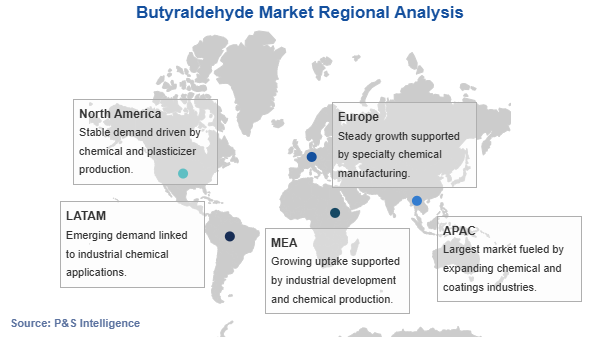
Asia-Pacific holds the largest share and has the highest CAGR, of approximately 5.7%, because the region has a strong concentration of petrochemical manufacturing facilities, integrated chemical production clusters, and expanding downstream demand from plastics, coatings, and industrial material industries. China, Japan, South Korea, and India continue to strengthen regional chemical processing capacity through refinery expansion projects, industrial corridor development, and investment in specialty chemicals. The region also benefits from lower manufacturing costs, improving export capabilities, and rising consumption of construction materials and automotive components that require oxo-alcohol derivatives. In addition, governments across major Asian economies are supporting domestic chemical production to reduce import dependence and strengthen industrial supply chains. Rapid urban development and industrial expansion are further increasing demand for flexible plastics, industrial coatings, and synthetic intermediates across regional manufacturing sectors.
China Butyraldehyde Market Analysis
China is the largest country market, because the country maintains extensive chemical manufacturing capacity, integrated refinery operations, and strong downstream demand for coatings, plasticisers, and engineered materials. Domestic producers continue expanding oxo-chemical production to support construction materials, industrial manufacturing, and packaging applications requiring aldehyde derivatives. Government support for industrial modernisation and chemical self-sufficiency is also strengthening local feedstock integration and production efficiency. According to the National Bureau of Statistics of China, China’s crude oil processing volume reached 737.59 million tonnes in 2025, supporting large-scale refinery and petrochemical production for oxo-alcohol derivative feedstocks. This is reinforcing China’s position as a major supply hub for downstream industrial chemical applications.
India Butyraldehyde Market Analysis
India is the fastest-growing country market, due to rising industrialisation, expanding specialty chemical manufacturing, and increasing investment in downstream plastics and coatings industries. Infrastructure development and automotive manufacturing growth are increasing domestic demand for industrial coatings, flexible plastics, and chemical intermediates used across construction and transportation sectors. Local manufacturers are also expanding production capacity to reduce dependence on imported industrial chemicals and strengthen regional supply availability. According to the Press Information Bureau of India, production of selected major chemicals and petrochemicals reached 58.617 million metric tonnes in FY2025, supporting growth in domestic chemical manufacturing and downstream industrial supply chains. This is encouraging producers to increase local oxo-chemical production and strengthen long-term supply integration across industrial materials markets.
North America Butyraldehyde Market Analysis
North America holds a significant share of the market because the region has a mature petrochemical infrastructure, strong feedstock availability from shale-based production, and well-established downstream chemical industries. The United States and Canada benefit from integrated refining and chemical manufacturing networks that support stable production of butyraldehyde and related oxo-alcohol derivatives. Demand remains supported by industrial coatings, automotive materials, packaging applications, and specialty chemical production. Chemical companies in the region are also investing in process modernization, emission reduction technologies, and operational efficiency improvements to maintain competitiveness. In addition, long-term supply agreements and advanced logistics infrastructure continue to strengthen regional supply chain reliability for industrial chemical manufacturers.
Europe Butyraldehyde Market Analysis
Europe maintains a stable position in the market due to its advanced specialty chemical sector and strong regulatory focus on sustainable industrial production. Countries such as Germany, the U.K., and France are emphasizing high-value chemical applications, energy-efficient manufacturing systems, and environmentally compliant processing technologies. Regional demand is supported by automotive coatings, engineered materials, industrial adhesives, and performance lubricant applications that require chemical intermediates with consistent quality standards. European manufacturers are also focusing on process innovation and low-emission production technologies to align with strict environmental regulations. In addition, growing investment in circular economy initiatives and specialty material development is supporting demand for advanced chemical formulations across industrial sectors.
The regions and countries analysed in this report are:
North America
U.S. (Larger Country)
Canada (Faster-Growing Country)
Europe
Germany (Largest Country)
U.K. (Fastest-Growing Country)
France
Italy
Spain
Rest of Europe
Asia-Pacific (Largest and Fastest-Growing Regional Market)
China (Largest Country)
India (Fastest-Growing Country)
Japan
South Korea
Australia
Rest of APAC
Latin America
Brazil (Largest Country)
Mexico (Fastest-Growing Country)
Rest of LATAM
Middle East and Africa
Saudi Arabia (Largest Country)
U.A.E. (Fastest-Growing Country)
South Africa
Rest of MEA
Butyraldehyde Market Competitive Landscape
The market is semi-consolidated because production is concentrated among a limited number of integrated oxo-chemical manufacturers with established hydroformylation capacity, propylene feedstock access, and downstream production of n-butanol, 2-ethylhexanol, plasticizers, and specialty intermediates. Additionally, companies compete through process efficiency, feedstock integration, operational reliability, and long-term supply agreements with coatings, adhesives, plasticizers, and industrial chemical manufacturers. Furthermore, expansion projects are focused on improving oxo-alcohol capacity, enhancing energy efficiency, and strengthening regional supply chains near major downstream manufacturing clusters. Similarly, producers continue investing in catalyst optimization, process modernization, and emission-control technologies to improve production performance while meeting evolving environmental requirements. High capital requirements, integrated petrochemical infrastructure, and complex process safety standards may continue to limit new market entrants, allowing established manufacturers to maintain strong positions across global butyraldehyde production and downstream chemical value chains.
Leading Companies in the Butyraldehyde Market:
BASF SE
Dow Inc.
Eastman Chemical Company
Mitsubishi Chemical Group Corporation
Saudi Basic Industries Corporation
Perstorp Holding AB
OQ Chemicals GmbH
LG Chem Ltd.
Grupa Azoty Spolka Akcyjna
Arkema S.A.
KH Neochem Co,. Ltd.
Sasol Limited
Butyraldehyde Market News
In March 2026, BASF SE launched butyl acrylate RE and 2-ethylhexyl acrylate RE in collaboration with Avery Dennison Corporation. BASF said the acrylates are made at its Freeport site using attributed renewable electricity. The products are used in polymer dispersion applications for coatings, adhesives and sealants, making the item relevant to acrylate suppliers.
In June 2025, Perstorp Holding AB launched its Synthetic-EF portfolio of saturated synthetic polyol ester base fluids for lubricant manufacturers. The company listed the range under synthetic base fluids for lubricants. This fits the butyraldehyde-linked downstream space because polyol esters use aldehyde-derived polyols and serve industrial lubricant formulation markets across equipment applications.
In May 2025, OQ Chemicals GmbH completed its change from Oxea GmbH and said it had launched dedicated heptanoic acid production at Oberhausen. The company linked the move to its carboxylic acid portfolio. This is relevant to oxo-chemicals because OQ Chemicals supplies aldehydes, alcohols and acids used by downstream chemical manufacturers in multiple sectors.
Frequently Asked Questions About This Report
How is butyraldehyde primarily produced in industrial manufacturing processes?+
Butyraldehyde is mainly produced through the hydroformylation of propylene, using rhodium or cobalt based catalysts. This process provides high efficiency and supports large scale chemical production.
Which industries are the major users of butyraldehyde worldwide?+
Butyraldehyde is widely used by the chemical, automotive, construction, pharmaceutical, agriculture, paints, coatings, and plastics industries. Its derivatives support many industrial manufacturing applications.
Why is butyraldehyde important for plasticizer and resin manufacturing?+
Butyraldehyde is a key raw material for producing 2 ethylhexanol and polyvinyl butyral resins. These materials are widely used in plasticizers, laminated safety glass, and durable coatings.
What factors influence demand for butyraldehyde across different industries?+
Demand is influenced by growth in automotive production, construction activities, pharmaceutical manufacturing, agricultural chemicals, and increasing consumption of coatings, resins, and specialty chemical products.
Want a report tailored exactly to your business need?
Leading companies across industries trust us to deliver data-driven insights and innovative solutions for their most critical decisions. From data-driven strategies to actionable insights, we empower the decision-makers who shape industries and define the future. From Fortune 500 companies to innovative startups, we are proud to partner with organisations that drive progress in their industries.
Client Testimonials
Working with P&S Intelligence and their team was an absolute pleasure – their awareness of timelines and commitment to value greatly contributed to our project's success. Eagerly anticipating future collaborations.
McKinsey & Company
India
Unmatched Standards
Our insights into the minutest levels of the markets, including the latest trends and competitive landscape, give you all the answers you need to take your business to new heights
Complete Data Security
We take a cautious approach to protecting your personal and confidential information. Trust is the strongest bond that connects us and our clients, and trust we build by complying with all international and domestic data protection and privacy laws