This Report Provides In-Depth Analysis of the Biosimilar Contract Manufacturing Market Report Prepared by P&S Intelligence, Segmented by Product Type (Recombinant Non-glycosylated Proteins, Recombinant Glycosylated Proteins, Recombinant Peptides), Source (Mammalian, Non-Mammalian), Service Type (Process Development, Analytical & Quality Control, Fil & Finish, Packaging & Labelling), Therapeutic Area (Oncology, Blood Disorders, Growth Hormonal Deficiency, Autoimmune Disorders, Diabetes & Metabolic Disorders), and Geographical Outlook for the Period of 2019 to 2032
Explore the market potential with our data-driven report
Biosimilar Contract Manufacturing Market Overview
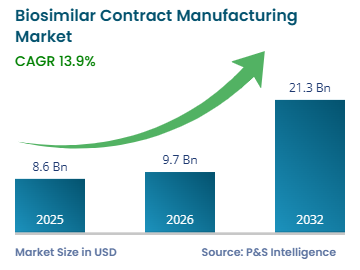
The biosimilar contract manufacturing market size will be an estimated USD 8.6 billion for 2025, and it will grow by 13.9% during 2026–2032, to reach USD 21.3 billion by 2032.
The market expansion is driven by the rising prevalence of chronic diseases, expiration of biologic drug patents, and increasing demand for cost-effective biologics that maintain comparable efficacy to reference products.
The biopharmaceutical industry is witnessing a wave of patent expirations for blockbuster biologics, creating substantial opportunities for biosimilar manufacturers. According to mAbxience, 69 biologic medicines will lose exclusivity by 2030, creating a huge market opportunity. This patent cliff is compelling pharmaceutical companies to outsource biosimilar production to contract manufacturing organizations that possess specialized expertise in biologics development, regulatory compliance, and large-scale manufacturing.
The strategic shift toward outsourcing enables drug developers to reduce capital investments, accelerate time-to-market, and focus resources on innovation rather than manufacturing infrastructure. Furthermore, oncology biosimilars, especially monoclonal antibodies, are a key segment in contract manufacturing, providing cost-effective cancer treatment options without compromising efficacy.
Biosimilar Contract Manufacturing Market Dynamics
Technological Advancements in BiomanufacturingAre Key Trends
Contract manufacturing organizations are investing heavily in advanced biomanufacturing technologies to enhance production efficiency, scalability, and cost-effectiveness.
The adoption of single-use systems, high-capacity bioreactors, continuous bioprocessing, and advanced purification technologies is transforming biosimilar manufacturing.
These innovations reduce production timelines, minimize contamination risks, improve yields, and lower operational costs.
Single-use bioreactors provide flexibility for multi-product facilities, enabling CMOs to serve multiple clients without extensive cleaning validation between production campaigns.
Mammalian cell expression systems, particularly Chinese hamster ovary cells, remain the gold standard for producing complex glycosylated proteins requiring human-like post-translational modifications.
Advancements in cell line development, media optimization, and process analytical technology have significantly improved productivity and consistency.
Contract manufacturers leveraging these cutting-edge capabilities attract pharmaceutical partners seeking rapid scale-up from clinical to commercial manufacturing.
Additionally, CMOs are also expanding internationally to meet regional regulatory requirements, facilitating global biosimilar launches and helping developers accelerate commercialization.
The impending loss of patent protection for numerous blockbuster biologics represents the primary catalyst driving biosimilar contract manufacturing market expansion.
This creates unprecedented opportunities for biosimilar developers and contract manufacturers.
Major biologics, including infliximab, adalimumab, trastuzumab, and rituximab have already lost exclusivity in multiple markets, while additional high-value products, such as pembrolizumab and denosumab, are approaching patent expiration.
The complexity of biosimilar development necessitates specialized manufacturing capabilities that many pharmaceutical companies lack in-house.
Contract manufacturing organizations provide critical infrastructure, including mammalian cell culture platforms, purification systems, analytical capabilities, and regulatory expertise required for biosimilar production.
This outsourcing model enables pharmaceutical companies to enter the biosimilar market rapidly without substantial capital investment in dedicated facilities.
The FDA approved 19 biosimilars in 2024, reaching a record high, with projections indicating 2025 could surpass this milestone, further intensifying demand for contract manufacturing services.
The recombinant non-glycosylated proteins category holds the largest market share, of 55%, in 2025. This dominance stems from the relative simplicity of manufacturing non-glycosylated proteins such as insulin, growth hormones, and granulocyte colony-stimulating factors in microbial expression systems. These molecules do not require complex post-translational modifications, enabling cost-effective production through bacterial fermentation platforms. The established manufacturing processes, shorter development timelines, and lower production costs make non-glycosylated proteins highly attractive for biosimilar developers, particularly in price-sensitive emerging markets.
The recombinant glycosylated proteins category will have the highest CAGR, of 14.2%, driven by the pipeline of complex monoclonal antibody biosimilars and Fc-fusion proteins requiring mammalian cell culture systems. Glycosylation patterns significantly influence protein stability, efficacy, and immunogenicity, necessitating sophisticated manufacturing platforms and extensive analytical characterization. Patent expirations for high-value monoclonal antibodies in oncology and autoimmune treatments are driving strong demand for contract manufacturing services capable of producing these complex molecules.
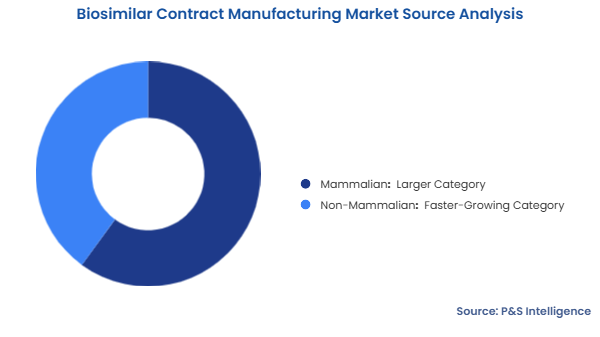
The mammalian category holds the larger market share, of 60%, in 2025, owing to its critical role in producing complex biologics requiring sophisticated post-translational modifications. Mammalian cell systems, particularly CHO cells, provide the eukaryotic cellular machinery necessary for proper protein folding, glycosylation, and other modifications essential for therapeutic efficacy. Approximately 70% of protein therapies have been created from mammalian cells, establishing them as the industry standard for monoclonal antibodies and other complex biologics.
The non-mammalian category will have the higher CAGR, of 14.3%, driven by cost-effectiveness and production efficiency advantages. Microbial systems, including bacterial and yeast platforms, offer faster production times, simpler downstream processing, and significantly lower manufacturing costs compared to mammalian systems. These advantages are particularly compelling for non-glycosylated biosimilars, such as insulin, growth factors, and cytokines, where glycosylation is not therapeutically relevant. Advances in microbial expression technology, including improved protein folding and secretion capabilities, are expanding the range of biosimilars amenable to non-mammalian production.
The sources analyzed in this report are:
Mammalian (Larger Category)
Non-Mammalian (Faster-Growing Category)
Service Type Analysis
The process development category holds the largest market share, of 45%, in 2025, reflecting the critical importance of establishing robust, scalable manufacturing processes for biosimilar production. Process development encompasses cell line development, upstream bioprocess optimization, downstream purification, and formulation development. Biosimilar manufacturers must demonstrate comparability to reference products through extensive analytical characterization, requiring sophisticated process development capabilities.
The fill & finish category will have the highest CAGR, of 14.1%, driven by the increasing number of biosimilars entering commercial production and the need for aseptic filling capabilities. As biosimilars move from clinical development to commercial production, demand grows for fill & finish services, including vial filling, lyophilization, prefilled syringes, and packaging, requiring specialized aseptic capabilities and compliance with strict regulatory standards. The complexity of maintaining sterility throughout filling operations, coupled with stringent regulatory requirements, creates barriers to entry that favor established contract manufacturers with dedicated aseptic filling facilities.
The trend toward prefilled syringes and autoinjectors for patient convenience is driving investment in specialized filling equipment and technologies, further supporting growth in this service segment. The fill–finish manufacturing market produced revenue amounting to USD 11.1 billion in 2024, and it is projected to grow to USD 20.7 billion by 2030, reflecting a compound annual growth rate (CAGR) of 10.9% from 2024 to 2030.
The service types analyzed in this report are:
Process Development (Largest Category)
Analytical & Quality Control
Fill & Finish (Fastest-Growing Category)
Packaging & Labelling
Therapeutic Area Analysis
The oncology category holds the largest market share in 2025, driven by the substantial clinical and economic impact of cancer biologics. Monoclonal antibodies targeting cancer cells represent some of the highest-value biologic therapies, with blockbuster products, including trastuzumab, bevacizumab, and rituximab, losing patent protection. The WHO estimates that 20 million cancer cases were diagnosed in 2022, with projections reaching 35 million cases by 2050. Oncology biosimilars provide critical cost savings for healthcare systems while maintaining therapeutic efficacy, making them highly attractive alternatives to branded products.
The autoimmune disorders category will have the highest CAGR during the forecast period, driven by the massive market opportunity created by adalimumab biosimilars and other anti-inflammatory biologics. Autoimmune conditions, including rheumatoid arthritis, inflammatory bowel disease, psoriasis, and ankylosing spondylitis, affect millions of patients globally, requiring long-term biologic therapy. The patent expiration of adalimumab, one of the world's best-selling drugs, has unleashed unprecedented biosimilar competition and demonstrated the substantial cost savings achievable through biosimilar adoption. The forecast for the autoimmune disease diagnosis market to reach at least USD 10,012.9 million reflects a huge opportunity for targeted biosimilars.
The therapeutic areas analyzed in this report are:
Oncology (Largest Category)
Blood Disorders
Growth Hormonal Deficiency
Autoimmune Disorders (Fastest-Growing Category)
Diabetes & Metabolic Disorders
Others
Drive strategic growth with comprehensive market analysis
North America Biosimilar Contract Manufacturing Market Size
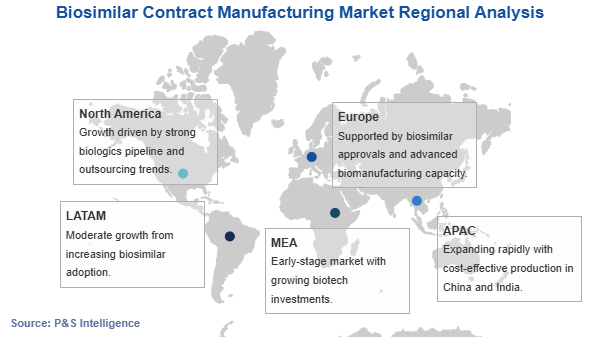
North America holds the largest market share, of 40%, in 2025, driven by the region's advanced biopharmaceutical infrastructure, strong regulatory framework, and increasing biosimilar adoption. The extensive R&D activities, early adoption of innovative biomanufacturing technologies, and strong payer incentives promoting cost-effective biosimilars further boost the North America biosimilar contract manufacturing market.
U.S. Biosimilar Contract Manufacturing Market Size
The U.S. government actively promotes biosimilar adoption through policy initiatives aimed at reducing healthcare costs, with the FDA introducing streamlined approval pathways that eliminate unnecessary clinical testing requirements. The FDA approved 19 biosimilars in 2024, reaching a record high, demonstrating regulatory support for biosimilar development. The region benefits from the presence of leading contract manufacturing organizations, including Catalent, Thermo Fisher Scientific, and Avid Bioservices, which provide comprehensive biosimilar manufacturing services. Numerous small and mid-sized biotech companies in the U.S. rely on contract manufacturers to commercialize biosimilar molecules due to limited internal manufacturing capacity. The high cost of establishing biologics manufacturing facilities creates barriers to vertical integration, favoring outsourcing partnerships with specialized CMOs.
Additionally, the substantial number of biologic patents expiring in the U.S. market, combined with increasing payer pressure for cost-effective therapies, is accelerating biosimilar adoption and driving demand for contract manufacturing services. The region's mature healthcare market, coupled with sophisticated reimbursement systems and strong intellectual property protections, provides an attractive environment for biosimilar commercialization.
Asia-Pacific will have the highest CAGR, of 14.0%. The region benefits from substantial cost advantages in biomanufacturing, skilled scientific workforce, improving regulatory frameworks, and increasing healthcare expenditures. The region's large patient populations affected by cancer, diabetes, and autoimmune disorders create substantial demand for affordable biologic therapies. WHO data indicates that 49.2% of all cancer cases and 56.1% of all cancer deaths occurred in Asia in 2022, highlighting the clinical need for accessible biosimilar therapies.
South Korea Biosimilar Contract Manufacturing Market Size
South Korea has established significant biosimilar manufacturing capabilities and is attracting partnerships from global pharmaceutical companies. South Korean companies Samsung Biologics and Celltrion have emerged as global leaders in biosimilar contract manufacturing, investing heavily in large-scale production capacity and forming strategic partnerships with multinational pharmaceutical companies. The region's combination of technical capabilities, cost competitiveness, and market access positions it for sustained growth in biosimilar contract manufacturing.
Europe Biosimilar Contract Manufacturing Market Size
Europe held a significant share in the biosimilar contract manufacturing market in 2025, benefiting from its pioneering role in biosimilar regulation and extensive manufacturing infrastructure. The European Medicines Agency has approved 86 biosimilars since 2006, establishing the region as the global leader in biosimilar adoption. European countries facing rising healthcare expenditures have actively promoted biosimilar utilization through favorable reimbursement policies, physician education initiatives, and procurement strategies. The region hosts numerous contract manufacturing organizations, including Lonza, Boehringer Ingelheim, and Rentschler Biopharma, which offer end-to-end biosimilar manufacturing services from cell line development through commercial production.
Europe’s robust regulations, advanced technical expertise, and high-quality standards make its CMOs attractive partners for biosimilar developers worldwide. European healthcare systems have demonstrated higher biosimilar penetration rates compared to other regions, with some national markets achieving biosimilar market shares exceeding 80% for certain molecules, validating the commercial viability and clinical acceptance of these products.
The regions and countries studied are as follows:
North America (Largest Regional Market)
U.S. (Larger Country)
Canada (Faster-Growing Country)
Europe
Germany (Largest Country)
U.K.
France (Fastest-Growing Country)
Italy
Spain
Rest of Europe
Asia-Pacific (Fastest-Growing Regional Market)
China (Largest Country)
India (Fastest-Growing Country)
Japan
South Korea
Australia
Rest of APAC
Latin America
Brazil (Largest Country)
Mexico (Fastest-Growing Country)
Rest of LATAM
Middle East and Africa
Saudi Arabia (Largest Country)
South Africa (Fastest-Growing Country)
U.A.E.
Rest of MEA
Biosimilar Contract Manufacturing Market Share
The market is semi-consolidated, characterized by the dominance of a few large global players while mid-sized and regional companies continue to serve specialized niches. Leading firms such as Samsung Biologics, Lonza, Boehringer Ingelheim, Catalent, and Biocon hold substantial market share, leveraging advanced technical capabilities, regulatory expertise, and global manufacturing networks. However, smaller organizations and emerging companies play a significant role by focusing on specialized capabilities, therapeutic areas, or cost advantages in regions like India and China. Mid-sized players focus on specialized capabilities or specific therapeutic areas, while emerging companies leverage cost advantages in regions such as India and China, reflecting the ongoing fragmentation alongside consolidation, defining the semi-consolidated nature of the market.
Key Biosimilar Contract Manufacturing Companies:
Samsung Biologics
Lonza
Boehringer Ingelheim Biopharmaceuticals GmbH
Catalent, Inc.
Biocon Biologics
Thermo Fisher Scientific Inc.
WuXi Biologics
Fujifilm Diosynth Biotechnologies
AGC Biologics
Rentschler Biopharma SE
Celltrion
Pfizer CentreOne
Biosimilar Contract Manufacturing Market News
In April 2025, Lotte Biologics Co. Ltd. inaugurated a new U.S. facility to provide comprehensive antibody–drug conjugate services, expanding its contract manufacturing capabilities for complex biologics and positioning the company to serve the growing ADC market segment.
In November 2024, Chime Biologics Co. Ltd. entered into an agreement with MedPacto for biologic production, strengthening its footprint in the Asian biosimilar contract manufacturing sector and broadening its client base.
In October 2024, Teva Pharmaceuticals Industries Ltd. partnered with mAbxience Holdings S.L. under a global licensing agreement to develop an anti-PD-1 oncology biosimilar, reflecting ongoing interest in immuno-oncology biosimilars and strategic collaborations between pharmaceutical and biosimilar developers.
In May 2024, Boehringer Ingelheim Biopharmaceuticals GmbH announced an agreement with Quallent Pharmaceuticals Ltd. to enhance biosimilar product availability, leveraging Quallent's distribution network and expertise to improve patient access to affordable biologic therapies.
In September 2023, Abbott Laboratories entered a collaboration with mAbxience Holdings S.L. to launch biosimilars targeting oncology, women's health, and respiratory conditions in emerging markets, with initial launches expected in 2025 pending clinical trial completion and regulatory approvals.
In June 2023, Samsung Biologics Co. Ltd. announced a long-term partnership with Pfizer Inc. to manufacture Pfizer's biosimilar portfolio, focusing on large-scale production for oncology, inflammation, and immunology biosimilars to expand global accessibility.
Want a report tailored exactly to your business need?
Leading companies across industries trust us to deliver data-driven insights and innovative solutions for their most critical decisions. From data-driven strategies to actionable insights, we empower the decision-makers who shape industries and define the future. From Fortune 500 companies to innovative startups, we are proud to partner with organisations that drive progress in their industries.
Client Testimonials
Working with P&S Intelligence and their team was an absolute pleasure – their awareness of timelines and commitment to value greatly contributed to our project's success. Eagerly anticipating future collaborations.
McKinsey & Company
India
Unmatched Standards
Our insights into the minutest levels of the markets, including the latest trends and competitive landscape, give you all the answers you need to take your business to new heights
Complete Data Security
We take a cautious approach to protecting your personal and confidential information. Trust is the strongest bond that connects us and our clients, and trust we build by complying with all international and domestic data protection and privacy laws