This Report Provides In-Depth Analysis of the Battery Recycling Equipment Market Report Prepared by P&S Intelligence, Segmented by Equipment Type (Shredders, Hydrometallurgical Equipment, Crushers, Separators, Sorting Systems, Pyrometallurgical Equipment, Direct Recycling Equipment), Recycling Process (Mechanical Processing, Hydrometallurgical Processing, Pyrometallurgical Processing, Direct Recycling), Battery Type (Lithium-Ion Batteries, Lead-Acid Batteries, Nickel-Cadmium Batteries, Nickel-Metal Hydride Batteries, Solid-State Batteries), Source of Battery Waste (Manufacturing Scrap, End-of-Life Batteries, Consumer Collection Waste, Industrial Battery Waste), End-User (Automotive, Energy Storage Systems, Consumer Electronics, Industrial, Telecommunications, Aerospace & Defense), and Geographical Outlook for the Period of 2021 to 2032
Explore the market potential with our data-driven report
Battery Recycling Equipment Market Future Outlook
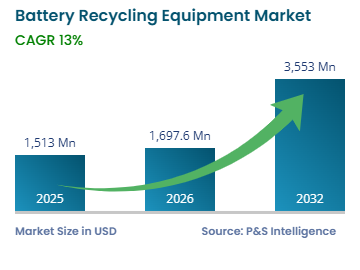
The battery recycling equipment market size was USD 1,513.0 million for 2025, and it will grow by 13.0% during 2026-2032, to reach USD 3,553.0 million by 2032.
The market is expanding as electric vehicles, energy storage systems, and portable electronics create a growing pipeline of batteries that will require safe dismantling, chemistry-based sorting, mechanical separation, and material recovery. Electric vehicle sales do not create immediate recycling demand because most traction batteries remain in service for several years, but higher annual sales increase the future volume of end-of-life packs that recycling plants must be prepared to process. Stricter hazardous waste rules are pushing recyclers, battery manufacturers, and automakers to invest in more controlled recycling infrastructure, while the need to recover lithium, nickel, cobalt, and graphite is strengthening demand for equipment that can improve yield and reduce dependence on newly mined raw materials.
According to the International Energy Agency, global electric car sales exceeded 17 million in 2024, reaching more than 20% of total car sales and expanding the future battery feedstock available for recycling. As these batteries reach the end of their service life, the growing feedstock is expected to support investment in automated shredders, discharging systems, sorting lines, black mass separation equipment, and refining units designed for different battery formats and chemistries. Advances in hydrometallurgical and direct recycling processes are also changing equipment requirements, as operators need systems that can protect material purity, improve worker safety, and deliver reusable battery-grade outputs. Asia Pacific remains central because of its large lithium-ion battery production ecosystem, while North America and Europe are expanding domestic recycling capacity to support critical mineral security and localized battery supply chains.
Key Market Insights
Shredders are the largest equipment type, holding a market share of 30%, due to their primary role in battery size reduction.
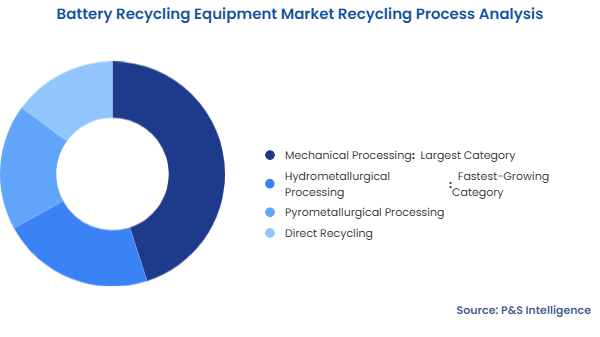
Hydrometallurgical processing is the fastest-growing process type, registering a CAGR of approximately 13.3%, driven by higher metal recovery efficiency and lower environmental impact.
Lithium-ion batteries are the largest and fastest-growing battery type, holding a market share of 35% and registering a CAGR of approximately 13.5%, due to rising EV and energy storage battery use.
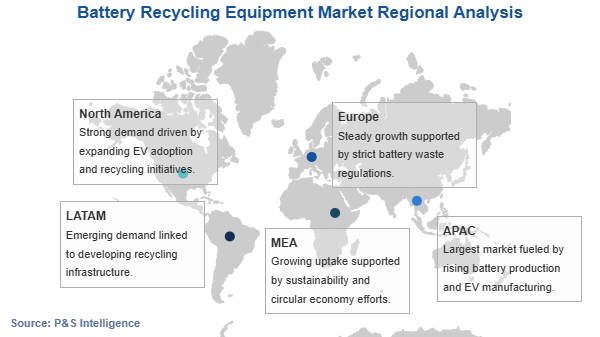
Asia-Pacific holds the largest share, of 40%, and has the highest CAGR, of approximately 13.9%, due to its strong electric vehicle, battery manufacturing, electronics production, and expanding battery recycling ecosystem.
China holds the largest country, due to its large EV manufacturing base, battery production capacity, and recycling infrastructure.
Battery Recycling Equipment Market Trends and Drivers
Integration of AI-Based Sorting and Robotic Disassembly Systems Is a Major Trend
Battery recycling equipment manufacturers are moving toward AI-based sorting, robotic disassembly, and integrated processing lines as lithium-ion battery waste becomes more varied by chemistry, pack design, and safety risk. Conventional systems often separate discharge, teardown, shredding, sorting, and refining into slower standalone steps, while integrated lines connect these stages through automated handling, sensors, and process controls. According to the International Energy Agency, global battery cell manufacturing capacity grew almost 30% in 2024 to more than 3 TWh, expanding cell output and raising production scrap volumes that must be identified, separated, and recycled before downstream recovery. Technology suppliers are responding with flexible automation platforms. In 2025, Comau highlighted its turnkey e-mobility portfolio at Battery Show Dubai, and its related Flex-BD system is described as a fully automated solution for sustainable battery recycling and second-life repurposing. AI-enabled sorting and robotic dismantling are reshaping competition by pushing equipment manufacturers to offer safer, higher-throughput, and more chemistry-flexible recycling systems.
Rising Volume of End-of-Life Electric Vehicle Batteries Drives Market
The rising installed base of electric vehicle and stationary storage batteries is strengthening long-term demand for battery recycling equipment used in discharge, pack dismantling, sorting, shredding, and refining. This demand is expected to increase over time as the growing installed battery base generates larger volumes of manufacturing scrap and end-of-life batteries requiring recycling. According to the International Energy Agency, EV battery deployment reached 1.2 TWh in 2025, almost 30% higher than 2024, expanding the installed base that recycling facilities must eventually handle. Regulatory requirements for safe disposal, producer responsibility, and recycled-content targets are pushing operators to invest in controlled processing systems that can recover lithium, nickel, cobalt, and graphite while reducing hazardous waste risks. The same equipment need is extending into stationary storage, as the International Energy Agency reported 63 GW of utility-scale storage additions in 2024, raising installed capacity to 124 GW.
High Capital Investment and Complex Battery Handling Procedures Limit Market Expansion
High capital costs and safety complexity restrain battery recycling equipment adoption, especially for operators handling damaged, high-voltage, or mixed-chemistry lithium-ion packs. These packs can contain residual charge, volatile electrolytes, inconsistent module layouts, and fire-damaged fractions, so recyclers often need automated discharge, inert-atmosphere drying, emission control, explosion protection, and segregated material-handling systems before shredding or refining. Regulation adds another barrier because compliance requires documented treatment, worker protection, and recovery performance, not only basic installation spending. Under the European Union Batteries Regulation, lithium-based waste batteries must meet a 65% recycling efficiency target by the end of 2025. ANDRITZ’s 2026 helix dryer launch, using vacuum-based closed-loop inert processing, shows how safety requirements are pushing equipment toward more specialized and costly designs.
Expansion of Closed-Loop Battery Manufacturing Ecosystems Creates Growth Opportunities
The closed-loop battery manufacturing opportunity is strengthening demand for equipment makers that supply shredding, sorting, purification, and refining systems for regional recycling plants. Automakers and cell producers are seeking higher recovery of lithium, nickel, cobalt, and graphite, while government incentives and recycled-content rules encourage investment in facilities that can return recovered materials to new battery production. According to the International Energy Agency, battery demand across electric vehicles and storage applications reached 1 TWh in 2024. This expanding battery base is expected to increase manufacturing scrap in the near term and end-of-life battery volumes over the longer term, supporting demand for advanced battery recycling equipment. Equipment suppliers that can process multiple chemistries and support traceable closed-loop operations are positioned for stronger adoption across North America and Europe.
Shredders are the largest category, holding a market share of 30%, because shredding systems perform the initial size reduction stage required before sorting, separation, and black mass recovery operations. Battery recyclers use these systems across lithium-ion, lead-acid, and industrial battery processing facilities to handle mixed battery formats safely and improve downstream material recovery efficiency. In 2025, ANDRITZ signed a lithium-ion battery recycling cooperation agreement with Duesenfeld to supply recycling plants and equipment, including shredders and dryers, reflecting rising industrial demand for integrated shredding systems supporting large-scale battery dismantling and material processing operations.
Hydrometallurgical Equipment is the fastest-growing category, registering a CAGR of approximately 13.7%, due to increasing industry preference for high-recovery recycling technologies capable of extracting lithium, nickel, cobalt, and manganese with improved purity levels. Recycling companies are investing in hydrometallurgical systems because these processes support lower emissions and higher material recovery efficiency compared to conventional thermal methods. Demand is also rising as battery manufacturers seek sustainable raw material sourcing and closed-loop production models. Expanding lithium-ion battery recycling operations are further accelerating the adoption of advanced chemical recovery and purification equipment.
Mechanical Processing is the largest category, holding a market share of 45%, because it serves as the foundation of most battery recycling workflows and is required for dismantling, crushing, sorting, and material separation activities. Recycling facilities widely adopt mechanical processing systems due to their ability to handle large battery volumes across multiple chemistries with lower operational complexity. These systems are also essential for preparing black mass and recyclable materials for further refining stages. Rising deployment of lithium-ion battery recycling plants is continuing to support demand for advanced mechanical processing technologies globally.
Hydrometallurgical Processing is the fastest-growing category, registering a CAGR of approximately 13.3%, because recyclers are increasingly adopting processes that improve recovery efficiency for lithium, nickel, cobalt, and other battery metals while reducing environmental impact. The process supports selective extraction of battery materials with higher purity and lower energy consumption than several conventional alternatives. In 2024, Mercedes-Benz opened Europe’s first battery recycling plant using an integrated mechanical-hydrometallurgical process, highlighting rising investments in advanced recovery technologies supporting battery-grade material reuse and stricter environmental processing standards across lithium-ion battery recycling operations.
The recycling processes analysed in this report are:
Lithium-Ion Batteries are the largest and fastest-growing category, registering a CAGR of approximately 13.5%, because electric vehicles, energy storage systems, and portable electronics are rapidly increasing global lithium-ion battery consumption. Rising volumes of end-of-life batteries and manufacturing scrap are increasing demand for recycling equipment capable of recovering lithium, graphite, cobalt, and nickel efficiently across industrial-scale processing facilities. Global lithium-ion battery manufacturing capacity exceeded 4 TWh by the end of 2025, according to the International Energy Agency, expanding the future volume of manufacturing scrap and end-of-life batteries available for recycling. This expanding feedstock is expected to support long-term demand for shredding, sorting, separation, and refining systems supporting lithium-ion battery recycling infrastructure.
The battery types analysed in this report are:
Lithium-Ion Batteries (Largest and Fastest-Growing Category)
Manufacturing scrap is the largest category, holding a market share of 45%, because battery gigafactories generate defective cells, electrode residues, and production waste during cell manufacturing. These materials are usually more consistent and easier to collect than post-consumer batteries, supporting steady feedstock availability for recycling equipment. In 2025, BMW Group and Encory officially commissioned the Cell Recycling Competence Center in Salching, where direct recycling mechanically processes residual materials from battery cell production and complete cells. The recovered raw materials are planned for reuse in BMW Group’s pilot battery cell production, supporting closed-loop manufacturing operations.
End-of-Life Batteries are the fastest-growing category, due to the rising number of electric vehicle batteries reaching replacement and disposal stages across global markets. Ageing consumer electronics, renewable energy storage systems, and industrial battery installations are also contributing to higher battery waste volumes, requiring specialised recycling infrastructure. Governments and automotive manufacturers are increasingly supporting organised battery collection and recycling programs to reduce environmental risks and recover valuable materials. This trend is accelerating investments in advanced dismantling, sorting, discharge, and material recovery systems designed specifically for end-of-life battery processing operations.
The source of battery wastes analysed in this report are:
Manufacturing Scrap (Largest Category)
End-of-Life Batteries (Fastest-Growing Category)
Consumer Collection Waste
Industrial Battery Waste
End-User Analysis
Automotive is the largest category, holding a market share of 35%, because electric vehicle production creates the strongest equipment demand for lithium-ion pack dismantling, discharge, shredding, sorting, and refining. EV packs contain recoverable lithium, cobalt, nickel, and manganese, making automotive battery streams commercially attractive for recyclers and equipment suppliers. Automakers are also preparing for future replacement volumes, while stricter mobility-focused recycling rules are encouraging investment in higher-capacity processing lines.
Energy Storage Systems are the fastest-growing category, as the same recycling equipment need is extending from vehicles to stationary storage projects. Utilities and renewable energy operators are deploying large-format storage systems that will later require safe decommissioning, controlled discharge, and chemistry-based processing. According to the International Energy Agency, 108 GW of new battery storage capacity was deployed worldwide in 2025, supporting the long-term demand for shredding, discharge, separation, and material recovery equipment as these battery systems reach end of life.
The end-users analysed in this report are:
Automotive (Largest Category)
Energy Storage Systems (Fastest-Growing Category)
Consumer Electronics
Industrial
Telecommunications
Aerospace & Defense
Others
Drive strategic growth with comprehensive market analysis
Battery Recycling Equipment Market Regional Outlook
Asia-Pacific holds the largest share, of 40%, and has the highest CAGR, of approximately 13.9%, because the region combines upstream cell production, downstream electronics assembly, electric vehicle manufacturing, and operating recycling capacity more tightly than other geographies. The regional advantage is not only volume; it is the presence of equipment suppliers, cathode and anode material processors, and fast project execution across China, Japan, and South Korea. According to the International Energy Agency, China accounted for 80% of global battery cell production in 2024, while China, Korea, and Japan led lithium-ion battery manufacturing equipment supply. This concentration gives Asia-Pacific a larger pool of production scrap, used packs, and process know-how. Equipment manufacturers gain long-term opportunities in automated pre-treatment lines, black mass handling systems, electrolyte control units, and recovery technologies built for high-throughput battery operations, especially as battery formats and chemistries diversify.
China Battery Recycling Equipment Market Analysis
China leads the country-level market because its electric vehicle output, cell production base, and power battery recycling standards create higher processing volumes than any other national market. The State Council Information Office of China reported that domestic retired power battery volume was about 400,000 metric tons in 2024, while recycling volume exceeded 300,000 metric tons. This large volume of retired and recycled batteries supports the need for automated disassembly, safe discharge, crushing, material classification, and wet-process recovery systems capable of continuously processing automotive, industrial, and energy storage battery streams.
India is emerging as a developing market because its battery recycling equipment demand is tied to fast electric two-wheeler adoption, early cell manufacturing investments, and the need to formalize collection from a fragmented vehicle base. According to the Press Information Bureau of India, 1,950,490 electric vehicles were sold in 2024, accounting for 7.44% of total vehicle sales. This expanding electric vehicle base is expected to support future demand for modular discharge systems, safer pack-opening tools, and chemistry-sensitive processing equipment as batteries gradually reach end of life and collection networks mature.
North America Battery Recycling Equipment Market Analysis
North America is witnessing steady growth because the region is using policy support, domestic battery manufacturing investments, and critical mineral security initiatives to build a localized battery value chain. The United States is encouraging battery recycling and material processing through government-backed funding programs, while automakers and cell producers are expanding regional battery plants that will generate production scrap and future end-of-life battery volumes. This creates demand for equipment used in safe discharge, pack diagnostics, automated dismantling, black mass processing, and hydrometallurgical recovery. Canada adds further momentum through critical mineral development and clean industrial supply-chain projects. For equipment manufacturers, North America offers long-term opportunities in recycling systems that support domestic material recovery, supply security, and lower dependence on imported battery inputs.
Europe Battery Recycling Equipment Market Analysis
Europe is experiencing steady expansion because battery regulations and circular economy initiatives are turning recycling equipment into a compliance-driven investment area. The European Union Batteries Regulation places stronger responsibility on producers, supports higher collection and recovery requirements, and encourages recycled material use in new batteries. These rules are pushing recyclers, automakers, and battery manufacturers to invest in controlled dismantling, emission management, safe storage, material traceability, and advanced recovery systems. Europe’s advantage is not low-cost scale, but strict sustainability standards and a clear policy push toward circular battery supply chains. This creates long-term opportunities for equipment manufacturers that can provide automated, audit-ready, and energy-efficient systems capable of handling multiple lithium-ion chemistries while supporting regional circular economy goals.
The regions and countries analysed in this report are:
North America
U.S. (Larger Country)
Canada (Faster-Growing Country)
Europe
Germany (Largest Country)
U.K. (Fastest-Growing Country)
France
Italy
Spain
Rest of Europe
Asia-Pacific (Largest and Fastest-Growing Regional Market)
China (Largest Country)
India (Fastest-Growing Country)
Japan
South Korea
Australia
Rest of APAC
Latin America
Brazil (Largest Country)
Mexico (Fastest-Growing Country)
Rest of LATAM
Middle East and Africa
Saudi Arabia (Largest Country)
U.A.E. (Fastest-Growing Country)
South Africa
Rest of MEA
Battery Recycling Equipment Market Share Analysis
The market is fragmented because battery recycling equipment demand varies by battery chemistry, pack format, recycling route, and regional processing requirement. Lithium iron phosphate, nickel manganese cobalt, and other lithium-ion chemistries require different handling, separation, and recovery methods, while mechanical, hydrometallurgical, pyrometallurgical, and direct recycling processes use different equipment configurations. This allows specialized equipment providers, regional engineering firms, automation companies, and recycling technology startups to compete in specific stages of the value chain instead of one company dominating the full market. Companies differentiate through customized shredding lines, discharge systems, sorting technologies, chemical processing units, robotics, and integrated plant designs. Fragmentation is also encouraging strategic partnerships between recyclers, automakers, and equipment suppliers, as companies combine process expertise with project execution capabilities. This competitive structure supports faster innovation, application-specific product development, and stronger differentiation across battery recycling equipment solutions.
Key Players in the Battery Recycling Equipment Market:
ANDRITZ AG
Hosokawa Micron Corporation
EKATO HOLDING GmbH
Metso Corporation
BHS-Sonthofen GmbH
SSI Shredding Systems, Inc.
Shred-Tech Corporation
Eldan Recycling A/S
Mettherm Inc.
SMS group GmbH
Grand Energy Manufacturing Co., Ltd.
Miracle Automation Engineering Co., Ltd.
Gongyi City Xiangrui Machinery Manufacturing Co., Ltd.
In February 2025, ANDRITZ AG signed a cooperation agreement with Duesenfeld to deliver lithium-ion battery recycling plants by combining Duesenfeld's patented recycling process with ANDRITZ's engineering expertise and shredding and drying equipment. The collaboration strengthens the market for integrated battery recycling equipment and turnkey plant solutions.
In March 2025, Primobius GmbH partnered with Watercycle Technologies to integrate advanced hydrometallurgical recovery technologies into lithium-ion battery recycling projects, enhancing end-to-end battery recycling plant capabilities and metal recovery efficiency.
In September 2025, SMS group GmbH acquired Primobius, making it a wholly owned subsidiary to accelerate the global deployment of industrial-scale lithium-ion battery recycling plants and strengthen its battery recycling equipment portfolio.
Frequently Asked Questions About This Report
What factors are driving growth in the battery recycling equipment market?+
Market growth is driven by rising electric vehicle adoption, expanding battery manufacturing, stricter recycling regulations, increasing battery waste, and the growing need to recover valuable materials such as lithium, nickel, cobalt, and graphite.
What types of equipment are used in battery recycling plants?+
Battery recycling plants use discharge systems, shredders, crushers, sorting systems, separators, hydrometallurgical equipment, pyrometallurgical equipment, and direct recycling systems to safely process spent batteries and recover valuable materials.
What are the major challenges in the battery recycling equipment market?+
Key challenges include high capital investment, battery chemistry diversity, fire and safety risks, complex processing requirements, and evolving regulatory standards.
How does battery recycling equipment improve material recovery?+
Advanced recycling equipment enables efficient battery dismantling, material separation, and recovery of valuable metals while improving safety and reducing material losses.
How are closed-loop battery manufacturing ecosystems creating opportunities for battery recycling equipment?+
Closed-loop battery manufacturing is increasing demand for advanced recycling equipment that enables the recovery and reuse of valuable battery materials in new battery production, supporting circular economy initiatives.
Want a report tailored exactly to your business need?
Leading companies across industries trust us to deliver data-driven insights and innovative solutions for their most critical decisions. From data-driven strategies to actionable insights, we empower the decision-makers who shape industries and define the future. From Fortune 500 companies to innovative startups, we are proud to partner with organisations that drive progress in their industries.
Client Testimonials
Working with P&S Intelligence and their team was an absolute pleasure – their awareness of timelines and commitment to value greatly contributed to our project's success. Eagerly anticipating future collaborations.
McKinsey & Company
India
Unmatched Standards
Our insights into the minutest levels of the markets, including the latest trends and competitive landscape, give you all the answers you need to take your business to new heights
Complete Data Security
We take a cautious approach to protecting your personal and confidential information. Trust is the strongest bond that connects us and our clients, and trust we build by complying with all international and domestic data protection and privacy laws