This Report Provides In-Depth Analysis of the Solid Oxide Fuel Cell Market Report Prepared by P&S Intelligence, Segmented by Type (Planar, Tubular), Application (Portable, Stationary, Transport), End User (Commercial & Industrial, Data Centers, Military & Defense, Residentials), and Geographical Outlook for the Period of 2019 to 2032
Explore the market potential with our data-driven report
Solid Oxide Fuel Cell Market Future Outlook
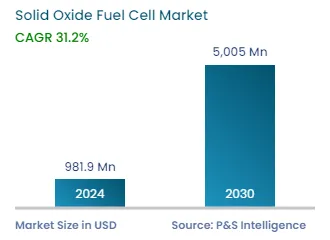
The solid-oxide fuel cell market was valued at USD 2.2 billion in 2024, which is expected to reach USD 12.4 billion by 2032, growing at a CAGR of 24.3% during 2025-2032. This is primarily ascribed to the superior efficiency, long-term stability, and fuel flexibility of solid oxide fuel cells, the increasing government subsidies and R&D on fuel cells, the rising need for energy-efficient power production, strict pollution rules and regulations, increased environmental concerns, and the growing emphasis on the utilization of renewable energy sources.
Their high electrical efficiency—up to 60%—and combined energy yield reaching 90% make them ideal for continuous, reliable power needs. Major players like Bloom Energy, Ceres Power, and Mitsubishi Power are rolling out systems in industrial sites, urban facilities, and residential projects. SOFCs are being developed for heavy-duty trucks, ships, and auxiliary power units (APUs) for aircraft and refrigerated trucks, offering quieter, fuel-flexible alternatives to traditional generators. Notably, Cummins tested an SOFC-based APU for heavy trucks in North America.
Portable SOFCs are appealing for military, telecommunications, and disaster relief, thanks to their silent operation, high energy density, and off-grid capabilities. These systems deliver reliable power in harsh, remote environments. Recent investments have backed SOFCs in hydrogen production and electrolyzers. In November 2024, Bloom Energy Corporation and American Electric Power Company Inc. agreed to deploy up to 1 GW of SOFC capacity in North America. Robert Bosch GmbH commissioned a pilot plant in Germany in early 2025 to commercialize industrial SOFC units. Mitsubishi Power tested a 250-kW hybrid SOFC–gas turbine cogeneration system at a steel plant in Japan.
Solid Oxide Fuel Cell Market Trends & Drivers
Government Incentives and R&D in Fuel Cells Are Major Trends
Government regulations and support for fuel cells are one of the key trends in the market.
For instance, the U.S. introduced several fuel cell programs and offers incentives and support for fuel cell installations, resulting in the high adoption of solid oxide fuel cells and other fuel settings in the country.
For instance, in October 2024, the U.S. Department of Energy (DOE) released a notice of funding opportunity for up to $46 million to accelerate the research, development, and demonstration of affordable clean-hydrogen and fuel cell technologies.
Moreover, in the APAC region, China, South Korea, and Japan are some of the well-known nations that are focusing on various applications of SOFCs, such as utility-scale power generation, and offering subsidies for these cells.
The R&D is focused on improving durability, reducing operating temperatures, and expanding fuel flexibility.
Leading institutions and corporations are collaborating on next-generation SOFC systems.
Ceres Power Holdings plc is developing high-efficiency, low-temperature SOFCs in the U.K. suitable for mass manufacturing.
In Japan, Mitsubishi Power, a subsidiary of Mitsubishi Heavy Industries Ltd., is conducting trials on hybrid systems that integrate SOFCs with gas turbines to enhance energy recovery.
Robert Bosch GmbH has launched a major R&D initiative in Germany to commercialize decentralized SOFC units for industrial and residential use.
Additionally, U.S. Department of Energy projects, such as the NETL Solid Oxide Fuel Cell Program, are funding advanced materials research and performance modeling to boost reliability and cost competitiveness.
These efforts aim to make SOFCs more scalable, affordable, and compatible with hydrogen and biofuels for future-ready energy systems.
Demand for High-Energy Efficiency Drives the Industry
Chemical and material technology advancements are enticing industry participants to use low-cost raw materials and attain low operating temperatures.
Additionally, these companies are taking action to reduce manufacturing and operational costs while gaining advantages from the high-energy conversion provided by solid oxide fuel cells.
All these factors are responsible for the SOFC market growth.
Further, the use of clean energy sources has grown due to the expanding global population and rising energy consumption.
With the increasing environmental concerns, governments across the globe are aiming to reduce the consumption of non-renewable energy sources.
In an effort to achieve this, stringent regulations for limiting the usage of non-renewable energy sources are being formed, which are leading to the development and adoption of alternative methods to create electricity.
The fuel cell technology shows high efficiency in energy generation, owing to which it has a huge application base in stationary power generation.
Countries across the world are shifting from traditional, non-renewable sources toward renewable sources of energy, to reduce their dependency on fossil fuels and keep the environment clean.
The regulatory bodies of countries, including the U.S., Japan, and Germany, have framed stringent regulations, to cut down on harmful emissions from several industries, such as power generation, chemicals, and automotive.
SOFCs offer several advantages, including high efficiency, fuel adaptability, and extremely low levels of nitrogen oxide (NOx) and sulfur oxide (Sox) emissions.
Owing to such factors, the demand for such products is projected to increase from several industries in the coming years.
In August 2024, Bloom Energy Holdings unveiled a hydrogen-capable system that is 60% more efficient.
Availability of Substitutes Restrains Market Growth
In the overall fuel cell market, solid-oxide fuel cell holds a quite small share which is majorly due to the limited range of applications.
Proton-exchange-membrane fuel cells are popular due to their versatility in a broad range of applications.
PEM and direct-methanol fuel cells have low operating temperatures which makes them ideal for military purposes, specifically in portable and unmanned systems.
Technologies such as proton exchange membrane fuel cells (PEMFCs), lithium-ion batteries, and traditional diesel or gas generators offer alternative solutions for power generation, especially in sectors where cost, portability, or startup time are critical.
PEMFCs, for instance, operate at lower temperatures and are better suited for automotive and portable applications, where quick startup is essential.
Lithium-ion batteries dominate in energy storage and electric mobility due to lower upfront costs and widespread infrastructure.
These substitutes often offer more mature supply chains, faster deployment, and lower maintenance requirements, making them more attractive to cost-sensitive or space-constrained industries.
As a result, the presence of these alternatives slows SOFC adoption, especially in applications where their higher efficiency and fuel flexibility are not primary concerns.
Solid Oxide Fuel Cell Market Segmentation and Category Analysis
Type Insights
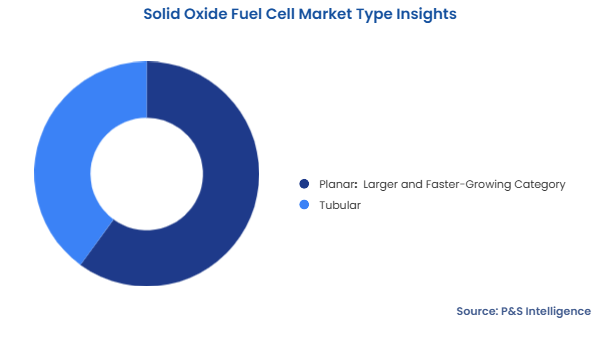
The planar category accounted for a larger revenue share in 2024 and it is also expected to hold its position during 2025–2032. This is primarily ascribed to its easy geometry, relatively easier construction procedure, and low-operating cost. Moreover, planar SOFCs are generally planned in a way that the ceramic fuel cell modules are positioned one above the other like a sandwich design with the electrolyte implanted between electrodes, which serve as the most vital components in the manufacturing of these fuel cells.
Additionally, the increasing stringency of government regulations, coupled with a rise in energy prices, is one of the key trends being observed in the planar SOFC market. With the surging awareness of alternative energy sources, combustion-based electricity generators are being replaced by renewable energy systems, such as solar panels, which display a higher efficiency in energy conversion. In addition, the fuel cells used in these devices do not cause any harmful emissions, owing to which they are suitable for stationary/backup power supply, transportation, and portable power.
This segment has two categories:
Planar (Larger and Faster-Growing Category)
Tubular
Application Insights
The stationary application holds the largest share in the market in 2024. This is related with the stationary solid-oxide fuel cell system which is the most efficient and environmentally friendly technologies for generating heat and electricity. These systems’ performance is evaluated on the basis of three advanced parameters such as durability, net electrical efficiency, and overall efficiency.
The transportation application is expected to grow with the highest CAGR during the forecast period. This is associated with the need for effective and low-emission power sources in marine vessels, heavy-duty vehicles, and auxiliary power units for aircraft. Advanced technologies are improving power density and minimizing system costs which makes solid oxide fuel cells a feasible substitute to traditional propulsion systems. Specifically, the maritime industry is dealing with solid oxide technology to fulfill strict emission regulations and the military sector is considering solid oxide fuel cells for different vehicular platforms.
Further, these applications have been analyzed:
Portable
Stationary (Largest Category)
Transportation (Fastest-Growing Category)
End User Insights
The data centers category accounted for a market share of around 45%, in 2024. This can be because data centers are highly power intensive and power-consuming, and these required a regular power supply around-the-clock to prevent the loss of important data. For instance, in January 2024, Caterpillar Inc. revealed the successful collaboration with Microsoft and Ballard Power Systems to show the potential of large-format hydrogen fuel cells to supply reliable and sustainable backup power for data centers.
The military & defense category is increasing at a steady growth rate. There is a growth opportunity for SOFCs in this sector, due to the surging demand for efficient and noiseless power production for military applications and the rising portable and stationary power generation by SOFCs. With increased chances for continued expansion in the industry, it is projected that portable SOFCs for military use will increase; and unmanned aerial vehicles and undersea vehicles are also using SOFCs to increase working durations.
This segment is divided into four categories:
Commercial & Industrial
Data Centers (Largest and Fastest-Growing Category)
Military & Defense
Residentials
Drive strategic growth with comprehensive market analysis
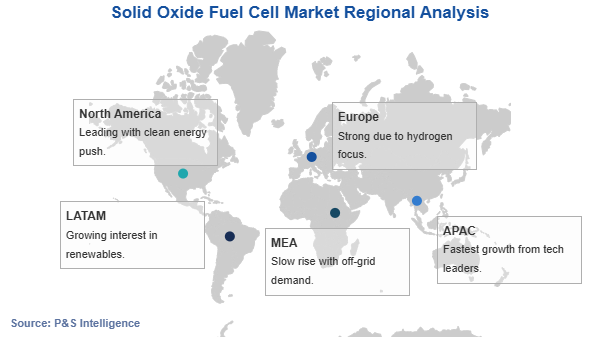
North America held the largest revenue share in 2024, and it is further projected to witness the same trend in the coming years. This is because of the strong support of government policies and initiatives, such as the Department of Energy’s Solid-State Energy Conversion Alliance programs. In the region, the U.S. is a larger and faster-growing market. This is due to the presence of a large number of data centers of major companies, such as IBM, Google, and Equinix, adopting SOFCs; the increased need for fuel cell power generation; tax benefits; and high R&D spending for hydrogen generation.
The market in the APAC region is anticipated to grow with the highest CAGR during the forecast period. APAC region is also expected to hold majority of the share of the global capacity demand in the near future, with Japan being the primary driver of this demand. In this region, solid oxide fuel cells are majorly used in stationary applications, and this segment will have a highest growth rate in the coming years.
In February 2024, Doosan Fuel Cell and Navig8 installed a 9–10 kW SOFC system—based on Ceres Power’s SteelCell platform—aboard a 50,000-ton chemical tanker. Though marine-based, this pilot explores SOFC’s use for clean propulsion and auxiliary power in transport settings, overlapping with heavy-duty EV and hybrid marine power concepts.
The regions and countries analyzed for this report include:
North America (Largest Regional Market)
U.S. (Larger and Faster-Growing Country Market)
Canada
Europe
Germany (Largest and Fastest-Growing Country Market)
Brazil (Largest and Fastest-Growing Country Market)
Mexico
Rest of LATAM
Middle East and Africa (MEA)
South Africa (Largest and Fastest-Growing Country Market)
Saudi Arabia
U.A.E.
Rest of MEA
Solid Oxide Fuel Cell Market Share
The market is fragmented in nature due to many players operating in the market. Major leaders in the market are investing a large sum of money in R&D, manufacturing capacity to drive market growth. Many organizations are utilizing different approaches to enhance efficiency, durability, and fuel flexibility which caters to the categories such as stationary power generation, transportation, and portable applications. Further, the market is also characterized by collaborations and partnerships among industry players, research institutions and governments which further contributes to its fragmented nature.
Key Solid Oxide Fuel Cell Companies:
Bloom Energy
Mitsubishi Power
Aisin Seiki
Kanadevia Corporation
Ceres Power
Adelan Ltd.
Upstart Power
Adaptive Energy
Solid Power
Watt Fuel Cell Corporation
Solid Oxide Fuel Cell Market News & Updates
In June 2025, Mitsui O.S.K. Lines Ltd. (MOL) and Samsung Heavy Industries Co. Ltd obtained the in-principle approval from the Lloyd's Register to design a 174,000-cubic-meter LNG carrier that will be propelled by SOFCs. Bloom Energy Corporation will supply the 300-kW SOFC, which will serve as an auxiliary power generator for the vessel scheduled for delivery in 2027.
In March 2024, Nissan Motor Co. Ltd. commenced trials of a power generation system fueled by bio-ethanol and powered by SOFC at its Tochigi plant, to increase power generation capacity for full-scale operations by 2030.
In March 2023, Bumhan Industries Co. Ltd. and Elcogen AS announced a collaboration to commercialize solid oxide fuel cells and electrolyzers.
In June 2023, Bloom Energy Corporation signed an agreement with Perenco Holdings to install 2.5 Megawatts (MW) worth of its solid-oxide fuel cell technology in England.
In February 2023, Weichai Power Co. Ltd. launched a stationary SOFC system based on technology from Ceres Power Holdings plc, which has EU CE certification from TÜD SÜD and achieved an operational time of 30,000 hours.
Want a report tailored exactly to your business need?
Leading companies across industries trust us to deliver data-driven insights and innovative solutions for their most critical decisions. From data-driven strategies to actionable insights, we empower the decision-makers who shape industries and define the future. From Fortune 500 companies to innovative startups, we are proud to partner with organisations that drive progress in their industries.
Client Testimonials
Working with P&S Intelligence and their team was an absolute pleasure – their awareness of timelines and commitment to value greatly contributed to our project's success. Eagerly anticipating future collaborations.
McKinsey & Company
India
Unmatched Standards
Our insights into the minutest levels of the markets, including the latest trends and competitive landscape, give you all the answers you need to take your business to new heights
Complete Data Security
We take a cautious approach to protecting your personal and confidential information. Trust is the strongest bond that connects us and our clients, and trust we build by complying with all international and domestic data protection and privacy laws