Smart Medical Devices Market Size & Share Analysis - Trends, Drivers, Competitive Landscape, and Forecasts (2026 - 2032)
This Report Provides In-Depth Analysis of the Smart Medical Devices Market Report Prepared by P&S Intelligence, Segmented by Product Type (Diagnostic Monitoring Devices, Smart Drug Delivery Devices, Therapeutic Devices), Connectivity Technology (Bluetooth, Cellular, Wireless Fidelity, Near Field Communication), Distribution Channel (Pharmacies, Online Channels, Medical Equipment Retailers), End User (Hospitals and Clinics, Homecare Settings, Ambulatory Surgical Centers, Diagnostic Centers), and Geographical Outlook for the Period of 2021 to 2032
Explore the market potential with our data-driven report
Smart Medical Devices Market Overview
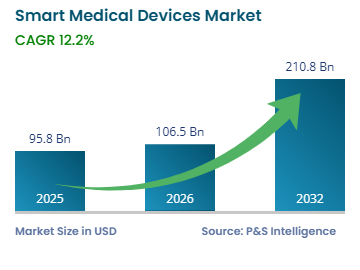
The smart medical devices market size was USD 95.8 billion in 2025, and it will grow by 12.2% during 2026-2032, to reach USD 210.8 billion by 2032.
The smart medical devices market is expanding as healthcare systems increasingly adopt connected care models that support continuous monitoring, faster clinical intervention, and more informed treatment decisions. Smart medical devices are being used across hospitals, clinics, and homecare settings to collect real-time health information and improve visibility into patient conditions. Growing acceptance of wearable technologies, remote monitoring solutions, and home-based healthcare is encouraging wider deployment of connected devices. Healthcare providers are also placing greater emphasis on preventive care and long-term disease management, creating demand for technologies that support ongoing patient engagement and clinical oversight.
The market is further supported by advances in digital health technologies that are improving the functionality and value of connected medical devices. According to the International Telecommunication Union, around 6 billion people, representing 74% of the global population, were using the internet in 2025. Broad internet availability is strengthening the foundation for app-connected medical devices, remote monitoring systems, and digital health platforms that rely on continuous data exchange. Smart medical devices, including network-connected medical devices, are increasingly integrated with telehealth platforms, electronic health records, cloud-based systems, and mobile health applications, allowing healthcare professionals to access patient information more efficiently. These developments are helping healthcare organisations extend care beyond traditional facilities, improve coordination between patients and clinicians, support medical device connectivity, and enable earlier identification of health issues through continuous monitoring and connected healthcare workflows across a growing range of care environments.
Key Market Insights
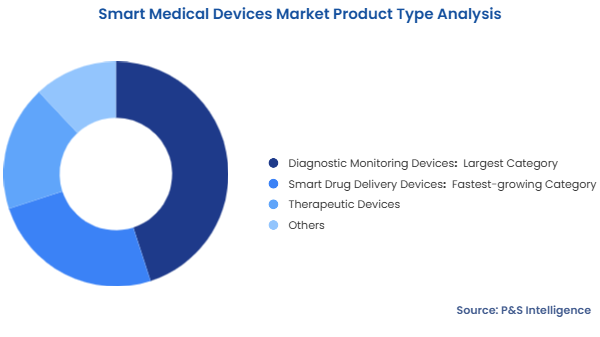
Diagnostic Monitoring Devices is the largest category, holding a market share of 45.0%, due to increasing demand for chronic disease management, early disease detection, and continuous patient assessment.
Cellular is the fastest-growing category, registering a CAGR of 13.3%, driven by rising demand for remote patient monitoring and uninterrupted health data transmission beyond clinical settings.
Pharmacies are the largest distribution channel, holding a market share of 45.0%, due to convenient device access, professional healthcare guidance, and strong patient engagement at the point of purchase.
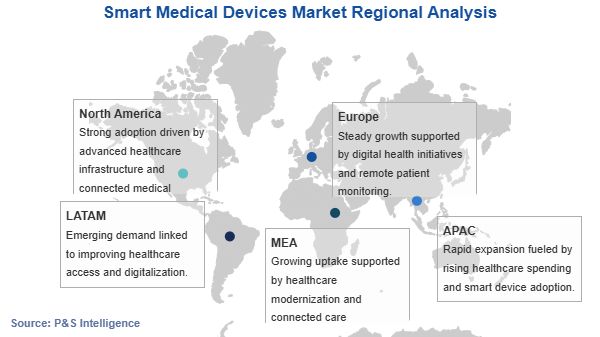
North America holds the largest share of 45.5%, due to advanced connected healthcare environments, widespread remote patient monitoring adoption, and strong digital health innovation.
Asia-Pacific is the fastest-growing region, registering a CAGR of 13.5%, driven by expanding digital healthcare access, growing telehealth ecosystems, and increasing adoption of remote monitoring solutions.
Smart Medical Devices Market Trends and Drivers
AI-Enabled Predictive Monitoring and Advanced Wearable Innovation Are a Major Trend
The smart medical devices industry is advancing towards intelligent monitoring systems that combine artificial intelligence, analytics, and connected technologies to support real-time health assessment and clinical decision-making. Manufacturers are increasingly embedding AI capabilities into wearables, biosensors, monitoring devices, and AI-enabled medical devices to move beyond basic data collection and provide actionable health insights. The U.S. Food and Drug Administration had authorised more than 1,000 AI-enabled medical devices in 2025 through established premarket pathways. According to the Global Digital Health Monitor 2024 Brief, 73% of participating countries reached Phase 3 or higher for digital health services and applications in 2024, while 95% used digital health systems to monitor population health. These developments are encouraging broader integration between smart medical devices, telehealth platforms, and digital care systems. Healthcare organisations are increasingly adopting connected monitoring technologies that support predictive healthcare, continuous patient observation, and more efficient sharing of health information between patients and clinical teams.
Rising Demand for Remote Patient Care and Chronic Disease Management Drives Market
The smart medical devices market is being driven by the growing need to manage chronic diseases through continuous monitoring and remote patient oversight. Healthcare providers are seeking more effective ways to track patient health, improve treatment adherence, and reduce avoidable hospital visits while supporting care delivery outside traditional clinical settings. The World Health Organisation reported that 1.4 billion people were living with hypertension globally in 2024, while just over one in five had the condition under control. According to the International Diabetes Federation, approximately 589 million adults aged 20–79 were living with diabetes worldwide in 2024. The substantial burden of chronic diseases is increasing demand for connected monitoring devices that provide real-time health data and support earlier intervention. Healthcare organisations are therefore expanding the use of smart medical devices to strengthen patient engagement, improve clinical visibility, and support long-term management of chronic health conditions.
Data Privacy, Cybersecurity, and Regulatory Compliance Challenges Restrain Market Growth
The smart medical devices market faces challenges related to protecting sensitive patient information across increasingly connected healthcare environments. Smart devices continuously collect, transmit, and store health data through wireless networks, cloud platforms, and mobile applications, increasing exposure to cybersecurity threats and unauthorised access. Manufacturers must also comply with complex requirements covering software validation, data protection, interoperability, and medical device safety across different jurisdictions. According to IBM, healthcare recorded the highest average data breach cost among all industries at USD 9.77 million in 2024. The financial and operational impact of security incidents is encouraging healthcare providers and device manufacturers to strengthen cybersecurity frameworks, invest in secure data management systems, and implement stricter compliance measures before expanding connected healthcare deployments.
Expansion of Home-Based Healthcare Ecosystems Creates Significant Market Opportunity
A major opportunity for the smart medical devices market lies in the expansion of home-based healthcare and decentralised care delivery models. Healthcare providers are increasingly supporting patient monitoring, disease management, and follow-up care outside traditional hospitals and clinics, creating demand for connected devices that can operate effectively in home environments. Integration with telehealth platforms and digital care programmes is also increasing the value of remote monitoring solutions. According to the United Nations Population Fund, people aged 65 years and above accounted for 10.3% of the global population in 2024. Growing elderly populations typically require long-term health monitoring, chronic disease management, and continuous care support. This is encouraging healthcare organisations to expand remote care programmes and increase adoption of connected medical devices designed for home-based healthcare settings.
Smart Medical Devices Market Segmentation Analysis
Product Type Analysis
Diagnostic Monitoring Devices is the largest category, holding a market share of 45.0%, due to their extensive use in chronic disease management, early disease detection, and continuous patient assessment across hospitals, clinics, and homecare settings. Demand is increasing as healthcare providers expand remote monitoring programmes and seek earlier identification of health conditions. According to the International Diabetes Federation, 252 million adults living with diabetes were undiagnosed worldwide in 2024.
Smart Drug Delivery Devices is the fastest-growing category, registering a CAGR of 12.5%, as healthcare providers and patients increasingly seek more precise, automated, and connected medication administration solutions. These devices help improve treatment adherence, reduce dosing errors, and support better management of chronic conditions requiring regular drug delivery. The shift toward personalised healthcare and home-based treatment models continues to create favourable conditions for the rapid expansion of this segment.
The product type analysed in this report are:
Diagnostic Monitoring Devices (Largest Category)
Smart Drug Delivery Devices (Fastest-growing Category)
Therapeutic Devices
Others
Connectivity Technology Analysis
Bluetooth is the largest category, holding a market share of 40.0%, because it offers a reliable, low-power, and cost-effective connectivity solution for a wide range of smart medical devices. The technology is widely used in wearable health monitors, glucose monitoring systems, blood pressure devices, and other connected healthcare products that require seamless communication with smartphones and healthcare applications. Its broad compatibility across consumer electronics and healthcare ecosystems has encouraged widespread adoption. The ability to support convenient data transfer while maintaining energy efficiency continues to make Bluetooth the preferred connectivity technology.
Cellular is the fastest-growing category, registering a CAGR of 13.3%, because healthcare providers increasingly require reliable connectivity beyond fixed wireless networks used in homes and clinical facilities. Cellular-enabled smart medical devices support uninterrupted transmission of patient information regardless of location, making them valuable for remote monitoring and decentralised healthcare delivery. The International Telecommunication Union reported that 4G networks were available to 93% of the global population in 2025. Broad network coverage is supporting wider deployment of cellular-enabled devices and helping healthcare organisations expand connected care programmes that depend on continuous access to patient health data.
The connectivity technologies analysed in this report are:
Bluetooth (Largest Category)
Cellular (Fastest-growing Category)
Wireless Fidelity
Near Field Communication
Others
Distribution Channel Analysis
Pharmacies are the largest category, holding a market share of 45.0%, due to their established role in providing healthcare products, patient guidance, and access to monitoring technologies used outside clinical settings. Many consumers prefer purchasing smart medical devices through pharmacies because they can receive professional support alongside product access. According to the International Pharmaceutical Federation, 5.57 million pharmacists were licensed or registered worldwide in 2025. The extensive global pharmacist workforce strengthens pharmacies' position within healthcare systems and supports broader distribution, patient education, and adoption of smart medical devices across community-based care settings.
Online Channels is the fastest-growing category, registering a CAGR of 12.9%, as consumers increasingly prefer digital purchasing platforms that offer convenience, product variety, and direct access to healthcare technologies. The expansion of e-commerce in healthcare has improved accessibility to smart medical devices for both urban and remote populations. Online platforms also enable consumers to compare products, access educational resources, and purchase devices without visiting physical stores. Growing digital adoption, expanding internet access, and increasing consumer comfort with online healthcare purchases continue to support strong growth in this segment.
The distribution channels analysed in this report are:
Pharmacies (Largest Category)
Online Channels (Fastest-growing Category)
Medical Equipment Retailers
Others
End User Analysis
Hospitals and Clinics are the largest category, holding a market share of 40.0%, because these facilities remain the primary locations for diagnosis, treatment, monitoring, and management of patient health conditions. Smart medical devices are widely deployed within hospitals and clinics to support clinical decision-making, patient assessment, and connected healthcare workflows. The World Health Organisation estimated the global health workforce exceeded 70 million people in 2025. The large concentration of trained healthcare professionals within these settings supports extensive utilisation of connected medical technologies and encourages continued integration of smart devices into routine patient care and monitoring activities.
Homecare Settings is the fastest-growing category, registering a CAGR of 13.1%, as healthcare delivery increasingly shifts toward patient-centred care outside traditional medical facilities. Smart medical devices enable continuous monitoring, disease management, and treatment support while allowing patients to remain in their homes. Growing demand for convenience, rising acceptance of remote healthcare services, and increasing focus on reducing hospital utilisation are encouraging adoption. Advances in connected health technologies and user-friendly device designs are further supporting expansion by making home-based monitoring and care more practical and accessible.
The end user analysed in this report are:
Hospitals and Clinics (Largest Category)
Homecare Settings (Fastest-growing Category)
Ambulatory Surgical Centres
Diagnostic Centres
Others
Drive strategic growth with comprehensive market analysis
Smart Medical Devices Market Geographical Analysis
North America Smart Medical Devices Market Analysis
North America holds the largest share, of 45.5%, because the region has an established digital healthcare ecosystem, widespread deployment of connected medical technologies, and strong integration of smart devices into routine clinical practice. Healthcare providers across the region are increasingly utilising remote patient monitoring programs, connected diagnostic tools, and wearable medical technologies to improve patient outcomes and reduce pressure on healthcare facilities. The region also benefits from advanced reimbursement frameworks and higher acceptance of digital health solutions among both healthcare professionals and patients. The U.S. contributes significantly through its extensive adoption of remote care platforms and connected chronic disease management solutions, while Canada is witnessing increasing implementation of virtual care services and community-based healthcare programs that support broader use of smart medical devices. Continuous investment in healthcare technology modernisation and interoperability initiatives further strengthens regional demand for connected medical solutions.
U.S. Smart Medical Devices Market Analysis
The U.S. holds a strong position in the smart medical devices market due to its advanced digital healthcare ecosystem and widespread adoption of connected care technologies. Healthcare providers increasingly use remote monitoring devices, connected therapeutics, and wearable health technologies to support chronic disease management and improve clinical outcomes. The U.S. Food and Drug Administration had authorised more than 1,000 AI-enabled medical devices in 2025 through established premarket pathways. The growing number of authorised devices reflects continued innovation in connected healthcare technologies. Healthcare organisations are integrating these solutions into patient monitoring programmes, digital care pathways, and home-based healthcare services, supporting broader use of smart medical devices across multiple care settings.
Canada Smart Medical Devices Market Analysis
Canada is experiencing increasing adoption of smart medical devices as healthcare providers expand connected care services across geographically dispersed populations. Remote monitoring technologies are becoming important tools for chronic disease management, home-based care, and ongoing patient supervision outside traditional healthcare facilities. Statistics Canada reported that 92% of healthcare providers had access to a digital health system in 2024, while 52% used one to share patient clinical information electronically outside their main practice setting. Strong digital health adoption supports the integration of connected medical technologies. Healthcare organisations are using these capabilities to improve care coordination, strengthen information sharing, and expand the deployment of smart medical devices across healthcare networks.
Asia-Pacific Smart Medical Devices Market Analysis
Asia-Pacific has the highest CAGR, of 13.5%, as healthcare systems across the region are rapidly expanding digital health capabilities and increasing access to connected care services. Rising healthcare awareness, growing adoption of wearable technologies, and expanding telehealth infrastructure are accelerating demand for smart medical devices. China serves as a major market due to its large-scale digital healthcare initiatives, strong domestic manufacturing capabilities, and increasing deployment of connected health platforms across hospitals and community healthcare networks. India is emerging as a key growth engine because of expanding access to digital healthcare services, increasing smartphone penetration, and rising adoption of remote monitoring solutions in both urban and underserved areas. The region is also benefiting from healthcare infrastructure development, broader internet connectivity, and government efforts to improve healthcare accessibility through technology-enabled care delivery.
China Smart Medical Devices Market Analysis
China has established a significant position in the smart medical devices market through expanding healthcare digitalisation and increasing adoption of connected healthcare services. Healthcare providers are integrating digital technologies into patient management, monitoring, and service delivery while supporting broader use of connected medical devices. National Health Commission data showed that more than 3,000 medical institutions in China provided online medical and nursing services in 2024 for patients unable to attend facilities in person. The expansion of digital healthcare services supports wider acceptance of connected health technologies. Healthcare institutions are increasingly incorporating smart monitoring devices into digital care programmes and patient management workflows across healthcare settings.
India Smart Medical Devices Market Analysis
India is emerging as a high-growth market for smart medical devices due to expanding digital healthcare access and increasing use of connected care services. Healthcare providers are adopting remote monitoring technologies to improve disease management and extend healthcare access across urban and rural populations. The Press Information Bureau of India reported that e-Sanjeevani had delivered more than 36 crore teleconsultations by 2025, with 232,291 healthcare providers onboarded to the national telemedicine service. The scale of digital healthcare utilisation demonstrates growing acceptance of technology-enabled care delivery. Healthcare organisations are increasingly exploring connected monitoring solutions that support remote patient management and broader access to healthcare services outside conventional facilities.
Europe Smart Medical Devices Market Analysis
Europe represents a mature market supported by strong healthcare infrastructure, expanding digital health strategies, and growing emphasis on preventive care. The region is increasingly adopting connected medical technologies to improve patient monitoring, support ageing populations, and enhance care coordination across healthcare networks. Germany remains a key contributor due to its advanced medical device industry, strong healthcare spending environment, and active adoption of connected monitoring solutions within clinical settings. The U.K. is experiencing notable momentum through digital healthcare transformation initiatives and the expansion of remote patient management programs across public healthcare systems. Across the broader region, healthcare providers are integrating smart medical devices into chronic disease management, post-discharge monitoring, and home healthcare programs. Regulatory support for digital health innovation and ongoing modernisation of healthcare delivery models continues to support market development throughout Europe.
The regions and countries analysed in this report are:
North America (Largest Regional Market)
U.S. (Larger Country)
Canada (Faster-Growing Country)
Europe
Germany (Largest Country)
U.K. (Fastest-Growing Country)
France
Italy
Spain
Rest of Europe
Asia-Pacific (Fastest-Growing Regional Market)
China (Largest Country)
India (Fastest-Growing Country)
Japan
South Korea
Australia
Rest of APAC
Latin America
Brazil (Largest Country)
Mexico (Fastest-Growing Country)
Rest of LATAM
Middle East and Africa
Saudi Arabia
U.A.E.
South Africa (Largest and Fastest-Growing Country)
Rest of MEA
Smart Medical Devices Market Competitive Landscape
The smart medical devices market is fragmented in nature, with competition distributed across a broad mix of global medical technology companies, specialised digital health providers, wearable device manufacturers, remote monitoring solution developers, and emerging healthcare technology companies. No single participant dominates the overall market, as competition is spread across multiple product categories, including diagnostic monitoring devices, smart drug delivery devices, therapeutic devices, and other connected healthcare solutions. The presence of specialised players serving specific medical conditions, device types, and care settings further contributes to the fragmented competitive structure. In addition, continuous innovation in sensors, connectivity technologies, artificial intelligence, and digital health platforms is enabling companies to introduce differentiated solutions and compete across multiple segments.
Key Players in the Smart Medical Devices Market:
Medtronic Public Limited Company
Abbott Laboratories
Koninklijke Philips NV
Siemens Healthineers AG
GE HealthCare Technologies Incorporated
Boston Scientific Corporation
Stryker Corporation
Johnson and Johnson
Baxter International Incorporated
Omron Corporation
Dexcom Incorporated
Insulet Corporation
ResMed Incorporated
Garmin Limited
Masimo Corporation
Smart Medical Devices Market Developments
In February 2026, Medtronic plc began the European commercial launch of the MiniMed Go Smart MDI system with the Simplera sensor. The solution integrates a smart insulin pen, continuous glucose sensor, and mobile application into a connected diabetes management platform for individuals using multiple daily insulin injections.
In January 2026, Abbott Laboratories launched Libre Assist within the Libre app at CES 2026. The feature uses FreeStyle Libre continuous glucose monitoring data and generative AI to help users evaluate food choices by predicting potential glucose impact and comparing estimates with actual post-meal sensor readings.
In December 2025, DexCom, Inc. launched the Dexcom G7 15 Day Continuous Glucose Monitoring System in the United States. The system was initially available through durable medical equipment providers and supported integration with selected automated insulin delivery platforms.
Frequently Asked Questions About This Report
What are smart medical devices used for in healthcare?+
They are used for patient monitoring, diagnosis, treatment support, and remote healthcare.
How do smart medical devices improve patient monitoring?+
They enable real-time tracking of vital signs and help healthcare professionals identify changes in patient conditions.
What is driving the adoption of smart medical devices?+
Rising chronic diseases, demand for remote monitoring, personalized care, and advancements in connected healthcare technologies are driving adoption.
How does AI support smart medical devices?+
AI helps analyze patient data, identify health patterns, and support faster clinical decision-making.
What are the key applications of smart medical devices?+
Key applications include remote patient monitoring, diagnostics, chronic disease management, medication management, and rehabilitation.
Want a report tailored exactly to your business need?
Leading companies across industries trust us to deliver data-driven insights and innovative solutions for their most critical decisions. From data-driven strategies to actionable insights, we empower the decision-makers who shape industries and define the future. From Fortune 500 companies to innovative startups, we are proud to partner with organisations that drive progress in their industries.
Client Testimonials
Working with P&S Intelligence and their team was an absolute pleasure – their awareness of timelines and commitment to value greatly contributed to our project's success. Eagerly anticipating future collaborations.
McKinsey & Company
India
Unmatched Standards
Our insights into the minutest levels of the markets, including the latest trends and competitive landscape, give you all the answers you need to take your business to new heights
Complete Data Security
We take a cautious approach to protecting your personal and confidential information. Trust is the strongest bond that connects us and our clients, and trust we build by complying with all international and domestic data protection and privacy laws