This Report Provides In-Depth Analysis of the Sleep Tech Devices Market Report Prepared by P&S Intelligence, Segmented by Product Type (Wearable, Non-Wearable), Application (Insomnia, Sleep Apnea, Narcolepsy, Restless Legs Syndrome, Rapid Eye Movement Sleep Behavior Disorder), Gender (Female, Male), Age Group (Below 45 Years, 45, Above 65 Years), Distribution Channel (Indirect, Direct), and Geographical Outlook for the Period of 2021 to 2032
Explore the market potential with our data-driven report
Sleep Tech Devices Market Overview
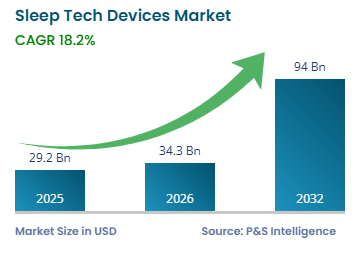
The sleep tech devices market size was USD 29.2 billion for 2025, and it will grow by 18.2% during 2026–2032, to reach USD 94.0 billion by 2032.
This growth is driven by the rising clinical and consumer burden of sleep disorders, with artificial intelligence, biosensors, and IoT connectivity being integrated into wearable and contactless monitoring platforms. Diagnostics are shifting structurally from clinic-centric models toward connected, at-home sleep management. Demand conditions reflect a substantial and under-treated patient pool, as research estimates that 83.7 million U.S. adults, or approximately 32.4% of the adult population, were living with obstructive sleep apnea in 2024.
Commercially, the market is transitioning toward recurring-revenue models in which hardware is bundled with subscription analytics, telehealth connectivity, and personalized coaching, thereby deepening user engagement and lifetime value. Manufacturers are competing on sensor accuracy, comfort, and ecosystem interoperability as consumer electronics and medical-device companies increasingly target the growing sleep technology market.
Key Market Insights
The sleep apnea category holds the largest market share, of 35% in 2025, driven by its high prevalence and widespread adoption of diagnostic and therapeutic devices.
The indirect category holds the largest market share, of 75% in 2025, driven by the widespread distribution of sleep devices through clinical, retail, and third-party channels.
The direct category will have the highest CAGR, of approximately 18.3%, driven by expanding direct-to-consumer sales and subscription-based business models.
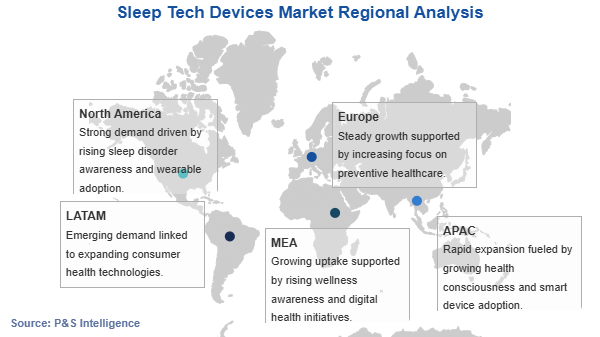
North America holds the largest market share, of 40%, in 2025, driven by a high disease burden, strong reimbursement support, and early adoption of sleep technologies.
Asia-Pacific will have the highest CAGR, of approximately 19.1%, driven by rising incomes, urbanization, and growing adoption of affordable wearable devices.
Sleep Tech Devices Market Trends and Drivers
AI-Enabled Contactless Monitoring and Subscription Models Are Key Trends
The market is shifting decisively from single-purpose tracking hardware toward AI-driven, contactless platforms paired with recurring-revenue analytics. Radar, ballistocardiography, and under-mattress sensors now capture respiration, heart rate, and sleep staging without body-worn contact, while machine-learning algorithms convert raw biosignals into personalized, clinically meaningful guidance. This contactless approach widens the addressable user base beyond wearable adopters to consumers seeking unobtrusive, long-term monitoring, subscription analytics deepen engagement and lifetime value. U.S. government policy is reinforcing this shift, the Centers for Medicare & Medicaid Services covers approved home sleep testing devices, including Type II, III, and qualifying Type IV devices, for the diagnosis of obstructive sleep apnea. This coverage encourages broader adoption of connected, home-based sleep monitoring technologies. The convergence of consumer electronics and medical-grade diagnostics is also blurring the historical boundary between wellness tracking and clinical sleep care.
Industry momentum is evident in commercial scale. For instance, Oura announced that it surpassed 2.5 million rings sold and achieved more than 200% membership growth, expanding sleep, heart health, and stress-monitoring capabilities have driven this growth, evidencing consumer demand for connected sleep technologies. As sensor accuracy improves and interoperability with telehealth and smart-home ecosystems advances, this trend is expected to intensify.
Rising Sleep-Disorder Burden and Aging Demographics Are Biggest Drivers
A large, under-treated patient population is the central force propelling market expansion. Sleep-disordered breathing, insomnia, and circadian disorders are rising alongside obesity, chronic stress, and aging populations, driving demand for diagnostic and therapeutic devices. The causal chain is well established; higher disease prevalence increases screening and treatment volumes, while greater awareness converts previously undiagnosed individuals into device users.
The World Health Organization reports that more than 1 billion adults worldwide were living with obesity in 2022. Obesity is a primary risk factor for obstructive sleep apnea, while demographic aging further increases demand as middle-aged and older populations, where prevalence is highest, continue to expand globally. The U.S. National Heart, Lung, and Blood Institute (NHLBI) estimates that approximately 50 to 70 million Americans have ongoing sleep disorders. This patient population requires diagnostic and therapeutic sleep technologies at scale. As prevalence and awareness rise together, this driver is positioned to sustain durable, structural demand rather than cyclical growth across the forecast period.
Data Privacy Concerns and High Device Costs Are Key Restraints
Despite favorable tailwinds, the market faces friction from elevated device costs and mounting concerns over biometric data security. Advanced trackers, smart beds, and therapeutic devices carry price points that exclude price-sensitive segments, while accuracy variability in lower-cost consumer devices erodes trust and clinical credibility, sleep platforms also collect sensitive physiological and behavioral data. This collection raises privacy and regulatory-compliance concerns that can slow adoption, especially where cross-border data governance is fragmented.
The European Union's General Data Protection Regulation (GDPR) classifies health and biometric data as sensitive personal data and requires strict safeguards for their processing. These obligations increase compliance requirements for connected sleep technology providers. The mechanism is direct; when consumers perceive cost barriers or data risk, purchase intent and sustained engagement decline. This decline dampens conversion despite rising awareness. Ongoing improvements in affordable sensor manufacturing, clinical validation, and privacy-by-design architectures are mitigating these barriers. Cost and data-governance constraints are likely to temper the pace of penetration in lower-income segments and tightly regulated markets through the forecast period.
At-Home Diagnostics and Emerging-Market Penetration Are Biggest Opportunity
A substantial gap between disease prevalence and diagnosis is opening untapped potential in home-based testing and underserved geographies, the vast majority of sleep apnea cases remain undiagnosed, and traditional in-lab polysomnography cannot scale to meet latent demand. This shortfall opens space for affordable home sleep apnea tests, wearable screening, and AI-assisted triage that route consumers toward clinical pathways. Emerging markets further expand this opportunity. Rising disposable incomes and deepening smartphone penetration are converting large populations into first-time device users, while expanding digital-health infrastructure provides the delivery backbone.
According to the International Telecommunication Union (ITU), 5.5 billion people, or 68% of the global population, were using the Internet in 2024. This connectivity provides a digital foundation for the adoption of connected sleep monitoring devices, home sleep tests, and app-based sleep health platforms. The combination of contactless screening technology and low-cost regional manufacturing creates a pathway to reach price-sensitive consumers previously excluded from sleep care. As regulatory frameworks for software-based diagnostics mature and reimbursement broadens, this opportunity is expected to unlock new revenue pools across both clinical and consumer channels.
Sleep Tech Devices Market Segmentation Analysis
Product Type Analysis
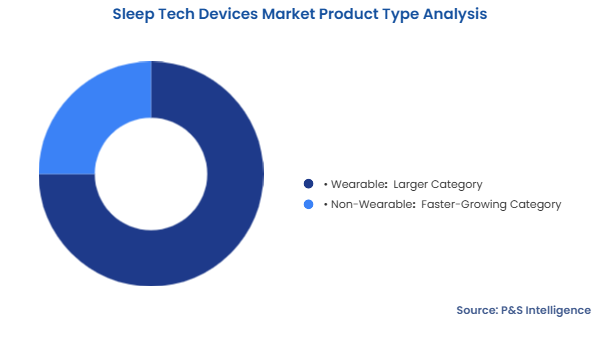
The wearable category holds the larger market share, of 75%, in 2025, driven by the affordability and multifunctionality of smartwatches, fitness bands, and smart rings, which embed sleep tracking within broader health-and-fitness ecosystems and integrate seamlessly with mobile and telehealth platforms. Their portability reinforces this position by making continuous wear practical across daily routines. Mainstream adoption has accelerated as consumer electronics leaders embed clinically relevant features into mass-market devices. This momentum is reflected in continued product innovation. In October 2024, Oura Health Oy launched the Oura Ring 4, featuring an expanded array of sensor pathways for improved accuracy across heart rate, SpO₂, temperature, and sleep staging in a lightweight titanium design.
The non-wearable category will have the higher CAGR, of approximately 18.4%, driven by rising demand for contactless, AI-powered sleep monitors, under-mattress sensors, and smart beds. These solutions eliminate body-worn contact. This contactless design delivers greater comfort and continuous, accurate data suited to both home and clinical settings. Aging consumers and premium buyers seeking unobtrusive longitudinal monitoring are reinforcing demand. FDA authorizations of AI-enabled sleep diagnostic technologies support broader adoption of automated home-based diagnostic solutions.
The product types analyzed in this report are:
Wearable (Larger Category)
Non-Wearable (Faster-Growing Category)
Application Analysis
The sleep apnea category holds the largest market share in 2025, reflecting its high global prevalence, strong clinical diagnosis rates, and the established base of therapeutic and diagnostic devices addressing the condition. Obstructive sleep apnea carries a substantial undiagnosed pool that continues to convert into device demand, while reimbursement pathways for therapy sustain volumes. National Institutes of Health (NIH) research indicates that obstructive sleep apnea affects between 9% and 38% of the general adult population, with prevalence increasing significantly with age and obesity.
The insomnia category will have the highest CAGR, of approximately 18.8%, driven by rising stress and screen exposure, while the proliferation of consumer-focused wearable trackers and contactless monitoring devices embeds cognitive behavioral therapy for insomnia (CBT-I), sleep coaching, and relaxation tools. The accessibility of these solutions broadens the addressable base beyond clinical settings. According to the National Institutes of Health (NIH), approximately 10% of adults have chronic insomnia disorder, while 30%–36% experience transient insomnia symptoms. These prevalence figures expand the addressable market for wearable sleep trackers, digital therapeutics, and home sleep monitoring devices.
The applications analyzed in this report are:
Insomnia (Fastest-Growing Category)
Sleep Apnea (Largest Category)
Narcolepsy
Restless Legs Syndrome
Rapid Eye Movement (REM) Sleep Behavior Disorder
Others
Gender Analysis
The female category holds the largest market share, of 80%, in 2025, and it will have the highest CAGR, driven by hormonal transitions across menstruation, pregnancy, and menopause disrupting sleep architecture and increasing women's need for tracking and intervention. This dynamic drives elevated demand for sleep monitoring. This dual position reflects both a large existing female user base and accelerating adoption as manufacturers integrate cycle tracking, menopause insights, stress monitoring, and personalized sleep analytics into wearable devices and connected sleep platforms.
National Institutes of Health (NIH) research confirms that sleep disturbances, including insomnia, are more prevalent among women, especially during the menopausal transition. The persistence of this leadership is reinforced as manufacturers increasingly design female-centric health ecosystems that integrate reproductive and sleep data. These ecosystems deepen engagement among women consumers and widen the addressable base across age cohorts through the forecast period.
The genders analyzed in this report are:
Female (Larger and Faster-Growing Category)
Male
Age Group Analysis
The 45-64 years category holds the largest market share, of 60%, in 2025, driven by obstructive sleep apnea, insomnia, and other sleep disorders peaking in middle age, when obesity, cardiovascular comorbidities, and hormonal change converge. This cohort combines high disease burden with the disposable income to invest in both consumer and therapeutic devices. U.S. Centers for Disease Control and Prevention (CDC) data show that adult obesity, a primary driver of sleep-disordered breathing, peaks in middle-aged adults. This peak reinforces demand concentration in this group.
The below 45 years category will have the highest CAGR, of approximately 18.6%, driven by rising adoption of consumer wearables among younger, digitally native consumers, alongside growing stress- and screen-related sleep complaints. Affordability and ecosystem integration accelerate uptake in this cohort. According to Japan's Ministry of Health, Labour and Welfare, approximately 40% of adults aged 20 years and older slept less than six hours per day on average in the National Health and Nutrition Survey. This shortfall points to growing demand for sleep monitoring and wearable sleep technologies among younger and working-age consumers.
The age groups analyzed in this report are:
Below 45 Years (Fastest-Growing Category)
45–64 Years (Largest Category)
Above 65 Years
Distribution Channel Analysis
The indirect category holds the largest market share in 2025, driven by this channel encompassing specialty clinics, hospitals, retail and pharmacy outlets, and third-party platforms through which the majority of devices reach consumers. This dominance rests on the consultative nature of higher-ticket therapeutic devices and the role of clinical channels in dispensing medical-grade equipment. Durable medical equipment suppliers bundling insurance pre-authorizations sustain the relevance of clinical and retail intermediaries. The U.S. Food and Drug Administration (FDA) regulates medical-grade sleep devices such as CPAP systems and home sleep apnea testing devices. This oversight supports their widespread adoption through hospitals, sleep clinics, and specialty medical equipment providers.
The direct category will have the highest CAGR, driven by brands capturing full margins and building first-party data relationships through direct-to-consumer e-commerce, while subscription models extend the value of each customer relationship. Rising digital adoption and the convenience of doorstep delivery accelerate this shift. According to the U.S. Census Bureau, U.S. retail e-commerce sales reached approximately USD 1.19 trillion in 2024. This volume supports the continued expansion of direct-to-consumer sales channels for connected health devices.
The distribution channels analyzed in this report are:
Indirect (Larger Category)
Direct (Faster-Growing Category)
Drive strategic growth with comprehensive market analysis
Sleep Tech Devices Market Geographical Analysis
North America Sleep Tech Devices Market Size
North America holds the largest market share, of 40%, in 2025, driven by the region's leadership stemming from an exceptionally high disease burden and mature reimbursement pathways for therapeutic sleep devices, the early commercialization of consumer wearables by domestic technology leaders has reinforced this position. A large diagnosed-and-undiagnosed patient base sustains demand across both clinical CPAP therapy and consumer-grade tracking, while favorable insurance coverage tied to therapy adherence accelerates device uptake.
The region also benefits from concentrated venture capital and the presence of category-defining hardware and medical-device manufacturers. U.S. Centers for Disease Control and Prevention (CDC) data show that adult obesity prevalence reached 40.3% during August 2021–August 2023. Obesity is a primary risk factor for obstructive sleep apnea and a driver of demand for sleep diagnostic and therapeutic devices.
Canada Sleep Tech Devices Market Size
Canada is also witnessing steady market growth, rising awareness of sleep health and expanding adoption of home-based sleep testing are driving demand, while increasing use of connected wearable devices broadens the addressable base. Statistics Canada reported that in 2020, only 61% of adults aged 18 to 64 years reported high sleep quality, while 77% met the recommended sleep duration. These gaps point to continued opportunities for technologies that monitor, assess, and improve sleep quality. Growing digital health adoption and increasing consumer awareness are expected to strengthen demand for sleep technology devices across the country, while improved access to sleep care services widens the channel for adoption.
Asia-Pacific Sleep Tech Devices Market Size
Asia-Pacific will have the highest CAGR, of approximately 19.1%, driven by rising disposable incomes and urbanization, while expanding awareness of sleep health and the deep penetration of regionally manufactured, cost-competitive wearables broaden market formation. Large and aging populations across the region create unmet diagnostic demand, while government public-health campaigns and digital-health initiatives accelerate consumer adoption.
National Bureau of Statistics of China data show that over 310 million people in China were aged 60 years and above by the end of 2024. This cohort expands the population most exposed to sleep disorders. According to the China Internet Network Information Center (CNNIC), China had approximately 1.108 billion internet users by the end of 2024. This connectivity provides a digital foundation for the adoption of app-connected sleep monitoring devices and home-based sleep technologies. The region's trajectory points to sustained acceleration as healthcare access widens and connected-device affordability improves.
India Sleep Tech Devices Market Size
India is the fastest-growing country market within Asia Pacific, driven by rising health awareness and a young, digitizing population providing the demographic foundation, while lower device costs relative to developed nations and government digital-health initiatives expand access to monitoring tools. Affordable domestic wearable brands and growing urban professional adoption are widening the consumer base, while increasing diagnosis of sleep-disordered breathing supports clinical-device demand.
A systematic review in Sleep Medicine Reviews indicates that the pooled prevalence of obstructive sleep apnea in Indian adults was approximately 11%. This prevalence signals a large and underdiagnosed population. As smartphone penetration deepens and digital-health infrastructure under national programs matures, India's market is positioned for the steepest growth trajectory in the region over the forecast period.
The regions and countries analyzed in this report are:
North America (Largest Regional Market)
U.S. (Larger and Faster-Growing Country)
Canada
Europe
Germany (Largest Country)
U.K. (Fastest-Growing Country)
France
Italy
Spain
Rest of Europe
Asia-Pacific (Fastest-Growing Regional Market)
China (Largest Country)
India (Fastest-Growing Country)
Japan
South Korea
Australia
Rest of APAC
Latin America
Brazil (Largest Country)
Mexico (Fastest-Growing Country)
Rest of LATAM
Middle East and Africa
Saudi Arabia (Largest Country)
South Africa
U.A.E. (Fastest-Growing Country)
Rest of MEA
Sleep Tech Devices Market Competitive Landscape
The market is fragmented, because it comprises diverse product categories, including wearable sleep trackers, smart rings, smartwatches, home sleep apnea testing devices, CPAP systems, smart beds, under-mattress sensors, and AI-powered sleep monitoring software, these segments are served by different groups of companies, ranging from established medical device manufacturers and consumer electronics firms to digital health startups. This breadth of participants prevents any single player from dominating the entire market. Competition is driven by continuous innovation in biosensors, artificial intelligence, contactless monitoring, cloud-based analytics, and smartphone integration, encouraging frequent product launches and differentiation.
The expansion of home-based sleep diagnostics and consumer wellness technologies has also lowered barriers for new entrants. Varying regulatory requirements and reimbursement policies across countries create opportunities for local players to compete alongside multinational companies. The market share remains distributed among numerous participants, with competition based on technology, clinical validation, pricing, user experience, ecosystem compatibility, and subscription-based digital health services rather than dominance by a few companies.
Key Players in the Sleep Tech Devices Market:
Apple Inc.
ResMed Inc.
Koninklijke Philips N.V.
Samsung Electronics Co., Ltd.
Google LLC
Garmin Ltd.
Oura Health Oy
Eight Sleep Inc.
Withings S.A.
Masimo Corporation
Compumedics Limited
Huawei Technologies Co., Ltd.
WHOOP, Inc
Sleep Tech Devices Market News
In May 2025, WHOOP, Inc. unveiled two new wearable devices, WHOOP 5.0 and WHOOP MG, featuring extended battery life, redesigned hardware, and expanded in-app health and recovery features. The launch deepens competition in the subscription-based sleep and recovery analytics segment, reinforcing recurring-revenue models.
In January 2025, Samsung Electronics Co., Ltd., through Samsung Venture Investment Corporation, invested in Pison Technology, a developer of AI-based neural sensing for health, wellness, and motion control. The investment signals strategic positioning in next-generation biosensing capabilities that could enhance future sleep-tracking accuracy.
In November 2024, Oura Health Oy partnered with DexCom, Inc. to integrate continuous glucose-monitoring data with Oura Ring sleep, heart-rate, and activity metrics. The collaboration links metabolic and sleep data, advancing the convergence of multi-signal health monitoring within a single consumer ecosystem.
Frequently Asked Questions About This Report
What factors are driving the growth of the sleep tech devices market?+
The growth is driven by increasing prevalence of sleep disorders, rising consumer awareness of sleep health, wider adoption of wearable devices, AI-enabled sleep monitoring, telehealth integration, and demand for home-based sleep diagnostics.
Which application generates the largest demand for sleep tech devices?+
Sleep apnea generates the largest demand because of its high prevalence, increasing diagnosis rates, and widespread use of CPAP and home sleep testing devices.
What are the major challenges faced by the sleep tech devices market?+
High device costs, data privacy concerns, limited reimbursement in some countries, and variable accuracy of consumer-grade devices are major market challenges.
How is artificial intelligence transforming sleep tech devices?+
What opportunities exist in the sleep tech devices market?+
Opportunities include expansion of home sleep testing, integration with digital therapeutics, personalized sleep coaching, smart bedroom ecosystems, and growth in emerging markets.
Want a report tailored exactly to your business need?
Leading companies across industries trust us to deliver data-driven insights and innovative solutions for their most critical decisions. From data-driven strategies to actionable insights, we empower the decision-makers who shape industries and define the future. From Fortune 500 companies to innovative startups, we are proud to partner with organisations that drive progress in their industries.
Client Testimonials
Working with P&S Intelligence and their team was an absolute pleasure – their awareness of timelines and commitment to value greatly contributed to our project's success. Eagerly anticipating future collaborations.
McKinsey & Company
India
Unmatched Standards
Our insights into the minutest levels of the markets, including the latest trends and competitive landscape, give you all the answers you need to take your business to new heights
Complete Data Security
We take a cautious approach to protecting your personal and confidential information. Trust is the strongest bond that connects us and our clients, and trust we build by complying with all international and domestic data protection and privacy laws