This Report Provides In-Depth Analysis of the Single-Use NPWT Devices Market Report Prepared by P&S Intelligence, Segmented by Application (Surgical Wounds, Lacerations, Burns, Pressure Ulcers, Venous Ulcers, Diabetic Ulcers), End User (Hospitals, Home Healthcare Settings), and Geographical Outlook for the Period of 2019 to 2032
Explore the market potential with our data-driven report
Single-Use NPWT Devices Market Future Prospects
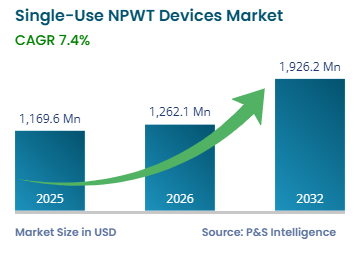
The global single-use negative pressure wound therapy (NPWT) devices market size was USD 1169.6 million in 2025, and it will grow by 7.4% during 2026–2032, to reach USD 1926.2 million by 2032. This growth is supported by the increasing demand for advanced wound management solutions, particularly single-use NPWT devices that improve healing outcomes, reduce hospital stays, and minimize infection risks. Single-use NPWT devices apply controlled negative pressure to wounds, promoting faster tissue regeneration, improving blood flow, and removing exudate, making them highly effective in managing complex and chronic wounds. Peer-reviewed studies estimate that diabetic foot ulcers have a prevalence of approximately 6.3% globally, supporting strong demand for advanced wound care solutions such as single-use NPWT devices.
The growing burden of chronic wounds and surgical procedures is reinforcing the adoption of single-use NPWT systems across healthcare settings. According to the World Health Organization, the rising incidence of chronic diseases and aging populations is contributing to increased demand for advanced wound care solutions. Additionally, the increasing focus on cost-efficient care and improved patient outcomes is driving the adoption of single-use NPWT devices. Furthermore, the increasing volume of surgical procedures globally is supporting market growth, as single-use NPWT devices are widely used in post-operative wound management.
Key Market Insights
Surgical wounds hold the largest market share, of 30%, in 2025, driven by the high volume of surgical procedures globally.
Diabetic ulcers will have the highest CAGR, of 8.6%, supported by the increasing prevalence of diabetes and related complications.
Hospitals hold the larger market share, of 85%, in 2025, due to the availability of advanced infrastructure and skilled professionals.
Home healthcare settings will have the higher CAGR, of 8.2%, driven by the shift toward outpatient and home-based care.
North America holds the largest market share, of 40%, in 2025, while Asia-Pacific will have the highest CAGR, of 8.6%, due to expanding healthcare access and rising patient population.
Single-Use NPWT Devices Trends & Driver
Shift in Preference toward Advanced Wound Therapies Is Key Trend
A key trend shaping the single-use negative pressure wound therapy devices market is the growing preference for advanced wound treatment solutions that deliver faster healing and reduced complication rates compared to conventional methods. Healthcare providers are increasingly adopting therapies that support improved clinical outcomes, particularly in the management of chronic and post-surgical wounds. Single-use NPWT devices are gaining traction due to their ability to deliver controlled negative pressure through portable, disposable systems, enabling effective treatment beyond traditional hospital settings and supporting early patient discharge. This transition is supported by ongoing product innovation focused on improving usability and treatment flexibility. This trend is further reinforced by growing real-world clinical validation, as demonstrated in October 2025 when Smith & Nephew plc reported results from a large-scale study involving over 22,000 patients, showing that single-use NPWT devices significantly reduce wound complications, shorten hospital stays, and optimize overall treatment costs in appropriate cases.
Clinical evidence from the National Institutes of Health indicates that advanced wound care approaches, including single-use NPWT devices, are associated with improved healing outcomes in chronic wounds compared to conventional treatments. Additionally, chronic wounds are estimated to affect approximately 1–2% of the population in developed regions, driving demand for effective and accessible treatment solutions such as single-use NPWT devices. This growing disease burden is accelerating the adoption of single-use NPWT devices across both hospital and home care settings, as providers increasingly shift toward efficient, easy-to-use, and scalable wound management solutions.
Rising Prevalence of Diabetes Is the Major Growth Driver
The rising prevalence of diabetes represents the most significant driver for the single-use NPWT devices market. Diabetes is a leading contributor to chronic wound development, particularly diabetic foot ulcers, which arise due to impaired blood circulation and neuropathy, resulting in delayed healing and increased risk of complications. These wounds often require prolonged and specialized treatment, thereby increasing reliance on advanced therapeutic solutions such as single-use NPWT devices.
According to the International Diabetes Federation, over 537 million adults were living with diabetes globally in 2023, and this number is projected to reach approximately 643 million by 2030. Additionally, clinical evidence suggests that approximately 15–25% of individuals with diabetes will develop a foot ulcer during their lifetime, further reinforcing the scale of the patient population requiring advanced wound care. In response to this growing demand, companies are actively expanding their single-use NPWT portfolios. For example, Cork Medical LLC launched the Nisus Touch and Nisus One single-use NPWT devices, strengthening its product offerings for chronic wound management. The rising burden of diabetes-related complications is significantly increasing the number of patients with hard-to-heal wounds, thereby accelerating demand for effective wound care technologies, including single-use NPWT devices.
Availability of Substitutes Is Key Restraint
The availability of alternative wound care therapies represents a key restraint for the single-use NPWT devices market. Conventional wound care methods and advanced dressings continue to serve as primary treatment options, particularly for wounds with low to moderate exudate levels where the use of single-use NPWT devices may not be clinically necessary. In addition, therapies such as hyperbaric oxygen treatment and bioengineered skin substitutes provide alternative approaches to NPWT, which can limit the adoption of single-use NPWT devices. These alternatives are often more accessible and may involve lower upfront costs, making them preferable in cost-sensitive healthcare settings.
Furthermore, the disposable nature of single-use NPWT devices can result in higher per-treatment costs compared to traditional dressings, which may influence treatment decisions, especially in resource-constrained environments. Healthcare providers may also opt for simpler and less resource-intensive treatment methods for less severe wounds, reducing reliance on single-use NPWT systems. Variations in reimbursement policies across regions can further restrict patient access, particularly in developing markets. Although these devices are designed for ease of use, they still require basic training and proper application, which may pose minor challenges in smaller healthcare facilities, thereby limiting widespread adoption.
Expansion of Home Healthcare and Outpatient Wound Management Is Key Opportunity
The expansion of home healthcare and outpatient wound management presents a significant opportunity for the single-use NPWT devices market. Healthcare systems are increasingly shifting toward decentralized care models to reduce hospital burden and treatment costs. Single-use NPWT devices are enabling effective wound treatment in home settings due to their portable and disposable design, improving patient convenience and treatment adherence. This transition is being supported by advancements in distribution infrastructure, such as initiatives by Cardinal Health Inc., which expanded its supply chain capabilities to enhance direct-to-patient delivery of medical products, improving access to wound care solutions.
Support from institutions such as the U.S. Department of Health and Human Services highlights the growing adoption of home-based healthcare services as part of broader healthcare system transformation. This shift is encouraging the development of compact and easy-to-use single-use NPWT devices tailored for outpatient care, creating new growth opportunities for manufacturers targeting home healthcare and ambulatory care settings. Additionally, the World Health Organization projects that the global population aged 60 years and above will reach approximately 1.4 billion by 2030, a demographic more susceptible to chronic wounds and more inclined toward home-based care, supporting increased demand for home-based treatment solutions.
The surgical wounds hold the largest market share, of 30%, in 2025, driven by the increasing number of surgical procedures worldwide and the need for effective post-operative wound management. Single-use Negative Pressure Wound Therapy (NPWT) devices are widely utilized in surgical settings to reduce infection risk, manage exudate, and promote faster healing, particularly in closed-incision and low-to-moderate exudate wounds. Their portable and disposable design makes them well-suited for both hospital and outpatient care, supporting early discharge and continuity of care. According to the World Health Organization, surgical site infections affect approximately 11% of patients in low- and middle-income countries, highlighting the need for effective wound management solutions in post-operative care.
The diabetic ulcers will have the highest CAGR, of 8.6%, driven by the rising prevalence of diabetes and associated complications. These wounds are often chronic and difficult to treat, requiring advanced therapies such as single-use NPWT devices that enable portable and continuous wound management across homecare and outpatient settings, improving healing outcomes and reducing the risk of amputation. This growing demand is further supported by industry developments, such as Cardinal Health Inc. strengthening its diabetes care capabilities through the acquisition of Advanced Diabetes Supply Group (ADSG), enhancing patient access to chronic disease management solutions and indirectly supporting the adoption of advanced wound care technologies.
The applications analyzed in this report are:
Surgical Wounds (Largest Category)
Lacerations
Burns
Pressure Ulcers
Venous Ulcers
Diabetic Ulcers (Fastest-Growing Category)
End User Analysis
Hospitals hold the larger market share, of 85%, in 2025, driven by the availability of advanced medical infrastructure, skilled healthcare professionals, and the high volume of surgical procedures. Single-use Negative Pressure Wound Therapy (NPWT) devices are widely used in hospital settings for managing post-operative wounds, particularly in closed-incision and controlled exudate scenarios where portable and disposable systems can support effective healing and reduce complications. For instance, Smith & Nephew plc reported that the use of its single-use NPWT systems in surgical applications has been associated with reduced wound complications and shorter hospital stays, highlighting their role in improving clinical outcomes within hospital environments.
Home healthcare settings will have the higher CAGR, of 8.2%, driven by the increasing preference for outpatient treatment and cost-effective care delivery. The availability of portable and easy-to-use single-use NPWT devices is enabling patients to receive treatment outside hospital settings, supporting continuity of care while reducing hospitalization duration and associated costs. Additionally, projections from the World Health Organization indicate that the global population aged 60 years and above will reach approximately 1.4 billion by 2030, a demographic more susceptible to chronic wounds and increasingly inclined toward home-based care, thereby accelerating the adoption of single-use NPWT devices in home healthcare settings.
The end users analyzed in this report are:
Hospitals (Larger Category)
Home Healthcare Settings (Faster-Growing Category)
Drive strategic growth with comprehensive market analysis
Single-Use NPWT Devices Market Geographical Outlook
North America Single-Use Negative Pressure Wound Therapy Devices Market Size
North America holds the largest market share, of 40%, in 2025, driven by the high prevalence of chronic wounds, diabetic foot ulcers, pressure ulcers, and increasing adoption of advanced wound management technologies across the U.S. and Canada. The region benefits from strong healthcare infrastructure, favorable reimbursement policies, and rising preference for portable and single-use NPWT systems in hospital, outpatient, and home healthcare settings. According to the U.S. National Institutes of Health (NIH), chronic wounds affect nearly 6.5 million patients annually in the United States, creating significant demand for advanced wound care solutions, thereby supporting the adoption of therapies such as single-use NPWT devices. In addition, the growing diabetic population continues to increase the incidence of diabetic foot ulcers requiring single-use NPWT-based treatment.
The region also witnesses strong adoption due to increasing surgical procedures and rising pressure injury cases among elderly patients. According to the U.S. CDC, pressure ulcers remain a major healthcare burden among long-term care patients and nursing home residents, supporting continuous demand for advanced wound closure and wound healing technologies. Furthermore, the Centers for Medicare & Medicaid Services (CMS) provides reimbursement coverage for single-use NPWT across multiple wound indications, further accelerating market penetration in North America. Technological advancements such as disposable and lightweight single-use NPWT systems designed for home-based care are additionally supporting regional market growth.
U.S. Single-Use Negative Pressure Wound Therapy Devices Market Size
The U.S. single-use negative pressure wound therapy (NPWT) devices market dominates the North American region due to strong healthcare spending, advanced clinical adoption, and supportive reimbursement frameworks. According to the Centers for Medicare & Medicaid Services, U.S. national health expenditure reached approximately USD 4.5 trillion, accounting for nearly 17.3% of GDP, reflecting the country’s high capacity to adopt advanced wound care technologies, including single-use NPWT systems. In addition, the Agency for Healthcare Research and Quality reports that surgical site infections occur in approximately 2%–5% of patients undergoing inpatient surgery, driving demand for effective post-operative wound management solutions such as portable single-use NPWT devices. The increasing shift toward outpatient and home-based care settings, along with continuous product innovation by key market players, further supports the growth of single-use NPWT device adoption across the United States.
Asia-Pacific will have the highest CAGR, of 8.6%, driven by the rapidly increasing burden of chronic wounds, expanding diabetic population, and improving healthcare infrastructure across key countries such as China, India, and Japan. According to the International Diabetes Federation, China accounts for over 140 million people living with diabetes, while India has more than 77 million cases, significantly increasing the risk of diabetic foot ulcers and other chronic wounds requiring advanced wound care solutions such as single-use NPWT devices. Additionally, expanding healthcare infrastructure is supporting market growth, with China’s National Health Commission of the People's Republic of China reporting more than 1,795 Grade-A tertiary hospitals in the country by the end of 2023, increasing access to advanced surgical and wound care treatments, including single-use NPWT devices. Growing awareness, improving access to care, and rising adoption of portable and cost-effective wound therapy systems are further accelerating the demand for single-use NPWT devices across the region.
India Single-Use Negative Pressure Wound Therapy Devices Market Size
India’s single-use negative pressure wound therapy devices market is expanding steadily due to increasing government investment in healthcare access and hospital infrastructure. According to the Press Information Bureau, more than 33,000 hospitals, including both public and private facilities, have been empaneled under the Ayushman Bharat PM-JAY scheme as of 2025, significantly improving access to advanced surgical and wound care treatments across the country. Additionally, the Government of India reported that Ayushman Bharat has operationalized 1.5 lakh Ayushman Arogya Mandirs (Health and Wellness Centres), strengthening primary healthcare and chronic wound management services nationwide. The expansion of healthcare coverage, rising hospitalization rates, and improving access to postoperative care are collectively supporting the adoption of single-use NPWT devices in India.
The regions and countries of the market are as follows:
North America (Largest Regional Market)
U.S. (Larger Country Market)
Canada (Faster-Growing Country Market)
Europe
Germany (Largest Country Market)
U.K.
France (Fastest-Growing Country Market)
Italy
Spain
Rest of Europe
Asia-Pacific (Fastest-Growing Regional Market)
China (Largest and Fastest-Growing Country Market)
India
Japan
South Korea
Australia
Rest of APAC
Latin America
Brazil (Largest and Fastest-Growing Country Market)
Mexico
Rest of LATAM
Middle East & Africa
Saudi Arabia (Largest Country Market)
South Africa (Fastest-Growing Country Market)
U.A.E.
Rest of MEA
Single-Use NPWT Devices Market Share
The market exhibits semi-consolidation, driven by strong brand recognition, extensive clinical evidence supporting product efficacy, well-established distribution networks across hospital and home healthcare channels, and the presence of a growing adoption base of single-use NPWT devices supporting recurring demand through disposables. This market structure reflects notable barriers to entry, including regulatory approval requirements, high clinical validation costs, and specialized manufacturing capabilities for wound therapy devices and dressing systems.
The competitive landscape is gradually evolving as single-use NPWT devices gain adoption alongside traditional reusable NPWT systems, driven by their portability, ease of use, and suitability for outpatient and homecare settings. This shift is creating opportunities for new entrants with relatively lower capital requirements and simplified product designs. However, established players continue to maintain competitive advantages through strong physician relationships, extensive clinical data supporting product outcomes, and integrated wound care portfolios that enable bundled treatment offerings.
Single-Use NPWT Devices Market Companies:
ConvaTec Group plc
Medela AG
Smith & Nephew plc
Lohmann & Rauscher GmbH & Co. KG
Molnlycke Health Care AB
Carilex Medical
TRIAGE MEDITECH PVT. LTD.
ATMOS MedizinTechnik GmbH & Co. KG
Genadyne Biotechnologies Inc.
Cardinal Health Inc.
Paul Hartmann AG
DHG
Solventum Corporation
CORK MEDICAL LLC
DeRoyal Industries, Inc.
Single-Use NPWT Devices Market News
In June 2025, Molnlycke Health Care AB signed an agreement with the Swedish Export Credit Corporation (SEK) to secure an investment of USD 400 million to support its global expansion and advancement in wound care solutions, including single-use NPWT technologies.
In September 2024, Solventum Corporation announced the launch of its V.A.C. Peel and Place Dressing, a new all-in-one extended-wear negative pressure wound therapy dressing designed to simplify application (in under two minutes) and can be worn up to 7 days, improving accessibility and comfort for single-use NPWT patients. This innovative dressing was made available in the United States and Canada and represents a key product evolution in Solventum’s single-use NPWT portfolio.
In May 2024, DeRoyal Industries Inc. introduced a light-deactivated disposable incisional NPWT product showcased at SAWC Spring 2024. The kit includes two dressings usable with or without attachment to the NPWT device and is designed to last up to 7 days at 80 mmHg negative pressure. This represents an expansion of DeRoyal’s NPWT product lineup with a disposable option.
In August 2023, Medela AG introduced an Invia Integrated Dressing for its single-use NPWT systems, approved for use across wound types in hospital and home settings for up to seven days.
Frequently Asked Questions About This Report
How does negative pressure wound therapy work?+
Single-Use Negative pressure wound therapy applies controlled suction to a wound through a sealed dressing to remove excess fluid, reduce infection risk, and promote faster tissue healing.
What types of wounds can be treated with negative pressure wound therapy?+
It is used for chronic and acute wounds such as diabetic foot ulcers, pressure ulcers, surgical wounds, traumatic injuries, and burns requiring advanced care.
What are the key benefits of negative pressure wound therapy?+
Key benefits include faster healing, reduced swelling, lower infection risk, improved blood circulation, and reduced frequency of dressing changes.
What types of devices are available for negative pressure wound therapy?+
Devices include conventional systems for hospital use, portable Single-Use NPWT devices, and single-use disposable systems for home-based care.
Which region has the largest share in the negative pressure wound therapy market?+
North America holds the largest share due to advanced healthcare infrastructure, high adoption of advanced wound care technologies, and strong reimbursement systems.
Want a report tailored exactly to your business need?
Leading companies across industries trust us to deliver data-driven insights and innovative solutions for their most critical decisions. From data-driven strategies to actionable insights, we empower the decision-makers who shape industries and define the future. From Fortune 500 companies to innovative startups, we are proud to partner with organisations that drive progress in their industries.
Client Testimonials
Working with P&S Intelligence and their team was an absolute pleasure – their awareness of timelines and commitment to value greatly contributed to our project's success. Eagerly anticipating future collaborations.
McKinsey & Company
India
Unmatched Standards
Our insights into the minutest levels of the markets, including the latest trends and competitive landscape, give you all the answers you need to take your business to new heights
Complete Data Security
We take a cautious approach to protecting your personal and confidential information. Trust is the strongest bond that connects us and our clients, and trust we build by complying with all international and domestic data protection and privacy laws