Single Use Assemblies Market Size & Share Analysis - Emerging Trends, Growth Opportunities, Competitive Landscape, and Forecasts (2025 - 2032)
This Report Provides In-Depth Analysis of the Single Use Assemblies Market Report Prepared by P&S Intelligence, Segmented by Product (Filtration Assemblies, Bag Assemblies, Bottle Assemblies, Mixing System Assemblies), Solution (Customized Solutions, Standard Solutions), Application (Filtration Assemblies, Cell Culture & Mixing, Sampling, Fill-finish), End User (Pharmaceutical and Biopharmaceutical Companies, CROs & CMOs, Academic & Research Institutes), and Geographical Outlook for the Period of 2019 to 2032
Explore the market potential with our data-driven report
Single Use Assemblies Market Outlook
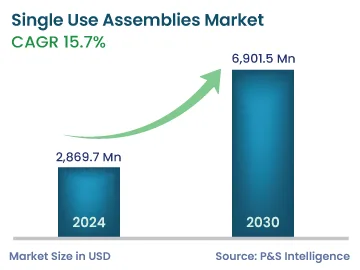
The single-use assemblies market size was USD 2,869.7 million in 2024, and it will grow by 15.2% during 2025–2032, to reach USD 8,808.2 million by 2032.
The market growth is driven by the increasing adoption of single-use technologies in biopharmaceutical manufacturing, driven by their ability to reduce contamination risks, minimize capital investment, and accelerate production timelines.
The increasing prevalence of cancer further fuels demand, as rising cases drive investments in drug discovery, research activities, and the development of novel therapies. According to the World Cancer Research Fund's Global Cancer Data, in 2022, approximately 10,311,610 men and 9,664,889 women were diagnosed with cancer worldwide, highlighting the urgent need for effective treatments. Additionally, advancements in cancer diagnostics and growing awareness drive the adoption of single-use assemblies in therapy manufacturing.
Single Use Assemblies Market Trends & Drivers
Technological Advancements Are Key Trends
The continuous innovation in materials science and component design is transforming single-use assemblies from simple disposable alternatives to sophisticated, integrated systems capable of supporting complex bioprocesses.
Advanced polymer films with improved mechanical properties, reduced extractables profiles, and enhanced gas permeability are enabling longer process runs and supporting more demanding applications.
The integration of sensors, automation, and digital connectivity into single-use components is creating smart assemblies that provide real-time process monitoring and control capabilities comparable to traditional stainless-steel systems.
Material innovation focuses particularly on addressing regulatory concerns about extractables and leachables while improving component performance.
In April 2023, Merck KGaA launched the Ultimus single-use process container film designed to provide extreme durability and leak resistance for single-use assemblies used for bioprocessing liquid applications.
In April 2024, Cytiva introduced the Xcellerex magnetic mixer, a single-use mixing system available in 2,000 and 3,000 L capacities for large-scale monoclonal antibody (mAb), vaccine, and gene therapy manufacturing processes.
These advancements in film technology directly address industry concerns about bag integrity and product safety, enabling single-use assemblies to be used in more critical process steps and with higher-value products.
The push for process intensification and continuous bioprocessing is driving demand for more sophisticated single-use assemblies that can support perfusion cell culture, continuous chromatography, and in-line monitoring.
Manufacturers are developing modular, plug-and-play systems that allow rapid reconfiguration of production lines, supporting the industry's need for multi-product facilities and accelerated development timelines.
Growing Biologics Market Is Biggest Driver
The exponential growth in biologics development and manufacturing represents the primary catalyst for the single-use assemblies market expansion.
Studies predict worldwide biopharmaceutical sales value to cross USD 745.1 billion by 2030.
Complex biologics, such as monoclonal antibodies, vaccines, and cell and gene therapies, require manufacturing solutions that can adapt quickly to changing production requirements while maintaining stringent quality standards.
The biopharmaceutical industry's shift toward single-use assemblies represents a fundamental transformation in manufacturing approaches.
These pre-sterilized, ready-to-use systems eliminate the need for complex cleaning and validation procedures associated with traditional stainless-steel equipment, enabling manufacturers to achieve faster batch turnovers and improved operational flexibility.
Single-use assemblies provide the necessary flexibility and scalability that traditional fixed equipment cannot match, particularly important as the industry shifts towards personalized medicines and smaller batch sizes.
The biopharmaceutical sector's evolution is characterized by rapid pipeline growth and increasing regulatory approvals for novel therapies.
The financial advantages of single-use assemblies extend beyond initial capital savings.
By eliminating cleaning validation, steam-in-place, and clean-in-place requirements, these systems reduce utility consumption, labor costs, and facility footprint.
Over 80% of the pharmaceutical firms have adopted single-use biorefinery systems because they are more affordable, effective, and dependable.
This highlights the widespread industry acceptance of these technologies as standard manufacturing practice rather than alternative solutions.
Single Use Assemblies Market Segmentation Analysis
Product Analysis
The bag assemblies category held the largest market share, of about 35%, in 2024, due to their low shipping costs and lightweight nature over stainless steel cans. Moreover, they do not require cleaning and returning, which saves capital and leads to low maintenance expenses. Among 2D and 3D bag assemblies, 2D bag assemblies are widely used because of their improved safety and greater compatibility with a wide range of chemicals. They also minimize the risk of leakage and contamination.
The filtration assemblies category will have the highest CAGR, due to the rapid expansion of contract manufacturing organizations and operational benefits of disposable filtration units. Moreover, the growing demand for products that can be rapidly adapted to the changing environments and the need for them to be flexible lead to the market growth. Regulatory mandates requiring redundant sterilizing filters immediately before filling operations ensure consistent demand for single-use filtration assemblies, while their pre-sterilized, validated nature eliminates time-consuming integrity testing and cleaning procedures.
The products analyzed in this report are:
Filtration Assemblies (Fastest-Growing Category)
Bag Assemblies (Largest Category)
Bottle Assemblies
Mixing System Assemblies
Solution Analysis
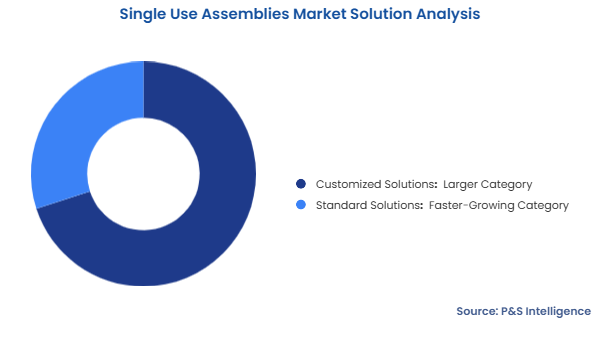
The customized category held the larger market share, of about 70%, in 2024, as various end users, including labs, biopharmaceutical and pharmaceutical companies, and academic institutes, are able to incorporate these systems into their unique processes, along with minimizing the inconvenience with cleaning and sterilization and streamlining production. In addition, customization according to their requirements is preferred by most companies. It helps in improving the processes and also provides better results compared to standard solutions.
The standard category will have the higher CAGR, of 15.6%, driven by the industry's push towards platform processes and standardization initiatives. The availability of pre-configured assemblies with validated designs accelerates implementation timelines and reduces qualification efforts, particularly attractive for facilities producing multiple products or those requiring rapid deployment of new production lines.
The solutions analyzed in this report are:
Customized Solutions (Larger Category)
Standard Solutions (Faster-Growing Category)
Application Analysis
The filtration category held the largest market share in 2024, due to the critical importance of contamination control throughout biopharmaceutical manufacturing. The implementation of single-use assemblies for filtration applications spans from clarification and bioburden reduction to virus removal and final sterile filtration, with each step requiring validated, pre-sterilized solutions that maintain product integrity while eliminating cross-contamination risks.
The cell culture & mixing category will have the highest CAGR, driven by the intensification of upstream processes and the adoption of high-density perfusion cultures. Single-use bioreactors with advanced mixing and integrated nutrient/waste management support continuous processing, enhancing productivity without compromising product quality.
The applications analyzed in this report are:
Filtration (Largest Category)
Cell Culture & Mixing (Fastest-Growing Category)
Sampling
Fill-finish
End User Analysis
The pharmaceutical & biopharmaceutical companies category held the largest market share, of approx. 55%, in 2024, reflecting their central role in driving innovation and setting industry standards for single-use technologies adoption. These companies leverage single-use assemblies across their development and manufacturing operations, from early-stage research through commercial production, benefiting from the flexibility to allocate equipment across multiple products without contamination concerns.
The CROs & CMOs category will have the highest CAGR, due to their usage of these types of products in various bioprocesses. The increasing outsourcing activities in biopharmaceutical manufacturing drive the adoption of single-use systems by CMOs for the maintenance of highly dynamic and changing product portfolios, enabling them to offer competitive services while minimizing capital investment and operational complexity. Rising government funding for clinical trials is boosting demand for single-use assemblies among biologics-focused CDMOs and CROs. Studies say that CRO service providers will make USD 179.2 billion and biologics CDMOs USD 39.0 billion by 2032.
The end users analyzed in this report are:
Pharmaceutical and Biopharmaceutical Companies (Largest Category)
CROs & CMOs (Fastest-Growing Category)
Academic & Research Institutes
Drive strategic growth with comprehensive market analysis
Single Use Assemblies Market Regional Outlook
North America Single-Use Assemblies Market Size
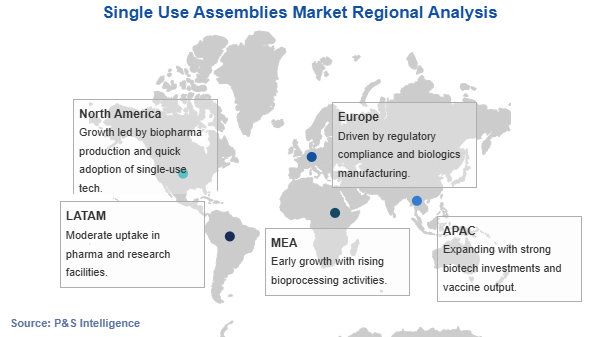
North America held the largest market share in 2024. This is attributed to the presence of key players and the rising prevalence of cancer and various other diseases, such as HIV. The presence of major biopharmaceutical companies, coupled with a supportive regulatory environment that encourages innovation, creates ideal conditions for single-use assemblies adoption. The region's focus on developing next-generation therapies, including cell and gene therapies, drives demand for flexible manufacturing solutions that single-use assemblies provide.
The adoption of Industry 4.0 and digital technologies in biopharmaceutical manufacturing is enhancing the use of single-use assemblies in North America. The FDA's Advanced Manufacturing Technologies program incentivizes firms to standardize on these modular kits, enabling validation cycles to drop from months to weeks, demonstrating regulatory support for innovative manufacturing approaches that leverage single-use technologies. Along with this, the country has an established biopharmaceutical sector, which is leading to the augmenting output of biologics. The rising healthcare expenditure of the population with its increasing disposable income is expected to boost the demand for new drugs in North America.
U.S. Single-Use Assemblies Market Size
In North America, the U.S. holds the leading position due to the presence of a large number of end users and the rapid adoption of advanced technologies in the country. Moreover, in July 2025, Thermo Fisher announced its acquisition of Sanofi's sterile fill-finish and packaging facility in Ridgefield, New Jersey. This acquisition enhances its U.S. manufacturing capabilities and supports the production of critical medicines.
The U.S. FDA has estimated that it will be approving around 10 to 20 cell & gene therapy products each year by 2025 due to the current clinical success rates and promising product pipeline, creating substantial demand for single-use assemblies that can support these complex manufacturing processes. The country's emphasis on domestic manufacturing capabilities, reinforced by recent supply chain disruptions, further accelerates investment in flexible, scalable production technologies.
Asia-Pacific Single-Use Assemblies Market Size
Asia-Pacific will have the highest CAGR, driven by rapid biopharmaceutical sector expansion and increasing investment in manufacturing infrastructure. The region's transformation from a cost-competitive manufacturing hub to an innovation center for biologics development creates unprecedented opportunities for single-use assemblies adoption. Countries across the region are establishing world-class biomanufacturing facilities that prioritize flexibility and speed-to-market, attributes that single-use technologies uniquely provide.
Moreover, in January 2024, CDMO AGC Biologics announced a growth strategy to develop pharmaceutical manufacturing capabilities in the Asia region through the expansion of their mammalian cell culture, mRNA and cell therapy facility in Japan, illustrating the regional commitment to advanced biomanufacturing technologies.
China Single-Use Assemblies Market Size
China leads the regional growth trajectory, supported by government initiatives to develop domestic biopharmaceutical capabilities and reduce dependence on imported medicines. The country's focus on biosimilar development and the expansion of contract manufacturing services drives substantial demand for single-use assemblies. In March 2024, Merck KGaA (Germany) invested approximately EURO 14 million to expand its M Lab Collaboration Center in Shanghai, China, demonstrating the strategic importance of this region in the global biopharmaceutical supply chain. The expansion is further supported by the growing emphasis on process intensification and continuous bioprocessing, where single-use assemblies play a pivotal role in achieving higher productivity while maintaining product quality and safety standards.
India Single-Use Assemblies Market Size
India's biopharmaceutical sector experiences remarkable growth, positioning the country as a global manufacturing hub for vaccines and biosimilars. The combination of skilled workforce, cost advantages, and improving regulatory standards creates an environment conducive to single-use technologies adoption. Local manufacturers are increasingly partnering with global suppliers to establish regional production of single-use components, reducing lead times and ensuring security of supply for the growing domestic market.
The geographical breakdown of the market is as follows:
North America (Largest Regional Market)
U.S. (Larger and Faster-Growing Country)
Canada
Europe
Germany (Largest and Fastest-Growing Country)
U.K.
France
Italy
Russia
Rest of Europe
Asia-Pacific (Fastest-Growing Regional Market)
China (Largest Country)
India (Fastest-Growing Country)
Japan
South Korea
Australia
Rest of APAC
Latin America
Brazil (Largest Country)
Mexico (Fastest-Growing Country)
Rest of LATAM
Middle East and Africa
Saudi Arabia
South Africa (Largest Country)
U.A.E. (Fastest-Growing Country)
Rest of MEA
Single Use Assemblies Market Share
The market is fragmented because it comprises a large number of global and regional suppliers, each offering specialized products for diverse biopharmaceutical applications such as monoclonal antibodies, vaccines, cell and gene therapies, and continuous bioprocessing. No single company dominates the market, with the top five players collectively controlling less than half of the global share. Additionally, the market’s technological diversity ranging from bioreactors and mixers to tubing sets and filtration units encourages multiple niche players to operate alongside major life sciences companies, maintaining a competitive structure.
Key Single Use Assemblies Companies:
Sartorius AG
Merck KGaA
Lonza Group Ltd.
Corning Incorporated
Adolf K
Thermo Fisher Scientific Inc.
VWR International, LLC (Avantor)
Compagnie de Saint-Gobain S.A.
Entegris Inc.
Danaher Corporation
PBS Biotech, Inc.
Meissner Filtration Products, Inc.
Single Use Assemblies Market News
In October 2024, Compagnie de Saint-Gobain S.A. launched Sani-Tech STHT-80 Silicone tubing applicable for high burst pressure and vacuum applications, enhancing the capabilities of single-use fluid transfer applications.
In June 2024, Cytiva, a brand of Danaher Corporation; introduced Supor Prime filters, supporting high throughputs and viscosity of 30 centipoises, improving recovery of final drug products during manufacturing.
In April 2024, Q-Biopharma LLC, d.b.a. SaniSure, launched Fill4Sure, a customized single-use filling assembly designed to accelerate drug product time-to-market while enhancing operational efficiency, process repeatability, and product security.
In May 2023, Getinge AB announced an agreement to acquire complete shares of Purity New England Inc., a provider of single-use bioprocessing technologies, strengthening its position in the single-use assemblies market.
Want a report tailored exactly to your business need?
Leading companies across industries trust us to deliver data-driven insights and innovative solutions for their most critical decisions. From data-driven strategies to actionable insights, we empower the decision-makers who shape industries and define the future. From Fortune 500 companies to innovative startups, we are proud to partner with organisations that drive progress in their industries.
Client Testimonials
Working with P&S Intelligence and their team was an absolute pleasure – their awareness of timelines and commitment to value greatly contributed to our project's success. Eagerly anticipating future collaborations.
McKinsey & Company
India
Unmatched Standards
Our insights into the minutest levels of the markets, including the latest trends and competitive landscape, give you all the answers you need to take your business to new heights
Complete Data Security
We take a cautious approach to protecting your personal and confidential information. Trust is the strongest bond that connects us and our clients, and trust we build by complying with all international and domestic data protection and privacy laws