This Report Provides In-Depth Analysis of the Remote Access Solutions Market Report Prepared by P&S Intelligence, Segmented by Component (Software, Hardware, Services), Deployment Mode (Cloud, On-Premises, Hybrid), Enterprise Size (Large Enterprises, Small and Medium Enterprises), Access Type (VPN Access, Privileged Access, Remote Desktop Access, Application Access, Third-Party/Vendor Access), End User (IT and Telecom, BFSI, Healthcare, Government and Defense, Manufacturing, Retail and E-commerce, Education, Energy and Utilities), and Geographical Outlook for the Period of 2021 to 2032
Explore the market potential with our data-driven report
Remote Access Solutions Market Overview
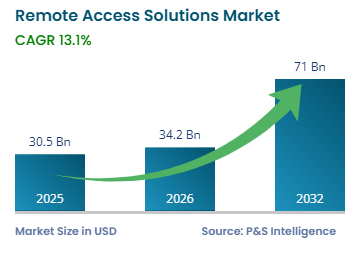
The remote access solutions market size was USD 30.5 billion in 2025, and it will grow by 13.1% during 2026-2032 to reach USD 71.0 billion by 2032.
The remote access solutions market is expanding as organisations increasingly depend on distributed work environments, cloud platforms, and digital business applications that require secure connectivity from any location. Employees, contractors, and external partners regularly access enterprise resources through multiple devices and networks, making secure and controlled access a critical operational requirement. Hybrid work has evolved from a temporary workplace arrangement into a long-term business model, while enterprises continue modernising legacy infrastructure and migrating workloads to public, private, and hybrid cloud environments. According to the International Telecommunication Union, 6 billion people, representing 74% of the global population, used the Internet in 2025. The scale of digital participation is increasing the volume of users, applications, and business processes that depend on secure remote connectivity.
The market is also gaining momentum as organisations strengthen cybersecurity strategies across increasingly distributed digital environments. Traditional perimeter-based security approaches are becoming less effective because users, applications, and business data are no longer confined to a single network boundary. Enterprises are therefore adopting remote access frameworks that incorporate identity-based authentication, access controls, continuous verification, and secure connectivity mechanisms. These capabilities help organisations protect sensitive information, support regulatory requirements, and reduce exposure to cyber threats while maintaining workforce flexibility.
Key Market Insights
Software is the largest and fastest-growing category, holding a market share of 60.5% and registering a CAGR of 13.8%, due to increasing adoption of remote desktop platforms, VPN solutions, and zero trust access technologies.
Cloud is the largest and fastest-growing category, holding a market share of 65.5% and registering a CAGR of 13.2%, due to continued migration of business applications, workloads, and collaboration tools to cloud environments.
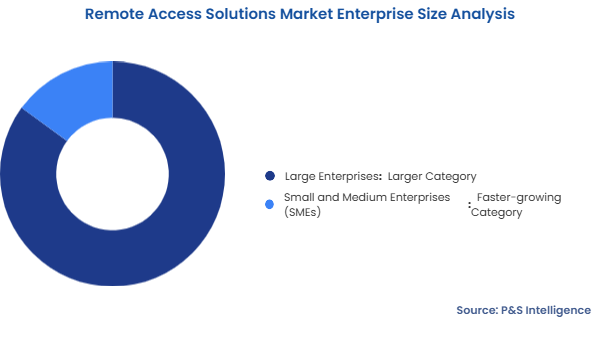
Large Enterprises are the larger category, holding a market share of 85.0%, due to extensive networks, large employee bases, and complex digital infrastructures requiring secure remote access capabilities.
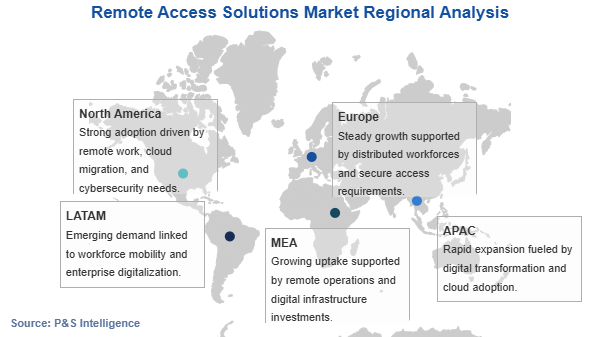
North America holds the largest share of 45.5%, due to strong adoption of zero trust frameworks, cloud-native applications, and advanced identity management platforms across enterprises.
Asia-Pacific is the fastest-growing region, registering a CAGR of 14.4%, driven by large-scale enterprise digitalisation, cloud computing expansion, and modernisation of business operations.
Remote Access Solutions Market Trends and Drivers
AI-Driven Zero Trust Access Integration Is Major Trend
The remote access solutions market is moving towards platforms that combine remote connectivity, identity verification, threat detection, and access control within a unified security architecture. Organisations are reducing dependence on standalone VPN environments and increasingly adopting zero trust frameworks that continuously validate users, devices, and application requests. Vendors are also embedding artificial intelligence into remote access platforms to automate policy management, strengthen threat detection, and improve security response capabilities. According to the International Telecommunication Union, 132 countries had a National Cybersecurity Strategy in 2024. This reflects growing adoption of structured cybersecurity frameworks that support identity-based access controls and modern security architectures.
The trend is also being shaped by wider use of artificial intelligence across enterprise environments. According to Microsoft and LinkedIn, 75% of global knowledge workers used artificial intelligence at work in 2024. Growing familiarity with AI technologies is encouraging organisations to adopt AI-enabled access management, behavioural monitoring, and policy automation capabilities. This is influencing product development across secure access service edge platforms, cloud-delivered access solutions, and identity-centric security tools that provide more adaptive and intelligent remote connectivity environments.
Expansion of Hybrid Workforces and Distributed Operations Drives Market
The continued expansion of hybrid work environments and geographically distributed business operations remains a major driver for the remote access solutions market. Organisations increasingly require employees, contractors, and third-party partners to securely access applications, databases, and internal systems from multiple locations. This shift has transformed remote connectivity into a core business requirement, particularly as enterprises expand cloud adoption and support flexible workforce models. According to the International Telecommunication Union, there were 99 mobile broadband subscriptions per 100 inhabitants globally in 2025. The widespread availability of mobile connectivity is increasing demand for secure access technologies that can support users across diverse devices and locations.
Demand is also being reinforced by rising use of cloud applications, collaboration platforms, and digital workflows that depend on reliable connectivity. According to the International Telecommunication Union, global fixed broadband traffic reached 6 zettabytes in 2024. Growing volumes of digital activity indicate greater reliance on cloud-based business operations and remote collaboration. Organisations are therefore investing in scalable and centrally managed remote access infrastructure that enables secure connectivity while supporting workforce productivity and operational continuity across distributed environments.
Complex Integration and Legacy Infrastructure Compatibility Challenges Restrain Market Growth
Integration requirements and infrastructure compatibility are important factors influencing the adoption of remote access solutions. Organisations increasingly operate across on-premises systems, cloud environments, customised applications, and distributed network architectures, creating a need for remote access platforms that can integrate seamlessly across different technology environments. Deployment may involve configuration, compatibility assessment, security policy alignment, and integration with existing IT systems, which can increase implementation requirements and extend deployment timelines. According to the World Economic Forum, two-thirds of organisations reported moderate-to-critical cybersecurity skills gaps in 2025, while only 14% reported having the people and skills required to meet their cybersecurity objectives. This highlights the growing importance of specialised cybersecurity expertise for implementing and managing secure remote access environments. As organisations modernise their IT infrastructure and adopt cloud-based and Zero Trust architectures, the requirement for specialised integration capabilities and cybersecurity expertise is expected to remain an important factor influencing the pace of remote access solution adoption.
Growing Adoption Among Small and Medium-Sized Enterprises Creates Market Opportunities
The increasing adoption of cloud applications, digital workflows, and flexible working models among small and medium-sized enterprises (SMEs) is creating significant opportunities for the remote access solutions market. SMEs are increasingly seeking scalable and easy-to-manage technologies that enable employees, contractors, and business partners to securely access applications and digital resources from different locations. Cloud-based and subscription-based remote access solutions are expanding the accessibility of advanced connectivity and security capabilities by reducing the need for extensive infrastructure and simplifying deployment and management. According to the International Telecommunication Union, 5G networks covered 55% of the global population in 2025. The expansion of high-speed mobile connectivity is supporting wider adoption of cloud-based applications, digital collaboration platforms, and distributed business operations. As SMEs continue to expand their digital capabilities and adopt cloud-driven business processes, demand for flexible, scalable, and centrally managed remote access solutions is expected to increase across developed and emerging markets.
Software is the largest and fastest-growing category, holding a market share of 60.5% and registering a CAGR of 13.8%, because organisations increasingly prefer software-based remote access solutions that can be deployed, updated, and managed with greater flexibility and scalability. Demand is being driven by the adoption of remote desktop software, VPN software, and Zero Trust Network Access (ZTNA) solutions that enable secure connectivity across distributed work environments. The increasing use of cloud-based applications, hybrid work models, and identity-centric security frameworks is further supporting demand for software-based remote access solutions. Organisations are increasingly prioritising centralised access management, continuous authentication, and secure connectivity across users, devices, applications, and locations.
Cloud is the largest and fastest-growing category, holding a market share of 65.5% and registering a CAGR of 13.2%, as organisations continue migrating applications, workloads, and collaboration platforms to cloud environments. Cloud deployment offers faster implementation, simplified administration, and easier scalability for distributed workforces. According to the International Telecommunication Union, global fixed broadband traffic reached 7.3 zettabytes in 2025. Rising digital traffic reflects growing dependence on cloud applications, collaboration tools, and remote workflows. This is encouraging organisations to adopt cloud-based remote access platforms that provide centralised security management, consistent access policies, and secure connectivity across users, devices, and locations.
The deployment mode analysed in this report are:
Cloud (Largest and Fastest-growing Category)
On-Premises
Hybrid
Enterprise Size Analysis
Large Enterprises are the larger category, holding a market share of 85.0%, because these organisations manage extensive networks, large employee populations, and complex digital infrastructures requiring secure remote connectivity. They operate across multiple sites and depend on remote access for workforce productivity, IT administration, and third-party collaboration. According to IBM, 42% of enterprise-scale organisations with more than 1,000 employees had actively deployed artificial intelligence in 2024. Stronger adoption of advanced digital technologies reflects greater infrastructure maturity and technology investment.
Small and Medium Enterprises (SMEs) are the faster-growing category, registering a CAGR of 13.5%, due to increasing digital transformation initiatives and greater access to affordable cloud-based remote connectivity solutions. Many SMEs are adopting flexible work models and cloud applications that require secure access from multiple locations. The availability of subscription-based services has reduced implementation barriers, enabling smaller organisations to deploy advanced remote access technologies without significant infrastructure investments.
The enterprise size analysed in this report are:
Large Enterprises (Larger Category)
Small and Medium Enterprises (SMEs) (Faster-growing Category)
Access Type Analysis
VPN Access is the largest category, holding a market share of 40.5%, because it remains one of the most widely deployed methods for establishing secure connections between users and corporate networks. Organisations across industries continue using VPN technologies to support remote employees, branch offices, contractors, and external stakeholders while maintaining controlled access to business resources. According to Microsoft, threat actors continued targeting remote access services such as virtual private networks, remote monitoring tools, cloud backup systems, and third-party deployment platforms in 2025.
Privileged Access is the fastest-growing category, registering a CAGR of 13.6%, as organisations place greater emphasis on securing access to critical systems, sensitive data, and administrative accounts. Increasing cybersecurity concerns are driving demand for stronger controls over privileged users, contractors, and third-party service providers. Businesses are adopting advanced access governance frameworks that monitor, authenticate, and restrict high-level system permissions.
The access type analysed in this report are:
VPN Access (Largest Category)
Privileged Access (Fastest-growing Category)
Remote Desktop Access
Application Access
Third-Party/Vendor Access
End User Analysis
IT and Telecom are the largest and fastest-growing category, holding a market share of 25.5% and registering a CAGR of 14.0%, because organisations in this sector operate highly connected environments that depend on continuous access to networks, applications, and digital infrastructure. The industry supports distributed operations, cloud-based services, and large technology workforces requiring secure connectivity. According to the International Telecommunication Union, mobile broadband networks using 3G or higher technology covered 96% of the global population in 2025. Expanding network coverage continues to support digital service delivery and connectivity demands, reinforcing investment in remote access solutions across technology and telecommunications environments.
The end user analysed in this report are:
IT and Telecom (Largest and Fastest-growing Category)
BFSI
Healthcare
Government and Defence
Manufacturing
Retail and E-commerce
Education
Energy and Utilities
Others
Drive strategic growth with comprehensive market analysis
Remote Access Solutions Market Regional Analysis
North America Remote Access Solutions Market Analysis
North America holds the largest share of 45.5% of the remote access solutions market, supported by the region's advanced digital infrastructure, strong enterprise technology adoption, and established cybersecurity ecosystem. Organisations across North America are increasingly adopting cloud-based applications, distributed IT environments, and digital business platforms that require secure and reliable access to enterprise applications, data, and networks from multiple locations. According to the U.S. Census Bureau, 86.2% of U.S. businesses used cloud computing in 2023, reflecting the region's high level of enterprise cloud adoption and creating a strong environment for secure remote access technologies. The widespread adoption of cloud services, hybrid work models, identity-based security frameworks, and zero trust architectures is supporting demand for remote access solutions across enterprises.
U.S. Remote Access Solutions Market Analysis
The United States represents a significant market for remote access solutions due to its mature enterprise technology ecosystem and advanced cybersecurity environment. Organisations across finance, healthcare, technology, government, and professional services rely on secure connectivity to support distributed operations and workforce flexibility. The U.S. Bureau of Labour Statistics reported that 32.5% of employed people who worked on an average day worked from home in 2024. The continued prevalence of remote working highlights the need for secure access to enterprise applications, data, and business systems. This is supporting investment in zero trust frameworks, identity management platforms, and remote access technologies that help organisations maintain secure and reliable connectivity across distributed work environments.
Canada Remote Access Solutions Market Analysis
Canada is experiencing increasing demand for remote access solutions as organisations modernise workplace infrastructure and expand cloud-based business operations. Businesses are focusing on enabling secure access for employees working across multiple locations while maintaining compliance with privacy and security requirements. Statistics Canada reported that 18.7% of employed people worked mostly from home in 2024. Continued adoption of remote and hybrid working arrangements is increasing demand for technologies that provide secure connectivity to applications, business systems, and digital resources. This is encouraging organisations to strengthen remote access capabilities, support workforce flexibility, and maintain secure operations across distributed working environments.
Asia-Pacific has the highest CAGR, of 14.4%, as organisations across the region are rapidly expanding digital infrastructure, cloud ecosystems, and technology-enabled business operations. Enterprises are increasingly adopting remote access platforms to support geographically dispersed workforces, multi-location operations, and growing digital service delivery requirements. According to the International Telecommunication Union, 77.1% of the population in Asia-Pacific used the Internet in 2025, while the region recorded 101 active mobile-broadband subscriptions per 100 inhabitants, reflecting the region's expanding digital connectivity and access infrastructure.
India Remote Access Solutions Market Analysis
India represents a significant market for remote access solutions, supported by its large information technology sector, expanding digital economy, and increasing adoption of cloud-based business applications. Organisations across IT services, financial services, healthcare, manufacturing, and other sectors are increasingly using digital platforms and distributed operating models, creating demand for secure and scalable access to enterprise applications, data, and IT infrastructure from multiple locations. According to the Telecom Regulatory Authority of India, India had 944.12 million broadband subscribers as of March 2025, representing a 2.17% year-on-year increase from 924.07 million in March 2024.
Europe Remote Access Solutions Market Analysis
Europe represents a mature market for remote access solutions, supported by strong enterprise cybersecurity practices, widespread digital transformation, and increasing adoption of cloud-based business technologies. Organisations across the region are increasingly focused on securing access to business applications, data, and digital infrastructure while maintaining compliance with privacy and data governance requirements. According to Eurostat, 52.7% of enterprises in the European Union used paid cloud computing services in 2025, an increase of 7.4 percentage points compared with 2023. Cloud services were widely used for email, office software, file storage, and security applications, reflecting the growing integration of cloud-based technologies into enterprise operations.
The regions and countries analysed in this report are:
The remote access solutions market is fragmented, with competition distributed across global cybersecurity vendors, remote connectivity specialists, cloud security providers, network infrastructure companies, and emerging access management firms. The market includes a broad range of offerings spanning remote desktop access, virtual private networks, zero trust network access, privileged access management, and cloud-delivered secure connectivity platforms. Continuous technological evolution has enabled new entrants to compete alongside established providers by offering specialised capabilities tailored to specific enterprise requirements. Vendors are actively expanding their portfolios through strategic partnerships, platform enhancements, and integration of advanced security capabilities to strengthen their market positions. The presence of numerous regional and international participants serving diverse industry requirements contributes to a competitive landscape where innovation and solution flexibility remain key factors influencing market dynamics.
Top Companies in the Remote Access Solutions Market:
TeamViewer SE
GoTo Group, Inc.
Citrix Systems, Inc.
Microsoft Corporation
AnyDesk Software GmbH
Zoho Corporation Pvt. Ltd.
BeyondTrust Corporation
ConnectWise, LLC
RealVNC Limited
Splashtop Inc.
IDrive Inc.
Parallels International GmbH
SolarWinds Corporation
Devolutions Inc.
Kaseya Limited
AppGate Cybersecurity, Inc.
Remote Access Solutions Market Developments
In June 2026, Zoho Assist introduced Secure Connect, adding mandatory multi-factor authentication (MFA) before technicians can connect to unattended devices, strengthening authentication and security for unattended remote access.
In June 2026, Devolutions Inc. released Remote Desktop Manager 2026.2, introducing multi-factor authentication (MFA) for privileged access management (PAM) checkouts, default just-in-time (JIT) elevation, multi-user checkouts, in-app ControlR, and full offline support for Devolutions Cloud, strengthening secure remote access and centralized IT management capabilities.
In March 2026, AppGate Cybersecurity, Inc. launched its Operational Technology (OT) Zero Trust Network Access (ZTNA) solution at RSAC 2026. The solution provides secure remote access for industrial control systems, manufacturing plants, energy facilities, and other critical infrastructure environments, extending Zero Trust security to operational technology networks.
In November 2025, Parallels International GmbH launched Parallels RAS 21.0, introducing enhanced security and access-control capabilities, including Windows Credential Manager integration for secure credential management, enhanced multi-factor authentication, conditional RADIUS-based authentication, and more granular control over remote-access environments.
Frequently Asked Questions About This Report
What does the remote access solutions market include for organizations?+
It includes technologies that enable authorized users to securely access applications, desktops, data, and networks from different locations.
What factors are driving demand in the remote access solutions market?+
Demand is driven by hybrid work, cloud applications, distributed operations, contractor and third-party access, business continuity requirements, and increasing cybersecurity needs.
Why are organizations adopting remote access solutions across operations?+
Organizations adopt remote access solutions to support flexible work models, enable secure connectivity, manage user access, and maintain productivity across distributed operations.
How do remote access solutions improve operational efficiency?+
These solutions improve operational efficiency by enabling secure connectivity, centralized access management, identity verification, session control, and timely access to critical business resources.
What factors influence the adoption of remote access solutions?+
Adoption is influenced by user experience, endpoint security, network performance, identity integration, access-policy management, system compatibility, and cybersecurity requirements.
Want a report tailored exactly to your business need?
Leading companies across industries trust us to deliver data-driven insights and innovative solutions for their most critical decisions. From data-driven strategies to actionable insights, we empower the decision-makers who shape industries and define the future. From Fortune 500 companies to innovative startups, we are proud to partner with organisations that drive progress in their industries.
Client Testimonials
Working with P&S Intelligence and their team was an absolute pleasure – their awareness of timelines and commitment to value greatly contributed to our project's success. Eagerly anticipating future collaborations.
McKinsey & Company
India
Unmatched Standards
Our insights into the minutest levels of the markets, including the latest trends and competitive landscape, give you all the answers you need to take your business to new heights
Complete Data Security
We take a cautious approach to protecting your personal and confidential information. Trust is the strongest bond that connects us and our clients, and trust we build by complying with all international and domestic data protection and privacy laws