Quantum Communication Market Size & Share Analysis - Emerging Trends, Growth Opportunities, Competitive Landscape, and Forecasts (2026 - 2032)
This Report Provides In-Depth Analysis of the Quantum Communication Market Report Prepared by P&S Intelligence, Segmented by Component (Solutions, Services), Transmission Medium (Fibre-based Quantum Communication, Satellite-based Quantum Communication, Free-space Quantum Communication), Deployment Mode (On-premises, Cloud), Organization Size (Large Enterprises, Small and Medium Enterprises), End-user (Government and Defense, Banking, Financial Services and Insurance, Telecommunications, Healthcare and Life Sciences, Energy and Utilities, Research and Academia, IT and Data Centers), Application (Secure Communication, Quantum Networking, Network Security, Data Encryption, Satellite Communication), and Geographical Outlook for the Period of 2021 to 2032
Explore the market potential with our data-driven report
Quantum Communication Market Future Outlook
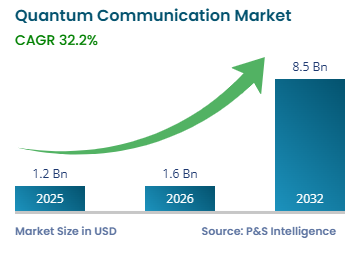
The quantum communication market size was USD 1.2 billion for 2025, and it will grow by 32.2% during 2026-2032, to reach USD 8.5 billion by 2032.
The market is expanding as organizations give higher priority to secure communication systems for protecting sensitive data moving across digital networks. Government agencies, telecom operators, banks, healthcare providers, and critical infrastructure users are handling larger volumes of confidential information through cloud platforms, fiber networks, satellite links, and connected enterprise systems. This is increasing the need for stronger encryption, quantum key distribution, and quantum-safe communication methods that can protect data during transmission and reduce exposure to future computing-based security risks.
According to the International Telecommunication Union, 177 countries had at least one regulation on personal data protection, privacy protection, or breach notification in force or in progress in 2024. This shows that data security is becoming a structured policy priority across many countries, not only an internal enterprise concern. Additionally, government-backed quantum programs, early fiber-based pilots, and satellite-enabled trials are helping move quantum communication from research settings into practical network deployments. This supports demand for integrated solutions, deployment services, secure communication applications, and quantum networking platforms across public-sector, defense, financial, telecom, and data center environments.
Key Market Insights
Solutions are the larger component, holding a market share of 75%, due to demand for integrated quantum security systems.
Services are the faster-growing component, registering a CAGR of approximately 32.4%, driven by the need for deployment expertise and system integration support.
Fibre-based quantum communication is the largest transmission medium, holding a market share of 55%, due to the existing telecom fibre infrastructure availability.
North America holds the largest share of 40%, due to strong government programs and early adoption in the defence and telecom sectors.
Asia-Pacific is the fastest-growing region, registering a CAGR of approximately 33.1%, driven by rapid national investments in quantum communication infrastructure.
Quantum Communication Market Trends and Drivers
Rising Shift Toward Satellite-based Quantum Communication Networks Is a Major Trend
The market is shifting toward satellite-enabled quantum communication to extend secure data transmission alongside terrestrial fiber infrastructure. Governments, telecom operators, and research organizations are expanding satellite-based capabilities to support long-distance quantum key distribution, cross-border communication, and secure connectivity for geographically dispersed networks. This approach complements existing fiber-based deployments while enabling broader coverage for regions where physical network expansion remains technically difficult or economically challenging. Growing interest in hybrid communication architectures is also supporting wider adoption across defense, public-sector, and commercial applications.
According to the International Telecommunication Union, the number of active satellites in orbit reached close to 10,000 in 2024, reflecting the continued expansion of global space-based communication infrastructure. Moreover, telecom providers are integrating quantum security technologies into existing terrestrial and satellite networks to create interoperable communication environments. These developments are improving deployment flexibility, supporting secure international connectivity, and expanding practical opportunities for quantum communication across increasingly diverse operational environments.
Growing Need to Protect Data from Future Quantum-based Cyber Threats Drives Market
The market is growing due to increasing concerns that existing encryption methods may become vulnerable as quantum computing capabilities continue to advance. Organizations across government, banking, healthcare, telecommunications, and critical infrastructure are strengthening long-term cybersecurity strategies to protect sensitive information from future computational threats. Traditional encryption systems were designed for conventional computing environments, creating demand for communication technologies that can provide stronger protection against emerging attack methods. This shift is encouraging broader evaluation of quantum communication as part of enterprise security planning rather than only research activities.
According to IBM, the global average cost of a data breach reached USD 4.88 million in 2024, while the International Telecommunication Union reported that 132 countries had enacted national cybersecurity strategies by 2024. These developments are encouraging organizations to strengthen secure communication infrastructure alongside existing cybersecurity investments. Furthermore, enterprises are incorporating quantum-safe technologies into long-term digital transformation plans to protect high-value information, support regulatory compliance, and improve resilience across increasingly connected communication networks without relying solely on conventional encryption methods.
High Cost and Complex Infrastructure Requirements Limit Wider Adoption
The market faces restraints because deploying quantum communication infrastructure requires specialized fiber routes, satellite systems, trusted nodes, quantum detectors, and skilled integration teams. These requirements increase project cost and make large-scale rollout difficult for users without strong technical and financial support. The World Bank reported that annual capital raised by private infrastructure funds fell to USD 94.9 billion in 2023, almost half of the 2022 level. This capital pressure affects advanced digital infrastructure projects because investors prefer lower-risk assets and clearer returns. Telecom operators, public agencies, and enterprises may delay quantum communication deployment when financing, interoperability, and long-term maintenance requirements remain uncertain.
Expansion of National Quantum Programs and Cross-border Secure Networks Creating New Growth Paths
The market presents strong growth potential as governments and technology providers build sovereign quantum communication networks to protect critical data and reduce dependence on foreign security infrastructure. Demand is rising because cross-border data exchange, defense communication, and enterprise networks require encryption methods that can withstand future computing threats. The United Nations Educational, Scientific, and Cultural Organization states that the Global Quantum Initiative for 2026–2028 targets 70+ member states and 15+ access-to-infrastructure partnerships. This coordinated activity supports vendors, service providers, and system integrators working on quantum key distribution, quantum-safe cryptography, satellite links, and interoperable secure networking platforms across national and commercial projects.
Quantum Communication Market Segmentation Analysis
Component Analysis
Solutions are the larger category, holding a market share of 75%, because organizations prefer integrated quantum communication platforms that combine quantum key distribution hardware, quantum random number generators, detectors, encryption software, and network security tools in one deployable system. These solutions support fiber-based, satellite-based, on-premises, and cloud deployment models, making them useful across government, defense, telecom, banking, and enterprise networks. The International Telecommunication Union estimated that global digital infrastructure investment requirements reached USD 1.6 trillion in 2024, highlighting the growing need for scalable communication platforms supporting advanced network technologies. Integrated solutions reduce vendor complexity, improve system control, and support wider deployment of secure quantum communication architectures.
Services are the faster-growing category, registering a CAGR of approximately 32.4%, because many organizations do not have the internal expertise needed to design, integrate, and maintain quantum communication systems. Service providers support consulting, deployment, integration, testing, and maintenance across solutions such as quantum key distribution, quantum-safe cryptography, and quantum network security. This need is stronger as users adopt fiber-based links, satellite communication, on-premises infrastructure, and cloud-based access models. Additionally, government agencies, financial institutions, SMEs, and telecom operators require technical support to move from pilot projects to operational networks. Services help users manage system complexity, ensure interoperability, and maintain secure communication performance across changing network environments.
The components analysed in this report are:
Solutions (Larger Category)
Quantum Key Distribution
Quantum Random Number Generator
Quantum Detectors
Quantum-safe Cryptography
Quantum Network Security
Services (Faster-Growing Category)
Consulting
Deployment and Integration
Support and Maintenance
Transmission Medium Analysis
Fiber-based Quantum Communication is the largest category, holding a market share of 60%, because it uses existing optical fiber infrastructure and supports stable deployment across cities, enterprise campuses, data centers, government facilities, and telecom networks. This medium connects strongly with solutions, on-premises deployment, secure communication, and quantum networking applications, as most early projects rely on controlled fiber links for quantum key distribution. Telecom providers and large enterprises already have fiber routes, which reduces deployment barriers compared with new satellite or free-space infrastructure. Its practical readiness supports wider adoption in defense, banking, research, and critical infrastructure environments where secure point-to-point and multi-node communication are required.
Satellite-based Quantum Communication is the fastest-growing category, because it enables secure communication across continents where terrestrial optical fiber networks have limited practical coverage across long-distance routes. Governments and space agencies are expanding satellite infrastructure to support long-distance quantum key distribution, secure government communication, and resilient international connectivity. The Indian Space Research Organisation reported that global space activity recorded 315 successful launches, placing about 4,198 satellites into orbit in 2025, reflecting the continued expansion of orbital communication infrastructure. Moreover, satellite-based systems connect with quantum networking, defense communication, and cross-border secure data transfer, creating stronger foundations for future quantum communication networks beyond local fiber systems.
The transmission medias analysed in this report are:
Fibre-based Quantum Communication (Largest Category)
Satellite-based Quantum Communication (Fastest-Growing Category)
Free-space Quantum Communication
Deployment Mode Analysis
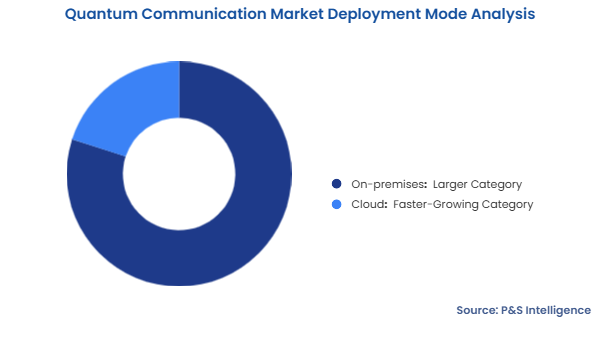
On-premises is the larger category, holding a market share of 80%, because organizations handling sensitive information prefer to operate quantum communication systems within controlled internal environments. This deployment model connects closely with fiber-based communication, large enterprises, government and defense users, banking networks, and secure communication applications, where direct control over encryption and key exchange is important. The Federal Bureau of Investigation reported that losses from internet crimes exceeded USD 16 billion in 2024, highlighting rising cybersecurity risks. On-premises deployment helps users maintain data sovereignty, reduce external exposure, and manage quantum security infrastructure within their own network and compliance environments.
Cloud is the faster-growing category, because organizations are exploring flexible ways to access quantum communication capabilities through flexible access models that reduce infrastructure requirements. Cloud-based models connect with services, SMEs, quantum-safe cryptography, network security, and quantum networking applications, as users can test secure communication functions through remote platforms. This model is useful for companies that need scalability but do not yet have the budget or technical staff for full on-premises systems. Additionally, providers are developing cloud-accessible quantum security services for integration with enterprise networks. Cloud deployment lowers entry barriers and supports gradual adoption across smaller firms and distributed users.
The deployment modes analysed in this report are:
On-premises (Larger Category)
Cloud (Faster-Growing Category)
Organisation Size Analysis
Large Enterprises are the larger category, because they have the financial resources, technical teams, and security requirements needed to adopt advanced quantum communication systems earlier. These organizations are active users of integrated solutions, fiber-based links, on-premises deployment, and secure communication applications across banking, telecom, data center, and critical infrastructure environments. They manage high-value data, large communication networks, and strict compliance needs, which makes quantum key distribution and quantum-safe network protection more relevant. Large enterprises also participate in pilot programs with technology providers and research partners, supporting early commercialization across practical deployment environments.
Small and Medium Enterprises are the faster-growing category, registering a CAGR of approximately 32.6%, because increasing cybersecurity awareness is raising demand for accessible quantum-safe communication solutions among smaller users. SMEs are more likely to depend on services, cloud deployment, consulting, and managed security support because they typically rely on managed security providers and external expertise. The World Economic Forum reported that 38% of smaller organizations reported insufficient cyber resilience in 2025, emphasizing the need for stronger security frameworks. Additionally, scalable quantum-safe cryptography and network security services are helping SMEs adopt advanced protection gradually without heavy infrastructure spending, supporting broader participation in secure communication ecosystems.
The organization sizes analysed in this report are:
Large Enterprises (Larger Category)
Small and Medium Enterprises (Faster-Growing Category)
End-user Analysis
Government and Defense is the largest category, holding a market share of 30%, because these users require highly secure communication systems to protect classified information, critical infrastructure, military networks, and national security data. This end-user segment connects strongly with on-premises deployment, fiber-based communication, satellite-based communication, secure communication, and quantum networking applications. According to the International Institute for Strategic Studies, global defense spending reached USD 2.63 trillion in 2025, reflecting a heightened focus on national security. Quantum communication supports secure key exchange, resilient command networks, and protected cross-border communication, making it a priority area for defense modernization and public-sector cybersecurity programs.
Banking, Financial Services, and Insurance is the fastest-growing category, registering a CAGR of approximately 32.8%, because financial institutions need stronger protection for transactions, customer records, payment systems, and interbank data exchange. This segment connects with solutions, services, on-premises infrastructure, cloud-based access, secure communication, and network security applications, as banks must secure both internal and distributed digital operations. Growing digital banking, fraud risks, and future threats to conventional encryption are pushing financial firms to explore quantum-safe cryptography and quantum key distribution. Additionally, service providers help financial institutions test and integrate these systems without disrupting existing payment and compliance infrastructure, supporting faster adoption across financial networks.
The end-users analysed in this report are:
Government and Defense (Largest Category)
Banking, Financial Services and Insurance (Fastest-Growing Category)
Telecommunications
Healthcare and Life Sciences
Energy and Utilities
Research and Academia
IT and Data Centers
Others
Application Analysis
Secure Communication is the largest category, holding a market share of 35%, because the core purpose of quantum communication is to protect data exchange from interception and future decryption risks. This application connects directly with quantum key distribution, quantum-safe cryptography, fiber-based links, satellite communication, on-premises deployment, government and defense networks, and banking systems. Most early commercial and public-sector projects are designed around secure transmission of sensitive information across controlled networks. Telecom operators, financial institutions, research bodies, and public agencies use secure communication to protect critical data flows, making it the main application area across current quantum communication deployments.
Quantum Networking is the fastest-growing category, because organizations are moving beyond point-to-point quantum links toward interconnected networks that securely exchange quantum keys across multiple nodes and users. Research institutions, telecommunications operators, and technology companies are expanding testbeds to develop scalable quantum networking architectures supporting metropolitan, regional, and national communication systems. The European Patent Office and the Organisation for Economic Co-operation and Development reported in 2025 that quantum communication generated the largest number of international patent families annually until 2022, demonstrating sustained global innovation in networking technologies. This development supports wider use of quantum networks across fiber, satellite, cloud, government, telecom, and enterprise environments.
The applications analysed in this report are:
Secure Communication (Largest Category)
Quantum Networking (Fastest-Growing Category)
Network Security
Data Encryption
Satellite Communication
Others
Drive strategic growth with comprehensive market analysis
Quantum Communication Market Regional Outlook
North America Quantum Communication Market Analysis
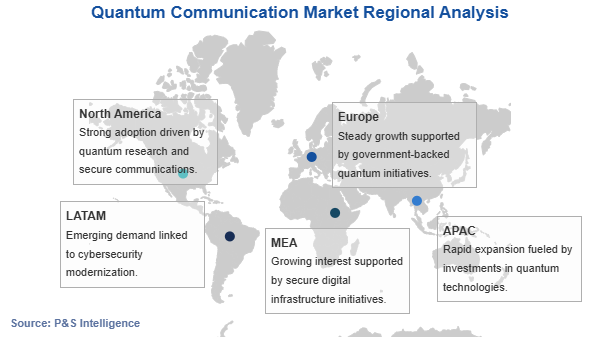
North America holds the largest share of 40% because the region combines advanced quantum research, established telecommunications infrastructure, and sustained investments in secure communication technologies. Government agencies, defense organizations, financial institutions, and telecom operators are actively deploying quantum communication through quantum key distribution networks, metropolitan fiber links, and quantum-safe encryption trials. Additionally, collaboration among national laboratories, universities, technology companies, and network providers is accelerating commercial deployment beyond experimental environments. Furthermore, large-scale funding supports the development of quantum repeaters, trusted node architectures, and integrated optical communication systems for critical infrastructure protection. Moreover, cybersecurity modernization initiatives and high-value enterprise data protection continue to expand demand for secure quantum networks across multiple industries. Ongoing pilot deployments, interoperability testing, and commercialization programs strengthen the regional ecosystem and support broader adoption across public and private communication infrastructure.
U.S. Quantum Communication Market Analysis
The United States leads the market due to strong federal support for quantum technologies and early deployment across defense, telecommunications, and critical infrastructure. Government agencies, research laboratories, and private technology companies are advancing quantum key distribution, quantum networking, and quantum-safe communication through coordinated development programs. The Federal Bureau of Investigation reported that the Internet Crime Complaint Center received 1,008,597 complaints in 2025, up from 859,532 in 2024, highlighting growing cybersecurity risks. Furthermore, increasing demand for resilient communication networks is encouraging wider deployment of quantum communication systems across government, defense, financial services, and enterprise environments while supporting continued commercialization of secure networking technologies.
Canada Quantum Communication Market Analysis
Canada is progressing steadily in the market through strong research partnerships, university-led innovation, and government support for secure communication technologies. The country continues expanding quantum networking capabilities by connecting academic research with commercial deployment and telecommunications infrastructure. In 2026, Toshiba Europe Limited and Quantum Bridge Technologies demonstrated an international quantum-safe communication network linking Cambridge and Toronto using quantum key distribution over field-installed fiber infrastructure. Additionally, practical demonstrations across existing communication networks are strengthening confidence in real-world deployment and encouraging broader adoption of quantum-safe communication technologies across public institutions and commercial organizations.
Asia-Pacific Quantum Communication Market Analysis
Asia-Pacific has the highest CAGR of approximately 33.1% because governments across the region are rapidly expanding national quantum communication capabilities through coordinated investments in research, infrastructure, and commercial deployment. China, Japan, South Korea, India, and Australia are advancing quantum key distribution networks, satellite-based quantum communication, metropolitan fiber corridors, and long-distance optical transmission systems. Additionally, strong collaboration between telecommunications companies, research institutes, and public agencies is accelerating technology validation and large-scale implementation. Furthermore, regional initiatives emphasize domestic technology development, secure cross-border connectivity, and resilient communication infrastructure for government, defense, and critical industries. Moreover, growing investments in quantum satellites, integrated photonic technologies, and quantum networking platforms are strengthening the regional innovation ecosystem. Expanding digital infrastructure, rising cybersecurity priorities, and sustained public funding continue to support rapid deployment across diverse communication environments.
China Quantum Communication Market Analysis
China is expanding rapidly in the market through the large-scale deployment of quantum communication infrastructure and continued integration with national telecommunications networks. Government-backed initiatives and domestic technology providers are accelerating the development of quantum key distribution, secure optical transmission, and metropolitan quantum communication systems. In 2025, China Telecom Quantum Group released a distributed cryptography system combining quantum key distribution with post-quantum cryptography and completed a cross-regional quantum-encrypted voice call using the platform. Moreover, integrating quantum communication with operational telecom services supports broader deployment across government, enterprise, and critical infrastructure communication networks.
India Quantum Communication Market Analysis
India is emerging in the market through government-backed quantum initiatives, expanding research capabilities, and collaboration between technology companies and academic institutions. National programs are encouraging the development of secure communication technologies while supporting indigenous quantum networking solutions for strategic applications. In 2025, Press Information Bureau reported that QNu Labs demonstrated India's first extensive quantum key distribution network over existing optical fiber infrastructure under the National Quantum Mission. Furthermore, successful deployment on operational fiber networks is strengthening technology validation and creating opportunities for wider adoption of quantum-safe communication across government, defense, and critical digital infrastructure.
Europe Quantum Communication Market Analysis
Europe is strengthening its position through coordinated regional initiatives that emphasize secure cross-border quantum communication and interoperable network development. The region prioritizes digital sovereignty, secure public-sector communication, and advanced data protection, creating strong demand for quantum communication infrastructure across member countries. Additionally, collaborative programs unite research institutions, telecommunications operators, technology developers, and government agencies to develop interconnected quantum networks using fiber-based quantum key distribution and trusted communication architectures. Furthermore, regional projects focus on harmonized technical standards, interoperability, and scalable deployment across national borders to enable long-term secure connectivity. Moreover, investments in quantum networking platforms, photonic technologies, satellite communication research, and secure optical infrastructure continue expanding the regional ecosystem. This coordinated approach supports consistent technology advancement while creating a resilient foundation for future quantum communication services across Europe.
The regions and countries analysed in this report are:
North America (Largest Regional Market)
U.S. (Larger Country)
Canada (Faster-Growing Country)
Europe
Germany (Largest Country)
U.K. (Fastest-Growing Country)
France
Italy
Spain
Rest of Europe
Asia-Pacific (Fastest-Growing Regional Market)
China (Largest Country)
India (Fastest-Growing Country)
Japan
South Korea
Australia
Rest of APAC
Latin America
Brazil (Largest Country)
Mexico (Fastest-Growing Country)
Rest of LATAM
Middle East and Africa
Saudi Arabia (Largest Country)
U.A.E. (Fastest-Growing Country)
South Africa
Rest of MEA
Quantum Communication Market Competitive Landscape
The market is fragmented because it includes established quantum technology companies, telecommunications providers, network equipment manufacturers, cybersecurity vendors, research organizations, and emerging startups contributing specialized expertise across the quantum communication ecosystem. Companies are advancing technologies such as quantum key distribution, quantum repeaters, secure optical transmission systems, satellite-based quantum communication, and network orchestration platforms. Additionally, collaboration between commercial enterprises, academic institutions, and government agencies is accelerating technology validation and large-scale deployment.
Furthermore, strategic partnerships support interoperability across fiber, free-space, and satellite communication networks while encouraging the development of standardized architectures. Moreover, vendors continue expanding their portfolios through research, pilot projects, and integrated security solutions tailored for critical infrastructure, defense, financial services, and telecommunications applications. This broad participation across multiple technology domains and deployment models creates a dynamic competitive landscape supported by continuous innovation and collaborative ecosystem development.
Key Players in the Quantum Communication Market:
Toshiba Corporation
Thales S.A.
ID Quantique SA
QuantumCTek Co., Ltd.
Arqit Quantum Inc.
QuintessenceLabs Pty Ltd
Qubitekk, Inc.
Quantum Xchange, Inc.
Nokia Corporation
NEC Corporation
Huawei Technologies Co., Ltd.
Mitsubishi Electric Corporation
KETS Quantum Security Ltd.
Aliro Quantum Inc.
Cisco Systems, Inc.
IonQ, Inc.
Orange S.A.
KT Corporation
Quantum Communication Market News
In April 2026, Cisco Systems, Inc. introduced the Universal Quantum Switch, a working research prototype designed to route quantum information between different quantum systems. The switch operates over standard telecom fibre and is intended to enable future quantum networking by connecting heterogeneous quantum devices.
In February 2026, IonQ, Inc. deployed the technology powering Romania’s National Quantum Communication Infrastructure (RoNaQCI), one of Europe’s largest operational quantum key distribution (QKD) networks. Built using commercially available QKD technology, the network connects national research and education infrastructure and contributes to Europe’s broader quantum communication initiative (EuroQCI).
In June 2025, Orange Business and Toshiba Europe Limited launched Orange Quantum Defender in Paris, the first commercial quantum-safe network service in France. The service combines Toshiba’s quantum key distribution (QKD) technology with post-quantum cryptography (PQC), is commercially available in the greater Paris area, and has already been adopted by a French financial services company connecting multiple sites.
In February 2025, KT Corporation launched a commercial hybrid quantum cryptography network in South Korea, combining quantum key distribution (QKD) with post-quantum cryptography (PQC)-based VPN technology. The network was deployed on KT’s 5G infrastructure, including systems linked to USIM operations, marking the transition of KT’s quantum-secure communication technology into real-world telecom operations.
Frequently Asked Questions About This Report
What is quantum communication and why is it important today?+
Quantum communication uses quantum physics to transmit information securely, helping protect sensitive data against advanced cyber threats and future computing risks.
How does quantum key distribution secure communication between two parties?+
Quantum key distribution sends encryption keys using quantum particles, allowing users to detect interception attempts and strengthen secure data exchange.
What role do photons play in modern quantum communication systems?+
Photons carry quantum information across optical links, helping systems distribute secure keys while making unauthorized measurement easier to detect.
Can quantum communication work over existing fiber optic network infrastructure?+
Quantum communication can use fiber optic infrastructure, but signal loss, distance limits, equipment needs, and network integration remain practical challenges.
Why are satellites important for long distance quantum communication networks?+
Satellites can support quantum links across longer distances, helping overcome fiber limitations and enabling secure communication between far apart locations.
Want a report tailored exactly to your business need?
Leading companies across industries trust us to deliver data-driven insights and innovative solutions for their most critical decisions. From data-driven strategies to actionable insights, we empower the decision-makers who shape industries and define the future. From Fortune 500 companies to innovative startups, we are proud to partner with organisations that drive progress in their industries.
Client Testimonials
Working with P&S Intelligence and their team was an absolute pleasure – their awareness of timelines and commitment to value greatly contributed to our project's success. Eagerly anticipating future collaborations.
McKinsey & Company
India
Unmatched Standards
Our insights into the minutest levels of the markets, including the latest trends and competitive landscape, give you all the answers you need to take your business to new heights
Complete Data Security
We take a cautious approach to protecting your personal and confidential information. Trust is the strongest bond that connects us and our clients, and trust we build by complying with all international and domestic data protection and privacy laws