This Report Provides In-Depth Analysis of the PTA Balloon Catheter Market Report Prepared by P&S Intelligence, Segmented by Material Type (Polyurethane, Nylon), Application (Coronary Artery Disease, Peripheral Vascular Disease), End User (Hospitals, Ambulatory Surgical Centers), Product Type (Standard and High-Pressure PTA Balloon Catheter, Specialty PTA Balloon Catheter), and Geographical Outlook for the Period of 2019 to 2032
Explore the market potential with our data-driven report
PTA Balloon Catheter Market Outlook
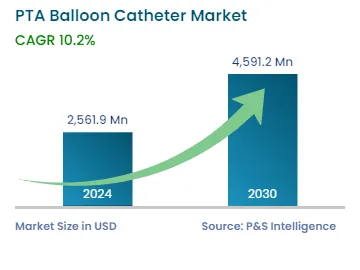
The global PTA balloon catheter market size was USD 2.5 billion in 2024, which is predicted to reach USD 5.5 billion by 2032, growing at a CAGR of 10.2% during 2025–2032.
The market is driven by the increasing prevalence of cardiovascular diseases, growing number of minimally invasive surgical procedures, and rising consumption of tobacco and incidence of obesity.
As of 2024, approximately 30% of the individuals aged 14 and older in Germany are active cigarette smokers, based on findings from the DEBRA study—a nationally representative survey. This marks a significant increase from around 26–27% in 2019–2020 and aligns with the upward trend noted in 2021, when smoking rates exceeded 30%. While WHO-standardized estimates report lower figures of about 21–22%, these are model-based and often underrepresent actual behavior.
The latest data also reveals a troubling decline in attempts to quit, with only 7.7% of the smokers making a serious one in 2024, compared to 30.4% in 2016, and just 19.5% of those using evidence-based cessation methods. This sharp rise in smoking prevalence, combined with low cessation efforts, highlights a growing public health challenge in Germany, potentially increasing the burden of smoking-related illnesses, such as cardiovascular disease.
A person who smokes fewer than five cigarettes a day may also show signs of a CVD. The cells that line the blood vessels become inflamed and swollen because the chemicals in cigarette smoke make the lumen thin and cause various vascular problems.
The demand for PTA balloon catheters is also growing due to the rising number of minimally invasive surgical procedures. This technique is now one of the standards in numerous routine operations. This is mainly because it results in fewer and smaller scars, lesser pain, lower risk of post-operative complications, and faster recoveries; is cost-effective, and has overall better outcomes. Moreover, it has been found that American hospitals could collectively prevent thousands of post-surgical complications and save up to USD 350 million each year by opting for minimally invasive surgeries for routine operations.
In the coming years, companies in the market can leverage the growth opportunities being offered by developing countries. an increasing number of people in emerging economies, including China and India, are becoming subject to stressful lifestyles, insufficient sleep, lack of exercise, and poor diet, all of which increase the prevalence of CVDs. Moreover, developing nations are also reporting a large number of aged people, who are prone to cardiac diseases. All these factors are together raising the demand for cardiac procedures, including angioplasties, thereby offering PTA balloon catheter providers several lucrative opportunities.
PTA Balloon Catheter Market Growth Factors
Environmental Regulations and Sustainability Initiatives Is Major Trend
Currently, over 35% of the surgeries conducted worldwide are minimally invasive.
Minimally invasive procedures require small incisions, which reduce the risk of infection and complications compared to traditional surgery.
In July 2025, Chamarajanagar Institute of Medical Sciences proposed a INR 10-crore investment in a cardiac catheterization laboratory, to provide advanced, minimally invasive procedures, such as angiography and angioplasty.
This initiative seeks to enhance cardiac emergency care and reduce the need for patients to travel long distances for treatment.
Patients experience shorter recovery times and can return to normal activities faster, making these procedures more appealing.
Minimally invasive treatments typically result in less scarring and reduced trauma to surrounding tissues.
There is a growing preference among patients and healthcare providers for procedures that require shorter hospital stays, leading to cost savings and quicker patient turnover.
The advancement in medical technology has made minimally invasive procedures more effective and accessible, fueling their demand across various medical specialties.
The reduction in anesthesia use and the overall procedure time further contribute to the appeal of minimally invasive approaches.
Healthcare providers are adopting these methods more frequently as they align with patient-centric care models, prioritizing comfort and convenience.
Growing Prevalence of Peripheral Artery Disease Is Key Driver
Peripheral artery disease (PAD) is becoming increasingly prevalent, primarily due to an aging global population and rising incidences of risk factors such as diabetes, hypertension, and obesity.
As per studies, up to 115 million people in the world could have diagnosed or undiagnosed peripheral artery disease, and the likely case count is probably even higher.
As people develop atherosclerosis, the arteries in the legs and other extremities narrow and harden, restricting blood flow and causing pain, cramping, and poor wound healing.
The global burden of PAD is expected to rise due to lifestyle factors such as smoking, physical inactivity, and poor dietary habits, contributing to higher rates of vascular disease.
Increased awareness and improved diagnostic techniques have led to more people being diagnosed with PAD, even in its early stages, which helps with better management and intervention.
In October 2024, Medtronic plc received the FDA approval for an Investigational Device Exemption (IDE) trial for its Prevail drug-coated balloon.
This study aims to assess the safety and effectiveness of the device in treating in-stent restenosis and de novo small vessels, with data supporting regulatory submissions for the treatment of coronary artery disease in the U.S. and Japan.
PAD significantly impacts the quality of life, with severe cases leading to limb amputation, if left untreated, further highlighting the importance of early detection and treatment.
Advances in minimally invasive interventional procedures, specifically PTA balloon angioplasty, enhance the effectiveness in treating PAD without the need for extensive surgery.
The growing prevalence of PAD is driving the demand for specialized medical devices, as part of the efforts to expand treatment options and improve patient outcomes.
As the number of patients with PAD increases, healthcare systems are under pressure to implement more efficient and effective management strategies, contributing to market growth in PAD-related technologies.
PTA Balloon Catheter Market Segmentation Analysis
Material Type Analysis
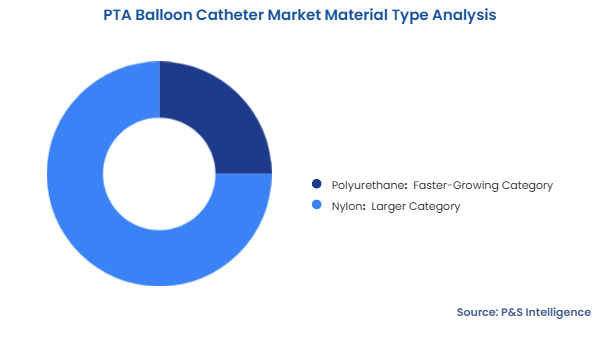
The nylon category held the larger market share, of 75%, in 2024. This is primarily because nylon offers high tensile strength and burst resistance, which are critical during angioplasty procedures. Here, balloons are inflated under high pressure to open narrowed or blocked blood vessels. Its semi-compliant nature allows for controlled expansion, giving surgeons the precision they need. Additionally, nylon catheters are relatively easy to manufacture and have been in use for many years, contributing to their widespread adoption across hospitals and clinics worldwide.
The material types analyzed here are:
Polyurethane (Faster-Growing Category)
Nylon (Larger Category)
Application Analysis
The peripheral vascular disease category held the larger market share, of 85%, in 2024. The prevalence of this disease in the U.S. is 45 to 50 million. The incidence of the disease increases sharply with age, with more than 20% of the people over 80 years old having it. It majorly results from progressive atherosclerotic disease, which results in a decrease in major organ blood flow and emergence of end-organ ischemia.
The most-common cause is atherosclerosis, which is a buildup of fatty deposits within the blood vessels, which reduces blood flow to that area. Apart from this, other causes are diabetes; a high level of sugar in the blood can damage and weaken the blood vessels, causing them to narrow. Infections, such as syphilis or salmonellosis, can also cause this disease.
Some autoimmune diseases can also cause inflammation of the arteries, which eventually causes peripheral vascular disease. People who are prone to this condition include tobacco users, diabetes mellitus, hypertension, HIV, and high cholesterol patients; a person whose BMI is greater than 30, people who have a medical history of stroke, CVDs, or heart attack or a family history of peripheral vascular disease, stroke, or coronary artery disease; and obese person.
The applications analyzed here are:
Coronary Artery Disease (Faster-Growing Category)
Peripheral Vascular Disease (Larger Category)
End User Analysis
The ambulatory surgical centers category will grow at the higher CAGR, of 10.5%, during the forecast period, because they offer a more-convenient and cost-effective setting for minimally invasive procedures. These centers are increasingly being equipped with advanced medical technologies and staffed by skilled healthcare professionals, making them well-suited for performing angioplasty procedures safely outside of traditional hospital settings. Patients often prefer ASCs because they typically provide shorter wait times, faster recovery, and reduced overall costs compared to hospitals. Healthcare systems also support ASCs to reduce the burden on hospitals and improve resource efficiency. As a result, more PTA procedures are being shifted to these outpatient facilities, leading to a significant rise in demand for PTA balloon catheters in this category.
The standard and high-pressure category held the larger market share, of 75%, in 2024, because these catheters are widely used in routine angioplasty procedures to treat peripheral artery disease. They are known for their strong inflation capability, durability, and effectiveness in dilating narrowed blood vessels. These catheters are commonly used in both hospitals and ambulatory settings, making them a staple in vascular interventions. Their broad applicability and proven clinical outcomes contribute to their high demand across global healthcare systems.
The product types analyzed here are:
Standard and High-Pressure (Larger Category)
Specialty (Faster-Growing Category)
Drive strategic growth with comprehensive market analysis
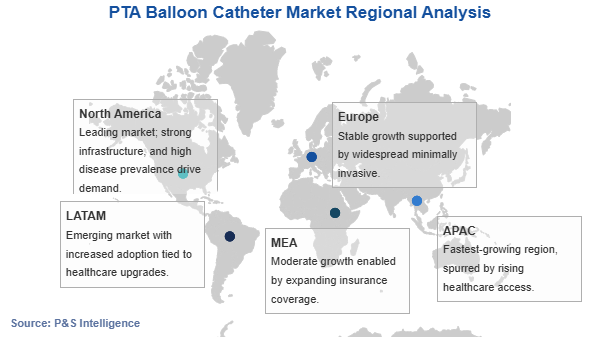
North America held the largest global PTA balloon catheter market share, around 40%, in 2024. In the U.S., for many years, cardiovascular diseases have been one of the major causes of death. As per the CDC, 0.69 million people in the country died of heart diseases in 2021, with more than one death every minute. Moreover, 1 out of every 3 adults are obese because of high calorie consumption, less physical activity, lack of opportunity and settings for exercise, oversized food portions, genetic factors, stress and emotional factors, and certain diseases, such as thyroid issues, Cushing’s syndrome, and polycystic ovary syndrome. Moreover, the U.S. government spends a significant portion of its gross domestic product (GDP) on healthcare every year.
APAC PTA Balloon Catheter Market Size
The APAC market is growing at the highest CAGR, mainly because of the rising prevalence of issues related to the heart and increasing aging population. In India, the most-common heart diseases are cardiomyopathy, coronary artery disease, rheumatic heart disease, valvular heart disease, cerebrovascular disease, heart attack, and heart failure. Factors such as economic development and the rising healthcare expenditure are expected to boost the growth of the market over the forecast period. The growing interest of private companies in investing in this market and the favorable government policies for cardiovascular disease patients are some of the other factors that are projected to boost the market advance over the forecast period.
In addition, health tourism activities are increasing in the country, which drives the market. APAC has also become the center of the global tobacco epidemic, and, unavoidably, it will face a rising burden of tobacco-related health problems in the years to come. Starting at a younger age, a growing proportion of males are smoking.
India PTA Balloon Catheter Market Size
In India, the quality of healthcare is progressing at a high rate. The country is one of the best medical tourism destinations, offering high-quality treatments at low costs, which is why it is now considered among the top six medical travel destinations in the world. Each year, around 2 million patients visit the country for medical advice and treatment. Hospitals in the country now utilize advanced technologies for the diagnosis and treatment of cardiac ailments. Another prominent factor for the rising arrival of heart patients in the country is that they get an appointment with a well-known cardiologist with relative ease.
China PTA Balloon Catheter Market Size
Globally, China is the largest manufacturer and consumer of tobacco products. There are more than 300 million smokers in China, accounting for more than 33% of the world's total. Over half the adult men are tobacco smokers in the country, and it accounts for about one in every three cigarettes smoked across the globe. Moreover, there are more than 250 million tobacco users in India, making it the country with the second-highest number of tobacco users, globally, after China.
Europe PTA Balloon Catheter Market Size
The market in Europe is also growing at a significant rate. The increasing adoption of minimally invasive surgeries, growing geriatric population, rising number of approved products, and presence of favorable reimbursement policies are expected to boost the market in the region in the coming years.
Italy PTA Balloon Catheter Market Size
In Italy, the increasing prevalence of heart diseases and resultant surge in the number of heart surgeries are expected to drive the market. The increasing number of ongoing clinical studies in this country is another factor expected to boost the market. In the country, more than 3 million people were suffering from heart diseases in February 2021. Therefore, the number of heart surgeries continues to increase in Italy, in turn, propelling the demand for balloon catheters for percutaneous transluminal angioplasties.
The regions and countries analyzed in this report are:
North America (Largest Regional Market)
U.S. (Larger Country Market)
Canada (Faster-Growing Country Market)
Europe
Germany (Largest Country Market)
U.K. (Fastest-Growing Country Market)
France
Italy
Spain
Rest of Europe
Asia-Pacific (Fastest-Growing Regional Market)
Japan
China (Largest Country Market)
India (Fastest-Growing Country Market)
Japan
South Korea
Australia
Rest of APAC
Latin America
Brazil (Largest Country Market)
Mexico (Fastest-Growing Country Market)
Rest of LATAM
Middle East and Africa
Saudi Arabia (Largest Country Market)
South Africa
U.A.E. (Fastest-Growing Country Market)
Rest of MEA
PTA Balloon Catheter Market Share
The global PTA balloon catheter market is consolidated as a few major players hold a significant share of the market. This consolidation is driven by factors such as the strong brand recognition, extensive distribution networks, and substantial financial resources of these leading companies. Their ability to invest heavily in research and development allows them to introduce innovative products, thereby maintaining competitive advantages and reinforcing their market positions. Furthermore, the economies of scale enjoyed by these dominant companies help streamline operations, reduce costs, and enhance profitability.
Top PTA Balloon Catheter Manufacturers:
Medtronic plc
Terumo Medical Corporation
Cardinal Health Inc.
Boston Scientific Corporation
Cook Medical
BIOTRONIK Inc.
Abbott Laboratories
Becton, Dickinson and Company
Natec Medical Ltd.
Surmodics Inc.
Meril Life Sciences Pvt. Ltd.
BrosMed Medical
PTA Balloon Catheter Market News
In January 2025, Boston Scientific Corporation announced the acquisition of Bolt Medical Inc., a developer of an intravascular lithotripsy (IVL) system designed to treat calcified coronary and peripheral artery lesions. The acquisition, valued at up to USD 664 million, positions Boston Scientific to compete in the growing IVL market, complementing its existing PTA balloon catheter portfolio.
In June 2023, Surmodics Inc. received the U.S. Food and Drug Administration (FDA)’s approval for the SurVeil DCB, a next-generation device designed to treat peripheral artery disease in the femoral and popliteal arteries.
In June 2023, BIOTRONIK SE & Co. KG introduced the Oscar multifunctional peripheral catheter at the Leipzig Interventional Course (LINC). This device features three fully user-adjustable components, a support catheter with integrated Lock Grip, an extendable dilator, and a length-adjustable PTA balloon. Designed for the dilation of stenotic segments in peripheral vessels, the Oscar catheter offers versatility in treating lesions in femoral, popliteal, and infrapopliteal arteries.
In February 2023, Abbott Laboratories announced the launch of a new generation of drug-eluting balloon catheters. This advancement aimed to improve the efficacy and safety profiles of PTA procedures, particularly in treating peripheral artery disease.
Want a report tailored exactly to your business need?
Leading companies across industries trust us to deliver data-driven insights and innovative solutions for their most critical decisions. From data-driven strategies to actionable insights, we empower the decision-makers who shape industries and define the future. From Fortune 500 companies to innovative startups, we are proud to partner with organisations that drive progress in their industries.
Client Testimonials
Working with P&S Intelligence and their team was an absolute pleasure – their awareness of timelines and commitment to value greatly contributed to our project's success. Eagerly anticipating future collaborations.
McKinsey & Company
India
Unmatched Standards
Our insights into the minutest levels of the markets, including the latest trends and competitive landscape, give you all the answers you need to take your business to new heights
Complete Data Security
We take a cautious approach to protecting your personal and confidential information. Trust is the strongest bond that connects us and our clients, and trust we build by complying with all international and domestic data protection and privacy laws