Catheters and Bands Market Size & Share Analysis - Emerging Trends, Growth Opportunities, Competitive Landscape, and Forecasts (2026 - 2032)
This Report Provides In-Depth Analysis of the Catheters and Bands Market Report Prepared by P&S Intelligence, Segmented by Product (Catheters, Bands), Procedure (Transfemoral, Transradial), Application (Acute Coronary Syndrome, Pre-Operative Coronary Assessment, Coronary Evaluation, Pulmonary Hypertension, Peripheral Arterial Disease, Bradycardia), Catheter Type (Therapeutic, Diagnostic), Catheter Shape (Pigtail, Judkins Left (JL), Judkins Right (JR), Bypass, Amplatz), Band Type (Regular, Long), End User (Hospitals, Clinics & Ambulatory Care Centers), and Geographical Outlook for the Period of 2021 to 2032
Explore the market potential with our data-driven report
Catheters and Bands Market Future Outlook
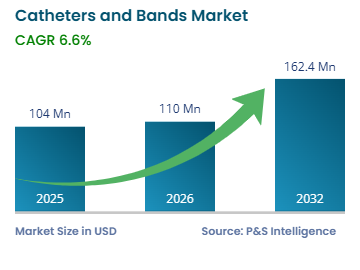
The catheters and bands in India, Sri Lanka, Bangladesh, and Nepal market was USD 104.0 million for 2025, and it will grow by 6.6% during 2026–2032, to reach USD 162.4 million by 2032.
The market growth is primarily driven by the rising incidence of cardiovascular disease in South Asian countries, including India, Nepal, Bangladesh, and Sri Lanka, where therapeutic catheterization enables minimally invasive coronary intervention and the growing number of hospitals providing advanced cardiac care. According to World Health Organization (WHO) statistics, cardiovascular disease is responsible for more than 34% of deaths in Sri Lanka and represents a major cause of mortality in the region; therefore, there is ongoing procedural demand.
Moreover, the market is increasingly supporting governmental initiatives focused on managing non-communicable diseases, specifically reorganizing the primary healthcare system in Sri Lanka, and deploying digital health infrastructure in Bangladesh. The shift towards value-based acute coronary syndrome care is establishing catheters and bands as key interventional tools at both tertiary cardiac centers and district-level hospitals across the region.
Catheters and Bands Market Trends & Drivers
Transradial Catheterization Adoption Is Key Trend
The shift in favor of transradial access catheterization has significantly changed the way cardiovascular interventionalists perform their work across South Asia.
Its well-documented clinical benefits include fewer vascular complications, faster patient ambulation, and shorter hospital stays when compared to the traditionally used transfemoral approach.
The evidence-based procedural changes have been demonstrated through interventional cardiology literature that radial artery access is associated with less bleeding risk.
Eligible patients can be discharged on the day of the procedure, which generates operational efficiencies in resource-constrained healthcare systems.
According to the American Heart Association, more than 230 million individuals worldwide suffer from peripheral artery disease (PAD) and PAD is a strong independent predictor of increased cardiovascular risk.
This increases the procedural demand for minimally invasive treatments.
As clinical evidence continues to show improved patient satisfaction scores and decreased post-procedure complication rates, regional hospitals in India, Sri Lanka and Bangladesh are increasingly adopting radial-first catheterization protocols, along with enhanced training programs for operators.
Specific devices, such as hydrophilic-coated catheters, reduce the incidence of arterial spasm during transradial interventions.
This shift is expected to position transradial catheterization as the standard of care in most cardiac catheterization laboratories across South Asia.
Government Health Coverage Expansion Is Biggest Driver
Universal health insurance coverage initiatives in South Asia, most notably India’s Ayushman Bharat Pradhan Mantri Jan Arogya Yojana (AB-PMJAY), are reducing financial barriers to cardiovascular interventions and increasing the adoption rate of catheter-based procedures among economically disadvantaged populations.
The Government of India’s National Health Authority reports that the AB-PMJAY program provides cashless health coverage of up to INR 5 lakh per family annually for a variety of medical procedures, including angioplasty, coronary angiography, and stenting.
The AB-PMJAY program’s elimination of out-of-pocket expenditures for cardiovascular procedures is increasing the number of catheterizations being performed at empaneled public and private hospitals.
Previously financially constrained patients now have access to interventional cardiology services.
Additionally, the inclusion of more than 1,900 medical procedures across 27 specialties, including comprehensive cardiothoracic and cardiovascular surgery packages, in the AB-PMJAY program is generating steady demand for therapeutic catheters and hemostasis bands throughout India.
Primary healthcare strengthening initiatives in Sri Lanka, funded by the World Bank, and Bangladesh’s growing digital health infrastructure also support continued growth in the cardiovascular care delivery system across the region and improve accessibility to cardiovascular care.
Catheters and Bands Market Segmentation Analysis
Product Analysis
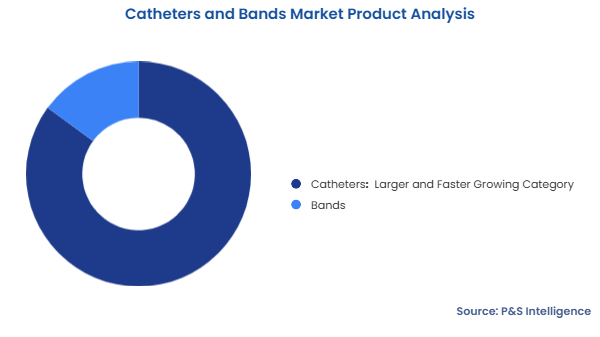
The catheters category holds the largest market share, of 85%, in 2025, and it will have the highest CAGR, of 6.9%, as these are widely used in all diagnostic coronary angiography, therapeutic interventional procedures, including angioplasty and stenting, and coronary evaluation protocols. They require precise vascular access and contrast medium administration. This category has benefited from established clinical pathways positioning catheters as an indispensable tool for managing acute coronary syndromes, assessing coronary arteries prior to surgical interventions, and performing chronic total occlusion interventions using specialized diagnostic and therapeutic catheters that allow for the safe and successful navigation of complex lesions and subsequent revascularization.
Additionally, the adoption rate of catheters has increased rapidly due to proliferation of the transradial technique, use of hydrophilic coatings to reduce the trauma caused by catheters on arteries, and miniaturization of catheters to be able to place smaller French size sheaths in patients that improve the comfort level of patients while maintaining the accuracy of the diagnosis.
The products analyzed in this report are:
Catheters (Largest and Fastest Growing Category)
Bands
Procedure Analysis
The transfemoral category holds the largest market share, of 70%, in 2025, due to the extensive experience of operators, standardized training in transfemoral catheterization techniques throughout South Asian medical education systems, and anatomical advantages allowing simultaneous left ventricular and coronary artery catheterization through large-bore vascular access. Transfemoral catheterization remains predominant in patients with severe peripheral artery disease limiting radial access, in high-risk PCI cases requiring mechanical circulatory support, and in facilities lacking specialized radial-specific equipment and hemostasis systems. In addition, transfemoral catheterization allows for easy bilateral coronary engagement and provides space for larger diameter therapeutic devices such as rotational atherectomy systems and intravascular imaging catheters that require substantial guide catheter support.
Faster growth in the market is expected in the category of catheters and bands used for transradial procedures. This can be mainly attributed to the growing demand for minimally invasive procedures across India, Sri Lanka, Bangladesh, and Nepal.
The procedures analyzed in this report are:
Transfemoral (Larger Category)
Transradial (Faster-Growing Category)
Application Analysis
The acute coronary syndrome category holds the largest market share, of 50%, in 2025, because of the high volume of myocardial infarctions and unstable angina that require emergency cardiac catheterization for diagnostic coronary angiography and therapeutic interventions such as primary percutaneous coronary intervention. Acute presentations require immediate access to the catheterization laboratory, and therapeutic catheters can quickly restore blood flow through obstructed coronary arteries, thereby limiting myocardial damage and improving survival.
The acute coronary syndrome category reflects South Asia's high cardiovascular disease mortality rates, with India having age-adjusted CVD death rates greater than the global average. This creates persistent demand for acute interventional capabilities in all tertiary cardiac centers and district hospitals capable of providing primary percutaneous coronary intervention programs.
The coronary evaluation category will have the highest CAGR, of 6.8%, due to the increasing prevalence of preventive cardiology, increasing recognition of coronary artery disease in asymptomatic high-risk populations, and increasing adoption of fractional flow reserve assessment utilizing specialized pressure-sensing guidewires and catheters to evaluate the severity of lesions. The expanded health insurance coverage allows for the funding of elective diagnostic catheterization previously prohibited by cost constraints. This also increases awareness among primary care physicians of proper referral criteria for coronary angiography in patients with stable chest pain syndromes.
The applications analyzed in this report are:
Acute Coronary Syndrome (Largest Category)
Pre-Operative Coronary Assessment
Coronary Evaluation (Fastest-Growing Category)
Pulmonary Hypertension
Peripheral Arterial Disease
Bradycardia
Catheter Type Analysis
The therapeutic category holds the largest market share in 2025, and it will have the highest CAGR, due to its primary role in interventional procedures such as angioplasty, stent deployment, chronic total occlusion interventions, and acute myocardial infarction treatment, which requires rapid coronary revascularization. Additionally, due to elevated rates of acute coronary syndromes and significant cardiovascular disease–related mortality burden in South Asia, the demand for therapeutic catheterization is expected to remain high as district hospitals continue to implement primary percutaneous coronary intervention programs.
Moreover, government health insurance coverage has expanded access to therapeutic interventions. Continued product development of therapeutic catheters, including hydrophilic coatings, improved torque control, and enhanced deliverability for challenging anatomies, is further supporting the growth of this category.
The catheter types analyzed in this report are:
Therapeutic (Largest and Fastest-Growing Category)
Diagnostic
Catheter Shape Analysis
The Judkins Left category holds the largest market share in 2025, as it is used in the vast majority of diagnostic and therapeutic catheterizations performed worldwide. The dominance of this catheter shape is attributed to its predictable engagement characteristics, broad anatomical compatibility among diverse patient populations, and standardized training of operators for Judkins Left catheter for accessing the left coronary system. Judkins Left catheters benefit from universal availability in all catheterization laboratories, lower unit costs due to economies of scale in manufacturing, and extensive clinical experience demonstrating reliability in routine and complex coronary interventions requiring left coronary artery visualization or therapeutic device delivery.
The Amplatz category will have the highest CAGR, driven by the increasing prevalence of challenging coronary anatomies, including horizontal aortic roots, dilated ascending aorta, and anomalous coronary origins, which require specialized catheter shapes beyond the standard Judkins configuration. Amplatz shapes offer superior backup support for complex interventions, including heavily calcified lesions, chronic total occlusions, and bifurcation treatments requiring stable guide catheter support.
The catheter shapes analyzed in this report are:
Pigtail
Judkins Left (JL) (Largest Category)
Judkins Right (JR)
Bypass
Amplatz (Fastest-Growing Category)
Band Type Analysis
The regular category holds the largest market share, of 80%, in 2025, driven by universal compatibility with standard radial artery compression protocols and cost-effectiveness enabling widespread adoption across resource-constrained healthcare settings. Another driver is well-established clinical evidence supporting the achievement of hemostasis in typical transradial catheterization procedures. Regular bands also provide simplified inventory management, minimal training requirements for nursing personnel applying radial compression, and adequate performance in the majority of transradial procedures that do not require long band lengths.
The long category will have the highest CAGR, of 7.0%, due to the increasing adoption of distal radial access techniques requiring compression over anatomically challenging wrist locations. Other factors include increasing utilization of larger French size sheaths requiring enhanced compression surface area for complex interventions, and increasing recognition of patient comfort advantages associated with distributed compression pressure along longer band length contact zones. Long bands accommodate diverse radial artery anatomies including tortuous courses, superficial positioning, and proximity to bony structures, requiring careful compression management to prevent both bleeding and arterial occlusion.
The band types analyzed in this report are:
Regular (Larger Category)
Long (Faster-Growing Category)
End User Analysis
The hospitals category holds the largest market share in 2025, as they offer 24-hour emergency catheterization laboratory access, comprehensive acute coronary syndrome management capabilities, and infrastructure to support both diagnostic angiography and therapeutic interventional procedures. Hospitals have dedicated tertiary cardiac centers that perform high volumes of procedures. District hospitals are implementing primary percutaneous coronary intervention programs under government cardiovascular care expansion initiatives, and specialty cardiac hospitals concentrate interventional cardiology expertise.
The clinics & ambulatory care centers category will have the highest CAGR, of 6.7%, driven by healthcare delivery model changes toward outpatient catheterization services that reduce hospitalization costs. Other drivers are expansion of elective diagnostic catheterization outside of traditional hospital settings and regulatory approval of ambulatory facilities to perform low risk coronary angiography with same day discharge protocols. Demand for ambulatory care services is expected to be especially strong in urban areas where specialty cardiac clinics equipped with catheterization laboratories serve commercially insured populations seeking expedited diagnostic evaluation. In semi-urban regions, clinics bridge the gap between primary care facilities and distant tertiary cardiac centers.
The end users analyzed in this report are:
Hospitals (Larger Category)
Clinics & Ambulatory Care Centers (Faster Growing Category)
Drive strategic growth with comprehensive market analysis
Catheters and Bands Market Geographical Analysis
India Catheters and Bands Market Size
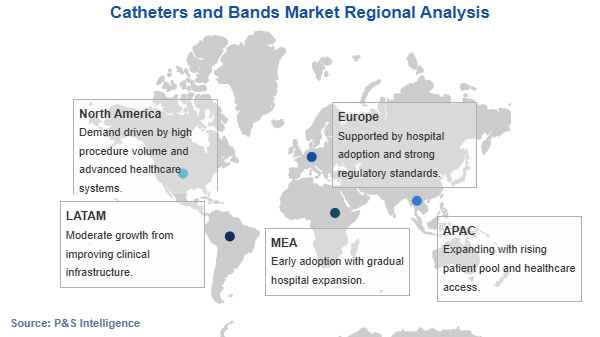
India holds the largest market share, of 45%, in 2025, and it will have the highest CAGR, due to its high burden of cardiovascular disease, and rapidly developing interventional cardiology infrastructure in the country. As reported by WHO India, the high burden of cardiovascular disease in India is reflected in the age-adjusted CVD mortality rates of 349 deaths per 100,000 men and 265 deaths per 100,000 women, significantly greater than global averages, resulting in high volumes of therapeutic catheterization procedures. A 2025 systematic review published in the International Journal of Environmental Research and Public Health reported an 11% pooled prevalence of cardiovascular disease among adults in India, with higher prevalence observed in urban populations.
India’s dominance also reflects the maturation of its digital health ecosystems, enabling remote diagnostic services, the increase in district hospital capabilities through government procurement initiatives and the emergence of domestic medical device manufacturers under “Make in India” policies, reducing reliance on imports. An analysis published in The Lancet Global Health demonstrated that cardiovascular disease accounted for 28.1% of total deaths and 14.1% of total Disability-Adjusted Life Years (DALYs) in India in 2016, increasing from 15.2% and 6.9% respectively in 1990, indicating the epidemiologic transition driving catheter demand.
Sri Lanka Catheters and Bands Market Size
Sri Lanka maintained the second largest country share in 2025, supported by a universal healthcare system that provides free cardiovascular services and established primary healthcare networks that emphasize screening for non-communicable diseases. According to the country information note on Sri Lanka healthcare published by the UK Government, non-communicable diseases, including cardiovascular disease, account for nearly 90% of the disease burden in Sri Lanka, and ischemic heart disease and stroke are among the top mortality causes.
The market is characterised by concentration of specialist cardiovascular care in developed urban centers such as Colombo, while regional and provincial hospitals are beginning to develop catheterization capabilities through funding provided by the World Bank as part of their Primary Healthcare System Strengthening Projects focusing on NCD detection and management. Moreover, due to its unique epidemiologic transition, Sri Lanka represents a transitional state between low and middle-income countries in terms of cardiovascular disease burden patterns, which places it in a unique position relative to other South Asian nations.
However, market development is constrained by the lack of specialized care units in rural regions, and patients often need to travel long distances for catheterization procedures. Stable growth is expected for Sri Lanka as healthcare system reorganization provides increased access to catheterization services at peripheral hospitals; however, the rate of growth is likely to be constrained by fiscal limitations in comparison to the rapid growth being experienced in nearby markets with larger government health budgets.
The countries of the market are as follows:
India (Largest and Fastest-Growing Country Market)
Sri Lanka
Bangladesh
Nepal
Catheters and Bands Market Share
The market is fragmented, with major medical technology companies around the world developing and maintaining their positions in the industry and smaller regional medical technology companies developing and selling to both local and international markets. The industry's structure can be characterized by substantial capital investment required for the development of unique catheter products, and clinical validation across many jurisdictions for regulatory approval. Another characteristic is long-standing relationships between hospitals and the various catheter product suppliers, which are typically based on the reliability of supply chain and the consistency of the quality of products provided by each supplier. Additionally, as district hospitals expand their catheterization capabilities, the addressable market is growing, leading to greater competition and new procurement opportunities for regional catheter and band suppliers.
Key Catheters and Bands Companies:
Terumo Corporation
Becton, Dickinson and Company
Medtronic plc
Teleflex Incorporated
Smiths Group plc
Boston Scientific Corporation
Sahajanand Medical Technologies Private Limited
Merit Medical Systems Inc.
Cardinal Health Inc.
Relisys Medical Devices Limited
Nipro Corporation
Polymed Medical Devices Pvt. Ltd.
Catheters and Bands Market News
In October 2025, Terumo Corp. launched the FineCross M3 Coronary Micro-Guide Catheter (India), characterized to improved crossing ability and higher navigability to perform difficult coronary interventions in patients who are undergoing PCI. This helps to strengthen Terumo’s position as a supplier of advanced therapeutic catheters in India’s expanding cardiovascular medical device market.
In April 2025, Boston Scientific initiated the OPTION-A clinical trial in the Asia Pacific region to evaluate the safety and efficacy of using the FARAPULSE pulsed field ablation system in combination with the WATCHMAN LAA closure device in patients undergoing simultaneous ablations and closure of the left atrial appendage.
In January 2025, Becton Dickinson & Co. announced plans to invest USD 30 million to expand its manufacturing capacity in Utah, U.S.A., to produce additional intravenous catheter production lines, in addition to 2024 investments that resulted in the company producing over 40 million additional IV catheters annually.
In August 2024, Terumo Corp. introduced the TREO Abdominal Stent-Graft System (India) that offers both suprarenal and infrarenal active fixation and is indicated for use in endovascular aneurysm repair (EVAR). The increasing incidence of abdominal aortic aneurysms in India, which is approximately 1 in every 10,000 individuals annually, will be addressed by this new stent-graft system from Terumo Corp.
Frequently Asked Questions About This Report
What is the market size of the catheters and bands market in 2025?+
The catheters and bands market in India, Sri Lanka, Nepal, and Bangladesh is valued at USD 104.0 million.
What is the growth rate of the catheters and bands market?+
The market is growing at a CAGR of 6.6% during the forecast period.
What are the key factors driving the catheters and bands market?+
The key factors driving the market include rising cardiovascular and urological disorders, increasing surgical volumes, preference for minimally invasive procedures, and technological improvements in catheter materials and design.
Which country dominates the catheters and bands market?+
India dominates the catheters and bands market.
What is the nature of the catheters and bands market?+
The catheters and bands market is fragmented.
Want a report tailored exactly to your business need?
Leading companies across industries trust us to deliver data-driven insights and innovative solutions for their most critical decisions. From data-driven strategies to actionable insights, we empower the decision-makers who shape industries and define the future. From Fortune 500 companies to innovative startups, we are proud to partner with organisations that drive progress in their industries.
Client Testimonials
Working with P&S Intelligence and their team was an absolute pleasure – their awareness of timelines and commitment to value greatly contributed to our project's success. Eagerly anticipating future collaborations.
McKinsey & Company
India
Unmatched Standards
Our insights into the minutest levels of the markets, including the latest trends and competitive landscape, give you all the answers you need to take your business to new heights
Complete Data Security
We take a cautious approach to protecting your personal and confidential information. Trust is the strongest bond that connects us and our clients, and trust we build by complying with all international and domestic data protection and privacy laws