This Report Provides In-Depth Analysis of the Pharmaceutical Sterility Testing Market Report Prepared by P&S Intelligence, Segmented by Product Type (Kits & Reagents, Services, Instruments), Test Type (Sterility, Bioburden, Bacterial Endotoxin, Container Closure Integrity, Antimicrobial Effectiveness, Rapid Micro), Application (Medical Devices, Pharmaceuticals and Biologics), End User (Biotechnology Companies, Pharmaceutical Companies), Type (In-house, Outsourcing), and Geographical Outlook for the Period of 2019 to 2032
Explore the market potential with our data-driven report
Pharmaceutical Sterility Testing Market Analysis
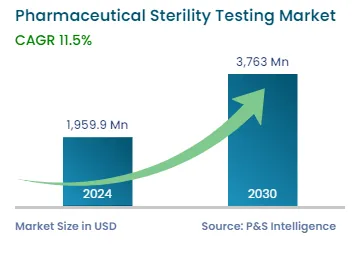
The pharmaceutical sterility testing market size will be an estimated USD 1.8 Billion in 2025, and it will grow by 11.8% during 2025–2032, to reach USD 4.2 Billion by 2032.
The market growth is driven by the expansion of biotechnology & pharmaceutical firms, rise in their research & development activities, surge in the prevalence of diseases, and significant government expenditure on the healthcare sector. The rising prevalence of diseases over the last few years has led to an increase in research and development activities for the production of safe and effective therapeutics. In this regard, the ongoing studies on the prevention of severe viral infections, including the novel coronavirus, and those centered on the development of safe and effective vaccines have a positive impact on the market.
The rising drug innovations, government healthcare investments, and demand for biologics and personalized medicine further contribute to this market. The pharmaceutical industry's commitment to ensuring product safety through sterility testing has become increasingly critical, as in 2024, the Food and Drug Administration (FDA) Center for Drug Evaluation and Research (CDER) approved 50 novel drugs that had active ingredients. The market expansion is further fueled by the growing complexity of pharmaceutical manufacturing processes and the introduction of advanced therapeutic products.
Additionally, the rising adoption of rapid microbiological methods and automated testing systems is transforming the sterility testing landscape, enabling faster product release and enhanced quality control. This technological evolution, combined with stringent regulatory requirements and the increasing volume of sterile drug production, positions the pharmaceutical sterility testing market for sustained growth throughout the forecast period.
Moreover, the growing burden of severe chronic diseases all over the world has led to an increased dependence on pharmaceuticals. For instance, according to the WHO, chronic diseases kill 41 million individuals every year, thus accounting for approximately 74% of all the deaths across the globe. Thus, many biopharmaceutical firms are focusing on the production of biologics and biosimilars, such as vaccines, monoclonal antibodies (mAbs), and growth factors.
Furthermore, the healthcare expenditure in such nations has significantly risen of late. Contract research organizations (CROs) and contract development & manufacturing organizations (CDMOs) provide affordable manufacturing and development services to biotech and pharma firms. Sterility testing is an utmost important step during the discovery and development of therapeutics and other pharmaceuticals, as it helps ensure product safety. Hence, the rising manufacturing capacities of CDMOs and CROs in developing nations would expand the need for sterility testing of therapeutics, thereby resulting in market expansion.
Rising Adoption of Advanced Rapid Microbiological Methods Is Key Trend
The pharmaceutical sterility testing market is experiencing a significant transformation with the adoption of rapid microbiological methods, marking a departure from traditional culture-based techniques.
Emerging rapid microbiological methods, such as ATP bioluminescence and PCR, are accelerating contamination detection and shortening product release times.
This technological advancement is particularly crucial for products with short shelf lives, including cell and gene therapies, where traditional 14-day incubation periods are impractical.
The expansion necessitates enhanced sterility testing capacity and the implementation of faster, more reliable testing methodologies.
The shift toward rapid methods is also driven by economic considerations, as pharmaceutical companies seek to reduce inventory holding costs and accelerate time-to-market for critical medications.
Furthermore, regulatory bodies are increasingly recognizing and accepting these advanced technologies.
The new chapter of USP <73> means that for short-life products, sterility test method validation per USP <1223> is no longer needed.
This regulatory flexibility encourages pharmaceutical manufacturers to invest in innovative testing platforms that can deliver results in days rather than weeks, significantly improving operational efficiency while maintaining the highest standards of product safety.
Many of these rapid microbiological methods are now integrated into automated testing systems, reducing manual intervention, minimizing errors, and supporting high-throughput testing workflows.
The adoption of rapid methods is also increasing in emerging markets such as India, China, and Brazil, driven by expanding biologics production and supportive regulatory frameworks.
Additionally, these methods enable real-time quality monitoring and risk-based sterility testing, improving overall product safety and operational reliability.
The urgency created by the COVID-19 pandemic further accelerated the adoption of rapid sterility testing for vaccines and biologics to meet short timelines without compromising safety.
Stringent Regulatory Requirements Are Biggest Drivers
The pharmaceutical sterility testing market is significantly driven by increasingly stringent regulatory requirements imposed by global health authorities.
Manufacturers of biological products must perform sterility testing of each lot of each biological product's final container material or other material, as appropriate and as approved in the biologics license application or supplement for that product.
These mandatory requirements ensure that every batch of sterile pharmaceutical products undergoes comprehensive testing before market release.
The rigorous standards set by the U.S. FDA are a significant driver of the sterility testing market in the United States.
The FDA conducted numerous inspections specifically targeting sterility compliance in pharmaceutical facilities.
This heightened regulatory scrutiny has prompted pharmaceutical companies to significantly increase their investments in sterility testing infrastructure and technologies.
Non-compliance with sterility testing regulations can have substantial financial consequences, with the average cost reported at around USD 14.8 million or higher, compelling companies to implement robust sterility testing programs.
This economic pressure, combined with the potential for product recalls and damage to company reputation, drives pharmaceutical manufacturers to prioritize robust sterility testing programs.
Moreover, international harmonization efforts are creating a more-unified global regulatory framework, further reinforcing the critical importance of comprehensive sterility testing across all markets.
The PMDA guidelines and Japanese Pharmacopeia require comprehensive sterility testing, method validation, and documentation for sterile pharmaceuticals and biologics.
Companies producing for Japan must adhere to strict aseptic production and sterility testing standards.
China’s NMPA regulations for sterile products require validated sterility testing methods, environmental monitoring, and documentation for batch release, fueling the demand for modern sterility testing infrastructure in the Asia-Pacific region.
The kits & reagents category holds the largest market share, of 65%, in 2025. This dominance is primarily driven by the essential nature of these consumables in every sterility testing procedure, regardless of whether testing is performed in-house or outsourced. From nutrient media to sterility indicators, filtration membranes, and rinse solutions, kits form the backbone of repeatable testing protocols. The consistent demand for these products stems from their single-use nature and the regulatory requirement for validated, quality-assured materials in each test cycle.
The services category will have the highest CAGR. This growth is fueled by smaller pharmaceutical companies and biotechnology firms that lack the infrastructure and expertise to conduct comprehensive sterility testing in-house. Additionally, contract testing organizations offer access to advanced technologies, regulatory expertise, and faster turnaround times, making outsourcing an attractive option for companies seeking to optimize their quality control processes while managing costs effectively.
The product types analyzed in this report are:
Kits & Reagents (Largest Category)
Services (Fastest-Growing Category)
Instruments
Test Type Analysis
The sterility testing category holds the largest market share, of 35%, in 2025, driven by the stringent regulatory mandates for final product testing and the growing volume of sterile pharmaceutical production. Parenteral drugs, IV fluids, ophthalmic fluids, and surgical irrigations are subject to FDA sterility requirements before they can be released to the market. The expansion of biologics manufacturing, particularly mAbs and cell-based therapies, further accelerates demand for sterility testing services. Additionally, the implementation of parametric release strategies and the adoption of rapid sterility testing methods are reshaping this segment, offering pharmaceutical manufacturers faster product release capabilities while maintaining compliance with stringent regulatory standards.
The rapid micro testing category will have the highest CAGR, due to its ability to deliver results in hours instead of days, enabling faster product release. Regulatory support, rising demand for biologics, cost reduction, and technological advancements in automation and reliable testing platforms further drive its rapid adoption globally.
The test types analyzed in this report are:
Sterility (Largest Category)
Bioburden
Bacterial Endotoxin
Container Closure Integrity
Antimicrobial Effectiveness
Rapid Micro (Fastest-Growing Category)
Application Analysis
The pharmaceuticals & biologics category holds the larger market share, of 70%, in 2025, and it will have the higher CAGR. This is owing to the wide usage of dosage forms such as ointments, eye drops, aerosols, and injectables. The sterility testing of such dosage forms is a mandatory requirement, and the increasing number of product recalls because of inadequate levels of sterility is further propelling the demand for sterility tests for conventional and biologic medications. Moreover, the rising incidence of cancer, viral diseases, neurological conditions, and other chronic diseases across the globe has led to the adoption of more-targeted and efficacious treatment options, such as vaccines, gene therapies, and other kinds of biologics. Studies predict biopharmaceutical firms to make USD 745.1 billion by 2030.
The applications analyzed in this report are:
Medical devices
Pharmaceuticals and Biologics (Larger and Faster-Growing Category)
End User Analysis
The pharmaceutical category holds the largest market share, of 80%, in 2025. This is because in order to introduce a new drug in the market, it is mandatory for pharmaceutical firms to conduct sterility tests, to ensure the safety of the therapeutics. Moreover, most of the drugs available are consumed through the oral route; hence, ensuring their safety becomes crucial. Furthermore, every country has its specific guidelines about the sterility tests that need to be conducted for a specific drug.
The biotechnology category will have the highest CAGR, driven by the increasing demand for biologics, gene therapies, and personalized medicines, which necessitate advanced sterility testing methods. The expansion of biotechnology firms' pipelines and their focus on innovative therapies contribute to this rapid growth.
The end users analyzed in this report are:
Biotechnology Companies (Faster-Growing Category)
Pharmaceutical Companies (Larger Category)
Type Analysis
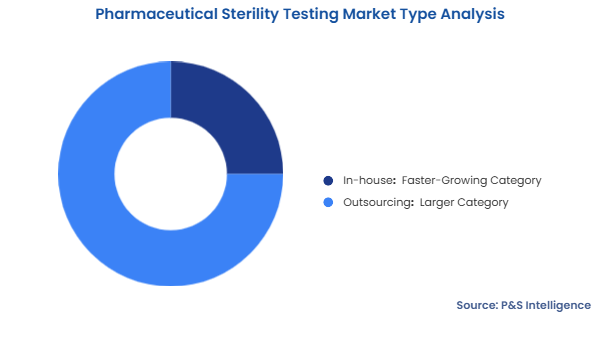
The outsourcing category holds the larger market share, of 75%, in 2025, because outsourcing is gaining significant traction among small and medium-sized pharmaceutical firms due to the advantages offered by them. Moreover, for pharmaceutical firms, outsourcing increases therapeutic expertise and operational efficiency, makes on-demand services available, and aids in the expansion of their geographical presence. Research indicates that by the year 2032, CRO service providers are projected to generate USD 179.2 billion, while biologics CDMOs are expected to reach USD 39.0 billion.
Additionally, many small and medium-sized firms do not have the adequate resources to fulfill their requirements for quality sterility testing and, as a result, prefer outsourcing to pass FDA policies. Furthermore, such services result in significant time and cost savings as the firms are not required to purchase new instruments for conducting the tests. Moreover, the need to hire and train individuals for the same is also eliminated. Currently, many major firms are focusing on marketing and research & development and, therefore, outsourcing such services.
The in-house category will have the highest CAGR, because it gives firms complete control over the quality of the product and helps in maintaining independence from suppliers, thereby allowing full control over their operations. Moreover, outsourcing organizations take up multiple projects at a time, which can result in delayed services.
The types analyzed in this report are:
In-house (Faster-Growing Category)
Outsourcing (Larger Category)
Drive strategic growth with comprehensive market analysis
North America Pharmaceutical Sterility Testing Market Size
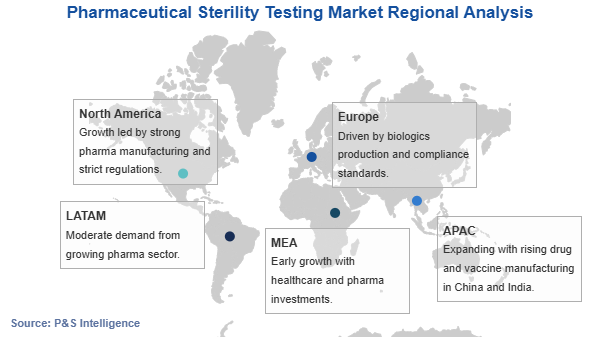
North America holds the largest market share, of 40%, in 2025, due to the presence of leading pharmaceutical and biopharmaceutical players, increasing research and development activities in the biotechnology and pharmaceutical sectors, growing count of product launches, high incidence of chronic ailments, and supportive government policies for the setup of research and development facilities in the region.
Moreover, the presence of robust healthcare policies, stringent drug approval requirements, growing public awareness of drug safety, rising adoption of cutting-edge technologies, and the introduction of gene and cell therapies for the treatment of several hematologic malignancies are resulting in the expansion of the regional market.
In addition, the increasing number of drug launches and the heightening focus on clinical trials, driven by the surging prevalence of contagious, non-contagious, and chronic diseases, support the market growth. For instance, in March 2022, VB Vaccines Inc. introduced PreHevbrio in the U.S. as a prophylaxis vaccine for the prevention of hepatitis B in adults aged 18 years and older. Furthermore, the growing adoption of advanced cell therapies for the treatment of cancer and the supportive government policies for healthcare cost reimbursement, clinical trials, and drug approvals drive the country's market.
Furthermore, the surge in the cases of diabetes and growth in the expenditure by Canadian authorities for research on this disease are having a positive impact on the market. In the last few years, the Canadian government has introduced various budgets favoring the research, development, surveillance, and prevention of diabetes. The U.S. is home to over 7,500 pharmaceutical and biotechnology companies that rely heavily on sterility testing to meet stringent regulatory standards.
The region's commitment to maintaining the highest quality standards in pharmaceutical manufacturing is evident in the increasing adoption of automated testing systems and rapid microbiological methods. Furthermore, the concentration of contract testing laboratories and the availability of skilled professionals specializing in microbiological testing contribute to North America's continued leadership in the pharmaceutical sterility testing market.
Asia-Pacific will have the highest CAGR, of approx. 12.0%, because of the rising prevalence of acute and chronic diseases in the region, increasing focus of regional governments on the healthcare sector, and rising geriatric population. Additionally, the developing nations in the region are taking initiatives to motivate overseas pharma and biotech businesses to establish their operations here. All such initiatives are expected to support and strengthen the domestic pharmaceutical sector, in turn, driving the demand for drug sterility testing services.
China holds the largest market share, and India is the fastest-growing pharmaceutical sterility testing market in the Asia-Pacific region. The region's growth is further accelerated by increasing investments from multinational pharmaceutical companies establishing manufacturing facilities to serve both local and global markets. This is a result of emerging countries increasingly harmonizing their regulatory norms with ICH standards.
The rapid growth in the biosimilars market and the increasing focus on generic drug manufacturing in countries like India and China further amplify the demand for sterility testing services. Government initiatives supporting pharmaceutical manufacturing, coupled with investments in research and development infrastructure, create a favorable ecosystem for market expansion. Additionally, the growing number of contract manufacturing organizations (CMOs) and contract research organizations (CROs) in the region contributes to the increased adoption of advanced sterility testing technologies and methodologies.
Europe Pharmaceutical Sterility Testing Market Size
Europe holds the second-largest share. This is because of the establishment of universal public healthcare systems in many nations in Europe, which has significantly increased the demand for healthcare products. The implementation of strict regulatory policies regarding the safety of drugs is another major factor contributing to the market growth. Germany plays a significant role in driving the regional market, supported by rising public awareness about drug safety, increasing healthcare budget, and surging geriatric population and its susceptibility to chronic ailments, which results in its increased dependence on drugs.
Furthermore, France is predicted to display significant growth during the projection time frame. This is because of the surging prevalence of diseases, improving healthcare facilities, and growing biotechnology and pharmaceutical sectors.
The geographical breakdown of the market is as follows:
North America (Largest Regional Market)
U.S. (Larger Country)
Canada (Faster-Growing Country)
Europe
Germany (Largest Country)
U.K. (Fastest-Growing Country)
France
Italy
Russia
Rest of Europe
Asia-Pacific (Fastest-Growing Regional Market)
China (Largest Country)
India (Fastest-Growing Country)
Japan
South Korea
Australia
Rest of APAC
Latin America
Brazil (Largest Country)
Mexico (Fastest-Growing Country)
Rest of LATAM
Middle East and Africa
Saudi Arabia (Fastest-Growing Country)
South Africa (Largest Country)
U.A.E.
Rest of MEA
Pharmaceutical Sterility Testing Market Share
The market is fragmented due to the presence of numerous small and mid-sized regional laboratories, contract testing organizations, and specialized service providers that cater to local regulatory requirements and niche therapeutic areas. These players compete alongside established multinational companies by offering cost-effective solutions, faster turnaround times, and customized testing services, thereby adding diversity to the competitive landscape.
Key Pharmaceutical Sterility Testing Companies:
STERIS plc
Boston Analytical
Sartorius AG
Arbro Pharmaceuticals Private Limited & Auriga Research Private Limited
Lucideon Limited
Pace Analytical Life Sciences
SGS Soci
Nelson Laboratories LLC
Merck KGaA
Pall Corporation
Charles River Laboratories International Inc.
Thermo Fisher Scientific Inc.
Pharmaceutical Sterility Testing Market News
In June 2025, Nelson Labs LLC announced the expansion of its Salt Lake City headquarters, doubling ISO-classified cleanroom capacity and upgrading systems to meet EU GMP Annex 1 standards, improving its sterility testing services.
In May 2024, Rapid Micro Biosystems Inc. launched the Growth Direct, an automated rapid sterility platform that reduces sterility testing time to 1–3 days, enhancing its position in the pharmaceutical sterility testing market.
Want a report tailored exactly to your business need?
Leading companies across industries trust us to deliver data-driven insights and innovative solutions for their most critical decisions. From data-driven strategies to actionable insights, we empower the decision-makers who shape industries and define the future. From Fortune 500 companies to innovative startups, we are proud to partner with organisations that drive progress in their industries.
Client Testimonials
Working with P&S Intelligence and their team was an absolute pleasure – their awareness of timelines and commitment to value greatly contributed to our project's success. Eagerly anticipating future collaborations.
McKinsey & Company
India
Unmatched Standards
Our insights into the minutest levels of the markets, including the latest trends and competitive landscape, give you all the answers you need to take your business to new heights
Complete Data Security
We take a cautious approach to protecting your personal and confidential information. Trust is the strongest bond that connects us and our clients, and trust we build by complying with all international and domestic data protection and privacy laws