Middle East Dermal Fillers Market Size & Share Analysis
Market Statistics
| Study Period | 2017 - 2030 |
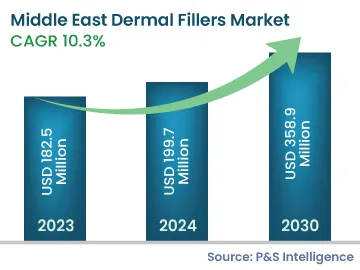
| 2023 Market Size | USD 182.5 Million |
| 2024 Market Size | USD 199.7 Million |
| 2030 Forecast | USD 358.9 Million |
| Growth Rate(CAGR) | 10.3% |
| Nature of the Market | Consolidated |
| Largest End User | Dermatology Clinics |
Growth Forecast
Key Players

Key Report Highlights
|
Explore the market potential with our data-driven report
The middle east dermal fillers market was valued at $182.5 million in 2023 and is projected to grow at a CAGR of 10.3% during the forecast period. The growing aging population, increasing awareness about age-related skin problems, thriving medical tourism industry, and surging disposable income are driving the growth of the dermal market.
In order to increase the adoption of anti-aging treatments, various organizations in the Middle East conduct several conferences, attracting patients and industry players to invest in the market in the region.
According to an article, in Saudi Arabia, Women seeking cosmetic surgery have increased significantly, with liposuction, rhinoplasty, and breast augmentation being the most popular procedures. This suggests that cosmetic surgery is becoming more widely recognized as a means of enhancing appearance.
Globally, an increase in the level of disposable income has led to high spending on expensive cosmetic treatments such as lip rejuvenation, face-lift, wrinkle treatment, and others. According to the World Bank, the gross national income (GNI) per capita of the Middle East and North Africa was $3.14 Trillion in 2015 which was increased to $4.39 Trillion in 2022.
Also, Saudi Arabia’s GNI for 2022 was $1,004.43B, a 16.83% increase from 2021. The increase in per capita income has led to a rise in the spending power of the Middle East population on various face treatments, which further drives the growth of the dermal fillers market.
Middle East Dermal Fillers Trends and Drivers
Increasing Demand for Lip Augmentation Procedures
- The trends observed in the market are increasing demand for lip augmentation procedures, a shift in preference for minimally invasive cosmetic surgeries, and growing product launches in the Middle East.
- For lip augmentation, hyaluronic acid-based lip fillers are used, which is a clear and biodegradable substance, normally produced by the human body. Further, it has been also observed that in order to have perfect lips, people worldwide prefer to travel to countries in the Middle East, due to the availability of low-cost plastic surgeries and the best plastic surgeons in the region.
Increasing Prevalence of Skin Problems Drives the Market
- Middle Eastern countries, especially the U.A.E., witness a very hot and sunny climate throughout the year, leading to various skin disorders such as sunburn, summer rash, summer acne, and dry skin. These conditions require the use of tissue fillers for their treatment leading to the growth of the regional market.
- The aging population plays a major role in the growth of the market. Old age is associated with loss of fibrous tissues and reduction in vascular and glandular tissues in the various layers of skin.
- According to the United Nations Department of Economic and Social Affairs (UNDESA), by 2050, the population aged 60 and above is anticipated to be 25% of the total population. This would further boost the demand for dermal fillers and eventually result in the expansion of the market size.
Stringent Regulatory Norms
- Due to the growth in the popularity of aesthetic medical procedures over the past several years, government bodies in the Middle East have imposed stringent regulations on the use of dermal fillers.
- The Canadian Association of Medical Spas and Aesthetic Surgeons (CAMACS) compliance has operations in Asia, the Middle East, Europe, Canada, and the U.S., and the Middle East governments have proposed that there should be registered nurse injectors who have undergone specific training for the administration of dermal fillers, volume enhancers, and neurotoxins.
- The CAMACS recognizes that combining cosmetics with medical procedures may be acceptable for enhancing the business and provides an additional level of handiness and expediency to the patients.
- There are certain training academies, such as Medical & Aesthetic Training Academy, that provide Botox and dermal fillers training in Dubai to attain level 7 industry-based qualification.
In-Depth Segmentation Outlook
Hyaluronic Acid - The Preferred Dermal Filler
- The hyaluronic acid-based dermal fillers have been holding the largest share in the market, with an estimated contribution of 80% in 2023. This is ascribed to the ability of these dermal fillers to attract water molecules, which aids in hydration and increasing skin volume.
- Hyaluronic acid-based fillers are the most commonly used dermal filler type in the region due to their ability to attract water molecules and aid in hydration.
- Moreover, the demand for hydroxylapatite-based is also growing. For instance, Radiesse is an injectable calcium hydroxylapatite (CaHA) filler, which is biocompatible, and is FDA approved. It helps in the improvement of the appearance of moderate to severe facial wrinkles and folds, such as the nasolabial folds. Also, it is used to improve the signs of facial fat loss associated with HIV.
- Synthetic polymer-based dermal fillers comprise PLLA and PMMA microspheres. PLLA is a biocompatible and biodegradable artificial polymer and is broadly used in bone screws and absorbable stitches. It is a long-lasting material, which is given in a series of injections for several months. The effects of PLLA-based treatment are generally seen after a certain span of time and may last for up to two years.
- Silhouette Soft and Sculptra by Sinclair Pharma plc is an example of a PLLA dermal filler available in the market.
- Whereas, PMMA is a biocompatible, non-biodegradable, semi-permanent filler and an artificial polymer. PMMA beads are round, tiny, and smooth particles that are not absorbed by the body and when used as a soft tissue filler, they are suspended in a gel-like solution.
- On the other hand, the collagen-based dermal fillers category is also growing significantly. It helps substitute the structure and the volume of the skin around different areas of the face including the mouth, nose, and cheeks.
- Collagen-based fillers refill the natural collagen of the skin. By enhancing the skin's collagen, injections smooth the facial lines and scars. The natural beauty of the skin is enhanced as the contour of the support structure is restored.
During the study, the following dermal filler types are included in the report:
- Hyaluronic Acid-Based Dermal Fillers (Largest and Fastest Type)
- Hydroxylapatite-Based Dermal Fillers
- Synthetic Polymer-Based Dermal Fillers
- Collagen-Based Dermal Fillers
Facial Line Correction Holds 60% Share
- The facial line correction held the largest market share, of 60%, in 2023. Dermal fillers are used to plump up and hydrate the skin, soften deep lines, and provide a smoother appearance.
- These fillers are injected into the face to flatten the creases and folds on the face, and in the areas that have lost fat and collagen due to aging.
- Moreover, face-lift also held a significant share in the market. It utilizes advanced dermal fillers, occasionally in combination with BOTOX. JUVEDERM, Radiesse, Restylane, Perlane, and Sculptra are some of the advanced dermal fillers used in various face-lift treatments.
- These dermal fillers replace the lost volume in the face and help the body to regenerate collagen. Most dermal fillers are comprised of natural substances produced in the body and are used to lift or contour various facial features.
Below are the major applications in which dermal fillers play an important role:
- Facial Line Correction (Largest and Fastest-Growing Application)
- Face-Lift
- Lip Treatment
- Others (Ear Rejuvenation, Chin Augmentation, Foot Fillers, and Nose Fillers)

Dermatology Clinics – Largest End User Category
- Dermatology clinics held the largest share of 70% in 2023. Several dermatology clinics are authorized to conduct minimally invasive skin treatments using dermal fillers.
- There has been an increase in the number of people visiting these clinics since they provide permanent and lasting solutions at a comparatively low cost. Dermatology clinics have experienced professionals for various treatments such as lip enhancements, face lifting, and scar reduction.
- Further, hospitals utilize various skin treatment procedures using dermal fillers and offer improved healthcare infrastructure, to provide advanced skin treatment to patients.
- The increasing healthcare expenditure by regulators in various countries allows hospitals to opt for the latest treatments, thereby offering their services to a large number of patients with skin aging problems.
- Also, some hospitals have specialty centers for skin care that provide scar reduction treatment, and skin rejuvenation treatment to the patients.

The following are end users in the market:
- Dermatology Clinics (Largest and Fastest-Growing End User)
- Hospitals
- Others
Drive strategic growth with comprehensive market analysis
Saudi Arabia Leads Middle East Market
- Geographically, Saudi Arabia has been leading the market in terms of size with a value of $90 million in 2023. This is attributed to the growing aging population, increasing demand for cosmetic procedures, and availability of skilled practitioners for dermal filler procedures in the country.
- Also, more than one-half of Saudi women (55.4%) undergo a cosmetic procedure. Over the past few years, the number of women who have undergone cosmetic surgery in Saudi Arabia has dramatically increased. This specifies that cosmetic surgery is fast becoming a trend that is related to beauty ideas, especially for women.
- On the other hand, the U.A.E. market is expected to grow at the highest CAGR of 11% during the forecast period. This can be due to the booming cosmetic and plastic surgery treatments and the increasing population base in the country.
- For instance, according to the World Bank, in 2022, the population of the U.A.E. increased to 9.4 million. Also, according to the Wisconsin Economic Development Corporation (WEDC), the medical aesthetics industry is gaining popularity in the country.
- Further, the U.A.E. is rapidly becoming a popular medical tourism destination. The country offers reasonable state-of-the-art medical procedures that are continuously advancing, which, in turn, attract medical tourists from Arab and Asian countries.
- The U.A.E. capital, Abu Dhabi, offers a favorable environment for recognized medical institutions and pioneers alike. On average, every year, over 15,000 medical tourists travel to Abu Dhabi to take advantage of its medical institutions.
Further, countries analyzed for this report include:
- Saudi Arabia (Largest Country Market)
- U.A.E. (Fastest-Growing Country Market)
- Others
The Market in Consolidated in Nature
The market has a high degree of consolidation, owing to limited number players present in the market. The players in the market are collaborating with other players as well as acquiring other players to expand their product portfolio and launch new products in the market.
Top Dermal Fillers Companies in Middle East:
- Allergan plc
- Galderma S.A.
- Merz Pharma GmbH & Co. KGaA
- Sinclair Pharma plc
- Teoxane Laboratories
- Gulf Dermal Filler FZC
- Suneva Medical
- Revance Therapeutics Inc.
- Cynosure LLC
- Cytophil Inc.
- BioPlus Co. Ltd.
Recent Developments
- Galderma announced regulatory approval, of Restylane SHAYPE, in January 2024. Restylane SHAYPE is a new hyaluronic acid injectable, which is designed to augment the chin.
- Galderma launched Radiesse (+) Lidocaine injectable implants for deep injection for soft tissue augmentation in February 2022. It is used to enhance mild to severe jawline contour loss in individuals above 21 years of age.
- Teoxane, a Swiss-based company offering hyaluronic acid filler, started its first subsidiary in the U.A.E, Middle East, in October 2020.