This Report Provides In-Depth Analysis of the Microcrystalline Cellulose Market Report Prepared by P&S Intelligence, Segmented by Source Type (Wood-Based, Non-Wood Based), Grade (Pharmaceutical Grade, Food Grade, Industrial Grade), Form (Powder, Colloidal, Granular), Application (Pharmaceuticals, Food and Beverages, Cosmetics and Personal Care, Nutraceuticals, Paints and Coatings), and Geographical Outlook for the Period of 2021 to 2032
Explore the market potential with our data-driven report
Microcrystalline Cellulose Market Overview
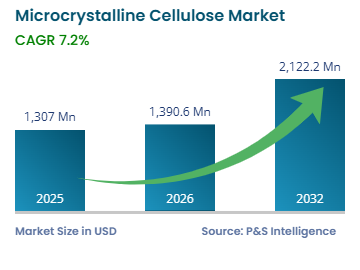
The microcrystalline cellulose market size was USD 1,307.0 million for 2025, and it will grow by 7.2% during 2026-2032, to reach USD 2,122.2 million by 2032.
The market is expanding because microcrystalline cellulose is widely used across pharmaceutical, food processing, nutraceutical, and personal care manufacturing. Its binding, stabilising, anti-caking, and texturising properties make it an important functional ingredient in tablets, capsules, processed foods, skincare products, and oral care formulations where formulation consistency and product stability remain critical. Pharmaceutical manufacturers are increasing the use of microcrystalline cellulose in solid oral dosage production because it supports direct compression processes, improves flowability, and helps maintain uniformity during high-volume manufacturing. Food and nutraceutical companies are also adopting plant-derived functional ingredients to support clean-label formulations, texture control, and shelf-life stability in processed and convenience products.
According to the World Health Organisation, the WHO Model Lists included 523 essential medicines for adults and 374 for children in 2025, supporting continued demand for reliable pharmaceutical formulations and excipients used across global medicine supply systems. Growing generic drug manufacturing across the Asia Pacific and stricter formulation standards in developed pharmaceutical markets are strengthening demand for high-performance excipients that support production efficiency and product quality. Manufacturers are also investing in non-wood cellulose production and alternative plant-based feedstocks to improve supply flexibility and sustainability performance. In personal care and cosmetic applications, microcrystalline cellulose is increasingly used in skincare, beauty, and oral care products because it functions effectively as a stabiliser, absorbent, and formulation aid across multiple industrial applications, supporting the broader growth of bio-based cosmetics and personal care ingredients across sustainable formulation systems.
Key Market Insights
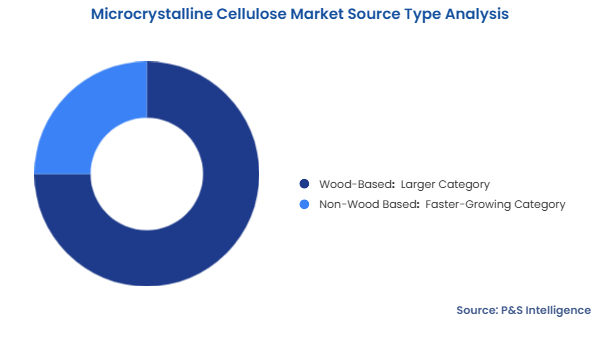
Wood-based is the larger source type, holding a market share of 75%, because wood pulp ensures consistent pharmaceutical- and food-grade MCC.
Non-Wood Based is the faster-growing source type, registering a CAGR of approximately 7.5%, due to sustainable alternative feedstocks reducing wood-pulp dependence.
Pharmaceuticals are the largest category, holding a market share of 35%, because microcrystalline cellulose is a core excipient in solid oral dosage manufacturing.
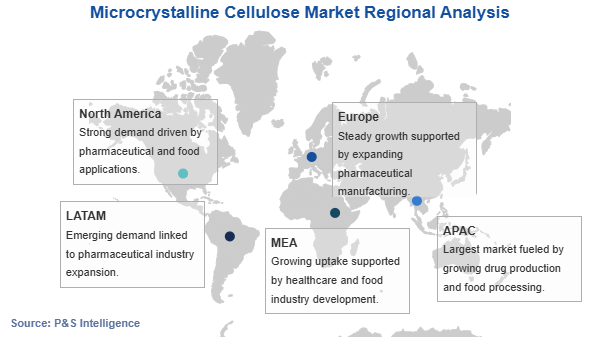
North America is the largest region, holding a market share of 40%, because established pharmaceutical ecosystems and strict excipient standards support demand.
Asia-Pacific is the fastest-growing region, registering a CAGR of approximately 8.1%, driven by expanding pharmaceutical capacity and rising generic medicine production.
Microcrystalline Cellulose Market Trends and Drivers
Development of Specialised and Sustainable Microcrystalline Cellulose Grades Is a Major Trend
Manufacturers in the microcrystalline cellulose market are increasingly developing customised grades for pharmaceutical, nutraceutical, food, and personal care applications. Companies are introducing multifunctional excipients that improve compressibility, moisture control, and formulation stability while supporting faster production processes and better batch consistency. Producers are also expanding clean-label and plant-based ingredient portfolios to match changing formulation preferences across processed foods, dietary supplements, and wellness products. According to the Food and Agriculture Organisation of the United Nations, in 2024, global wood pulp production reached 189 million tonnes, showing the large cellulose raw material base available for cellulosic ingredient and excipient production. Manufacturers are also increasing the use of alternative cellulose feedstocks beyond traditional wood pulp to strengthen supply flexibility and support sustainability targets across industrial production systems.
According to the Food and Agriculture Organisation of the United Nations, international trade in wood pulp reached an all-time high of 73 million tonnes in 2024, supporting wider raw-material movement for cellulose-based manufacturing. This is encouraging producers to strengthen regional production capabilities and technical support networks so they can serve pharmaceutical and food manufacturers more efficiently across multiple markets. Recent product launches have included low-moisture pharmaceutical grades, co-processed excipients for direct compression, and cellulose solutions designed for high-performance dietary supplements. The trend is also increasing competition among suppliers to develop specialised MCC grades that meet stricter formulation, processing, and quality requirements across regulated healthcare and consumer product industries.
The market is growing steadily because microcrystalline cellulose is widely used as a core excipient in tablet and capsule manufacturing. Pharmaceutical companies are increasing production of generic medicines, over-the-counter drugs, and nutraceutical supplements that require reliable binding, disintegration, and flow properties during formulation. Microcrystalline cellulose also supports direct compression processes, helping manufacturers reduce processing complexity and maintain product consistency during large-scale production. According to the World Health Organisation, in 2024, 48 medicine products were prequalified, including additional generic rifapentine formulations and paediatric TB formulations, supporting demand for quality-assured pharmaceutical formulation inputs. Expanding healthcare access and rising pharmaceutical manufacturing activity across emerging economies are also increasing the use of multifunctional excipients that improve formulation stability and production efficiency.
According to the World Health Organisation, the Collaborative Registration Procedure recorded 194 new registrations in 2024, taking cumulative registrations to 1,476 and supporting wider registration of quality-assured finished pharmaceutical products. Pharmaceutical manufacturers are therefore increasing the use of excipients that support standardised production quality across multiple dosage formulations and regulatory environments. The growing focus on formulation consistency, manufacturing efficiency, and regulatory compliance is strengthening long-term demand for microcrystalline cellulose across pharmaceutical production facilities. Its compatibility with a broad range of active ingredients and processing systems continues to support adoption in high-volume tablet and capsule manufacturing applications.
Volatility in Cellulose Raw Material Supply and Production Costs Limits Market Expansion
The market faces pressure from fluctuations in the availability and pricing of cellulose-based raw materials used in microcrystalline cellulose production. Manufacturers depend heavily on wood pulp, cotton linters, and other plant-derived feedstocks that are affected by forestry output, agricultural conditions, environmental regulations, and supply chain disruptions. Changes in energy, chemical processing, and transportation costs also influence overall production economics, particularly for pharmaceutical-grade MCC that requires strict quality control and high-purity processing standards. Producers operating in price-sensitive pharmaceutical and food ingredient markets often face difficulty transferring rising raw-material costs to end users, which places additional pressure on operating margins and long-term procurement planning.
According to the Food and Agriculture Organisation of the United Nations, global pulp from fibres other than wood production stood at 10 million tonnes in 2024, down 6% from 2023, showing pressure on alternative cellulose-based raw material availability. Reduced availability of alternative cellulose feedstocks is creating additional sourcing challenges for manufacturers attempting to diversify beyond traditional wood pulp supply chains. Buyers are also demanding standardised excipient performance and batch consistency across large-scale pharmaceutical and food production environments, increasing compliance and validation requirements for suppliers. These conditions are making raw material procurement, production planning, and quality management more difficult for MCC manufacturers operating across highly regulated industrial applications.
Expansion of Plant-Based Functional Ingredients in Food and Nutraceutical Products Creates Growth Opportunities
Growing demand for plant-based, clean-label, and wellness-oriented products is creating new opportunities for microcrystalline cellulose manufacturers across food and nutraceutical applications. Food processors and supplement brands are using cellulose-based ingredients to improve texture, suspension, fat reduction, and shelf stability in protein products, fortified foods, meal replacements, and dietary supplements. According to the Food and Agriculture Organisation of the United Nations, global vegetable production reached 1.2 billion tonnes in 2024, supporting the scale of plant-based food processing where cellulose-based ingredients can be used for texture, stability, and formulation consistency. This creates room for suppliers to develop specialised MCC grades for processed foods, nutraceutical blends, and sustainable ingredient systems.
Wood-based is the larger category, holding a market share of 75%, because wood pulp remains the most reliable feedstock for producing consistent pharmaceutical- and food-grade microcrystalline cellulose. Manufacturers prefer wood-based cellulose because it supports stable purity, predictable particle behaviour, and uniform batch performance during high-volume production. Mature pulp processing infrastructure also helps suppliers maintain large-scale commercial manufacturing across pharmaceutical, food, and personal care applications. According to the Food and Agriculture Organisation of the United Nations in 2024, global industrial roundwood removals reached 1.96 billion cubic metres, supporting the availability of wood-based cellulose feedstock for large-scale MCC production. Strong feedstock availability and established supply chains continue supporting the dominance of wood-based MCC across regulated industrial applications.
Non-Wood Based is the faster-growing category, registering a CAGR of approximately 7.5%, due to rising interest in sustainable and alternative cellulose feedstocks. Producers are exploring cotton linters, bamboo, agricultural residues, and other plant sources to reduce dependence on traditional wood pulp. These materials also support waste utilisation and lower environmental pressure in sourcing. Demand is increasing as food, nutraceutical, and personal care brands look for plant-based ingredients with cleaner sourcing stories and better alignment with sustainability-focused product development.
The source types analysed in this report are:
Wood-Based (Larger Category)
Non-Wood Based (Faster-Growing Category)
Cotton Linters
Bamboo
Agricultural Residues
Others
Grade Analysis
Pharmaceutical Grade is the largest category, holding a market share of 45%, because microcrystalline cellulose is heavily used in tablets, capsules, and direct compression formulations. Drug manufacturers depend on this grade for binding, disintegration, flow improvement, and formulation stability. It is also preferred because pharmaceutical production requires high purity, consistent particle size, and strict quality control. As solid oral dosage manufacturing remains a major application area, pharmaceutical-grade MCC continues to account for the strongest demand across regulated manufacturing environments.
Food Grade is the fastest-growing category, as food manufacturers increasingly use microcrystalline cellulose for texture control, fat replacement, moisture retention, and shelf-life stability across processed food formulations. Demand is increasing in dairy, bakery, confectionery, and ready-to-eat products where formulation consistency and clean-label positioning remain important. Food-grade MCC is also gaining wider acceptance because it improves structure and mouthfeel without significantly affecting flavour profiles in reformulated products. According to the Food and Agriculture Organisation of the United Nations in 2024, global milk production reached 985 million tonnes, supporting demand for food-grade stabilisers and texture-control ingredients used in dairy and processed food formulations. Growing processed food production and plant-based product development continue to strengthen demand for food-grade MCC ingredients.
The grades analysed in this report are:
Pharmaceutical Grade (Largest Category)
Food Grade (Fastest-Growing Category)
Industrial Grade
Others
Form Analysis
Powder is the largest category, because it is the most widely used form in pharmaceutical, food, and nutraceutical manufacturing. Powdered microcrystalline cellulose supports direct compression processes and provides reliable binding, flowability, and disintegration performance in tablet and capsule production. Manufacturers also prefer powder form because it blends efficiently with active ingredients and integrates easily into large-scale dry processing systems. In 2025, the United States Food and Drug Administration’s first-time generic drug approval list reached 91 entries, including tablet and capsule products, supporting demand for powdered excipients used in solid oral dosage manufacturing. Strong pharmaceutical production activity and increasing generic drug manufacturing continue to support commercial demand for powdered MCC formulations.
Colloidal is the fastest-growing category, registering a CAGR of approximately 7.7%, due to its increasing use in liquid, semi-solid, and suspension-based formulations. Food, beverage, cosmetic, and personal care manufacturers use colloidal microcrystalline cellulose for stabilisation, viscosity control, and texture improvement. It is especially useful where ingredients need to remain evenly dispersed over time. Growth is supported by demand for smoother product structures in dairy alternatives, sauces, creams, skincare products, and oral care formulations requiring stable and uniform performance.
The forms analysed in this report are:
Powder (Largest Category)
Colloidal (Fastest-Growing Category)
Granular
Application Analysis
Pharmaceuticals are the largest category, holding a market share of 35%, because microcrystalline cellulose is a core excipient in solid oral dosage manufacturing. It is widely used in tablets and capsules as a binder, filler, disintegrant, and direct compression aid. Pharmaceutical companies value it for its stability, compatibility, and ability to support consistent drug release and production efficiency. Strong demand from generic medicines, over-the-counter drugs, and nutraceutical tablets continues to keep pharmaceutical applications ahead of other end-use areas.
Food and Beverages are the fastest-growing category, as manufacturers increase the use of microcrystalline cellulose in processed foods, dairy products, bakery items, confectionery, and meat formulations. The ingredient helps improve texture, moisture control, suspension stability, and product consistency across large-scale food processing applications. Demand is also rising from low-fat, plant-based, and clean-label product development, where functional ingredients are required without strongly affecting taste or appearance. According to the Food and Agriculture Organisation of the United Nations in 2024, world meat production reached 374 million tonnes, supporting demand for functional food ingredients used in moisture control, texture stability, and processed food formulation. Expanding processed food manufacturing and formulation innovation continues to increase the use of MCC across food and beverage applications.
Drive strategic growth with comprehensive market analysis
Microcrystalline Cellulose Market Regional Outlook
North America Microcrystalline Cellulose Market Analysis
North America holds the largest share, of 40%, because the region has a highly established pharmaceutical manufacturing ecosystem supported by strong excipient quality standards and advanced drug formulation capabilities. Large pharmaceutical companies in the U.S. and Canada continue to use microcrystalline cellulose extensively in solid oral dosage production due to its compatibility with high-speed manufacturing and direct compression technologies. The region also benefits from mature nutraceutical and processed food industries that increasingly demand multifunctional and clean-label ingredients. In addition, strict regulatory frameworks encourage the use of high-purity excipients with consistent performance characteristics, which supports long-term demand for premium microcrystalline cellulose grades. Ongoing investments in pharmaceutical research, speciality formulations, and sustainable ingredient sourcing further strengthen market expansion across North America.
U.S. Microcrystalline Cellulose Market Analysis
U.S. demand for microcrystalline cellulose is supported by the country’s large pharmaceutical manufacturing base and strong presence of branded and generic drug producers. Pharmaceutical companies continue investing in oral solid dosage development, where excipients are required to maintain formulation consistency and manufacturing efficiency. The country also has a well-developed nutraceutical industry with rising demand for dietary supplements and wellness products using plant-derived ingredients. In FY 2024, the United States Food and Drug Administration recorded 694 generic drug approvals under its Generic Drugs Program. Strong generic drug production and increasing use of cellulose-based stabilisers in processed food applications continue supporting demand for pharmaceutical- and food-grade MCC across industrial manufacturing environments.
Canada Microcrystalline Cellulose Market Analysis
Canada’s market is influenced by growing demand for nutraceuticals, natural health products, and specialised pharmaceutical formulations. Manufacturers are increasingly focusing on sustainable ingredient sourcing and environmentally responsible processing methods, supporting the use of plant-based cellulose materials across healthcare and food applications. The country’s food processing industry is also increasing the use of functional ingredients in packaged foods and nutritional products designed for health-conscious consumers. In 2025, Canada had 431 employer establishments in pharmaceutical and medicine manufacturing. Regulatory emphasis on ingredient transparency, product quality, and controlled formulation standards continues to strengthen demand for high-purity microcrystalline cellulose grades across pharmaceutical and processed food manufacturing applications.
Asia-Pacific has the highest CAGR, of approximately 8.1%, as pharmaceutical manufacturing capacity continues to expand rapidly across China, India, Japan, and South Korea. The region is becoming a major production hub for generic medicines, dietary supplements, and processed food ingredients, creating sustained demand for excipients and stabilising agents used in large-scale manufacturing. Rising healthcare access, growing domestic drug consumption, and increasing exports of pharmaceutical products are encouraging manufacturers to scale production facilities and improve formulation standards. In addition, regional food and personal care industries are increasingly incorporating cellulose-based ingredients into plant-based and functional consumer products. Government support for industrial development and the availability of cost-effective manufacturing infrastructure are also helping regional producers strengthen their position in global supply chains.
China Microcrystalline Cellulose Market Analysis
China remains a major market due to its large-scale pharmaceutical and chemical manufacturing infrastructure. Domestic manufacturers continue expanding production of generic medicines and over-the-counter formulations that require excipients for tablet stability, flowability, and processing performance. The country also has a rapidly growing processed food and personal care industry where cellulose ingredients are used for stabilisation and formulation enhancement. Xinhua, citing China’s Centre for Drug Evaluation annual drug review report, stated that the Centre for Drug Evaluation accepted 20,149 drug registration applications in 2025. Expanding pharmaceutical formulation activity and strong industrial supply chains continue supporting domestic demand for pharmaceutical-grade microcrystalline cellulose across healthcare manufacturing sectors.
India Microcrystalline Cellulose Market Analysis
India is experiencing strong growth due to expanding generic pharmaceutical production and rising exports of finished drug formulations. Domestic manufacturers are increasing the use of excipients that support cost-efficient direct compression and large-volume tablet manufacturing processes. The country’s growing nutraceutical and wellness product industry is also creating demand for cellulose-based ingredients used in dietary supplements and functional foods. In 2024–25, India exported pharmaceutical products to 191 countries, according to the Press Information Bureau of India. Expanding pharmaceutical manufacturing infrastructure and increasing formulation development activity continue to strengthen demand for pharmaceutical-grade microcrystalline cellulose across domestic and export-oriented healthcare production environments.
Europe Microcrystalline Cellulose Market Analysis
Europe maintains a stable position in the microcrystalline cellulose market due to its strong pharmaceutical quality standards and established food ingredient manufacturing sector. Countries such as Germany, France, the U.K., and Italy continue to support demand through advanced pharmaceutical production and growing adoption of functional ingredients in food and nutraceutical applications. Regional manufacturers are placing greater emphasis on sustainable sourcing practices, environmentally responsible production methods, and high-performance excipient development. The market also benefits from increasing demand for clean-label processed foods and specialised healthcare formulations requiring reliable texture, stability, and binding performance. In addition, European regulatory focus on ingredient traceability and product consistency continues to support the use of pharmaceutical-grade and food-grade microcrystalline cellulose across multiple industries.
The regions and countries analysed in this report are:
The microcrystalline cellulose market is semi-consolidated, with a limited group of established manufacturers holding strong positions across pharmaceutical, food, and industrial supply chains. Market competition is largely influenced by production capacity, product purity standards, regulatory compliance, and long-term relationships with pharmaceutical and food processing companies. Leading producers benefit from integrated raw material sourcing, advanced processing technologies, and broad distribution networks that support consistent product quality across multiple regions. The market also shows high entry barriers because manufacturing pharmaceutical-grade microcrystalline cellulose requires strict quality control systems, specialised processing infrastructure, and compliance with international regulatory standards. Companies are increasingly competing through customised excipient development, application-specific grades, and regional expansion strategies rather than price alone. Strategic partnerships, capacity expansions, and investments in sustainable cellulose sourcing continue to strengthen the position of major participants operating in this market.
Key Players in the Microcrystalline Cellulose Market:
Asahi Kasei Corporation
Roquette Freres
International Flavors and Fragrances Inc
Rayonier Advanced Materials Inc
DuPont de Nemours Inc
Avantor Inc
Borregaard ASA
Sigachi Industries Limited
Accent Microcell Limited
DFE Pharma GmbH and Company KG
Mingtai Chemical Company Limited
Chemfield Cellulose Private Limited
Anhui Sunhere Pharmaceutical Excipients Company Limited
Huzhou City Linghu Xinwang Chemical Company Limited
Blanver Farmoquimica e Farmaceutica SA
Ashland
Evonik
Microcrystalline Cellulose Market News
In February 2026, DFE Pharma launched its Continuous Manufacturing platform for formulation development. The setup combines CM-ready excipients, a testing environment at its Hyderabad C2F Centre, and formulation support with Gericke equipment. It is linked to oral solid dose manufacturing, where excipient flow, blending, and compression behaviour are checked before wider process use.
In October 2025, Ashland introduced vialose sucrose for parenteral formulations and presented low-nitrite excipient grades for oral solid dose use. The update included Plasdone low nitrite povidone, Polyplasdone LN crospovidone, and Benecel low nitrite hypromellose. The news fits the excipients market because it covers newly added materials used in drug formulation.
In September 2025, Evonik launched MaxiPure Polysorbate 80 for injectable drug formulations and biopharmaceutical applications. The product is a high-purity non-ionic surfactant used as an excipient in formulations and process steps. The news fits the excipients market because it adds a named material for parenteral and biopharma formulation work after launch.
In April 2025, IFF Pharma Solutions launched Low Nitrite METHOCEL HPMC for pharmaceutical dosage forms. The range is a cellulose ether excipient line made for nitrosamine mitigation work. It relates to the cellulose-based excipients market because HPMC is used in controlled-release and immediate-release tablets, capsules, and other finished dosage forms.
In October 2025, Roquette launched KLEPTOSE Crysmeb methyl-beta-cyclodextrin for oral and parenteral formulations. The product is a modified cyclodextrin excipient for active pharmaceutical ingredients with solubility or stability limits. The news fits the pharmaceutical excipients market because it adds a named formulation material to Roquette’s cyclodextrin portfolio after product release.
Frequently Asked Questions About This Report
What is microcrystalline cellulose, and where is it commonly used?+
Microcrystalline cellulose is a purified cellulose material widely used as an excipient, stabilizer, thickener, and texturizer in pharmaceuticals, food products, cosmetics, and personal care formulations.
Why is microcrystalline cellulose widely used in pharmaceutical tablet manufacturing?+
Microcrystalline cellulose provides excellent compressibility, binding properties, and flow characteristics. These qualities help produce strong tablets with consistent quality, stability, and uniform drug distribution.
Which industries commonly use microcrystalline cellulose in commercial applications?+
Microcrystalline cellulose is widely used in pharmaceutical, food and beverage, cosmetics, personal care, nutraceutical, and industrial manufacturing sectors. Its multifunctional properties support numerous formulation requirements.
How is microcrystalline cellulose manufactured from natural cellulose sources?+
Microcrystalline cellulose is produced by controlled acid hydrolysis of purified wood pulp or plant based cellulose. The material is then washed, dried, and processed into fine particles.
What advantages does microcrystalline cellulose offer in food product formulations?+
Microcrystalline cellulose improves texture, stabilizes emulsions, prevents ingredient separation, and enhances moisture retention. These properties help maintain product consistency and extend shelf life.
Want a report tailored exactly to your business need?
Leading companies across industries trust us to deliver data-driven insights and innovative solutions for their most critical decisions. From data-driven strategies to actionable insights, we empower the decision-makers who shape industries and define the future. From Fortune 500 companies to innovative startups, we are proud to partner with organisations that drive progress in their industries.
Client Testimonials
Working with P&S Intelligence and their team was an absolute pleasure – their awareness of timelines and commitment to value greatly contributed to our project's success. Eagerly anticipating future collaborations.
McKinsey & Company
India
Unmatched Standards
Our insights into the minutest levels of the markets, including the latest trends and competitive landscape, give you all the answers you need to take your business to new heights
Complete Data Security
We take a cautious approach to protecting your personal and confidential information. Trust is the strongest bond that connects us and our clients, and trust we build by complying with all international and domestic data protection and privacy laws