Medical Gases and Equipment Market Size & Opportunities Analysis - Growth Strategies, Competitiveness, and Forecasts (2025 - 2032)
This Report Provides In-Depth Analysis of the Medical Gases and Equipment Market Report Prepared by P&S Intelligence, Segmented by Type (Gases, Equipment), By Form of Delivery (High Pressure Cylinders, Liquid Tanks, Bulk Delivery), Application (Therapeutic, Diagnostics, Pharmaceutical manufacturing and research), End User (Hospitals, Homecare Settings, Pharmaceutical and Biopharmaceutical Companies, Diagnostic and Research Laboratories, Academic Institutes and Research Institutes), and Geographical Outlook for the Period of 2019 to 2032
Explore the market potential with our data-driven report
Medical Gases and Equipment Market Future Outlook
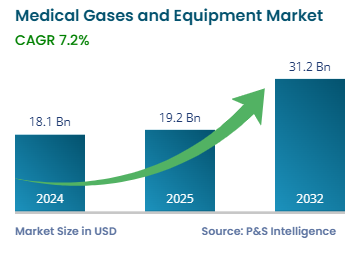
The global medical gases and equipment market size stood at USD 18.1 billion in 2024, which is expected to reach USD 31.2 billion by 2032, advancing at a CAGR of 7.2% during 2025–2032. This is primarily ascribed to the rising incidence of chronic diseases all over the world. In addition, the spur in the home healthcare sector size, coupled with technological advancements, is expected to boost the domain progress in the forecast period.
Furthermore, the growing prevalence of respiratory diseases, on account of the growing count of tobacco smokers and mounting pollution levels, and the rising frequency of preterm births are boosting the domain expansion.
Moreover, the active involvement of public organizations to support the adoption of this equipment is propelling the domain size. Additionally, the FDA recently announced the updation of its CGMP regulations to include new labeling, color, and design necessities for oxygen supply closures and compartments, to make them easily distinguishable and reduce the risk of gas pollution.
Medical Gases and Equipment Market Emerging Trends
Growing Healthcare Sector IS Biggest Market Driver
The healthcare expenditure is increasing across the globe owing to the increasing prevalence of diseases and rising government and non-government initiatives.
This leads to an increase in affordability and accessibility of the treatment and diagnosis for different conditions.
The increasing healthcare spending by governments around the world leads to the rising demand for medical gases and equipment.
The rapidly aging population is another major driver for the market in both advanced and emerging economies.
The population of people in the 60 and above age group is expected to reach 2.1 billion by 2050, according to the World Health Organization (WHO).
The increasing life expectancy and fall in birth rates are the major causes of aging population.
The elderly require extensive care, as they are prone to illness due to low immunity levels and high recovery time.
These people are more susceptible to chronic diseases, such as cancer, neurological disorders and cardiovascular diseases, thus leading to an increase in demand for better diagnosis and therapies.
The demand for medical gases and equipment is primarily surging due to increasing prevalence of chronic and lifestyle associated diseases, such as heart disease, cancer, stroke, and respiratory disease.
For instance, the WHO estimated 20 million cancer cases and 9.7 million associated deaths in 2022.
The incidence of various cancers and their mortality increase with age.
The rapidly increasing burden of cancer is leading to increase in demand for oncology services, which further compels government organizations and healthcare providers to provide facilities for effective disease diagnosis and treatment.
The prevalence of respiratory diseases, such as allergic disease and asthma, are increasing rapidly due to increasing air pollution, and rapidly growing number of smokers.
The increase in the concentration of ground-level ozone and fine particle concentration can lead to various reactions, such as throat irritation, chronic obstructive respiratory disease, and asthma.
As per the WHO, asthma affects over 260 million people and kills more than 450,000 humans each year.
The fragmented healthcare industry and high operating margins in emerging economies make them attractive to investors, when compared to developed economies.
Countries such as China and India have large populations, and their healthcare infrastructure is improving, thus illustrating an immense growth potential.
As per the Press Information Bureau, the Indian’s government’s health spending rose from INR 2.43 lakh crore in FY2017–18 to INR 5.85 lakh crore in FY2023–24.
Further, manufacturing medical devices in developing regions tends to decrease the overall cost of operations, thus reducing the price of the products without altering their quality.
Moreover, with the increasing income and rapid urbanization, the demand for associated gases and equipment is expected to increase in these countries, thus creating ample growth opportunities for the sector.
Inadequate Medical Reimbursements Hamper Market Growth
In developing countries, such as India and China, the burden of respiratory diseases is high due to limited access to primary healthcare services, poverty, increasing prevalence of tobacco use, increasing environmental pollution, limited healthcare reimbursement, and poor healthcare infrastructure.
However, the increasing healthcare costs in these countries are hampering the affordability of healthcare facilities among the aging population.
The availability of health insurance in developed countries differs from the developing countries in various aspects.
Developed nations, such as Germany and France, have public healthcare systems, whereas in developing nations such as India and China, people continue to rely on out-of-pocket payment methods to finance healthcare services.
The majority of insurance companies do not provide coverage for some of the respiratory and lifestyle associated diseases.
Thus, the limited healthcare reimbursement for medical gases and equipment hinders the growth of the market.
Medical Gases and Equipment Market Segmentation Analysis
Type Analysis
Medical gases held the larger share in 2024 as they are repetitive purchase. The equipment once purchased, is used for years, while depending on demand, gas stocks dwindle and need to be frequently replenished.
Medical gas equipment is the faster-growing category due to the rapid expansion in healthcare infrastructure. The increase in the number of hospitals, diagnostic centers, laboratories, clinics, pharmaceutical factories, and other associated facilities directly drives the demand for gas cylinders, compressors, valves, pumps, manifolds, and other equipment.
Under medical gases, the pure category held the larger share in 2024 due to the high prevalence of chronic diseases, rising number of hospitalizations, and surging count of road accidents all over the world. Globally, road accidents lead to more than 1.0 million deaths and severe injuries in around 50 million people every year. Thus, the demand for supplemental oxygen is rising exponentially in various healthcare settings.
Based on pure gas type, oxygen accounted for the largest share in 2024 owing to the presence of a large patient population suffering from respiratory diseases, including COPD, as well as cardiac arrest, significant trauma, and severe bleeding. Moreover, pure oxygen is used in the restoration of the tissue oxygen tension.
In addition, the increasing number of patients requiring emergency care and ambulatory surgeries are burgeoning the category advance. Further, for the treatment of noxious substance poisoning and severe hypoxia, 100% oxygen must be administered through a facial mask. Therefore, owing to the life-saving ability of O2, the category is expected to continue to dominate the segment during the forecast period.
Medical air is set to witness the highest CAGR, of XX%, during the forecast period, driven by its wide use in nebulizers for the management and treatment of respiratory patients, patients suffering from oxygen toxicity, and humidity treatment. Additionally, its extensive usage in the NICU and ICU is driving the demand for it.
The mixtures category is expected to witness the higher CAGR in the forecast period. This is because of the snowballing use of lung diffusion mixtures in diagnostic as well as therapeutic applications, including neonatal care, rehabilitation wellness, disability assessment, intensive care, and GI, CVD, and respiratory disease management.
Amongst these mixtures, lung diffusion mixtures are being bought the most, propelled by their rising usage in the calibration of analytical instruments. The lung diffusion mixture comprises carbon monoxide, which is required for the detection of the dispersion in the lungs during the pulmonary function test; and helium, for the determination of the lung volume. Hence, due to the wide applicability of such mixtures, the category is set to grow with a significant rate in the upcoming period.
These types have been analyzed:
Medical Gas (Larger and Category)
Pure
By Type
Oxygen
Carbon dioxide
Nitrous oxide
Nitrogen
Medical air
Helium
Mixtures
Blood gas mixtures
Lung diffusion mixtures
Nitrous oxide–oxygen mixtures
Carbon dioxide–oxygen mixtures
Laser gas mixtures
Aerobic mixtures
Anaerobic mixtures
Ethylene oxide
Helium–oxygen Mixtures
Medical Gas Equipment (Faster-Growing Category)
Accessories
Hoses
Manifolds
Regulators
Flowmeters
Suction regulators
Vacuum Systems
Outlets
Monitoring systems
Valves with integrated pressure regulator
Compressors
Others
Oxygen concentrators
Cryogenic products
Gas delivery systems
Others
Form of Delivery Analysis
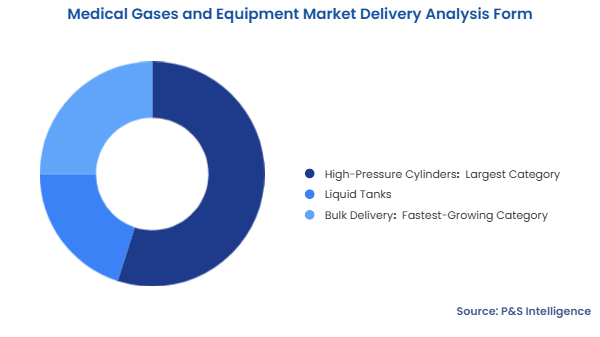
Based on the form of delivery, high-pressure cylinders hold the largest share, of 55%, as they are extensively utilized in hospitals and homecare settings. Additionally, the prominent players mainly prefer the delivery of these substances in high-pressure cylinders due to their safety and ease of use.
Bulk delivery is the fastest-growing category due to the rising demand for cost-effective high-volume of medical gas supply to major end users. With the increasing count of patients, hospitals, long-term-care facilities, hospice care centers, and other high-volume users are going for bulk purchases.
These forms of delivery are covered:
High-Pressure Cylinders (Largest Category)
Liquid Tanks
Bulk Delivery (Fastest-Growing Category)
Application Analysis
The therapeutic application category accounted for the largest share in 2024. This is due to the surging use of medical air, oxygen, carbon dioxide, nitric oxide, and helium as medicine for the treatment of many disorders. Additionally, medicinal oxygen is widely employed in healthcare settings all over the world as complementary to anesthetic agents and in inhalation therapy. Moreover, nitrous oxide is high in demand in hospitals for utilization as an analgesic, anesthetic, and refrigerant in cryosurgical procedures.
The surging adoption of minimally invasive procedures, such as endoscopy, arthroscopy, and laparoscopy, is significantly increasing the usefulness of carbon dioxide as an insufflation air for the broadening and stabilizing of the body cavities, to improve the visibility of the operating area.
The diagnostics category is projected to register the highest CAGR, of 8.5%, in the forecast period, driven by the surging adoption of various gaseous agents in imaging and general laboratory applications. In general laboratories, an aerobic and anaerobic incubator environment is required for the growth and maintenance of microbiological cell cultures, which is supported by oxygen, carbon dioxide, and hydrogen-rich mixtures.
Moreover, the varied usage of these substances in the diagnostics sector, such as of liquid helium to cool the superconductive coils in MRI machines and of test gas for the calibration as well as maintenance of the instruments used for providing inhalable anesthetics, is expected to drive the category’s revenue in the upcoming period.
These applications have been analyzed:
Therapeutic (Largest Category)
Respiratory diseases
Cardiovascular diseases
Anesthesia
Cryosurgery
Others
Diagnostics (Fastest-Growing Category)
Medical imaging
General laboratory Use
Others
Pharmaceutical manufacturing and research
Drug discovery
Process development
Pharmaceutical manufacturing
Quality Control
Others
End User Analysis
Hospitals had the largest revenue share in 2024, of more than 55%. This is on account of the rising number of hospitals in both developed as well as developing counties and their wide adoption of nitrogen protoxide, carbon dioxide, liquid nitrogen, and medicinal air in emergency rooms, ICUs, and surgical rooms.
The home healthcare category is set to record the highest CAGR in the upcoming period, owing to the shifting inclination of people toward home-based health services. Moreover, governments have taken various measures to allow people to get long-term care in their homes.
Patients suffering from respiratory diseases, such as COPD, pneumonia, and lung cancer, are turning to portable devices, which will increase the product demand in homecare settings. Moreover, technological advancements have increased the functionality options for a variety of gas handling equipment used in home-based care. In turn, the introduction of lightweight and portable handling equipment has aided in the growth of the home healthcare sector.
Furthermore, the medical gas cylinder technology has advanced dramatically in the last few years. Lightweight, non-limited-life (NLL) composite cylinders have recently entered the sector, and they are expected to play an important role in the development of portable oxygen therapies and other innovative homecare treatments over the next few years. These products provide significant benefits to patients in homecare settings by addressing their desire for a cylinder that is significantly lighter than conventional aluminum cylinders.
We have covered these end users:
Hospitals (Largest Category)
Homecare Settings (Fastest-Growing Category)
Pharmaceutical and Biopharmaceutical Companies
Diagnostic and Research Laboratories
Academic Institutes and Research Institutes
Drive strategic growth with comprehensive market analysis
Medical Gases and Equipment Market Geographical Analysis
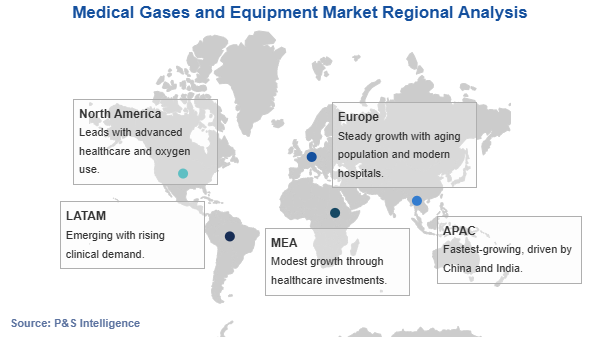
North America accounted for the largest medical gases and equipment market share, of 40%, in 2024, owing to the soaring use of the associated gases for the treatment as well as management of CVDs, asthma, and COPD in hospitals, coupled with the high prevalence of these diseases in the region.
Additionally, the U.S. accounts for the higher sales value in the region, driven by the presence of numerous healthcare facilities. Furthermore, as a result of the current increase in the use of home-based therapy, the medical gas sector in the U.S. is experiencing a rise in standards, analysis, and delivery procedures.
Europe held the second-largest share, in 2021, on account of the presence of various public organizations, such as the Medical Gas Association and European Industrial Gases Association, that frame standard rules and regulations for product manufacturers. Germany, France, and the U.K. together account for the major share in the region, driven by the surging number of hospitals and rising adoption of home-based care in these countries.
APAC is expected to witness the highest CAGR during the forecast period, of 8.8%. The growth is attributed to growing geriatric population, increasing prevalence of respiratory diseases, rapid urbanization and increasing prevalence of chronic and lifestyle associated diseases. As per the World Economic Forum, Asia is hole to the most geriatric people in the world, led by Japan, Hong Kong, and South Korea. Among them, the share of people at least 65 years old is the highest in Japan, around 30%. Further, by 2050, this share is set to become 37.5% in 2050. Similarly, 40.6% of the people in Hong Kong and 39.4% in South Korea will be at least 65 years old by 2050.
Moreover, an estimated 43 million people in China have severe respiratory diseases, including COPD and asthma. Similarly, asthma affects over 35 million people in India, thus driving the demand for oxygen for the afflicted.
The market is fragmented as a wide variety of pure and mixed gases are used in medical settings. Equally diverse is the equipment used to deliver the gases to patients and includes compressors, tubes, valves, cylinders, manifolds, sensors, controllers, and others.
Further, while the gases are supplied by chemical companies, the equipment is provided by medical device companies.
Hence, companies that sell the gases do not majorly sell the equipment as well and vice versa.
Further, since the COVID-19 pandemic, a whole lot of companies that were never engaged in this business took it up, in order to meet the massive increase in the demand for oxygen, onsite gas generators, cylinders, and other associated equipment.
Key Medical Gases and Equipment Companies:
Air Products and Chemicals Inc.
Flexicare (Group) Limited
L’Air Liquide S.A.
Nippon Sanso Holdings Corporation
Atlas Copco AB
Linde PLC
SOL SpA
GCE Holding AB
Messer SE & Co. KGaA
NOL Group
Ingersoll Rand Inc.
GHC GERLING, HOLZ & CO. Handels GmbH
Medical Gases and Equipment Market News
In January 2025, Atlas Copco AB acquired Medi-teknique Ltd., which provides preventive maintenance for medical gas equipment as well as replacements in the U.K.
In December 2024, Nippon Sanso Corporation reached an agreement to acquire Esteve Teijin Healthcare (ETH. A joint venture of Teijin Holdings Europe BV and Corporación Químico-Farmacéutica Esteve offers home respiratory therapy services in Spain.
In April 2024, L’Air Liquide S.A. acquired two entities in the Netherlands and Belgium that provide nutrition and home infusion solutions to over 100,000 respiratory disease patients in these countries.
In April 2024, GCE Holding AB launched the PNP100 HTM gas manifold under its MEDIGARD DUPLEX brand for medical gas supply.
Want a report tailored exactly to your business need?
Leading companies across industries trust us to deliver data-driven insights and innovative solutions for their most critical decisions. From data-driven strategies to actionable insights, we empower the decision-makers who shape industries and define the future. From Fortune 500 companies to innovative startups, we are proud to partner with organisations that drive progress in their industries.
Client Testimonials
Working with P&S Intelligence and their team was an absolute pleasure – their awareness of timelines and commitment to value greatly contributed to our project's success. Eagerly anticipating future collaborations.
McKinsey & Company
India
Unmatched Standards
Our insights into the minutest levels of the markets, including the latest trends and competitive landscape, give you all the answers you need to take your business to new heights
Complete Data Security
We take a cautious approach to protecting your personal and confidential information. Trust is the strongest bond that connects us and our clients, and trust we build by complying with all international and domestic data protection and privacy laws