Material Handling Robotics Market Size & Share Analysis - Trends, Drivers, Competitive Landscape, and Forecasts (2026 - 2032)
This Report Provides In-Depth Analysis of the Material Handling Robotics Market Report Prepared by P&S Intelligence, Segmented by Robot Type (Articulated Robots, Collaborative Robots, SCARA Robots, Cartesian Robots, Delta/Parallel Robots, Cylindrical Robots), Application (Pick & Place, Machine Tending, Storage, Palletizing & Depalletizing, Packaging, Transportation), End Use Industry (Automotive, Retail & E-Commerce, Electrical & Electronics, Manufacturing, Food & Beverage, Pharmaceuticals, Aerospace, Chemicals), and Geographical Outlook for the Period of 2021 to 2032
Explore the market potential with our data-driven report
Material Handling Robotics Market Future Outlook
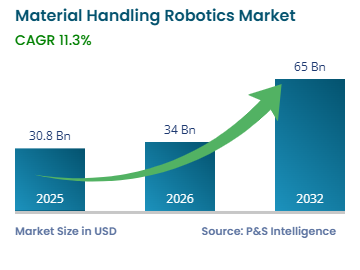
The material handling robotics market size was USD 30.8 billion for 2025, and it will grow by 11.3% during 2026–2032, to reach USD 65.0 billion by 2032.
The market growth is driven by the accelerating deployment of articulated arms, autonomous mobile robots (AMRs), and collaborative robots across pick-and-place, palletizing, and machine-tending operations. This deployment positions robotics as a core lever for warehouse and factory-floor productivity, as manufacturers and logistics providers turn to automation to address persistent labor shortages.
The adoption is intensifying as automotive, electronics, and retail e-commerce operators scale automation to compress fulfillment cycles and offset rising labor costs. The International Federation of Robotics (IFR) reports that global industrial robot installations reached 542,000 units in 2024, more than double the volume recorded a decade earlier. This installation growth reflects sustained capital commitment to factory and warehouse automation. The Association for Advancing Automation (A3) reports that North American companies ordered approximately 9,055 robots in the first quarter of 2026. This continued investment underscores the expanding role of robotics in warehouse and manufacturing automation, supporting sustained market growth.
Key Market Insights
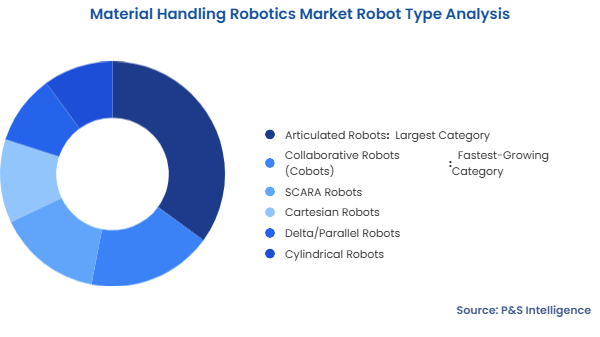
The articulated robots category holds the largest market share of 35%, in 2025, driven by their exceptional versatility and high payload capacity.
The machine tending category will have the highest CAGR, of approximately 11.6%, driven by increasing automation of CNC machining, injection molding, and metal fabrication.
The automotive category holds the largest market share of 25% in 2025, driven by the industry's high-volume production environment.
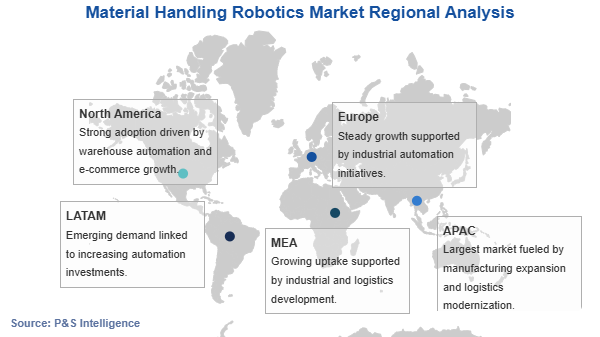
North America holds the largest market share of 40%, in 2025, driven by strong automotive and logistics automation.
Asia-Pacific will have the highest CAGR of approximately 12.2%, during the forecast period, driven by expanding manufacturing and warehouse automation.
Material Handling Robotics Market Trends and Drivers
AI-Enabled Perception and Robotics-as-a-Service Models Are Key Trends
Material handling robotics is shifting from fixed, pre-programmed automation toward AI-enabled systems capable of adapting to variable box sizes, unstructured pallets, and dynamic warehouse layouts without manual reprogramming. Robotics-as-a-Service (RaaS) financing is accelerating this transformation by converting large upfront capital purchases into monthly operating expenses, opening automation to small and mid-sized operators previously priced out of the market. Vendors are increasingly bundling fleet-orchestration software with hardware to enable centralized management of mixed robot fleets across multiple facilities.
The International Federation of Robotics (IFR) reports that Robotics-as-a-Service (RaaS) deployments for professional service robots grew by 42% in 2024. This growth outpaced traditional sales channels, as subscription-based financing lowers barriers for first-time automation buyers in transportation and logistics applications. Product innovation is further accelerating this trend. In February 2026, Kawasaki Heavy Industries, Ltd. introduced the CP110L high-speed palletizing robot for logistics, packaging, and manufacturing applications, reflecting continued investment in faster, higher-throughput material handling solutions. This shift toward flexible, software-defined automation is expected to continue accelerating as AI perception models mature, narrowing the gap between rigid, single-task robots and more adaptive material handling systems.
Structural Labor Shortages and Reshoring Momentum Are Biggest Drivers
Manufacturers and logistics providers are accelerating investment in material handling robotics as growing workforce constraints and factory reshoring initiatives increase the need for efficient, automated material flow. New production facilities across North America and Europe are being designed with higher levels of automation from the outset. This design shift is driving demand for autonomous mobile robots (AMRs), robotic arms, and intelligent material handling systems that enhance productivity, improve operational efficiency, and support around-the-clock operations.
The U.S. Bureau of Labor Statistics (BLS) estimates nearly 1 million annual job openings in production occupations, on average, from 2024 to 2034. This projected demand reflects sustained workforce need and continues to encourage manufacturers to invest in automation and material handling robotics. As demand for automation continues to grow, robotics vendors are expanding investments in easier-to-deploy solutions, including simplified programming, plug-and-play grippers, and user-friendly automation platforms. These solutions are enabling manufacturers and warehouse operators to implement robotic material handling systems more efficiently and at greater scale. This investment momentum is reflected in industry expansion initiatives. In December 2025, Universal Robots A/S announced a new U.S. Operations Hub in Michigan to manufacture collaborative robots, expand domestic production capacity, and support growing reshoring and industrial automation demand.
Skilled Workforce Shortages and Integration Complexity Are Key Restraints
Despite falling hardware costs, the shortage of technicians and engineers capable of programming, integrating, and maintaining robotic systems continues to limit the pace of material handling robotics adoption. Small and mid-sized manufacturers without in-house automation expertise face this constraint most directly. Integration with legacy production equipment, warehouse management systems (WMS), and enterprise resource planning (ERP) platforms adds technical complexity. This complexity requires longer implementation timelines and specialized expertise, while additional customization can increase project costs and delay deployment.
These challenges are most pronounced for organizations transitioning from manual or semi-automated operations. Limited technical resources and complex integration requirements can slow automation initiatives in these settings and reduce the speed of large-scale robotic deployment across warehouses and manufacturing facilities. As the market continues to mature, vendor-led training programs, simplified no-code deployment tools, and standardized integration platforms are expected to reduce these implementation challenges. Expanding systems integrator capabilities are also accelerating successful deployment across warehouses and manufacturing facilities.
E-Commerce Fulfillment Expansion Is Biggest Opportunity
The sustained shift of retail spending toward online channels is creating durable demand for high-throughput, error-resistant order fulfillment that is driving greater adoption of automated warehouse operations. Retailers and third-party logistics providers are increasingly embedding pick-and-place and sortation robots directly into fulfillment center design rather than retrofitting automation after the fact. This design shift is creating a growing addressable base of greenfield facilities built around robotic workflows from inception.
The U.S. Census Bureau reports that U.S. e-commerce retail sales reached USD 326.7 billion in the first quarter of 2026. This figure represented growth of 9.8% year over year and accounted for 16.9% of total U.S. retail sales, highlighting the continued growth of online retail and the increasing need for advanced warehouse automation solutions. As e-commerce continues to expand, new opportunities are emerging for robotics manufacturers, system integrators, and warehouse automation providers beyond large distribution centers. Smaller urban micro-fulfillment facilities represent a growing share of this opportunity, where compact robotic systems can improve operational efficiency and support faster last-mile delivery commitments.
Material Handling Robotics Market Segmentation Analysis
Robot Type Analysis
The articulated robots category holds the largest market share of 35%, in 2025, driven by their exceptional versatility and high payload capacity. These robots perform a wide range of material handling tasks, including palletizing, depalletizing, pick-and-place, machine tending, and heavy-duty material transfer within a single reconfigurable platform. This flexibility enables manufacturers and warehouse operators to automate multiple processes with one robotic system, improving operational efficiency, throughput, and space utilization while reducing manual handling. Widespread adoption across automotive, electronics, logistics, food & beverage, and other manufacturing industries continues to strengthen demand for articulated robots. This sustained demand is reinforcing its leadership position in the material handling robotics market. The International Federation of Robotics (IFR) reports that the global operational stock of industrial robots reached 4,664,000 units in 2024. This stock level reflects the continued expansion of industrial automation across manufacturing and material handling applications.
The collaborative robots category will have the highest CAGR of approximately 11.7%, due to their simplified programming, flexible deployment, and built-in safety features that enable safe operation alongside human workers without extensive safety fencing. Their lower implementation complexity and ease of integration are encouraging adoption among small and medium-sized manufacturers, warehouses, and distribution centers that previously faced barriers to automation. As businesses increasingly seek flexible, scalable, and cost-effective robotic solutions, cobots are expanding the addressable market for material handling robotics and accelerating automation across a broader range of industries and warehouse environments.
The pick & place category holds the largest market share of 35%, in 2025, driven by their widespread adoption across manufacturing, warehousing, logistics, electronics, food & beverage, and e-commerce fulfillment operations. These systems perform high-speed, repetitive, and highly accurate object handling, improving throughput, reducing manual intervention, and enhancing operational efficiency across diverse production and distribution environments. Industries continue to prioritize productivity and accuracy as automation expands. Demand for pick-and-place robotic systems is sustaining this position as the largest application segment in the material handling robotics market.
The machine tending category will have the highest CAGR, as manufacturers increasingly automate CNC machining, injection molding, metal fabrication, and other production processes to improve productivity, maximize equipment utilization, and maintain consistent production quality. Growing adoption across general manufacturing industries, combined with increasing demand for flexible automation solutions, is expanding the use of robotic machine tending beyond traditional automotive applications. This broader adoption is accelerating demand for material handling robots and supporting the fastest-growing position among application segments. The International Federation of Robotics (IFR) reports that global industrial robot installations will increase to approximately 575,000 units in 2025 and exceed 700,000 units by 2028. This trajectory highlights the continued expansion of industrial automation while creating favorable growth opportunities for machine tending applications.
The applications analysed in this report are:
Pick & Place (Largest Category)
Machine Tending (Fastest-Growing Category)
Storage
Palletizing & Depalletizing
Packaging
Transportation
Others
End Use Industry Analysis
The automotive category holds the largest market share in 2025, driven by the industry's high-volume production environment. Continuous movement of components, assemblies, and finished parts requires precise, repetitive, and efficient material handling. The industry's increasing adoption of electric vehicle manufacturing is expanding demand for robotic handling systems, as battery module and component handling require higher levels of automation, safety, and precision. These factors continue to reinforce the automotive industry's leadership and sustain demand for material handling robotics worldwide. The International Organization of Motor Vehicle Manufacturers (OICA) reports that global vehicle production reached 96.4 million units in 2025. This scale of production reflects the large-scale movement of components and assemblies, which continues to drive demand for robotic material handling systems across automotive manufacturing.
The retail & e-commerce category will have the highest CAGR of approximately 12.0%, driven by retailers and third-party logistics providers continuing to expand automated fulfillment operations to manage increasing online order volumes. This expansion is improving order accuracy and accelerating delivery timelines. Growing investment in robotic sortation, goods-to-person systems, and automated warehouse technologies is enabling higher throughput while supporting scalable fulfillment operations. The U.S. Bureau of Labor Statistics (BLS) estimates that warehousing and storage employment will increase by 13.1% during 2022–2032. This projected growth reflects the continued expansion of warehousing operations, driven largely by e-commerce growth, reinforcing the need for advanced material handling automation.
The end use industries analysed in this report are:
Automotive (Largest Category)
Retail & E-Commerce (Fastest-Growing Category)
Electrical & Electronics
Manufacturing
Food & Beverage
Pharmaceuticals
Aerospace
Chemicals
Others
Drive strategic growth with comprehensive market analysis
Material Handling Robotics Market Regional Outlook
North America Material Handling Robotics Market Size
North America holds the largest market share of 40%, in 2025, driven by more than a decade of sustained automotive and logistics automation investment and an established automotive manufacturing base. Rapid expansion of e-commerce fulfillment infrastructure is expanding the addressable market for automated material handling systems. Accelerating factory reshoring initiatives are also increasing this demand. Persistent shortages of warehouse and manufacturing labor are driving the adoption of autonomous mobile robots and robotic arms as a long-term productivity solution. Robotics-as-a-service financing models are lowering capital barriers for small and mid-sized manufacturers adopting automation. The International Federation of Robotics (IFR) reports that robot installations in the Americas exceeded 50,100 units in 2024. The United States accounted for 68% of regional installations. IFR also reports that North America recorded a robot density of 204 units per 10,000 manufacturing employees in 2024, underscoring the region's high level of manufacturing automation and continued investment in robotics.
U.S. Material Handling Robotics Market Size
The U.S. is the larger and faster-growing country market within North America. The growth is increasingly diversified beyond automotive into food production, life sciences, and non-manufacturing logistics. Reshoring initiatives and a persistently tight manufacturing labor market are structurally raising demand for autonomous and semi-autonomous material handling systems. Robotics-as-a-Service adoption is also converting large capital purchases into operating expenses, broadening the addressable customer base among small and mid-sized manufacturers.
The International Federation of Robotics (IFR) reports that U.S. industrial robot installations rose 11% to 38,000 units in 2025. The automotive industry remained the largest adopter, at 13,500 units. Food industry robot adoption increased by 30%. Non-manufacturing sectors, including warehousing and logistics, recorded 41% growth. This growth highlights the expanding use of robotics across material handling applications, and the U.S. market's trajectory remains firmly positive. IFR reports favorable growth prospects for North American industrial modernization. Accelerating reshoring initiatives and persistent skilled-labor shortages support this outlook.
Asia-Pacific Material Handling Robotics Market Size
Asia-Pacific will have the highest CAGR of approximately 12.2%, during the forecast period, driven by China's manufacturing scale, expanding e-commerce logistics networks, and rapid warehouse automation adoption across India and Southeast Asia. China's national robotics strategy has driven a decade of sustained capacity build-out. Rising domestic manufacturer competitiveness is compressing equipment costs and broadening access for mid-sized factories. The International Federation of Robotics (IFR) reports that China installed 295,000 industrial robots in 2024. This total represented 54% of global deployments, the highest annual total on record for any single country. Additionally, India's automotive and warehousing sectors are scaling automation from a small base, generating outsized percentage growth. Government-backed industrial modernization programs across the region continue to channel capital toward smart-factory and automated-warehouse deployments. The International Federation of Robotics (IFR) reports that India installed a record 9,100 industrial robots in 2024, up 7% year-on-year. This total ranked sixth worldwide in annual installations.
This growth trajectory is expected to continue strengthening. IFR estimates average annual growth potential of around 10% for Chinese manufacturing robot demand through 2028. India and Southeast Asian markets are positioned to narrow the regional gap as warehousing infrastructure matures.
Europe Material Handling Robotics Market Size
Europe held the second-largest regional market for material handling robotics in 2025, driven by Germany's advanced automotive and industrial machinery base. Stringent workplace safety regulations favor certified collaborative and articulated robots. A mature systems integrator ecosystem supports the region's automation capacity. Manufacturers' continued push toward nearshored, automation-intensive production is reinforcing this leadership. Updated EU machinery safety regulations are supporting the wider deployment of collaborative and intelligent material handling robots designed for safe human-robot collaboration. The International Federation of Robotics (IFR) reports that Germany installed 26,982 industrial robots in 2024. This total represented 32% of Europe's annual total, retaining Germany's position as the region's largest robot market.
These regions and countries are analysed:
North America (Largest Regional Market)
U.S. (Larger and Faster-Growing Country)
Canada
Europe
Germany (Largest Country)
U.K. (Fastest-Growing Country)
France
Italy
Spain
Rest of Europe
Asia-Pacific (Fastest-Growing Regional Market)
China (Largest Country)
India (Fastest-Growing Country)
Japan
South Korea
Australia
Rest of APAC
Latin America
Brazil (Largest Country)
Mexico (Fastest-Growing Country)
Rest of LATAM
Middle East & Africa
Saudi Arabia (Largest Country)
South Africa
U.A.E. (Fastest-Growing Country)
Rest of MEA
Material Handling Robotics Market Share Analysis
The market is fragmented, with competition spread across global industrial robot manufacturers, autonomous mobile robot developers, warehouse automation providers, and regional system integrators. Leading companies including ABB Ltd., FANUC Corporation, KUKA AG, Yaskawa Electric Corporation, Daifuku Co., Ltd., Swisslog Holding AG, GreyOrange, and Locus Robotics offer industrial robots, AMRs, warehouse automation systems, software platforms, and integrated material handling solutions. No single company dominates the overall market because vendors specialize in different robot types, applications, industries, and geographic regions. Continuous innovation is driving competition across AI-enabled automation and autonomous navigation, while robotics-as-a-service and fleet management software are further expanding the competitive field. Customized system integration, strategic partnerships, and acquisitions are also reinforcing the market's fragmented structure.
Top Companies in the Material Handling Robotics Market:
ABB Ltd.
FANUC Corporation
KUKA AG
Yaskawa Electric Corporation
Mitsubishi Electric Corporation
Omron Corporation
Daifuku Co., Ltd.
KION Group AG
Honeywell Intelligrated
Swisslog Holding AG
Geekplus Technology Co., Ltd.
GreyOrange Pte. Ltd.
Locus Robotics Corporation
Kawasaki Heavy Industries, Ltd.
Universal Robots A/S
Material Handling Robotics Market News
In June 2026, Kawasaki Heavy Industries, Ltd. expanded its collaboration with Dexterity Inc., scaling production of its RL030N 8-degree-of-freedom robot arm platform for integration into Dexterity's Mech robots deployed in warehouse trailer-loading and unloading applications. The partnership extends Kawasaki's reach into physical-AI-driven logistics automation.
In April 2026, Universal Robots A/S expanded its collaboration with Flex, with Flex deploying Universal Robots collaborative robots and Mobile Industrial Robots autonomous mobile robots across its own facilities while manufacturing robotics components for Teradyne's global customer base. The expanded partnership deepens vertical integration across Teradyne's robotics supply chain.
In January 2026, KUKA AG partnered with AI company Algorized to integrate advanced perception software enabling real-time human-motion sensing into its collaborative robot arms. The collaboration supports safer human-robot coexistence in shared material handling workspaces.
Frequently Asked Questions About This Report
What are the key factors driving the growth of the Material Handling Robotics Market?+
The market is primarily driven by rising warehouse automation, expanding e-commerce, labor shortages, increasing demand for faster order fulfillment, and growing adoption of AI-enabled robotic systems.
How are AI and autonomous mobile robots (AMRs) transforming material handling operations?+
AI and AMRs improve navigation, optimize workflows, reduce manual labor, enhance picking accuracy, and enable flexible, real-time warehouse operations.
What are the major applications of material handling robotics?+
Key applications include pick-and-place, palletizing and depalletizing, machine tending, packaging, sorting, transportation, and warehouse storage automation.
What challenges are affecting the adoption of material handling robotics?+
High initial investment, system integration complexity, workforce skill shortages, and interoperability with legacy equipment remain the primary adoption challenges.
Want a report tailored exactly to your business need?
Leading companies across industries trust us to deliver data-driven insights and innovative solutions for their most critical decisions. From data-driven strategies to actionable insights, we empower the decision-makers who shape industries and define the future. From Fortune 500 companies to innovative startups, we are proud to partner with organisations that drive progress in their industries.
Client Testimonials
Working with P&S Intelligence and their team was an absolute pleasure – their awareness of timelines and commitment to value greatly contributed to our project's success. Eagerly anticipating future collaborations.
McKinsey & Company
India
Unmatched Standards
Our insights into the minutest levels of the markets, including the latest trends and competitive landscape, give you all the answers you need to take your business to new heights
Complete Data Security
We take a cautious approach to protecting your personal and confidential information. Trust is the strongest bond that connects us and our clients, and trust we build by complying with all international and domestic data protection and privacy laws