This Report Provides In-Depth Analysis of the Asia-Pacific Industrial Robot Market Report Prepared by P&S Intelligence, Segmented by Offering (Hardware, Software, Services), Type (Articulated, Cartesian, Cylindrical, Polar, SCARA, Delta), Payload (Small-to-Medium, Large, Extra Large), Application (Material Handling, Welding, Assembling, Material Removal, Painting, Inspection, Machine Tending, Sealing/Dispensing), Industry (Automotive, Electricals & Electronics, Chemicals, Rubber & Plastics, Metal & Machinery, Medical Devices, Food & Beverages, E-Commerce, Pharmaceuticals), and Geographical Outlook for the Period of 2021 to 2032
Explore the market potential with our data-driven report
Asia-Pacific Industrial Robot Market Key Insights
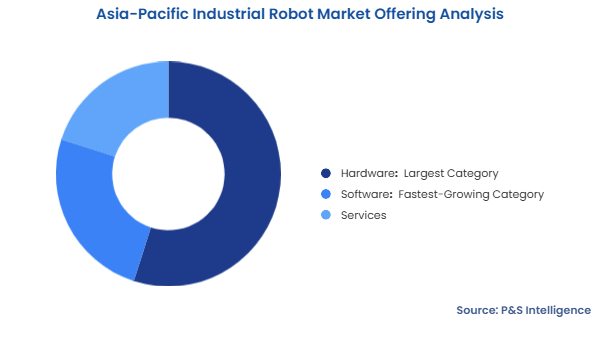
Hardware has the largest share, of 55%, because robot arms, actuators, sensors, controllers, and core mechanical components are essential for manufacturing and logistics operations.
Cylindrical robots have highest CAGR, of 14.8%, driven by their increasing adoption for material handling, assembly, and pick-and-place operations in China, Southeast Asia, and India.
Material handling is the largest and fastest-growing category, with 25% share and 14.9% CAGR, respectively.
The automotive industry dominates the market, as it uses large numbers of robots for spot welding, arc welding, assembly, material handling, and machine tending.
The electricals & electronics category has the highest CAGR, of 14.7%, driven by rising production of semiconductors, consumer electronics, PCB assembly, and batteries.
China is the largest country market within the Asia-Pacific industrial robot sector, with 40% share.
India represents the fastest-growing country market within Asia-Pacific, with 14.5% CAGR.
Asia-Pacific Industrial Robot Market Overview
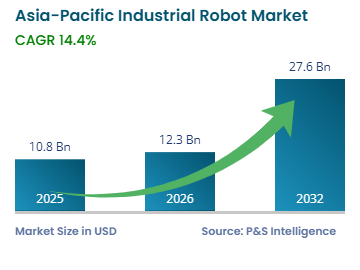
The Asia-Pacific industrial robot market size was USD 10.8 billion in 2025, and it is set to expand at a CAGR of 14.4% during 2026–2032, reaching approximately USD 27.6 billion by 2032.
The APAC industrial robot market is driven by rapid industrialization, strong automotive and electronics manufacturing growth, rising labor costs, increasing demand for productivity and quality, and government support for automation and smart manufacturing. The region accounted for approximately 74% of global industrial robot installations in 2024, far exceeding Europe’s 16–17% and the Americas’ 9–10%. China alone represented about 54% of global deployments, installing roughly 295,000 units with an operational stock exceeding 2 million robots. Japan and South Korea remain significant markets, while India’s adoption is growing rapidly. Key drivers include large export‑oriented manufacturing bases, especially in automotive and electronics, pushing companies to adopt robots to improve productivity and quality.
The rising labor costs and workforce shortages, particularly in China and Japan, accelerate automation adoption, while government policies, such as China’s industrial upgrade programs and robotics incentives in Japan and South Korea, further encourage investment. APAC’s dominance reflects structural economic shifts toward high-efficiency, high-precision automated production, meeting the growing demand for both traditional and emerging industries. The combination of massive production scale, technological investment, and supportive policy ensures APAC remains the global hub for industrial robotics.
In the APAC industrial robotics market, there is a strong convergence toward AI‑enabled and collaborative automation, extending robot use beyond traditional fixed‑cage tasks into more adaptive, human‑centric roles. AI integration allows robots to handle more complex, variable tasks and makes automation accessible to a broader set of industries, such as logistics, electronics, and warehouse workflows previously less automated. Meanwhile, collaborative robots—designed to work safely alongside humans—are gaining traction, supported by easier programming interfaces and lower barriers to integration. These trends reflect a shift toward flexible, intelligent automation that supports efficiency and precision while enabling human–machine teaming. The pace of adoption illustrates not only scale but also technological sophistication in APAC’s robotics ecosystem.
Policy‑Led Automation and Quality Productivity Gains Drive Market
APAC’s industrial robotics growth is shaped by strong policy direction and the imperative for competitive manufacturing productivity. Governments across the region—especially in China, Japan, and South Korea—have articulated strategic frameworks that elevate automation, digital manufacturing, and smart factories as national priorities. China’s industrial modernization initiatives aim to upgrade manufacturing capacity and enhance quality through automation, contributing to its leadership position in robot demand. Japan’s and Korea’s innovation roadmaps similarly emphasize advanced manufacturing technologies that combine robotics with data intelligence, supporting sectoral competitiveness globally.
Moreover, rising labor costs and talent shortages in major markets reinforce automation as a practical response to workforce constraints. Improved robotics quality, consistency and productivity appeal to manufacturers seeking to sustain export competitiveness, reduce defect rates, and accelerate throughput without proportionally increasing labor. This policy environment, combined with economic pressures for high‑efficiency production, amplifies robotics adoption across automotive, electronics and other precision manufacturing segments, underpinning APAC’s sustained industrial automation momentum.
The Made in China 2025 and related smart manufacturing push explicitly target robotics and automation as key sectors for global competitiveness, encouraging factories to install industrial robots across key industries through deployment initiatives like a push to place 100,000 robots in factories, subsidies for R&D and manufacturing, and local government support such as innovation centers and purchase incentives to reduce adoption costs. Japan’s Society 5.0 (Super Smart Society) policy aims to integrate advanced technologies including robots, AI, IoT, and industrial automation into society and industry to solve societal and economic challenges. It supports smart factories and promotes robotics R&D and adoption across sectors as part of Japan’s broader national innovation strategy.
South Korea has long included robotics in national innovation plans, with programs like Manufacturing Innovation 3.0 and targets to deploy over one million robots by 2030 across manufacturing, logistics and other sectors, along with strategic support for certification, global expansion, and collaboration between government, industry, and training institutions. India’s Make in India initiative and related Industry 4.0 programs have allocated funds for industrial automation and robotics adoption, including budgets for supporting SMEs and priority sectors like automotive and electronics to modernize production lines with robots.
Singapore’s government has rolled out substantial investment in AI, digital infrastructure, and innovation schemes (e.g., national AI strategies and enterprise R&D incentives) that indirectly support industrial automation and robotics deployment by lowering technology costs and enhancing digital readiness. National digital transformation and smart manufacturing initiatives in countries like Vietnam and Thailand are building ecosystems that encourage automation adoption, often tied to broader industrial modernization and foreign investment incentives that make robotics integration more attractive.
Financial and Skills Barriers Hinder Adoption
Despite strong regional demand, the APAC industrial robotics market faces significant adoption barriers rooted in cost and talent limitations. High upfront expenditures for acquiring industrial robots, integrating them with existing systems, and maintaining hardware/software can deter especially small and medium‑sized enterprises (SMEs) that lack the scale and capital of larger manufacturers. The complexity of robotic systems—particularly those incorporating advanced sensors or AI capabilities—intensifies the need for skilled professionals who can program, deploy, and troubleshoot these technologies. However, many APAC markets are challenged by a shortage of such technical talent, slowing broader adoption outside large industrial hubs.
Integration with legacy equipment and workflows further raises technical complexity and implementation time, increasing total cost of ownership and diminishing near‑term return on investment for some firms. The combination of financial barriers and talent gaps therefore constrains the pace at which automation can penetrate diverse industrial sub‑sectors, despite overall demand growth.
A 2025 survey found that 77% of employers in APAC are struggling to fill positions, notably in IT & data, engineering, and technical roles. This represents a large increase from 45% in 2014 and exceeds the global average workforce shortage, directly constraining manufacturers’ ability to deploy and scale robot automation. Studies show that over 45% of APAC manufacturers face barriers to adopting smart manufacturing technologies, with lack of skilled staff and resistance to tech change cited as leading challenges.
A major growth opportunity in APAC’s industrial robotics market is the expansion of robot‑as‑a‑service (RaaS) models, which shift robotics adoption from high capital expenditure to operational expenditure frameworks. RaaS allows manufacturers—especially SMEs and mid‑market firms—to deploy advanced automation technologies without the burden of large upfront costs for hardware and integration. By subscribing to robotics capabilities on a pay‑per‑use or lease basis, companies can align automation costs with production cycles and scale deployment based on need.
This flexibility can accelerate adoption across industries where traditional investment hurdles have slowed automation, such as smaller manufacturing lines, logistics operations, and emerging sectors like e‑commerce fulfilment. RaaS also encourages experimentation with AI‑enhanced, sensor‑driven and mobile robotics without long‑term financial commitments, enabling firms to build internal skills over time. As APAC continues to lead global industrial robot installations (e.g., 74% share of new deployments in 2024), RaaS stands out as a compelling pathway for wider market inclusion—bringing smart automation to a broader base of industrial players and supporting incremental automation strategies that match diverse business needs and growth trajectories.
Hardware remains the highest-revenue‑generating category with 55% share. This is because robot arms, actuators, sensors, controllers, and core mechanical components represent the majority of upfront automation costs as they are essential for manufacturing and logistics operations. Robust demand in high‑volume sectors like automotive and electronics assembly drives ongoing investment in robust articulated arms, high‑precision SCARA and Cartesian robots, and heavy‑payload units for welding, material handling and machine tending, making hardware the dominant revenue source for industrial robot suppliers across APAC. In many component breakdowns, hardware contributes more than half of total industrial robotics revenue, with sensors and end‑effectors commanding premium prices because they directly impact precision and cycle times.
Software is the fastest‑growing category in the APAC robotics market, with 14.6% CAGR, due to the increasing need for intelligent automation powered by AI, ML, fleet management systems, and cloud orchestration platforms. Advanced robot software enables greater autonomy, predictive maintenance, real‑time analytics, simulation, and integration with factory IT systems, boosting operational efficiency and flexibility. China and India account for over half of installations and deployment of AI‑enabled tools for robot coordination and optimization. Software such as fleet management and AI‑based path planning is becoming increasingly essential in complex manufacturing and logistics scenarios, enabling robots to adapt to dynamic tasks, reduce downtime, and enhance productivity.
The following offerings are covered
Hardware (Largest Category)
Controllers
Sensors
Drives
Robotic Arms
End Effectors
Others
Software (Fastest-Growing Category)
Services
Type Analysis
Articulated robots are the largest type category in the APAC industrial robotics market by revenue and deployment share, dominating manufacturing applications across automotive, electronics, and general manufacturing. Their multi-axis design, high flexibility, and ability to perform complex motions make them ideal for welding, assembly, material handling, palletizing, and machine tending. Globally, articulated robots accounted for roughly 34% of all industrial robot installations in 2023, and APAC reflects a similar dominance due to its massive manufacturing base in China, Japan, South Korea, and India, where high-volume automotive and electronics assembly lines rely heavily on articulated arms. Their versatility, precision, and established install base ensure they remain the preferred choice for factories seeking scalable and robust automation solutions. In terms of usage, articulated robots are especially prominent in spot welding (automotive), PCB assembly (electronics), and precision handling in high-mix manufacturing, often operating in multi-robot cells to optimize cycle times.
Cylindrical robots are the fastest-growing category with 14.8% CAGR. This growth is driven by APAC’s expanding manufacturing base—particularly in China, Southeast Asia, and India—where cylindrical robots are increasingly adopted for material handling, assembly, and pick-and-place operations. Their relatively simple mechanical structure, compact footprint, and cost-effectiveness make them attractive for small- and mid-scale manufacturers seeking automation with lower integration complexity.
These types are covered:
Articulated (Largest Category)
Cartesian
Cylindrical (Fastest-Growing Category)
Polar
SCARA
Delta
Others
Payload Analysis
The small-to-medium category dominates the market with 60% share, and it also has the highest CAGR. These robots are widely deployed in electronics manufacturing, assembly, material handling, machine tending, and general automation tasks, where their size, speed, and flexibility match production requirements. Countries such as China, Japan, South Korea, and India see high penetration of these robots in consumer electronics assembly lines, PCB manufacturing, and light automotive component assembly, where precision and repeatability are critical.
Their versatility makes them suitable for SMEs as well as large manufacturers, enabling manufacturers to adopt automation without significant floor-space or power requirements. Growth is also driven by the increasing adoption by SMEs, rising need for productivity gains and labor cost mitigation, and the expansion of electronics, food & beverage, and consumer goods manufacturing. Additionally, collaborative and AI-enabled robots are often built in this payload range, further fueling adoption as manufacturers pursue more intelligent and adaptable automation systems.
These payloads are covered:
Small-to-Medium (Largest and Fastest-Growing Category)
Large
Extra Large
Application Analysis
Material handling is the largest and fastest-growing category, with 25% share and 14.9% CAGR, respectively. It encompasses a broad range of tasks, including pick-and-place operations, palletizing, loading & unloading, sorting, and warehouse logistics automation. In the automotive, electronics, e‑commerce, food & beverage, and consumer goods industries, material handling robots improve throughput, reduces labor costs, and supports high-volume operations. China, Japan, South Korea, and India lead in robotized material handling deployments, with millions of units installed in factories, warehouses, and distribution centers.
These applications are covered:
Material Handling (Largest and Fastest-Growing Category)
Welding
Assembling
Material Removal
Painting
Inspection
Machine Tending
Sealing/Dispensing
Others
Industry Analysis
The automotive industry is the largest user of industrial robots in APAC, primarily for spot welding, arc welding, assembly, material handling, and machine tending within vehicle production. High-volume automotive hubs in Japan, South Korea, China, and India drive massive robot deployments, with some leading automotive plants operating hundreds to thousands of robot units per factory. Globally and in APAC, automotive continues to account for the largest share of robot units by volume, given the scale, repetitive nature of tasks, and precision requirements that favor automation.
APAC remains the world’s largest automotive production hub, with total vehicle output reaching around 117 million units in 2024, driven by China, Japan, South Korea, India, and ASEAN countries. Production volume grew by about 2.9% in 2024 compared to the previous year.
The electricals & electronics category has the highest CAGR, of 14.7%, largely driven by rapid expansion of semiconductors, consumer electronics, PCB assembly, and battery manufacturing. These activities rely heavily on small-to-medium payload robots for precision assembly, pick-and-place, and handling of delicate components. For instance, in China and India, electronics manufacturing has contributed to double-digit annual growth in robot installations, reflecting both higher adoption rates and growing production capacity.
In 2024, electronics equipment and components production in Asia was valued at roughly USD 1,494 billion, with the region central to global supply chains. In 2024, APAC produced approximately 23 billion semiconductor devices (individual chip units), a 2.2% increase year-on-year. China accounted for about 89% of this volume (21 billion units). For electronic chips broadly (including discrete and ICs), APAC output was around 449 billion units in 2024, up 4.7% from 2023.
Drive strategic growth with comprehensive market analysis
Asia-Pacific Industrial Robot Market Regional Outlook
China Industrial Robot Market Share
China is the largest country market within the Asia-Pacific industrial robot sector, with 40% share. The 295,000 units installed in China in 2024, represented 54% of global deployments according to the International Federation of Robotics (IFR). The country's operational robot stock surpassed 2 million units in 2024, the largest of any nation worldwide, reflecting comprehensive automation initiatives across automotive assembly, electronics manufacturing, metal processing, and consumer goods production. This market leadership stems from government-led industrial modernization programs including the Made in China 2025 initiative, which provides substantial purchase subsidies averaging 17.5% of equipment costs alongside preferential financing and tax incentives specifically targeting robotics adoption.
China's robot density reached 470 robots per 10,000 manufacturing workers in 2024, quadrupling from 97 robots per 10,000 workers in 2017, demonstrating rapid automation penetration addressing rising labor costs and demographic pressures from an aging workforce. Major manufacturing clusters including the Yangtze River Delta, Pearl River Delta, and Bohai Economic Rim create integrated ecosystems where component suppliers, systems integrators, and end users collaborate on rapid technology deployment cycles. The electrical and electronics sector leads adoption with 83,000 units installed in 2024, followed by automotive manufacturing with 57,200 installations, while emerging applications in food processing, textiles, and wood products expand addressable markets.
A significant structural shift occurred as Chinese domestic robot manufacturers captured 57% market share in 2024, surpassing foreign suppliers for the first time after maintaining approximately 28% share over the preceding decade. This transformation reflects maturing domestic technical capabilities, competitive pricing strategies, and government procurement preferences favoring local suppliers. Looking forward, sustained economic growth projected at 4.9% GDP expansion in 2024 alongside continued industrial policy support positions China for sustained robot adoption growth, though potential moderation may occur as automation penetration rates approach those of advanced manufacturing economies. Infrastructure investments in smart manufacturing industrial parks, 5G connectivity for factory automation, and advanced manufacturing research centers reinforce long-term growth trajectory.
India Industrial Robot Market Growth
India represents the fastest-growing country market within Asia-Pacific, with 14.5% CAGR. Industrial robot installations reached 8,510 units in 2023, marking a 59% increase from the previous year and securing the country's position as the seventh-largest market globally for annual robot installations, according to the IFR. The operational robot stock nearly doubled since 2018 to 44,958 units in 2023, reflecting an average annual growth rate of 14% as manufacturers accelerate automation adoption across automotive component manufacturing, electronics assembly, pharmaceutical production, and metal fabrication operations.
The automotive industry drives demand, accounting for 42% of robot installations with 3,551 units deployed in 2023, representing a 139% surge as both vehicle manufacturers and component suppliers expand electric vehicle production capacity. Government initiatives including Make in India and Production Linked Incentive (PLI) schemes provide financial support, with INR 4,500 crore allocated in 2024 as subsidies to over 2,000 companies adopting robotic systems, reducing capital barriers for automation investment. The OECD projects India's GDP growth at 6.5% annually through 2025, creating favorable macroeconomic conditions supporting manufacturing expansion and capital equipment investment.
Major manufacturing hubs including Bengaluru, Pune, Chennai, and Delhi NCR concentrate robot deployments, benefiting from established automotive clusters, electronics manufacturing zones, and engineering talent availability. Emerging applications in rubber and plastics processing with 408 units installed (up 17%) and metal industry operations with 329 units demonstrate diversification beyond traditional automotive dominance. Robot density remains low at approximately 7 robots per 10,000 manufacturing workers compared to China's 470 and South Korea's 1,012, indicating substantial headroom for continued growth as India pursues manufacturing sector expansion targeting 25% GDP contribution by 2025 from approximately 12% currently.
The APAC industrial robot market is generally consolidated, dominated by a few global leaders in industrial robotics, alongside strong regional players. Companies like FANUC, Yaskawa, ABB, KUKA, and Kawasaki hold a significant share of the market, particularly in high-volume applications, such as automotive manufacturing, electronics assembly, and heavy industries. These players benefit from established technology portfolios, extensive service networks, and long-term contracts with large manufacturers, which makes it challenging for smaller or new entrants to compete in high-end industrial automation segments.
At the same time, the market exhibits some fragmentation in niche and emerging segments, particularly in collaborative robots, small-to-medium payload robots, and specialized applications like pharmaceuticals, food & beverage, or small electronics assembly. Here, smaller local players and startups are entering with innovative, flexible, and cost-effective solutions targeting small and medium enterprises (SMEs). Countries such as China, India, and Vietnam are seeing increased activity from domestic robot manufacturers aiming to provide affordable alternatives for local industries.
The competitive landscape increasingly differentiates along solution complexity dimensions where high-precision applications in semiconductor manufacturing, aerospace component production, and medical device assembly favor established manufacturers offering micron-level repeatability and validated process capabilities. Conversely, applications including basic material handling, simple assembly operations, and packaging tasks show growing adoption of value-positioned alternatives where functional adequacy outweighs performance differentiation. Strategic positioning shifts toward comprehensive solutions bundling hardware, software platforms for fleet management and predictive maintenance, and application-specific tooling rather than robot-only offerings.
Leading Companies in the Asia-Pacific Industrial Robot Market:
ABB Ltd.
FANUC Corporation
Yaskawa Electric Corporation
Kawasaki Heavy Industries Ltd.
Mitsubishi Electric Corporation
Panasonic Corporation
Toshiba Machine Co Ltd.
OMRON Corporation
KUKA Aktiengesellschaft
Seiko Epson Corporation
Denso Corporation
Techman Robot Inc.
Hyundai Heavy Industries Co Ltd.
Doosan Corporation
Siasun Robot & Automation Co Ltd.
ESTUN Automation Co Ltd.
GSK CNC Equipment Co Ltd.
Asia-Pacific Industrial Robot Market Developments
In November 2025, Partner Robotics raised an undisclosed Series A funding round led by China Growth Capital, with participation from Cowin Capital and Redpoint China Ventures. The funding will be used to develop embodied intelligence robotics technologies for construction scenarios, commercialize its flagship Floor Tile Paving Robot P900 and Intelligent Scribing Robot L3000, expand overseas distribution networks and service centers, and strengthen its supply chain.
In October 2025, SoftBank Group announced a definitive agreement to buy the robotics division of ABB Ltd. for approximately USD 5.4 billion.
In October 2025, Chinese robotics firm AgiBot introduced the industrial‑grade AgiBot G2 robot with high‑performance actuators and advanced spatial perception, in addition to LinkCraft, a zero‑code platform that converts human motion videos into robot actions to simplify deployment in manufacturing and logistics.
In October 2025, ABB Ltd. announced the launch of three new factory robot families—Lite+, PoWa, and IRB1200—in China. These robots target mid‑sized manufacturers with capabilities for polishing, pick‑and‑place, and basic automation tasks.
In August 2025, Omron Corporation launched its new OMRON TM20 collaborative robot, featuring a 20-kg payload capacity. It is designed to work with other Omron sensors, controllers, and software, to provide comprehensive automation solutions for manufacturers seeking enhanced flexibility and productivity in assembly operations.
In October 2024, Universal Robots announced expanded collaborative robot distribution partnerships across APAC. The company established enhanced service centers in Vietnam, Indonesia, and Thailand to support SMEs seeking flexible automation solutions with rapid deployment capabilities and intuitive programming interfaces.
In May 2024, ABB Ltd. introduced 46 new models in its modular big robot range, capable of handling payloads between 70 kg and 620 kg. These offerings provide manufacturers with greater flexibility, improved choice, and enhanced execution capabilities for heavy-duty material handling and assembly operations.
In March 2024, Mitsubishi Electric Corporation added the RV‑12CRL to its MELFA RV‑CR industrial robot lineup, enhancing workpiece transfer stability with extended I/O support for gripper control.
Frequently Asked Questions About This Report
What was APAC industrial robot market size in 2025?+
In 2025, the industrial robot market in APAC size was USD 10.8 billion.
Which type has largest APAC industrial robot industry share?+
Articulated type has the largest APAC industrial robot industry share, of 25%.
Which country has largest APAC industrial robot market share?+
China is the largest industrial robot market in APAC, with 40% share.
What are the key APAC industrial robot industry drivers?+
The APAC industrial robot industry is driven by rapid industrialization, rising automotive and electronics production, rising labor costs, demand for higher productivity and quality, and government support for automation and smart manufacturing.
What is the APAC industrial robot market nature?+
The industrial robot market in APAC is consolidated.
Want a report tailored exactly to your business need?
Leading companies across industries trust us to deliver data-driven insights and innovative solutions for their most critical decisions. From data-driven strategies to actionable insights, we empower the decision-makers who shape industries and define the future. From Fortune 500 companies to innovative startups, we are proud to partner with organisations that drive progress in their industries.
Client Testimonials
Working with P&S Intelligence and their team was an absolute pleasure – their awareness of timelines and commitment to value greatly contributed to our project's success. Eagerly anticipating future collaborations.
McKinsey & Company
India
Unmatched Standards
Our insights into the minutest levels of the markets, including the latest trends and competitive landscape, give you all the answers you need to take your business to new heights
Complete Data Security
We take a cautious approach to protecting your personal and confidential information. Trust is the strongest bond that connects us and our clients, and trust we build by complying with all international and domestic data protection and privacy laws