Indonesia Micromobility Market Size & Share Analysis - Trends, Drivers, Competitive Landscape, and Forecasts (2026 - 2032)
This Report Provides In-Depth Analysis of the Indonesia Micromobility Market Report Prepared by P&S Intelligence, Segmented by Service (Bike Sharing, Kick Scooter Sharing, Scooter Sharing), Sharing Model (Dockless, Station-based), Trip (One-Way, Round), Model (First & Last-Mile, Multimodal), and Geographical Outlook for the Period of 2021 to 2032
Explore the market potential with our data-driven report
Indonesia Micromobility Market Overview
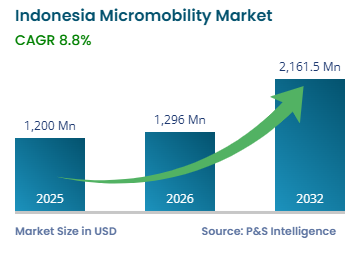
The Indonesia micromobility market size was USD 1,200.0 million for 2025, and it will grow by 8.8% during 2026–2032, to reach USD 2,161.5 million by 2032.
This growth is driven by escalating road congestion across Jakarta and other major metropolitan centers, rising demand for first- and last-mile connectivity linking commuters to bus and rail transit hubs, and the comparatively low cost of dockless scooter- and bike-sharing services relative to private vehicle ownership and fuel expenses.
Urbanization continues to reinforce demand for compact, short-distance mobility while increasing the need for flexible transportation options in densely populated cities. The World Bank identifies this as a key structural trend shaping Indonesia's economic development and transport demand, supporting the increasing adoption of micromobility solutions for short-distance urban travel. Government efforts to electrify two-wheeled transport are accelerating fleet modernization. The International Energy Agency reports that Indonesia targets 13 million electric motorcycles by 2030 and expects the electric share of two- and three-wheeler sales to increase from less than 2% in 2024 to around 30% by 2030.
Key Market Insights
The scooter sharing category holds the largest market share, of 60%, in 2025, driven by Indonesia's strong two-wheeler culture.
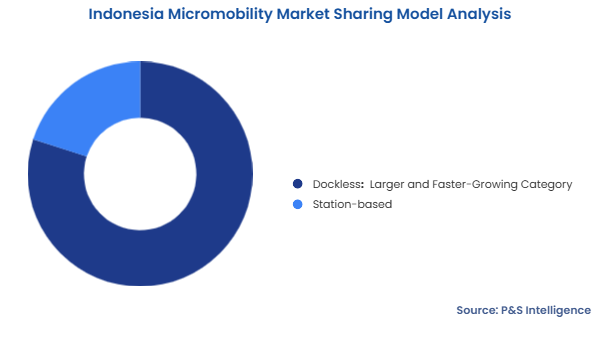
The dockless category holds the larger market share, of 80%, in 2025, and will record the higher CAGR, of approximately 9.2%, due to its infrastructure-light deployment model.
The first & last-mile category holds the larger market share, of 75%, in 2025, driven by strong demand for transit connectivity.
DKI Jakarta holds the largest market share, of 40%, in 2025, driven by its high population density and strong urban mobility demand.
West Java will witness the highest CAGR, of approximately 9.7%, driven by its large population and rapid industrialization.
Indonesia Micromobility Market Trends and Drivers
Battery-Swapping Infrastructure Expansion Is Key Trend
Battery-swapping infrastructure is emerging as a key trend in Indonesia's micromobility market. This infrastructure enables shared electric two-wheeler fleets to minimize charging downtime and maximize vehicle utilization. Unlike conventional charging, standardized battery-swapping systems allow depleted batteries to be exchanged within minutes, improving fleet availability for high-frequency urban operations. Indonesia's Ministry of Energy and Mineral Resources has targeted the deployment of 10,000 Public Battery Swap Stations (SPBKLU) by 2025, with an additional 15,625 SPBKLU planned by 2030 under the national Battery Electric Vehicle Acceleration Program.
The swapping ecosystem is expanding through collaborations involving companies such as OYIKA, Electrum, Swap Energi, and Pertamina, improving operational efficiency for fleet operators. For instance, Electrum and Pertamina have partnered to expand battery-swapping infrastructure for electric two-wheelers, reducing charging-related downtime and improving fleet utilization. Charging-related downtime is falling, and fleet utilization is rising, supporting the wider adoption of shared electric micromobility services across major urban centers.
Government Electrification Incentives and Urban Congestion Are Biggest Drivers
Government incentives designed to accelerate electric-vehicle adoption are directly benefiting micromobility fleet operators by lowering vehicle acquisition costs and encouraging a shift away from combustion-powered scooters and bikes. The International Energy Agency reports that Indonesia introduced a VAT discount on EV sales in April 2023. This policy remains in effect through 2025 and has helped improve the affordability of electric vehicles, including electric two-wheelers.
This incentive structure, combined with worsening road congestion in Jakarta and other major metropolitan centers, is pushing commuters toward compact, app-based mobility solutions capable of navigating dense traffic more efficiently than private vehicles. The International Energy Agency reports that Indonesia recorded approximately 105,000 electric two-wheeler sales in 2024. Expanding domestic manufacturing capacity and supportive government policies are strengthening the supply ecosystem for shared electric micromobility fleets.
Regulatory Fragmentation and Safety Concerns Are Key Restraints
The absence of a unified national regulatory framework specifically governing shared micromobility services is constraining operators' ability to scale consistently across Indonesia's provinces. Unlike national electrification policies that apply uniformly to vehicle sales, rules governing where e-scooters and e-bikes may operate, parking requirements, and rider safety standards are set at the municipal or provincial level. This patchwork of requirements raises compliance costs for operators expanding beyond their home cities.
Rising safety concerns involving unregulated riding on sidewalks and major roadways have prompted some municipalities to introduce operational restrictions for shared micromobility services in dense urban areas such as Jakarta and Surabaya. Until a more consistent national framework for shared micromobility emerges, operators are likely to prioritize expansion into cities with clearer local regulatory support rather than pursuing a uniform nationwide rollout.
Tourism-Driven Demand in Bali Is Biggest Opportunity
Indonesia's tourism recovery is opening a growth opportunity for the micromobility market by increasing demand for convenient, affordable, and sustainable short-distance transportation in high-traffic tourist destinations. BPS-Statistics Indonesia's Bali Province office recorded 551,100 foreign tourist arrivals in December 2024, a 16.54% increase over the previous month. This reflects sustained visitor demand in destinations such as Seminyak, Kuta, and Ubud. Heavy traffic congestion and limited parking availability define these areas. The concentration of hotels, restaurants, beaches, and tourist attractions encourages visitors to use e-bikes and e-scooters for first- and last-mile travel as well as short recreational trips.
Unlike urban commuter sharing, this visitor-driven segment typically operates on daily or hourly rental pricing rather than per-minute trip fares, enabling operators to generate higher revenue per vehicle. As tourism continues to recover and sustainable mobility initiatives gain momentum across resort destinations, micromobility operators have an opportunity to diversify revenue streams beyond major metropolitan markets by expanding rental services tailored to leisure and tourism demand.
Indonesia Micromobility Market Segmentation Analysis
Service Analysis
The scooter sharing category holds the largest market share, of 60%, in 2025, reflecting the country's deeply entrenched two-wheeler culture and rider familiarity with seated, automatic-transmission vehicle formats. The Association of Indonesian Motorcycle Industry (AISI) reports that automatic-transmission, scooter-style motorcycles accounted for 90.39% of Indonesia's 6.33 million domestic motorcycle sales in 2024, underscoring the strong consumer preference for seated scooter formats that shared mobility operators have mirrored in their fleet composition. This widespread familiarity lowers the adoption barrier for shared scooter services compared with stand-up alternatives.
The kick scooter sharing category will have the highest CAGR, of approximately 9.4%, driven by its lower acquisition cost, compact design, and suitability for short-distance, high-frequency travel in campuses, residential communities, and tourism destinations. Operators are increasingly deploying stand-up kick scooters as a cost-efficient complement to seated scooter fleets, particularly for first- and last-mile connectivity, supporting faster category expansion than the more mature scooter-sharing segment.
The dockless category holds the larger market share, of 80%, in 2025, and it will have the higher CAGR, reflecting the structural advantages of station-free deployment in a country where urban land is limited and dedicated docking infrastructure requires significant capital investment. Dense urban environments such as Greater Jakarta (Jabodetabek) and Bali, which are key focus areas for Indonesia's electric mobility development, favor flexible deployment models that can adapt to changing travel demand. Dockless operations enable fleet operators to redeploy vehicles dynamically across residential areas, campuses, business districts, and tourist destinations without the upfront investment required for fixed docking stations. This operational flexibility and lower infrastructure cost are expected to support faster adoption of dockless models than station-based alternatives throughout the forecast period.
The sharing models analyzed in this report are:
Dockless (Larger and Faster-Growing Category)
Station-based
Trip Type Analysis
The one-way category holds the larger market share in 2025, and it will have the higher CAGR, of approximately 9.0%, driven by Indonesia's point-to-point commuting patterns and growing demand for first- and last-mile connectivity. The World Bank reports that motorcycles account for 430 of every 488 motor vehicles per 1,000 people in Indonesia, highlighting the country's strong reliance on two-wheelers for daily transportation. As urban congestion increases and public transport networks continue to expand, one-way shared micromobility trips are expected to grow further by providing convenient first- and last-mile connections to employment centers, commercial districts, and transit hubs.
The trip types analyzed in this report are:
One-Way (Larger and Faster-Growing Category)
Round
Model Analysis
The first & last-mile category holds the larger market share, of 75%, in 2025, supported by its role in bridging the connectivity gap between commuters' origins or destinations and the nearest mass transit access point. BPS-Statistics Indonesia's DKI Jakarta Province office recorded 3,474,541 MRT Jakarta passengers in June 2024, a 28.22% year-on-year increase, illustrating the expanding base of transit riders who require short-distance connectivity solutions to complete their journeys.
The multimodal category will have the higher CAGR, driven by the continued expansion of MRT Jakarta, LRT Jakarta, TransJakarta, and commuter rail services, along with integrated mobility initiatives such as the JakLingko payment and fare integration system. These developments are making it easier for commuters to combine micromobility with multiple public transport modes within a single journey, supporting the growing adoption of multimodal travel across Indonesia's major urban centers.
The models analyzed in this report are:
First & Last-Mile (Larger Category)
Multimodal (Faster-Growing Category)
Drive strategic growth with comprehensive market analysis
Indonesia Micromobility Market Geographical Analysis
DKI Jakarta Micromobility Market Size
DKI Jakarta holds the largest market share, of 40%, in 2025, driven by its high population density, extensive public transport network, and strong demand for first- and last-mile connectivity. A dense mix of residential, commercial, and educational zones creates concentrated demand for short-distance trips to TransJakarta, MRT Jakarta, and commuter rail stations, making scooter- and bike-sharing services a natural complement to public transit. The World Bank notes that public transport modal share is only around 15–20% in Jakarta and Bandung, and 5% or lower in many other large Indonesian cities, reinforcing the dependence on direct, flexible travel modes.
Operators have prioritized Jakarta and its greater metropolitan area for dockless fleet deployment given the high trip density achievable within compact urban blocks. According to BPS-Statistics Indonesia, DKI Jakarta is the country's most densely populated province, while BPS DKI Jakarta reported that TransJakarta and MRT Jakarta carried approximately 37.46 million and 4.06 million passengers, respectively, in December 2025, underscoring the strong demand for first- and last-mile mobility solutions that support micromobility adoption.
West Java Micromobility Market Size
West Java will have the highest CAGR, of approximately 9.7%, propelled by its status as the country's most populous province and its role as a rapidly industrializing corridor bordering Greater Jakarta. Cities such as Bekasi, Bandung, Depok, and Karawang are absorbing commuter demand as shared mobility operators expand service coverage between residential satellite cities and major employment centers. Indonesia's expanding electric two-wheeler manufacturing ecosystem is strengthening domestic supply chains for shared mobility fleets. West Java's population is projected to reach approximately 50.76 million in 2025, the largest among Indonesia's provinces, according to BPS-Statistics Indonesia. This large population base, combined with the region's expanding manufacturing ecosystem, positions the province for sustained micromobility fleet expansion during the forecast period.
The provinces of the market are as follows:
DKI Jakarta (Largest Province)
West Java (Fastest-Growing Province)
East Java
Central Java
Banten
Bali
North Sumatra
South Sulawesi
Rest of Indonesia
Indonesia Micromobility Market Share Analysis
The market is fragmented, characterized by the presence of numerous regional ride-hailing platforms, shared mobility operators, domestic electric two-wheeler manufacturers, and local rental providers, with no single company holding a dominant nationwide position. Competition varies across cities due to differences in local regulations, urban infrastructure, tourism demand, and deployment strategies. Companies such as Grab Holdings Inc., Beam Mobility Holdings Pte. Ltd., and Gogoro Inc. compete through multi-city operations, fleet deployment, and battery-swapping infrastructure, while domestic players including PT. Migo Anugerah Sinergi and PT. Surya Teknologi Perkasa focus on localized services tailored to urban mobility and tourism-oriented markets. The continued expansion of regional operators and the entry of new local mobility providers are expected to intensify competition and broaden service availability across major cities and tourism destinations.
Key Players in the Indonesia Micromobility Market:
PT GoTo Gojek Tokopedia Tbk
Grab Holdings Inc.
Gogoro Inc.
Beam Mobility Holdings Pte. Ltd.
PT Migo Anugerah Sinergi
PT Surya Teknologi Perkasa
Viar Motor Indonesia
PT Juara Bike
Giant Manufacturing Co., Ltd.
Merida Industry Co., Ltd.
Segway-Ninebot Group
NIU Technologies
Indonesia Micromobility Market News
In June 2026, Grab Holdings Inc. partnered with Wuling through GrabRentals Indonesia to support the expansion of its electric-vehicle fleet, with Grab aiming to triple its fleet from more than 14,000 EVs to over 40,000 units by the end of 2026.
In September 2025, Beam Mobility Holdings Pte. Ltd. completed its merger with Neuron Mobility, forming Neuron Mobility Holdings, which operates approximately 100,000 e-scooters across 100 cities worldwide. Both the Beam and Neuron brands were retained, with Beam continuing to focus on Southeast Asia, including Indonesia.
Frequently Asked Questions About This Report
What is driving the growth of the Indonesia micromobility market?+
The market is driven by worsening urban traffic congestion, increasing demand for first- and last-mile connectivity, rapid urbanization, and government incentives promoting electric two-wheelers.
What are the major trends in the Indonesia micromobility market?+
Key trends include the expansion of battery-swapping infrastructure, increasing deployment of shared electric two-wheelers, strategic partnerships among mobility providers and energy companies, and the growing adoption of dockless sharing systems.
How is the Indonesian government supporting micromobility adoption?+
The Indonesian government supports micromobility through VAT incentives for electric vehicles, the battery electric vehicle acceleration program, and the expansion of public battery swap stations (SPBKLU), encouraging the electrification of shared mobility fleets.
What role does first- and last-mile connectivity play in the Indonesia micromobility market?+
First- and last-mile connectivity enables commuters to travel conveniently between residential areas and public transport hubs such as MRT Jakarta, TransJakarta, and commuter rail stations, improving urban mobility and reducing dependence on private vehicles.
How is battery-swapping infrastructure influencing the Indonesia micromobility market?+
Battery-swapping infrastructure reduces charging downtime, improves fleet utilization, and enhances operational efficiency, supporting wider adoption of shared electric two-wheelers across Indonesia.
Want a report tailored exactly to your business need?
Leading companies across industries trust us to deliver data-driven insights and innovative solutions for their most critical decisions. From data-driven strategies to actionable insights, we empower the decision-makers who shape industries and define the future. From Fortune 500 companies to innovative startups, we are proud to partner with organisations that drive progress in their industries.
Client Testimonials
Working with P&S Intelligence and their team was an absolute pleasure – their awareness of timelines and commitment to value greatly contributed to our project's success. Eagerly anticipating future collaborations.
McKinsey & Company
India
Unmatched Standards
Our insights into the minutest levels of the markets, including the latest trends and competitive landscape, give you all the answers you need to take your business to new heights
Complete Data Security
We take a cautious approach to protecting your personal and confidential information. Trust is the strongest bond that connects us and our clients, and trust we build by complying with all international and domestic data protection and privacy laws